
Threshold Condition of Energy Splitting for Some Classes of Symmetric Double Well Potential
DOI:
https://doi.org/10.48048/tis.2025.8805Keywords:
Dong potential, Double-well potential, Eigen-energy, Eigenfunction, Energy splitting, Filter method, Razavy potential, Threshold conditionAbstract
The double-well potential (DWP) is a prevalent mathematical model for systems with 2 force centers, widely applied in quantum physics. Often expressed as a function with multiple parameters, the DWP can exhibit either single-well or double-well behavior depending on these parameters. Within the tunneling regime, optical properties are primarily characterized by the energy difference resulting from energy splitting (ES). Thus, formulating boundary conditions for the DWP and quantifying ES are critical but understudied areas. This research explores the threshold conditions for the existence of DWPs and ES in 2 common classes of symmetric DWPs: The extensively studied Razavy potentials and the more recently introduced Dong potentials. Utilizing quasi-exact solutions for Razavy potentials and the filter method for Dong potentials, we analyze the dependence of ES on DWP parameters. Our findings align well with existing numerical data, eigenfunction analysis and energy difference approaches. This innovative methodology allows for the examination of threshold conditions for higher ES, and provides an opportunity to control ES in DWPs by adjusting structural parameters.
HIGHLIGHTS
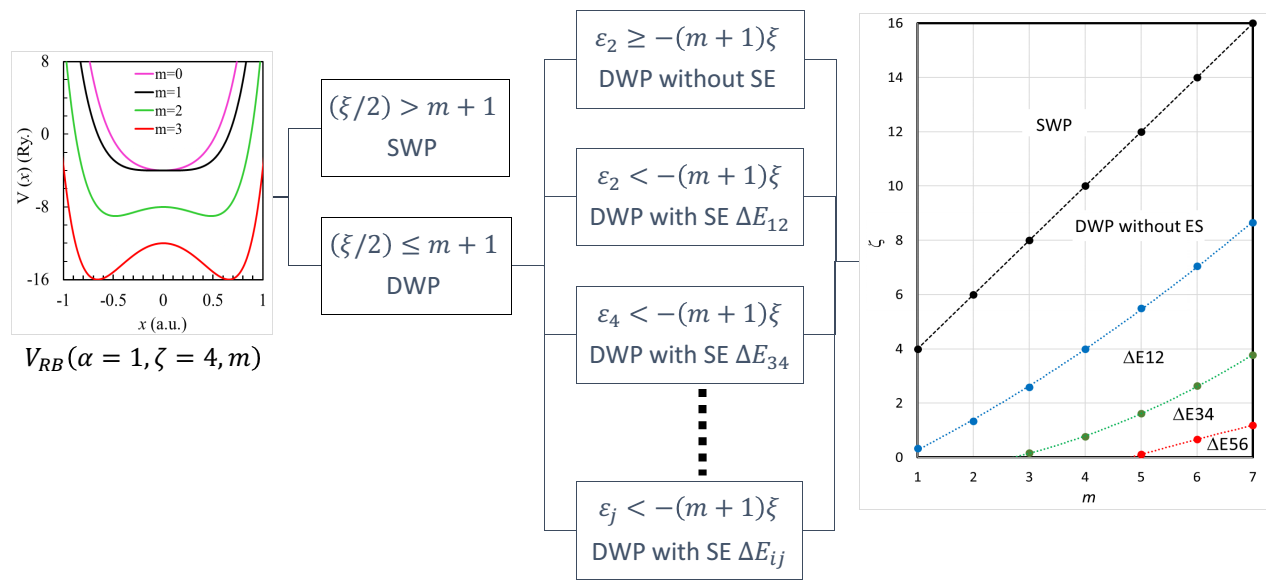
- For symmetric-hyperbolicus double well potentials there are some threshold condition,.i.e.: (i) threshold for existence DWP, (ii) threshold for existence DWP with first-level energy splitting rE12 characterized by ε2 = Vmax, and (iii) Threshold for existence DWP with higher-level energy splitting rEij characterized by εj = Vmax.
- The method has been applied in the Razavy and Dong class potentials. The eigen-energies are determined through quasi-exact solutions for Razavy potentials and numerically using the filter method for Dong potentials.
- We find the the critical condition as a function od structural parameters. Our findings are in good agreement with the eigenfunction and energy difference approaches.
GRAPHICAL ABSTRACT
Downloads
References
A Kumar and P Kumar. How the two-center three-electron hemibond affect the inversion barrier of NH3 in X-NH3 complex (X = F, Cl and Br). Journal of Chemical Sciences 2024; 136, 48.
S Halder, S Samaddar, K Purkait, CR Mandal and M Purkait. Two-center interference effects for single electron capture in fast ionmolecule collisions. Indian Journal of Physics 2020; 94, 151-159.
F Correa and O Quintana. Integrable extensions of two-center Coulomb systems. Physical Review D 2024; 109(8), 085011.
KC Chen. On action-minimizing solutions of the two-center problem. Acta Mathematica Scientia 2022; 42(6), 2450-2458.
V Jelic and F Marsiglio. The double-well potential in quantum mechanics: A simple, numerically exact formulation. European Journal of Physics 2012; 33(6), 1651.
M Razavy. An exactly soluble Schrödinger equation with a bistable potential. American Journal of Physics 1980; 48, 285-288.
H Konwent. One-dimensional Schrödinger equation with a new type double-well potential. Physics Letters A 1986; 118(9), 467-470.
S Habib, A Khare and A Saxena. Statistical mechanics of double sinh-Gordon kinks. Physica D 1998; 123(1-4), 341-356.
M Gambhir, B Vidhani, S Devi and V Prasad. Impact of asymmetry of Razavy-type coupled well system and static electric field on the time-dynamical studies of entanglement. The European Physical Journal Plus 2023; 138, 57.
A Turkoglu, H Dakhlaoui, ME Mora-Ramos and F Ungan. Optical properties of a quantum well with Razavy confinement potential: Role of applied external fields. Physica E: Low-Dimensional Systems and Nanostructures 2021; 134, 114919.
H Dakhlaoui, JA Gil Corrales, AL Morales, E Kasapoglu, A Radu, RI Restrepo, V Tulupenko, JA Vinasco, ME Mora Ramos and CA Duque. Theoretical study of electronic and optical properties in doped quantum structures with Razavy confning potential: Effects of external fields. Journal of Computational Electronics 2022; 21, 378-395.
RJ Hussin and IB Karomi. Ultrashort cavity length effects on the performance of GaInP multiple-quantum-well laser diode. Results in Optics 2023; 12, 100452.
MS Al-Ghamdi, NM Almalky, R Sait, SJ Gillgrass and B Karomi. Effect of barrier layer width on the optical and spectral properties of InAsP/AlGaInP quantum dot lasers. Optical Materials 2023; 145, 114475.
EB Al, E Kasapoglu, S Sakiroglu, H Sari and I Sökmen. Influence of position dependent effective mass on impurity binding energy and absorption in quantum wells with the Konwent potential. Materials Science in Semiconductor Processing 2021; 135, 106076.
M Sayrac, JC Martínez-Orozco, ME Mora-Ramos and F Ungan. The nonlinear optical rectification, second and third harmonic generation coefficients of Konwent potential quantum wells. The European Physical Journal Plus 2022; 137, 1033.
KA Rodríguez-Magdaleno, FM Nava-Maldonado, E Kasapoglu, ME Mora-Ramos, F Ungan and JC Martínez-Orozco. Nonlinear absorption coefficient and relative refractive index change for Konwent potential quantum well as a function of intense laser field effect. Physica E: Low-Dimensional Systems and Nanostructures 2023; 148, 115618.
H Dakhlaoui, W Belhadj, MO Musa and F Ungan. Electronic states and optical characteristics of GaAs spherical quantum dot based on Konwent-like confining potential: Role of the hydrogenic impurity and structure parameters. Optik 2023; 277, 170684.
H Dakhlaoui, W Belhadj, F Ungan and NS Al-Shameri. Linear and nonlinear optical properties in GaAs quantum well based on Konwent-like potential: Effects of impurities and structural parameters. Physica E: Low-Dimensional Systems and Nanostructures 2023; 152, 115760.
EB Al, E Kasapoglu, H Sari and I Sökmen. Optical properties of spherical quantum dot in the presence of donor impurity under the magnetic field. Physica B: Condensed Matter 2021; 613, 41287.
Q Dong, GH Sun, J Jing and SH Dong. New findings for two new type sine hyperbolic potentials. Physics Letters A 2019; 383(2-3), 270-275.
AS Durmuslar, CA Billur, A Turkoglu and F Ungan. Optical properties of a GaAs quantum well with new type of hyperbolic confinement potential: Effect of structure parameters and intense laser field. Optics Communications 2021; 499, 127266.
Abdurrouf, G Saroja and M Nurhuda. Estimation of energy separation in tunelling states in symmetric hyperbolicus double-well potential problem using filter method. Trends in Sciences 2024; 21(3), 7355.
MA Reyes, E Condori-Pozo and C Villasenor-Mora. On the analytical solutions of the quasi-exactly solvable Razavy type potential V(x) = Vo (sinh**4 (x)-k sinh**2 (x)). arXiv 2018; 1806, 03388.
WC Poel. 2011, Energieaufspaltung im Razavy-Potenzial (in German). Bachelor’s Thesis. Institut für Theoretische Physik, Munster, Germany.
A Fulst. 2011, Analytische und numerische Untersuchungen quasi-exakt lösbarer Potentiale (in German). Bachelor’s Thesis. Institut für Theoretische Physik, Munster, Germany.
Q Dong, FA Serrano, GH Sun, J Jing and SH Dong. Semi-exact solutions of the Razavy potential. Advances High Energy Physics 2018; 2018, 9105825.
M Baradaran and H Panahi. Exact solutions of a class of double-well potentials: Algebraic bethe ansatz. Advances in High Energy Physics 2017; 2017, 8429863.
AJ Sous. Eigenenergies for the Razavy potential using the asymptotic iteration method. Modern Physics Letters A 2007; 22, 1677-1684.
Q Dong, SS Dong, E Hernández-Márquez, R Silva-Ortigoza, GH Sun and SH Dong. Semi-exact solutions of Konwent potential. Communications in Theoretical Physics 2019; 71(2), 231.
M Nurhuda and A Rouf. Filter method without boundary-value condition for simultaneous calculation of eigenfunction and eigenvalue of a stationary Schrödinger equation on a grid. Physical Review E 2017; 96, 033302.
Abdurrouf, M Nurhuda and Wiyono. Modelling one-dimensional crystal by using harmonic oscillator potential. IOP Conference Series: Materials Science and Engineering 2019; 546, 052001.
Abdurrouf, MA Pamungkas, W Wiyono and M Nurhuda. Implementation of filter method to solve the Kronig-Penney model. AIP Conference Proceedings 2020; 2234(1), 040001.
Abdurrouf, MA Pamungkas and M Nurhuda. The energy spectrum of imperfect Kronig-Penney model. International Journal of Innovative Technology and Exploring Engineering 2020; 9(3S), 205-208.
Abdurrouf, MA Pamungkas and M Nurhuda. Numerical solution of the Schrödinger equation with periodic coulomb potential. Journal of Physics: Conference Series 2021; 1825, 012105.
MK El-Daou, TH AlZanki and NS Al-Mutawa. Quasi-exactly solvable differential models: A canonical polynomials approach. American Journal of Computational Mathematics 2019; 9(2), 92740.
A Khare and BP Mandal. Anti-isospectral transformations, orthogonal polynomials, and quasi-exactly solvable problems. Journal of Mathematical Physics 1990; 39, 3476-3486.
A Garg. Tunnel splittings for one-dimensional potential wells revisited. American Journal of Physics 2000; 68, 430-437.
AE Sitnitsky. Analytic calculation of ground state splitting in symmetric double well potential. Computational and Theoretical Chemistry 2018; 1138, 15-22.
CM Porto and NH Morgon. Analytical approach for the tunneling process in double well potentials using IRC calculations. Computational and Theoretical Chemistry 2020; 1187, 112917.
Downloads
Published
How to Cite
Issue
Section
License
Copyright (c) 2024 Walailak University

This work is licensed under a Creative Commons Attribution-NonCommercial-NoDerivatives 4.0 International License.





