
Investigation of the Electrochemical Methylene Orange Effluent Degradation Using Graphite Battery Waste and Seawater
DOI:
https://doi.org/10.48048/tis.2025.8764Keywords:
Graphite Battery waste, Seawater, Methylene orange, Graphite battery waste, Seawater, Methylene orangeAbstract
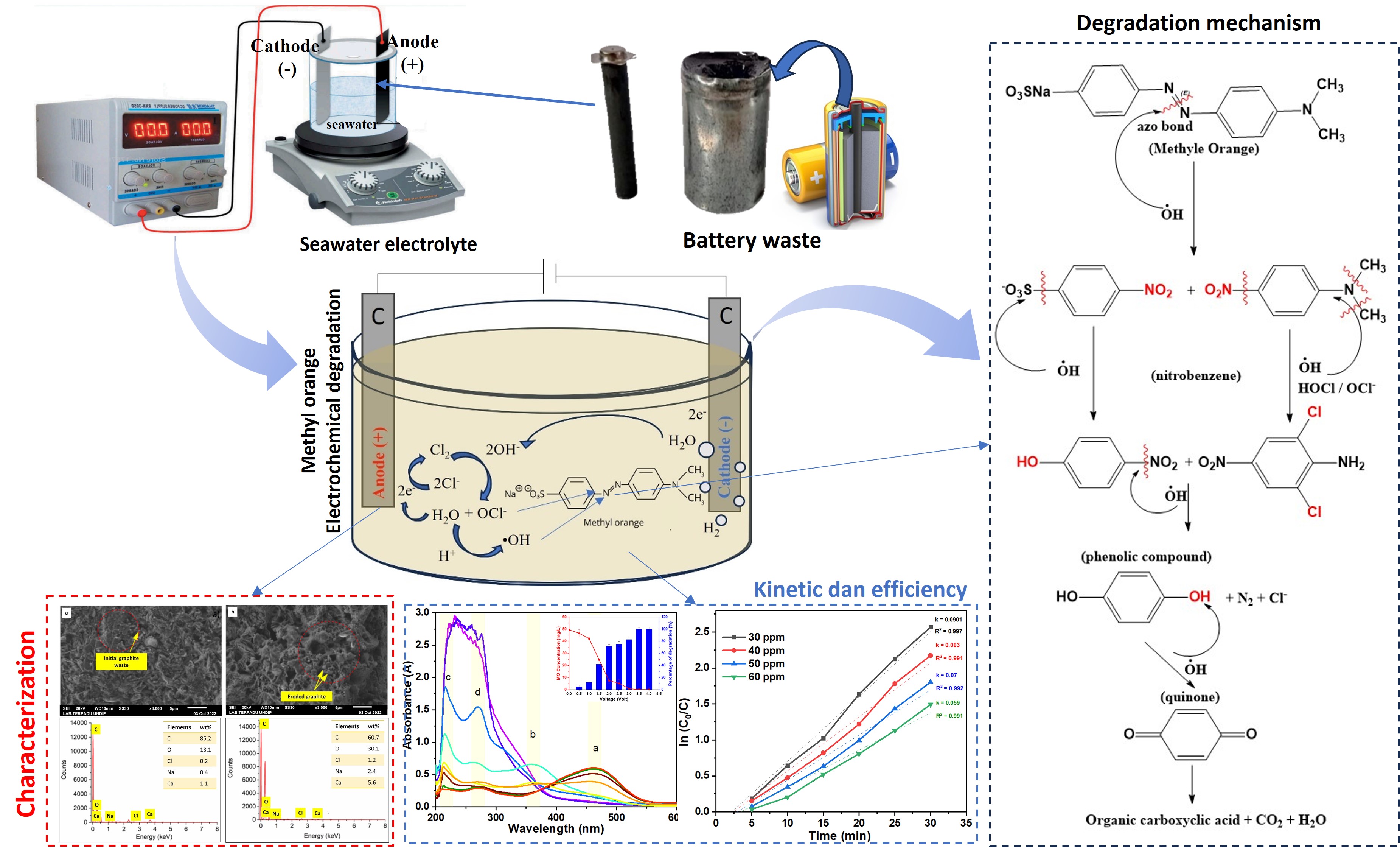
Electrochemical degradation using seawater and graphite electrodes from waste batteries for methylene orange (MO) dye degradation has been successfully carried out. Electrode characterization, electrolyte calibration, and dye degradation effectiveness with various voltages, pH, kinetics, and degradation reaction mechanisms were observed. Characterization showed a characteristic 2θ peak by X-ray diffractometer (XRD) at 26.5 °, and scanning electron microscopy-energy dispersive X-ray spectrometer (SEM-EDX) showed the morphology of hollow grains with carbon (C) and oxygen (O) composition. In addition, scanning potentiometry showed the initiation of hypochlorite compound formation and MO degradation. Further study of degradation effectiveness showed optimal results at 3 volts and above voltages. Hypochlorous acid (HOCl) and hypochlorite ions (OCl-) from seawater are very effective oxidizing agents in acidic conditions compared to other pH conditions. Pseudo-first-order kinetics regulate the electron attack from the hypochlorite oxidizer (OCl-), the hydroxyl groups (•OH) from the seawater electrolysis mechanism with graphite electrode media on the reactive groups, the ring binding on MO, and the degradation. This indicates that the graphite electrode system used to reuse waste batteries and seawater has the potential to degrade waste dyes in aquatic environments.
HIGHLIGHTS
- Electrochemical system with graphite electrode battery waste and seawater electrolyte.
- Characterization with XRD, SEM-EDX, spectrometry, and potentiometry.
- Analysis of the effect of voltage and pH treatment variation.
- Kinetic and degradation mechanism of methylene orange.
GRAPHICAL ABSTRACT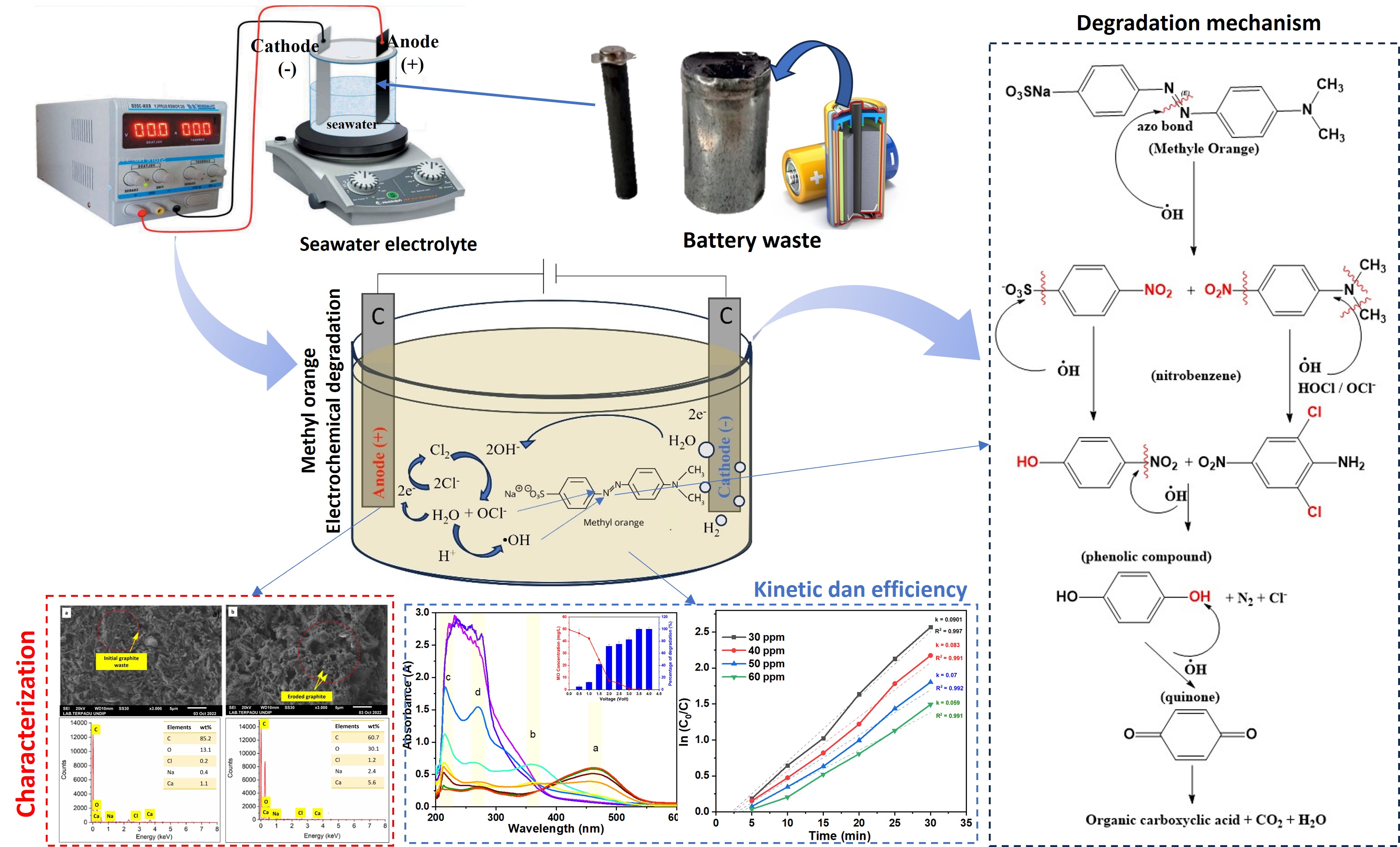
Downloads
References
J Malinauskaite, L Anguilano and XS Rivera. Circular waste management of electric vehicle batteries: Legal and technical perspectives from the EU and the UK post Brexit. International Journal of Thermofluids 2021; 10, 100078.
EM Melchor-Martínez, R Macias-Garbett, A Malacara-Becerra, HMN Iqbal, JE Sosa-Hernandez and R Parra-Saldivar. Environmental impact of emerging contaminants from battery waste: A mini review. Case Studies in Chemical and Environmental Engineering 2021; 3, 100104.
BS Rathi, PS Kumar and DVN Vo. Critical review on hazardous pollutants in water environment: Occurrence, monitoring, fate, removal technologies and risk assessment. Science of The Total Environment 2021; 797, 149134.
B Pizzicato, S Pacifico, D Cayuela, G Mijas and M Riba-Moliner. Advancements in sustainable natural dyes for textile applications: A Review. Molecules 2023; 28(16), 5954.
AL Ahmad, JY Chin, MHZM Harun and SC Low. Environmental impacts and imperative technologies towards sustainable treatment of aquaculture wastewater: A review. Journal of Water Process Engineering 2022; 46, 102553.
S Jiang, Y Lyu, J Zhang, X Zhang, M Yuan, Z Zhang, G Jin, B He, W Xiong and H Yi. Continuous adsorption removal of organic pollutants from wastewater in a UiO-66 fixed bed column. Journal of Environmental Chemical Engineering 2024; 12(2), 111951.
G Gunawan, A Haris, E Uswatun, S Glikeria and RA Wijaya. Study of methylene blue adsorption with silver chloride coagulants from photographic film waste. Journal of Environment and Earth Science 2022; 12(4), 54-62.
RM El-taweel, N Mohamed, KA Alrefaey, S Husien, AB Abdel-Aziz, AI Salim, NG Mostafa, LA Said, IS Fahim and AG Radwan. A review of coagulation explaining its definition, mechanism, coagulant types, and optimization models; RSM, and ANN. Current Research in Green and Sustainable Chemistry 2023; 6, 100358.
S Mehra, J Saroha, E Rani, V Sharma, L Goswami, G Gupta, AK Srivastava and SN Sharma. Development of visible light-driven SrTiO3 photocatalysts for the degradation of organic pollutants for waste-water treatment: Contrasting behavior of MB & MO dyes. Optical Materials 2023; 136, 113344.
MF Lanjwani, M Tuzen, MY Khuhawar and TA Saleh. Trends in photocatalytic degradation of organic dye pollutants using nanoparticles: A review. Inorganic Chemistry Communications 2024; 159, 111613.
Gunawan, NBA Prasetya and RA Wijaya. Electrochemical synthesis of ferrate (FeO42–) in extreme alkaline medium and its application in dye degradation. Asian Journal of Chemistry 2022; 34(12), 3361-3368.
Q Wang, Y Zhang, Y Yang, H Fu, Y Liang and J Ma. Zero valent copper-mediated ferrate (Ⅵ) for the degradation of bisphenol AF. Journal of Environmental Chemical Engineering 2023; 11, 109600.
G Gunawan, NBA Prasetya and RA Wijaya. Degradation of ciprofloxacin (CIP) antibiotic waste using the advanced oxidation process (AOP) method with ferrate (VI) from extreme base electrosynthesis. Trends in Sciences 2023; 20(7), 6639.
DS Widodo, L Suyati, Gunawan, A Haris, RA Wijaya and SE Safitri. Modification of fenton method in decolorizing remazol black b via irradiationless approach using lead oxide. AIP Conference Proceedings 2022; 2553, 020040.
G Gunawan, NBA Prasetya, DS Widodo and RA Wijaya. Electrochemical degradation of methylene blue with seawater and Pb/PbO2 electrodes from battery waste. Karbala International Journal of Modern Science 2023; 9(4), 725-741.
MS Najafinejad, S Chianese, A Fenti, P Iovino and D Musmarra. Application of electrochemical oxidation for water and wastewater treatment: An overview. Molecules 2023; 28(10), 4208.
T Liu, L Hao, Y Zhang, Y Hu, Q Zhao, Y Lu and X Ping. Anodized Bi2O3 film prepared in NaOH and oxalic acid and the photocatalytic activity in organic dye degradation. Journal of Materials Science: Materials in Electronics 2020; 31, 10846-10854.
R Antonelli, GRP Malpass, MGCD Silva and MGA Vieira. Photo-assisted electrochemical degradation of ciprofloxacin using DSA® anode with NaCl electrolyte and simultaneous chlorine photolysis. Journal of Water Process Engineering 2022; 47, 102698.
Z Frontistis, D Mantzavinos and S Meric. Degradation of antibiotic ampicillin on boron-doped diamond anode using the combined electrochemical oxidation - Sodium persulfate process. Journal of Environmental Management 2018; 223, 878-887.
G Gunawan, NBA Prasetya, A Haris and E Pratista. Ferrate synthesis using NaOCl and its application for dye removal. Open Chemistry 2022; 20(1), 1142-1154.
FF Al-Qaim, ZH Mussa, MR Othman and MP Abdullah. Removal of caffeine from aqueous solution by indirect electrochemical oxidation using a graphite-PVC composite electrode: A role of hypochlorite ion as an oxidising agent. Journal of Hazardous Materials 2015; 300, 387-397.
L Sun, G Yang, X Cao and L Zhou. Photodegradation of methylene blue in natural seawater. Journal of Ocean University of China 2010; 9, 135-138.
T Xu, X Tang, M Qiu, X Lv, Y Shi, Y Zhou, Y Xie, M Naushad, SS Lam, HS Ng, C Sonne and S Ge. Degradation of levofloxacin from antibiotic wastewater by pulse electrochemical oxidation with BDD electrode. Journal of Environmental Management 2023; 344, 118718.
H Yu, X Zhang, M Zhao, L Zhang, H Dong and H Yu. Norfloxacin degradation by a green carbon black-Ti/SnO2-Sb electrochemical system in saline water. Catalysis Today 2019; 327, 308-314.
A Asghar, AAA Raman and WMAW Daud. Advanced oxidation processes for in-situ production of hydrogen peroxide/hydroxyl radical for textile wastewater treatment: A review. Journal of Cleaner Production 2015; 87, 826-838.
X Teng, J Li, Z Wang, Z Wei, C Chen, K Du, C Zhao, G Yang and Y Li. Performance and mechanism of methylene blue degradation by an electrochemical process. RSC Advances 2020; 10(41), 24712-24720.
SF Deriase, RA El-Salamony, E Amdeha and AM Al-Sabagh. Statistical optimization of photocatalytic degradation process of methylene blue dye by SnO–TiO2–AC composite using response surface methodology. Environmental Progress & Sustainable Energy 2021; 40(5), e13639.
G Wang, Y Liu, J Ye, Z Lin and X Yang. Electrochemical oxidation of methyl orange by a Magnéli phase Ti4O7 anode. Chemosphere 2020; 241, 125084.
A Shalaby, D Nihtianova, P Markov, AD Staneva, RS Iordanova and YB Dimitriev. Structural analysis of reduced graphene oxide by transmission electron microscopy. Bulgarian Chemical Communications 2015; 47(1), 291-295.
T Luo, J Liu, L Chen, S Zeng and Y Qian. Synthesis of helically coiled carbon nanotubes by reducing ethyl ether with metallic zinc. Carbon 2005; 43(4), 755-759.
SMS Al-Mufti, A Almontasser and SJA Rizvi. Single and double thermal reduction processes for synthesis reduced graphene oxide assisted by a muffle furnace: A facile robust synthesis and rapid approach to enhance electrical conductivity. AIP Advances 2022; 12(12), 125306.
A Ahmed, A Hayat, MH Nawaz, P John and M Nasir. Construction of sponge-like graphitic carbon nitride and silver oxide nanocomposite probe for highly sensitive and selective turn-off fluorometric detection of hydrogen peroxide. Journal of Colloid and Interface Science 2020; 558, 230-241.
C Saleh and B Romadhon. Design and build of hydrogen production prototype using water electrolysis method using solar panels. International Journal of Scientific Engineering and Science 2022; 6(2), 72-77.
AA Afify, GK Hassan, HE Al-Hazmi, RM Kamal, RM Mohamed, J Drewnowski, J Majtacz, J Mąkinia and HA El-Gawad. Electrochemical production of sodium hypochlorite from salty wastewater using a flow-by porous graphite electrode. Energies 2023; 16(12), 4754.
G Amikam, P Nativ and Y Gendel. Chlorine-free alkaline seawater electrolysis for hydrogen production. International Journal of Hydrogen Energy 2018; 43(13), 6504-6514.
N Janudin, NAM Kasim, VF Knight, NA Halim, SAM Noor, KK Ong, WMZW Yunus, MNF Norrrahim, MSM Misenan, MAIA Razak, MZ Ahmad and MH Yaacob. Sensing techniques on determination of chlorine gas and free chlorine in water. Journal of Sensors 2022; 2022, 1898417.
M Deborde and UV Gunten. Reactions of chlorine with inorganic and organic compounds during water treatment-Kinetics and mechanisms: A critical review. Water Research 2008; 42(1-2), 13-51.
PCW Cheung, DR Williams, DW Kirk, PJ Murphy, SJ Barton and J Barker. Decolourisation of metal-azo dyes in wastewaters by sodium peroxodi sulphate: A Template for experimental investigations. The Open Environmental Research Journal 2023; 16, e259027762301240.
DAE Mously, AM Mahmoud, MM Gomaa and HZ Yamani. Rapid catalytic reduction of environmentally toxic azo dye pollutant by Prussian blue analogue nanocatalyst. RSC Advances 2024; 14, 15232-15239.
LG Devi, SG Kumar, KM Reddy and C Munikrishnappa. Photo degradation of methyl orange an azo dye by advanced fenton process using zero valent metallic iron: Influence of various reaction parameters and its degradation mechanism. Journal of Hazardous Materials 2009; 164(2-3), 459-467.
H Saada, B Fabre, G Loget and G Benoit. Is direct seawater splitting realistic with conventional electrolyzer technologies? ACS Energy Letters 2024; 9(7), 3351-3368.
MF Hanafi and N Sapawe. Influence of pH on the photocatalytic degradation of methyl orange using nickel catalyst. Materials Today: Proceedings 2020; 31(1), 339-341.
J Zhang, Q Liu, Y Chen, Z Liu and C Xu. Determination of acid dissociation constant of methyl red by multi-peaks Gaussian fitting method based on UV-visible absorption spectrum. Acta Physica Sinica 2012; 28(5), 1030-1036.
X Lin, X Wang, Q Zhou, C Wen, S Su, J Xiang, P Cheng, X Hu, Y Li, X Wang, X Gao, R Nozel, G Zhou, Z Zhang and J Liu. Magnetically recyclable MoS2/Fe3O4 hybrid composite as visible light responsive photocatalyst with enhanced photocatalytic performance. ACS Sustainable Chemistry & Engineering 2019; 7(1), 1673-1682.
S Mortazavi-Derazkola, M Salavati-Niasari, O Amiri and A Abbasi. Fabrication and characterization of Fe3O4@SiO2@TiO2@Ho nanostructures as a novel and highly efficient photocatalyst for degradation of organic pollution. Journal of Energy Chemistry 2017; 26(1), 17-23.
D Ge, Z Zeng, M Arowo, H Zou, J Chen and L Shao. Degradation of methyl orange by ozone in the presence of ferrous and persulfate ions in a rotating packed bed. Chemosphere 2016; 146, 413-418.
Y Zhao, J Cui, S Sarrouf, S Hojabri and AN Alshawabkeh. Degradation of Ibuprofen in flow-through system by the electro-fenton process activated by two iron sources, Available at: https://doi.org/10.21203/rs.3.rs-2608922/v1, accessed May 2021.
Z Zhang, G Wang, W Li, L Zhang, T Chen and L Ding. Degradation of methyl orange through hydroxyl radical generated by optically excited biochar: Performance and mechanism. Colloids and Surfaces A: Physicochemical and Engineering Aspects 2020; 601, 125034.
M Saeed, S Adeel, M Ilyas, MA Shahzad, M Usman, EU Haq and M Hamayun. Oxidative degradation of Methyl Orange catalyzed by lab prepared nickel hydroxide in aqueous medium. Desalination and Water Treatment. 2016; 57(27), 12804-12813.
Downloads
Published
How to Cite
Issue
Section
License
Copyright (c) 2024 Walailak University

This work is licensed under a Creative Commons Attribution-NonCommercial-NoDerivatives 4.0 International License.





