
Chemical Composition and In Vitro Protein Digestibility of Duckweed and Feed Ingredients
DOI:
https://doi.org/10.48048/tis.2024.8324Keywords:
Chemical composition, Duckweed, Feed ingredient, In vitro digestibility, ProteinAbstract
Duckweed is an aquatic floating plant with the potential to be used as animal feed due to its richness in protein, amino acids, starch, vitamin and minerals. Furthermore, duckweed has a high growth rate and reproducibility. Therefore, this research aimed to determine the chemical composition and in vitro protein digestibility of duckweed (Lemna, Wolffia and Spirodela) in comparison to other feed ingredients. The chemical composition was determined through proximate analysis including dry matter (DM), crude protein (CP), ether extract (EE), crude fiber (CF), ash and nitrogen free extract. The in vitro protein digestibility procedure simulates conditions similar to those in the swine digestive tract using synthetic enzymes to control pH, temperature and digestion time. In the results of chemical composition, Lemna and Wolffia were classified as protein sources, with high CP content (221.87 and 442.65 g/kg DM, respectively) and low CF content (63.30 and 109.11 g/kg DM), whereas Spirodela had low CP content (179.64 g/kg DM) and CF content (170.57 g/kg DM). The EE content in duckweed amounted to 16.74, 46.23 and 52.47 g/kg DM for Wolffia, Spirodela and Lemna, respectively. Additionally, high ash content was observed in Spirodela (212.40 g/kg DM), Wolffia (149.34 g/kg DM) and Lemna (142.06). For standardized ileal digestibility (SIDCP), the SIDCP of all feed ingredients were within the range of 32 to 96 %. With regard to duckweed, Lemna (72 %) showed significantly higher (p < 0.05) SIDCP compared to Wolffia (69 %) and Spirodela (39 %) due to the low contents of CF and ash. Based on nutritional values, Lemna and Wolffia were grouped with corn DDGS and brewer’s grain, indicating their potential as animal feed for sustainable livestock production.
HIGHLIGHTS
- Duckweed exhibited high protein content, ranging from 179.64 to 65 g/kg dry matter.
- For in vitro protein digestibility, Lemna and Wolffia had high true digestibility, amounting to 79 and 75 %, respectively.
- Based on nutritional values, Lemna and Wolffia were grouped with corn DDGS and brewer’s grain, indicating their potential as animal feed for sustainable livestock production.
GRAPHICAL ABSTRACT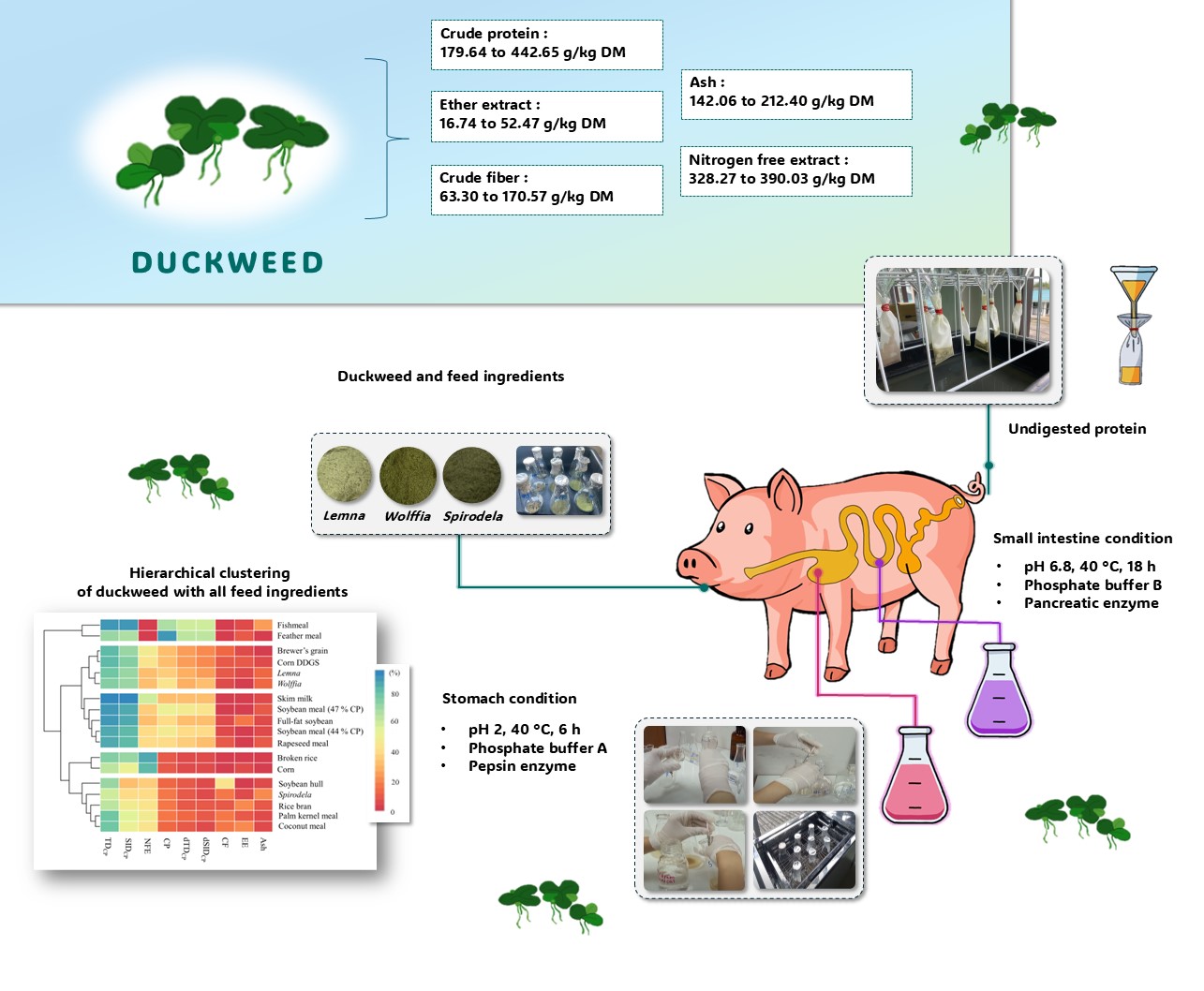
Downloads
References
GR Moekti. Industrial livestock production: A review on advantages and disadvantages. IOP Conf. Ser. Earth Environ. Sci. 2020; 492, 012094.
EU Ahiwe, AA Omede, MB Abdallh and PA Iji. Managing dietary energy intake by broiler chickens to reduce production costs and improve product quality. In: B Yucel and T Taskin (Eds.). Animal husbandry and nutrition. IntechOpen, London, 2018, p.115-45.
G Fenwick. The assessment of a new protein source - rapeseed. Proc. Nutr. Soc.1982; 41, 277-88.
R Luthada-Raswiswi, S Mukaratirwa and G O’Brien. Animal protein sources as a substitute for fishmeal in aquaculture diets: A systematic review and meta-analysis. Appl. Sci. 2021; 11, 3854.
Y Zhang, M Luo, X Fang, F Zhang and M Cao. Energy value of rice, broken rice, and rice bran for broiler chickens by the regression method. Poult. Sci. 2021; 100, 100972.
O Onwudike. Palm kernel meal as a feed for poultry. 3. Replacement of groundnut cake by palm kernel meal in broiler diets. Anim. Feed Sci. Tech. 1986; 16, 195-202.
K Mat, Z Abdul Kari, ND Rusli, H Che Harun, LS Wei, MM Rahman, HN Mohd Khalid, MH Mohd Ali Hanafiah, SA Mohamad Sukri and RIA Raja Khalif. Coconut palm: Food, feed, and nutraceutical properties. Animals 2022; 12, 2107.
E Landolt. The family of Lemnaceae-a monographic study. Vol I. Veroeffentlichungen des Geobotanischen Institutes der ETH, Zurich, Switzerland, 1986.
K Sree and KJ Appenroth. Worldwide genetic resources of duckweed: Stock collections. In: XH Cao, P Fourounjian and W Wang (Eds.). The duckweed genomes. Springer, Cham, Switzerland, 2020, p. 39-46.
F Diwan. Duckweed and its broad-spectrum applications. Climate Survival Solutions, Colorado, 2023.
X Ge, N Zhang, GC Phillips and J Xu. Growing Lemna minor in agricultural wastewater and converting the duckweed biomass to ethanol. Bioresour. Tech. 2012; 124, 485-8.
V Okomoda, S Solomon and G Ataguba. Potential uses of the family Lemnaceae. J. Agr. Vet. Sci. 2012; 4, 1-14.
LL Rusoff, EW Blakeney and DD Culley. Duckweeds (Lemnaceae family): A potential source of protein and amino acids. J. Agr. Food Chem. 1980; 28, 848-50.
M Sońta, A Rekiel and M Batorska. Use of duckweed (Lemna L.) in sustainable livestock production and aquaculture - a review. Ann. Anim. Sci. 2019; 19, 257-71.
N Shen, Q Wang, J Zhu, Y Qin, S Liao, Y Li, Q Zhu, Y Jin, L Du and R Huang. Succinic acid production from duckweed (Landoltia punctata) hydrolysate by batch fermentation of Actinobacillus succinogenes GXAS137. Bioresour. Tech. 2016; 211, 307-12.
GY Baek, M Saeed and HK Choi. Duckweeds: Their utilization, metabolites and cultivation. Appl. Biol. Chem. 2021; 64, 73.
J Demann, F Petersen, G Dusel, M Bog, R Devlamynck, A Ulbrich, HW Olfs and H Westendarp. Nutritional value of duckweed as protein feed for broiler chickens - digestibility of crude protein, amino acids and phosphorus. Animals 2023; 13, 130.
H Zakaria and M Shammout. Duckweed in irrigation water as a replacement of soybean meal in the laying hens’ diet. Braz. J. Poult. Sci. 2018; 20, 573-82.
M Ahammad, M Swapon, T Yeasmin, M Rahman and M Ali. Replacement of sesame oil cake by duckweed (Lemna minor) in broiler diet. Pak. J. Biol. Sci. 2003; 6, 1450-53.
BS Moss. 1999, Economics and feed value of integrating duckweed production with a swine operation. Master Thesis. Texas Tech University, Texas, United States.
OJ Rojas, Y Liu and HH Stein. Concentration of metabolizable energy and digestibility of energy, phosphorus, and amino acids in lemna protein concentrate fed to growing pigs. J. Anim. Sci. 2014; 92, 5222-9.
S Boisen and J Fernandez. Prediction of the apparent ileal digestibility of protein and amino acids in feedstuffs and feed mixtures for pigs by in vitro analyses. Anim. Feed Sci. Tech. 1995; 51, 29-43.
A Lemme, V Ravindran and WL Bryden. Ileal digestibility of amino acids in feed ingredients for broilers. Worlds Poult. Sci. J. 2004; 60, 423-38.
D Jezierny, R Mosenthin, N Sauer and M Eklund. In vitro prediction of standardised ileal crude protein and amino acid digestibilities in grain legumes for growing pigs. Animals 2010; 4, 1987-96.
NM de Carvalho, DL Oliveira, MAD Saleh, ME Pintado and AR Madureira. Importance of gastrointestinal in vitro models for the poultry industry and feed formulations. Anim. Feed Sci. Technol. 2021; 271, 114730.
AOAC International. Association of official analytical collaboration. AOAC International, Gaithersburg, 2005.
R Core Team. R: A language and environment for statistical computing, reference index version 4.3.1. R Foundation for Statistical Computing, Vienna, Austria, 2023.
G James, D Witten, T Hastie and R Tibshirani. Classification. In: G James, D Witten, T Hastie and R Tibshirani (Eds.). An introduction to statistical learning. 2nd ed. Springer, Cham, Switzerland, 2013, p. 129-95.
GM Dryden. Animal nutrition science. Cabi, Wallingford, 2008.
HH Stein, LV Lagos and GA Casas. Nutritional value of feed ingredients of plant origin fed to pigs. Anim. Feed Sci. Tech. 2016; 218, 33-69.
E Degussa. AMINODat® 5.0. Amino acid composition of feedstuffs. Evonik Degussa GmbH, Hanau, Germany, 2015.
P McDonald, RA Edwards, JFD Greenhalgh, CA Morgan, LA Sinclair and RG Wilkinson. Animal nutrition. Trans-Atlantic, Philadelphia, 2011.
B Kerr, W Dozier and G Shurson. Effects of reduced-oil corn distillers dried grains with solubles composition on digestible and metabolizable energy value and prediction in growing pigs. J. Anim. Sci. 2013; 91, 3231-43.
KJ Appenroth, KS Sree, M Bog, J Ecker, C Seeliger, V Böhm, S Lorkowski, K Sommer, W Vetter and K Tolzin-Banasch. Nutritional value of the duckweed species of the genus Wolffia (Lemnaceae) as human food. Front. Chem. 2018; 6, 483.
J Xu, Y Shen, Y Zheng, G Smith, XS Sun, D Wang, Y Zhao, W Zhang and Y Li. Duckweed (Lemnaceae) for potentially nutritious human food: A review. Food Rev. Int. 2023; 39, 3620-34.
I Showqi, FA Lone and JIA Bhat. Evaluation of the efficiency of duckweed (Lemna minor L.) as a phytoremediation agent in wastewater treatment in Kashmir Himalayas. J. Biorem. Biodegrad. 2017; 8, 405.
S Boisen and BO Eggum. Critical evaluation of in vitro methods for estimating digestibility in simple-stomach animals. Nutr. Res. Rev. 1991; 4, 141-62.
S Boisen. In vitro analyses for predicting standardised ileal digestibility of protein and amino acids in actual batches of feedstuffs and diets for pigs. Livest. Sci. 2007; 109, 182-5.
DJ Bloxham, M Azain, GM Pesti and SB Wu. Total amino acid level affects the results of standardized ileal digestibility assays for feed ingredients for swine. Anim. Nutr. 2023; 13, 19-30.
C Pedersen and S Boisen. Establishment of tabulated values for standardized ileal digestibility of crude protein and essential amino acids in common feedstuffs for pigs. Acta Agr. Scand. Sect. A Anim. Sci. 2002; 52, 121-40.
YL Yin, TJ Li, RL Huang, ZQ Liu, XF Kong, WY Chu and FG Yin. Evaluating standardized ileal digestibility of amino acids in growing pigs. Anim. Feed Sci. Tech. 2008; 140, 385-401.
N Fu, S Huang, J Xiao and XD Chen. Producing powders containing active dry probiotics with the aid of spray drying. Adv. Food Nutr. Res. 2018; 85, 211-62.
R Mosenthin. Current concepts of protein digestion and absorption in the pig review. Vet. Zootech. 2003; 20, 30-8.
O Rojas and HH Stein. Concentration of digestible, metabolizable, and net energy and digestibility of energy and nutrients in fermented soybean meal, conventional soybean meal, and fish meal fed to weanling pigs. J. Anim. Sci. 2013; 91, 4397-405.
RC Sulabo, LI Chiba, FN Almeida, SD Brotzge, RL Payne and HH Stein. Amino acid and phosphorus digestibility and concentration of digestible and metabolizable energy in hydrolyzed feather meal fed to growing pigs. J. Anim. Sci. 2013; 91, 5829-37.
Y Zhang, R Yang and W Zhao. Improving digestibility of feather meal by steam flash explosion. J. Agric. Food Chem. 2014; 62, 2745-51.
BJ Kerr and GC Shurson. Strategies to improve fiber utilization in swine. J. Anim. Sci. Biotechnol. 2013; 4, 11.
C Parsons, L Potter and R Brown. Effects of dietary carbohydrate and of intestinal microflora on excretion of endogenous amino acids by poultry. Poult. Sci. 1983; 62, 483-9.
R Mosenthin and W Sauer. The effect of source of fiber on pancreatic secretions and on amino acid digestibility in the pig. J. Anim. Physiol. Anim. Nutr. 1991; 65, 45-52.
ZJ Sandor, N Revesz, D Varga, F Toth, L Ardo and G Gyalog. Nutritional and economic benefits of using DDGS (distiller’dried grains soluble) as feed ingredient in common carp semi-intensive pond culture. Aquacult. Rep. 2021; 21, 100819.
L Montagne, J Pluske and DA Hampson. A review of interactions between dietary fibre and the intestinal mucosa, and their consequences on digestive health in young non-ruminant animals. Anim. Feed Sci. Tech. 2003; 108, 95-117.
R Mosenthin, WC Sauer and F Ahrens. Dietary pectin’s effect on ileal and fecal amino acid digestibility and exocrine pancreatic secretions in growing pigs. J. Nutr. 1994; 124, 1222-9.
X Wang and CM Parsons. Effect of raw material source, processing system, and processing temperatures on amino acid digestibility of meat and bone meals. Poult. Sci. 1998; 77, 834-41.
R Shirley and C Parsons. Effect of ash content on protein quality of meat and bone meal. Poult. Sci. 2001; 80, 626-32.
National Research Council. Nutrient requirements of swine. 11th ed. National Academy Press, Washington DC, 2012.
C Kaewtapee, R Mosenthin, S Nenning, M Schäffler, M Eklund and P Rosenfelder-Kuon. Standardized ileal digestibility of amino acids in European soya bean and rapeseed products fed to growing pigs. J. Anim. Physiol. Anim. Nutr. 2017; 102, e695-e705.
RA Mohedano, RHR Costa, FA Tavares and PB Filho. High nutrient removal rate from swine wastes and protein biomass production by full-scale duckweed ponds. Bioresour. Tech. 2012; 112, 98-104.
F Petersen, J Demann, D Restemeyer, A Ulbrich, HW Olfs, H Westendarp and KJ Appenroth. Influence of the nitrate-n to ammonium-n ratio on relative growth rate and crude protein content in the duckweeds Lemna minor and Wolffiella hyalina. Plants 2021; 10, 1741.
J Xu, W Cui, JJ Cheng and AM Stomp. Production of high-starch duckweed and its conversion to bioethanol. Biosyst. Eng. 2011; 110, 67-72.
J Phipps. Dendrogram topology. Syst. Zool. 1971; 20, 306-8.

Downloads
Published
How to Cite
Issue
Section
License
Copyright (c) 2024 Walailak University

This work is licensed under a Creative Commons Attribution-NonCommercial-NoDerivatives 4.0 International License.





