
A Comparative Study of Congo Red Textile Dye Photodegradation Using ZnO Al and ZnO Al+Mn Nanoparticles
DOI:
https://doi.org/10.48048/tis.2024.8219Keywords:
ZnO Al/Mn Nanoparticles, Photodegradation, Congo redAbstract
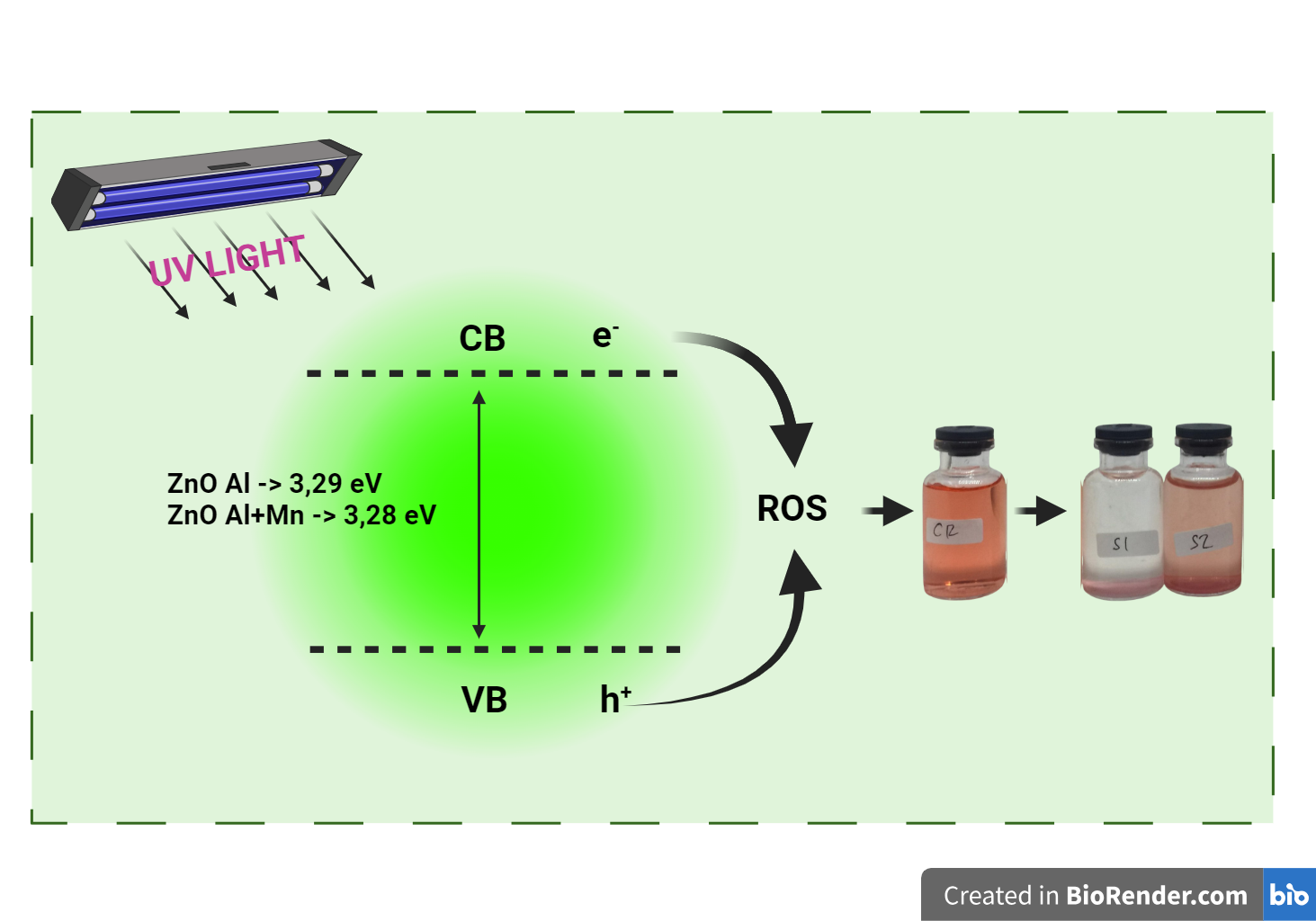
Photodegradation of Congo Red textile dye was successfully carried out using ZnO Al and ZnO Al+Mn nanoparticles synthesized using the bottom-up coprecipitation method. Powder X-ray diffraction provides information that Al and Mn doping successfully inserted in the host crystal structure while maintaining the Hexagonal Wurtzite crystal structure. However, a shift in the diffraction peak caused by the lattice distance changes with the addition of doping. FE-SEM EDS provides information that both nanoparticles are nonuniform sphere-like due to the addition of dopping, and each dopping is detected through EDS spectra. There is a decrease in the gap energy in each sample. ZnO Al nanoparticles have a gap energy of 3.29 eV, and ZnO Al+Mn nanoparticles have a gap energy of 3.28 eV. However, the decrease in the gap energy is not directly related to the percentage and kinetic rate of Congo Red photodegradation. Adding 5 mg of ZnO Al Nanoparticles powder could degrade Congo Red up to 97.9 % within 120 min using UV A radiation or 0.03504/min. At the same time, adding ZnO Al+Mn Nanoparticles powder with the same parameters could only degrade 67.6 % or 0.00759/min.
HIGHLIGHTS
- Energy Bandgap Modification of ZnO Nanoparticles
The incorporation of Al single dopants and Al, Mn co-dopants into ZnO nanoparticles synthesized via a bottom-up coprecipitation method significantly alters the energy bandgap. Al single doping resulted in a bandgap of 3.29 eV, while Al, Mn double doping yielded a bandgap of 3.28 eV.
- Enhanced Photocatalytic Activity of Al-Doped ZnO
Al-doped ZnO nanoparticles exhibited superior photocatalytic activity toward the degradation of Congo Red textile dye. With a photodegradation rate constant of 0.03504 min⁻¹, these nanoparticles achieved 97.9 % degradation of Congo Red within 120 minutes.
- Comparative Photocatalytic Performance of Al, Mn Co-Doped ZnO
While Al, Mn co-doped ZnO nanoparticles were synthesized using the same method, their photocatalytic performance for Congo Red degradation was notably lower than that of Al-doped ZnO. The calculated photodegradation rate constant was 0.00759 min⁻¹, resulting in 67.6 % degradation within the same timeframe.
GRAPHICAL ABSTRACT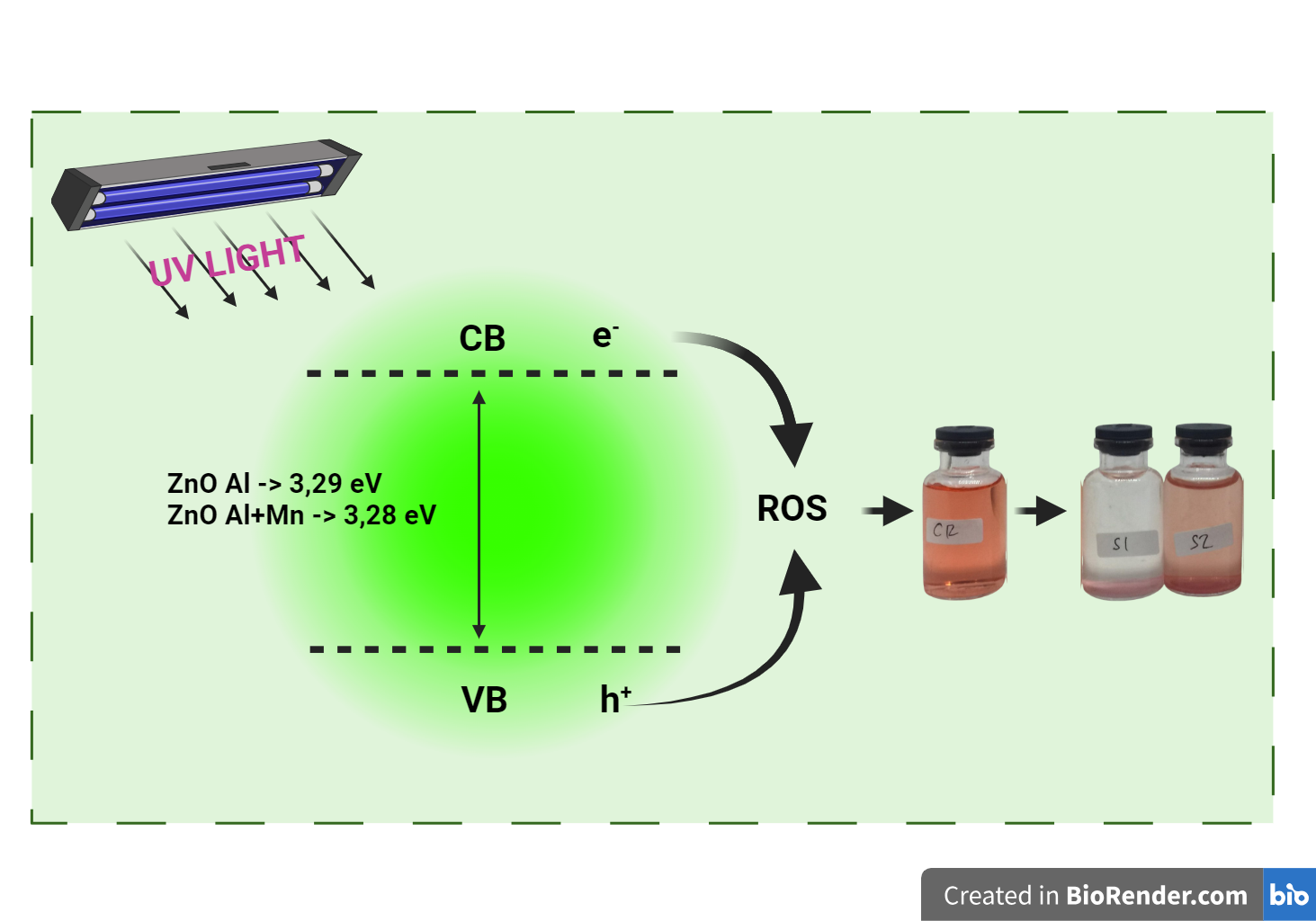
Downloads
References
B Lellis, CZ Fávaro-Polonio, JA Pamphile and JC Polonio. Effects of textile dyes on health and the environment and bioremediation potential of living organisms. Biotechnol. Res. Innovat. 2019; 3, 275-90.
RE Adam, G Pozina, M Willander and O Nur. Synthesis of ZnO nanoparticles by co-precipitation method for solar driven photodegradation of Congo red dye at different pH. Photon. Nanostructures 2018; 32, 11.
S Boudiaf, N Nasrallah, M Mellal, B Belhamdi, C Belabed, MA Djilali and M Trari. Kinetic studies of Congo Red Photodegradation on the hetero-system CoAl2O4/ZnO with a stirred reactor under solar light. J. Environ. Chem. Eng. 2021; 9, 105572.
MB Mobarak, NS Pinky, F Chowdhury, MS Hossain, M Mahmud, MS Quddus, SA Jahan and S Ahmed. Environmental remediation by hydroxyapatite: Solid state synthesis utilizing waste chicken eggshell and adsorption experiment with Congo red dye. J. Saudi Chem. Soc. 2023; 27, 101690.
Mahesha, M Nagaraja, A Madhu, N Suriyamurthy, SS Reddy, M Al-Dossari, NSA EL-Gawaad, SO Manjunatha, K Gurushantha and N Srinatha. Chromium-doped ZnO nanoparticles synthesized via auto-combustion: Evaluation of concentration-dependent structural, band gap-narrowing effect, luminescence properties and photocatalytic activity. Ceram. Int. 2023; 49, 22890.
D Savitha, HKE Latha, HS Lalithamba, S Mala and YV Jeppu. Structural, optical and electrical properties of undoped and doped (Al, Al + Mn) ZnO nanoparticles synthesised by green combustion method using terminalia catappa seed extract. Mater. Today Proc. 2022; 60, 988.
R Ghorbali, G Essalah, A Ghoudi, H Guermazi, S Guermazi, AE Hdiy, H Benhayoune, B Duponchel, A Oueslati and G Leroy. The effect of (In, Cu) doping and co-doping on physical properties and organic pollutant photodegradation efficiency of ZnO nanoparticles for wastewater remediation. Ceram. Int. 2023; 49, 33828.
MR Al-Mamun, MZI Rokon, MA Rahim, MI Hossain, MS Islam, MR Ali, MS Bacchu, H Waizumi, T Komeda and MZH Khan. Enhanced photocatalytic activity of Cu and Ni-doped ZnO nanostructures: A comparative study of methyl orange dye degradation in aqueous solution. Heliyon 2023; 9, e16506.
N Sholeha, AM Afianti, M Diantoro, A Aripriharta and H Pujiarti. Structure, functional groups, and optical properties of Al doped ZnO nanorods thin films. Mater. Today Proc. 2023. https://doi.org/10.1016/j.matpr.2023.04.159.
W Purwaningrum, FP Sari, Julinar, A Ahmadi and M Said. Effect of Al Concentration over ZnO-Al2O3 Physicochemical Characteristics and Removal of Remazol Red RB. ASEAN J. Chem. Eng. 2022; 22, 206.
F Abdulrahman, AN Abdulqodus and MA Almessiere. Biosynthesis of Al-doped ZnO nanoparticles with different Al doping ratio for methylene orange dye degradation activity. Ceram. Int. 2023; 49, 34920.
HJ Lee, JH Kim, SS Park, SS Hong and GD Lee. Degradation kinetics for photocatalytic reaction of methyl orange over Al-doped ZnO nanoparticles. J. Ind. Eng. Chem. 2015; 25, 199.
MA Nawaz. 2016, Effect of transition metals doping on the properties of ZnO thin films. Ph. D. Dissertation. The Islamia University of Bahawalpur, Bahawalpur, Pakistan.
CO Chey. Synthesis of ZnO and transition metals doped ZnO nanostructures. Linköping University Electronic Press, Linköping, Sweden, 2015.
M Al-Gariaa, GS Elasala, EH Ismail, MMH Khalil and IM El-Sewify. Photodegradation of antibacterial cefotaxime using Mn doped ZnO nanosphere. Inorg. Chem. Comm. 2023; 158, 111434.
S Roguai and A Djelloul. Structural, microstructural and photocatalytic degradation of methylene blue of zinc oxide and Fe-doped ZnO nanoparticles prepared by simple coprecipitation method. Solid State Comm. 2021; 334-335, 114362.
R Prasetyowati, D Widiawati, E Swastika and W Ariswan. Synthesis and characterization of magnetite (Fe3O4) nanoparticles based on iron sands at Glagah Beach Kulon Progo with coprecipitation methods at various NH4OH concentrations. In: Proceedings of the Science and Science Education International Seminar, Yogyakarta, Indonesia. 2019.
K Pavani and A Kumar. ZnO nanostructures: Simple routes of synthesis. Int. J. Eng. Res. Tech. 2015; 4, 505-8.
P Gnanamozhi, A Monamary, SD Jereil, JE Pauline, JAO Ratnam, A Ganeshkumar, V Pandiyan, AA Alothman, RA Alshgari and M Govindasamy. Effective photocatalytic degradation of methylene blue (MB) and reactive red 120 (RR120) using Al substituted ZnO nanoparticles. Surface Interfac. 2023; 41, 103203.
S Landi, IR Segundo, E Freitas, M Vasilevskiy, J Carneiro and CJ Tavares. Use and misuse of the Kubelka-Munk function to obtain the band gap energy from diffuse reflectance measurements. Solid State Comm. 2022; 341, 114573.
G Saxena, IA Salmani, MS Khan and MS Khan. Structural co-related optical properties of Al and Cu co-doped ZnO nanoparticles. Nano Struct. Nano Objects 2023; 35, 100986.
BCB Salgado, RA Cardeal and A Valentini. Photocatalysis and Photodegradation of Pollutants. In: R Nascimento, OP Ferreira, AJD Paula and VOS Neto (Eds.). Nanomaterials applications for environmental matrices: Water, soil, and air. Elsevier, Amsterdam, Netherlands, 2019, p. 449-88.
N Yudasari, A Hardiansyah, Y Herbani, MMS Uliyanti and D Djuhana. Single-step laser ablation synthesis of ZnO-Ag nanocomposites for broad-spectrum dye photodegradation and antibacterial photoinactivation. J. Photochem. Photobiol. A Chem. 2023; 441, 114717.
M Saqib, SU Rahman, S Ali, SA Khan, B Ismail and AM Khan. Comparative studies of “3d” transition metals (Co, Mn, Ni) doped ZnO nanoparticles for visible light degradation of methylene blue. Mater. Today Comm. 2023; 37, 107335.
Downloads
Published
How to Cite
Issue
Section
License
Copyright (c) 2024 Walailak University

This work is licensed under a Creative Commons Attribution-NonCommercial-NoDerivatives 4.0 International License.





