
Electron Beam Induced Mutation in Curcuma longa L. Against Bacterial Wilt Disease
DOI:
https://doi.org/10.48048/tis.2024.8061Keywords:
Bacterial wilt disease, Electron beam, Induce mutation, Tissue culture, TurmericAbstract
Curcuma longa L. is a medicinal plant that contains bioactive constituents with various pharmacological properties. However, turmeric is vulnerable to the bacterial wilt disease caused by Ralstonia solanacearum, substantially lowering yields and resulting in death. Thus, this study aims to induce mutations of turmeric cv. ‘Trang 2’ by applying electron beams (8 MeV) and selecting the resulting populations resistant to bacterial wilt disease. Sixty-day-old plantlets cultured in vitro were exposed to 0, 50, 100 and 150 Gy electron beams with a 240 Gy/min dose rate. The experiment was performed at the Thailand Institute of Nuclear Technology. To explore the potential of electron beam sensitivity in the survival and growth rate, unirradiated plantlets were used to normalize the radiation treatments. Plantlet survival was used to calculate the lethal dose (LD), and the number of new shoots was used to estimate the growth reduction (GR) dose through regression analysis. The survival and growth rates of the plantlets decreased as the radiation dose increased. At doses of 100 and 150 Gy, the turmeric plantlets could not produce new shoots. The median lethal dose (LD50) was 58.6 Gy. A 50 % growth reduction dose (GR50) was observed at 45.3 Gy. Symptom severity ranged from 11.7 to 91.7 %, demonstrating significantly lower levels in the EBRTP-2 and EBRTP-4 M1V5 electron-beam-irradiated populations. Furthermore, the disease incidence was 33.3 % in the EBRTP-6 population. Finally, turmeric populations resistant to bacterial wilt (EBRTP-2, EBRTP-4 and EBRTP-6) were isolated after electron-beam-induced mutation at 50 Gy.
HIGHLIGHTS
- The lethal dose (LD) and growth reduction dose (GR) in electron beam in vitro irradiated samples were calculated using the regression equation of the survival rate and the growth rate, respectively. The median lethal dose was 58.6 Gy (LD50), while a 50 % growth reduction dose was revealed at 45.3 Gy (GR50). This information will provide the baseline for optimum dose utility in a turmeric mutation breeding program.
- This study was productive in performing artificial inoculations by immersion of wounded roots in bacterial cells-suspension compared to the other inoculation methods by injection of bacterial cells suspension at the base of the stem and soil infestation (data not shown). The symptoms of wilting caused by infections by Ralstonia solanacearum are influenced by pathogenic strains, inoculation methods and environmental factors.
- The electron beam can also be used as an effective mutagen in turmeric. In this study, turmeric populations resistant to bacterial wilt (EBRTP-2, EBRTP-4 and EBRTP-6) were isolated after electron-beam-induced mutation at 50 Gy.
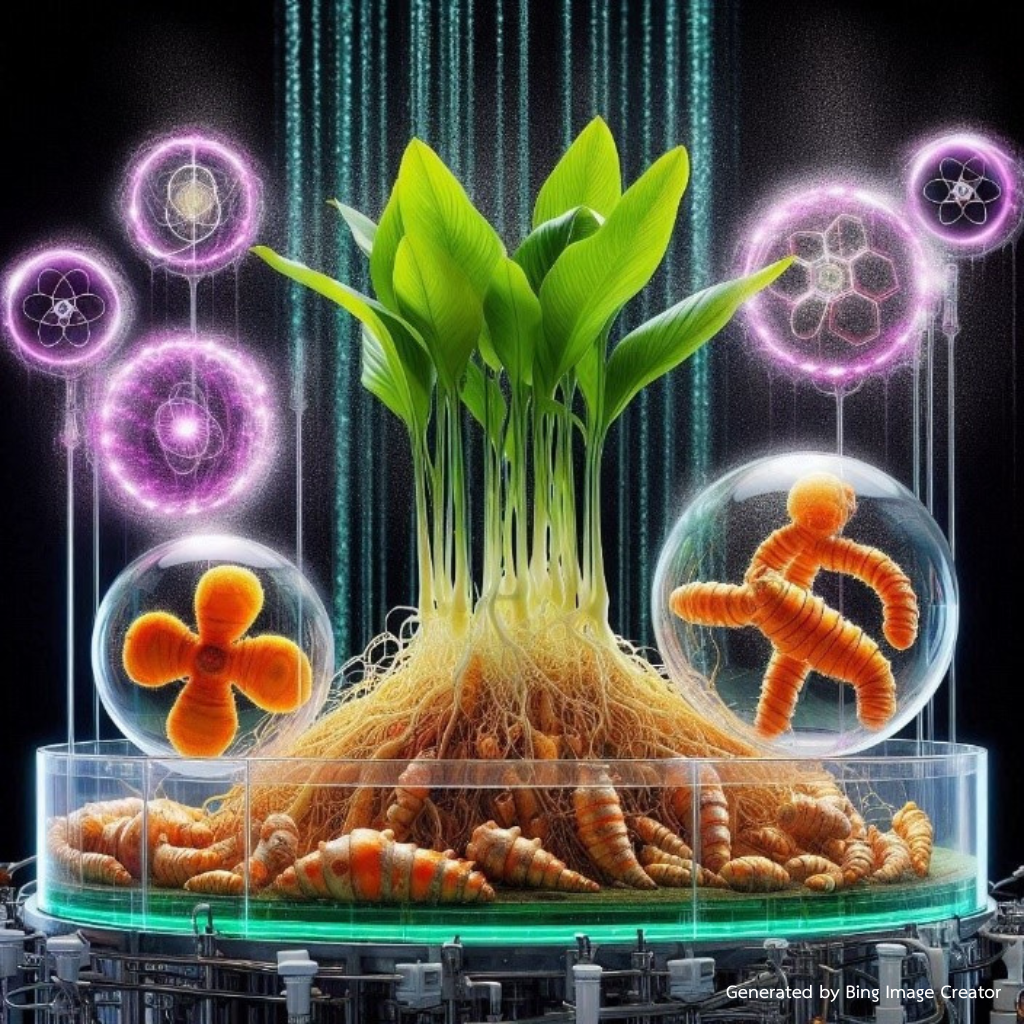
GRAPHICAL ABSTRACT

Downloads
References
S Burapan, M Kim, Y Paisooksantivatana, BE Eser and J Han. Thai Curcuma species: Antioxidant and bioactive compounds. Foods 2020; 9, 1219.
S Sukati and W Khobjai. Total phenolic content and DPPH free radical scavenging activity of young turmeric grown in southern Thailand. Appl. Mech. Mater. 2019; 886, 61-9.
Department of Agriculture. Turmeric cv. Trang84-2, Available at: https://doa.go.th/share/docs/ cultivarhort/suggestcv/turmerictrang84-2.pdf/, accessed December 2023.
Z Wang, W Luo, S Cheng, H Zhang, J Zong and Z Zhang. Ralstonia solanacearum - A soil borne hidden enemy of plants: Research development in management strategies, their action mechanism and challenges. Front. Plant Sci. 2023; 14, 1141902.
K Chen, L Wang, H Chen, C Zhang, S Wang, P Chu, S Li, H Fu, T Sun, M Liu, Q Yang, H Zou and W Zhuang. Complete genome sequence analysis of the peanut pathogen Ralstonia solanacearum strain Rs-P. 362200. BMC Microbiol. 2021; 21, 118.
A Balamurugan, K Sakthivel, RK Gautam, SK Sharma and A Kumar. Ralstonia solanacearum: Biology and its management in solanaceous vegetable crops. Microorganisms for Sustainability. Springer, Singapore, 2020, p. 259-89.
A Chakraborty, S Mahajan, SK Jaiswal and VK Sharma. Genome sequencing of turmeric provides evolutionary insights into its medicinal properties. Comm. Biol. 2021; 4, 1193.
L Ma, F Kong, K Sun, T Wang and T Guo. From classical radiation to modern radiation: Past, present, and future of radiation mutation breeding. Front. Publ. Health 2021; 9, 768071.
A Tripathi, S Kumar, A Gautam, B Lenka, JR Choudhary and PR Pradhan. Mutagenesis and transgenesis in plant breeding. Advanced crop improvement. Springer Cham, Switzerland, 2023, p. 111-41.
A Raina and M Danish. Mutagenesis in plant breeding for disease and pathogen resistance. Agr. Res. Tech. 2018; 13, 555869.
S Mondal, VC Petwal, AM Badigannavar, PG Bhad, VP Verma, SG Goswami and J Dwivedi. Electron beam irradiation revealed genetic differences in radio-sensitivity and generated mutants in groundnut (Arachis hypogaea L.). Appl. Radiat. Isot. 2017; 122, 78-83.
VM Loyola-Vargas and N Ochoa-Alejo. An introduction to plant tissue culture: Advances and perspectives. Meth. Mol. Biol. 2018; 1815, 3-13.
T Murashige and F Skoog. A revised medium for rapid growth and bio-assays with tobacco tissue culture. Physiol. Plantarum 1962; 15, 473-97.
NR Fonseca, LSS Oliveira, LMS Guimarães, RU Teixeira, CA Lopes and AC Alfenas. An efficient inoculation method of Ralstonia solanacearum to test wilt resistance in Eucalyptus spp. Trop. Plant Pathol. 2016; 41, 42-7.
C Tosri, K Chusreeaeom, M Limtiyayotin, N Sukin and P Jompuk. Comparative effect of high energy electron beam and 137Cs gamma ray on survival, growth and chlorophyll content in curcuma hybrid ‘Laddawan’ and determine proper dose for mutations breeding. Emirates J. Food Agr. 2019; 31, 321-7.
NAA Tjou-Tam-Sin, JLJVD Bilt, M Westenberg, PPMA Gorkink-Smits, NM Landman and M Bergsma-Vlami. Assessing the pathogenic ability of Ralstonia pseudosolanacearum (Ralstonia solanacearum Phylotype I) from ornamental Rosa spp. plants. Front. Plant Sci. 2017; 8, 1895.
CH Bock, KS Chiang and EMD Ponte. Plant disease severity estimated visually: A century of research, best practices, and opportunities for improving methods and practices to maximize accuracy. Trop. Plant Pathol. 2022; 47, 25-42.
SKD Dakha. Determination of radiosensitivity: Prerequisite factor for induced mutagenesis. Harnessing plant biotechnology and physiology to stimulate agricultural growth. Agrobios, New Delhi, India, 2019, p. 51-70.
JI Royani, Sudarsono, L Abdullah and SI Aisyah. Radio-sensitivity of irradiated seed, plantlets, callus, and in vitro leaves from Indigofera zollingeriana Miq by gamma rays. IOP Cof. Ser. Earth Environ. Sci. 2021; 913, 12061.
S Magori, A Tanaka and M Kawaguchi. Physically induced mutation: Ion beam mutagenesis. In: K Meksem and G Kahl (Eds.). The Handbook of Plant Mutation Screening: Mining of Natural and Induced Alleles. Willey, Weinheim, Germany, 2010.
WX Luo, YS Li, BM Wu, YE Tian, B Zhao, L Zhang, K Yang and P Wan. Effects of electron beam radiation on trait mutation in azuki bean (Vigna angularis). Afr. J. Biotechnol. 2012; 11, 12939-50.
K Chusreeaeom and O Khamsuk. Effects of gamma irradiation on lipid peroxidation, survival and growth of turmeric in vitro culture. J. Phys. Conf. Ser. 2019; 1285, 12003.
CK Waje, SY Jun, YK Lee, KD Moon, YH Choi and JH Kwon. Seed viability and functional properties of broccoli sprouts during germination and postharvest storage as affected by irradiation of seeds. J. Food Sci. 2009; 74, C370-C374.
A Waskow, D Butscher, G Oberbossel, D Klöti, PRV Rohr, A Büttner Mainik, D Drissner and M Schuppler. Low energy electron beam has severe impact on seedling development compared to cold atmospheric pressure plasma. Sci. Rep. 2021; 11, 16373.
NC Surakshitha and K Soorianathasundaram. Determination of mutagenic sensitivity of hardwood cuttings of grapes ‘Red Globe’ and ‘Muscat’ (Vitis vinifera L.) to gamma rays. Scientia Horticulturae 2017; 226, 152-6.
A Álvarez-Holguín, CR Morales-Nieto, CH Avendaño-Arrazate, R Corrales-Lerma, F Villarreal-Guerrero, E Santellano-Estrada and Y Gómez-Simuta. Mean lethal dose (LD50) and growth reduction (GR50) due to gamma radiation in Wilman lovegrass (Eragrostis superba). Revista Mexicana De Ciencias Pecuarias 2019; 10, 227-38.
Aminah, A Nur, Abdullah, N Tahir, Edy and Nuraeni. Improving the genetic diversity of soybean seeds and tolerance to drought irradiated with gamma rays. Int. J. Curr. Res. Acad. Rev. 2015; 3, 105-13.
I Muhammad, MY Rafii, MH Nazli, SI Ramlee, AR Harun and Y Oladosu. Determination of lethal (LD) and growth reduction (GR) doses on acute and chronic gamma-irradiated Bambara groundnut [Vigna subterranea (L.) Verdc.] varieties. J. Radiat. Res. Appl. Sci. 2021; 14, 133-45.
A Ajitomi, Y Inoue, M Horita and K Nakaho. Bacterial wilt of three Curcuma species, C. longa (turmeric), C. aromatica (wild turmeric) and C. zedoaria (zedoary) caused by Ralstonia solanacearum in Japan. J. Gen. Plant Pathol. 2015; 81, 315-9.
N Shikazono, C Suzuki, S Kitamura, H Watanabe, S Tano and A Tanaka. Analysis of mutations induced by carbon ions in Arabidopsis thaliana. J. Exp. Bot. 2005; 56, 587-96.
U Promnart, V Puripunyavanich, K Boonsirichai, P Doungsoongnern, R Kaewchuenchai, S Chamotri, K Klakhaeng and F Sarsu. Breeding Thai rice for flood tolerance through electron beam-induced mutations. Int. J. Genet. Eng. 2017; 5, 1-10.
OP Bamidele and CT Akanbi. Effect of gamma irradiation on physicochemical properties of stored pigeon pea (Cajanus cajan) flour. Food Sci. Nutr. 2013; 1, 377-83.
G Prasath, PI Vethamoni, P Balasubramanian, C Vanniarajan, J Souframanien, N Senthil and G Hemalatha. Effect of mutagenesis on germination, plant survival, pollen sterility and seed sterility in M1 generation of cluster bean (Cyamopsis tetragonaloba L.) variety MDU 1. J. Phcog. Phytochemistry 2019; 8, 3502-7.
V Eswaramoorthy, T Kandasamy, K Thiyagarajan, C Vanniarajan and S Jegadeesan. Effectiveness and efficiency of electron beam in comparison with gamma rays and ethyl methane sulfonate mutagens in cowpea. Appl. Radiat. Isot. 2021; 171, 109640.
Downloads
Published
How to Cite
Issue
Section
License
Copyright (c) 2024 Walailak University

This work is licensed under a Creative Commons Attribution-NonCommercial-NoDerivatives 4.0 International License.





