
Influences of Enterobacter Cloacae Strain Fg 5-2 and Its Vermicompost and Nitrogen Fertilizer Usage Efficiency on Groundnut Yield
DOI:
https://doi.org/10.48048/tis.2024.8039Keywords:
Enterobacter cloacae strain Fg 5-2, Groundnut, Productivity, Vermicompost, CNF, VMCAbstract
Reducing production costs by replacing chemical nitrogen fertilizer (CNF) with natural nitrogen fertilizers from endophytic nitrogen-fixing bacteria is an optimally alternative solution to utilize natural nitrogen sources from biological nitrogen fixation to improve crop yields. Three levels of nitrogen (N) and vermicompost (VMC) application combined with Enterobacter cloacae strain Fg 5-2 (EC strain Fg 5-2) inoculation, which were carried out in 2 experiments, aimed to evaluate its impacts on the groundnut output. The 2 experiments consisted of 0, 20, 40 kg N ha–1 and 0, 5.0, 10 t VMC ha–1 application associated with EC strain Fg 5-2 inoculation and 4 replications. Results observed that 50 % CNF reduction, which increased up to 16.5 % of the groundnut yield compared to no CNF application, was no yield difference of the 100 % CNF application. Application of 10 t VMC ha–1 associated with EC strain Fg 5-2 inoculation increased up to 38.4 % compared to no VMC amendment. The groundnut yield of experiment 1 and 2 remarkably increased up to 19.6 and 12.9 %, respectively, with the EC strain Fg 5-2 inoculation compared to the non- EC strain Fg 5-2 inoculation. Application of VMC was the high efficiency on the nodulous number and weight of groundnut. Application of 20 kg N or 10 t VMC ha–1 combined with EC strain Fg 5-2 inoculation adequately reached highest groundnut yield. These selected results are the best associated rate to reduce CNF by applying EC strain Fg 5-2 inoculation to improve farmland nutrients and increase the groundnut yield.
HIGHLIGHTS
In experiment 1:
- Isolation and identification of endogenous N-fixing bacterium species from peanut nodules on a low nutrient sandy soil
- When Enterobacter cloacae strain Fg 5-2 associated with a 50 % reduction of chemical nitrogen fertilizer application, the peanut yield increased up to 16.5 % compared to no nitrogen fertilizer application and no significant difference compared to the 100 % chemical nitrogen fertilizer application
- The peanut yield increased up to 19.6 % with the Enterobacter cloacae strain Fg 5-2 inoculation compared to the non- Enterobacter cloacae strain Fg 5-2 inoculation.
In experiment 2:
- When Enterobacter cloacae strain Fg 5-2 associated with 10 t vermicompost ha–1 amendment, the peanut yield increased up to 38.4 % compared to no vermicompost amendment
- The peanut yield increased up to 12.9 % in treatmentas of the Enterobacter cloacae strain Fg 5-2 inoculation compared to the non-Enterobacter cloacae strain Fg 5-2 inoculation.
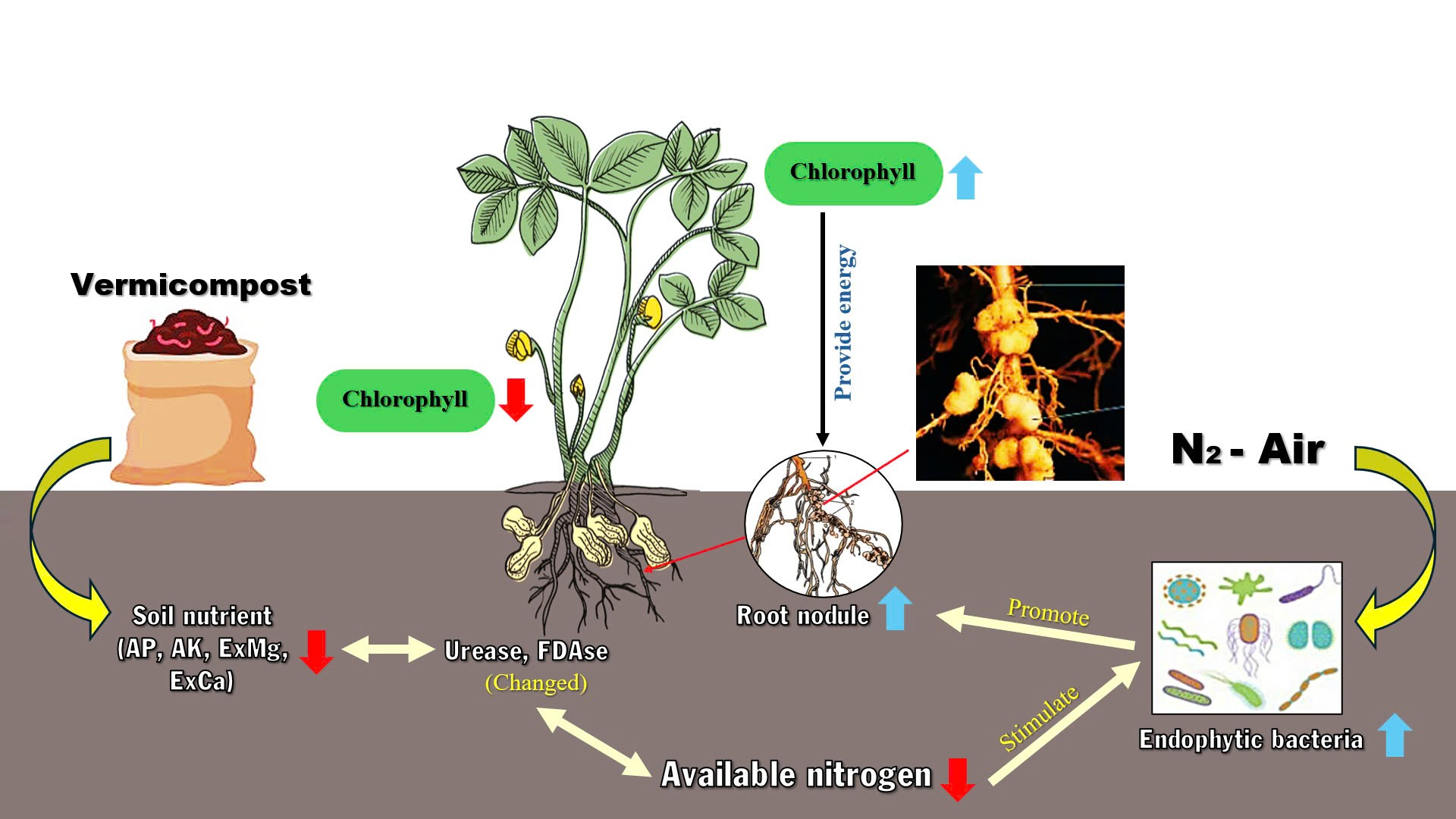
GRAPHICAL ABSTRACT
Downloads
References
V Taru, S Mshelia and E Adebayo. Economic efficiency of resource use in groundnut production in Adamawa state of Nigeria. World J. Agr. Sci. 2008; 4, 896-900.
RO Hammons, D Herman and HT Stalker. Origin and early history of the peanut. In: HT Stalker and RF Wilson (Eds.). Peanuts genetics, processing, and utilization. Academic Press, Massachusetts, United States, 2016, p. 478.
W Htoon, W Kaewpradit, N Vorasoot, B Toomsan, C Akkasaeng, N Puppala, S Wongkaew and S Jogloy. Relationships between nutrient uptake and nitrogen fixation with aflatoxin contamination in peanut under terminal drought. Agronomy 2019; 9, 419.
G Li, X Guo, W Sun, L Hou, G Wang, R Tian, X Wang, C Qu and C Zhao. Nitrogen application in pod zone improves yield and quality of two peanut cultivars by modulating nitrogen accumulation and metabolism. BMC Plant Biol. 2024; 24, 48.
J Huang, RK Afshar, A Tao and C Chen. Efficacy of starter n fertilizer and rhizobia inoculant in dry pea (Pisum Sativum Linn.) production in a semi-arid temperate environment. Soil Sci. Plant Nutr. 2017; 63, 248-53.
M Aslani and MK Souri. Growth and quality of green bean (Phaseolus vulgaris L.) under foliar application of organic chelate fertilizers. Open Agr. 2018; 3, 146-54.
LM Sorathiya, AB Fulsoundar, KK Tyagi, H Fujikake, MD Patel and RR Singh. Eco-friendly and modern methods of livestock waste recycling for enhancing farm profitability. Int. J. Recycl. Org. Waste Agr. 2014; 3, 50.
A Ahmad, Z Aslam, K Bellitürk, N Iqbal, S Naeem, M Idrees, Z Kaleem, MY Nawaz, M Nawaz, M Sajjad, WU Rehman, HN Ramzan, M Waqas, Y Akram, MA Jamal, MU Ibrahim, HAT Baig and A Kamal. Vermicomposting methods from different wastes: An environment friendly, economically viable and socially acceptable approach for crop nutrition: A review. Int. J. Food Sci. Agr. 2021; 5, 58-68.
J Pathma and N Sakthivel. Microbial diversity of vermicompost bacteria that exhibit useful agricultural traits and waste management potential. Springerplus 2012; 1, 26.
HW Wang, CY Ma, FJ Xu, F Lu, W Zhang and CC Dai. Root endophyte enhanced peanut-rhizobia interaction is associated with regulation of root exudates. Microbiol. Res. 2021; 250, 126765.
NV Chuong. Response of peanut quality and yield to chicken manure combined with Rhizobium inoculation in sandy soil. Commun. Sci. Tech. 2023; 8, 31-7.
A Bhattarai, B Bhattarai and S Pandey. Variation of soil microbial population in different soil horizons. J. Microbiol. Exp. 2015; 2, 75-8.
F Liu, T Hewezi, SL Lebeis, V Pantalone, PS Grewal and ME Staton. Soil indigenous microbiome and plant genotypes cooperatively modify soybean rhizosphere microbiome assembly. BMC Microbiol. 2019; 19, 201.
V Vives-Peris, C Ollas, A Gomez-Cadenas and RM Perez-Clemente. Root exudates: From plant to rhizosphere and beyond. Plant Cell Rep. 2020; 39, 3-17.
Q Qu, Z Zhang, WJGM Peijnenburg, W Liu, T Lu, B Hu, J Chen, J Chen, Z Lin and H Qian. Rhizosphere microbiome assembly and its impact on plant growth. J. Agr. Food Chem. 2020; 68, 5024-38.
NV Chuong, LM Tuan, TLK Tri, NNP Trang, HT Tuan and NTT Diem. Efficient evaluation of E. asburiae, K. quasipneumoniae and E. cloacae combination with vermicompost on growth and yield of groundnut. Seybold Rep. 2023; 18, 1862-70.
NV Chuong. Effect of three different nitrogen rates and three rhizosphere n2- fixing bacteria on growth, yield and quality of peanuts. Trend. Sci. 2024; 21, 7281.
AM Yatoo, S Rasool, S Ali, S Majid, MU Rehman, M Ali, R Eachkoti, S Rasool, SM Rashid and S Farooq. Vermicomposting: An eco-friendly approach for recycling/management of organic wastes. In: KR Hakeem, RA Bhat and H Qadri (Eds.). Bioremediation and biotechnology: Sustainable approaches to pollution degradation. Springer, Cham, Switzerland, 2020, p. 167-87.
H Ayyobi, E Hassanpour, S Alaqemand, S Fathi, J Olfati and G Peyvast. Vermicompost leachate and vermiwash enhance French dwarf bean yield. Int. J. Veg. Sci. 2014; 20, 21-7.
U.S. Department of Agriculture. Soil taxonomy: A basic system of soil classification for making sand interpreting soil surveys. 2nd eds. Natural Resources Conservation Service, U.S. Department of Agriculture, Washington DC, 1999, p. 436.
ES Matoso, VM Reis, SJ Giacomini, MTD Silva, AR Avancini and SDDAE Silva. Diazotrophic bacteria and substrates in the growth and nitrogen accumulation of sugarcane seedlings. Sci. Agr. 2021; 78, 184.
F Mus, MB Crook, K Garcia, AG Costas, BA Geddes, ED Kouri, P Paramasivan, MH Ryu, GED Oldroyd, PS Poole, MK Udvardi, CA Voigt, JM Ané and JW Peters. Symbiotic nitrogen fixation and the challenges to its extension to nonlegumes. Appl. Environ. Microbiol. 2016; 82, 3698-710.
M Mondal, SK Gunri, A Sengupta and R Kundu. Productivity enhancement of rabi groundnut (Arachis hypogaea L.) under polythene mulching and rhizobium inoculation under new alluvial zone of West Bengal. Int. J. Curr. Microbiol. Appl. Sci. 2018; 7, 2308-13.
L Chen, H Shi, J Heng, D Wang and K Bian. Antimicrobial, plant growth-promoting and genomic properties of the peanut endophyte Bacillus velezensis LDO2. Microbiol. Res. 2019; 218, 41-8.
FS Prestes, AAM Pereira, ACM Silva, PO Pena and MS Nascimento. Effects of peanut drying and blanching on Salmonella spp. Food Res. Int. 2019; 119, 411-6.
NV Chuong. Response of peanut quality and yield to chicken manure combined with Rhizobium inoculation in sandy soil. Commun. Sci. Tech. 2023; 8, 31-7.
GA Divito and VO Sadras. How does phosphorus, potassium and sulphur affect plant growth and biological nitrogen fixation in crop and pasture legumes? A meta-analysis. Field Crop. Res. 2014; 156, 161-71.
L Zhou, XD Li, X Tang, YJ Linand and ZF Li. Effects of different application amount of N, P, K fertilizers on physiological characteristics, yield and kernel quality of peanut. Chin. J. Appl. Ecol. 2007; 18, 2468-74.
R Mendes, P Garbeva and JM Raaijmakers. The rhizosphere microbiome: Significance of plant beneficial, plant pathogenic, and human pathogenic microorganisms. FEMS Microbiol. Rev. 2013; 37, 634-63.
Y Li, N Bai, Z Tao, X Mi, G He and Z Wang. Rethinking application of animal manure for wheat production in China. J. Clean. Prod. 2021; 318, 128473.
S Guo, J Pan, L Zhai, B Khoshnevisan, S Wu, H Wang, B Yang, H Liu and B Lei. The reactive nitrogen loss and GHG emissions from a maize system after a long-term livestock manure incorporation in the North China Plain. Sci. Total Environ. 2020; 720, 137558.
Z Liu, Y Song, L Ge, X Pan, Y Zhao, L Cheng, Y Li, W Wang and X Liu. Impact of various organic fertilizers on the growth, yield, and soil environment of peanuts subjected to continuous cropping obstacles. Pol. J. Environ. Stud. 2023; 32, 3683-93.
K Jindo, C Chocano, JMD Aguilar, D Gonzalez, T Hernandezand and C Garcia. Impact of compost application during 5 years on crop production, soil microbial activity, carbon fraction, and humification process. Commun. Soil Sci. Plant Anal. 2016; 47, 1907-19.
VC Nguyen. Effect of three different nitrogen rates and three rhizosphere N2- fixing bacteria on growth, yield and quality of peanuts. Trend. Sci. 2024; 21, 7281.
NV Chuong. Output and nutrition of the peanut as affected by lime, vermicompost addition with Enterobacter Asburiae strain Cjy141 inoculation in the low nutrient soil. J. Xi'an Shiyou Univ. Nat. Sci. 2024; 20, 533-44.
P Fincheira and A Quiroz. Microbial volatiles as plant growth inducers. Microbiol. Res. 2018; 208, 63-75.
LM Ludueña, MS Anzuay, JG Angelini, M McIntosh, A Becker, O Rupp, A Goesmann, J Blom, A Fabra and T Taurian. Genome sequence of the endophytic strain Enterobacter sp. J49, a potential biofertilizer for peanut and maize. Genomics 2018; 111, 913-20.
X Zhou, N Zhang, L Xia, Q Li, J Shao, Q Shen and R Zhang. ResDE two-component regulatory system mediates oxygen limitation-induced biofilm formation by Bacillus amyloliquefaciens SQR9. Appl. Environ. Microbiol. 2018; 84, e2744-17.
H Etesami. Root nodules of legumes: A suitable ecological niche for isolating non-rhizobial bacteria with biotechnological potential in agriculture. Curr. Res. Biotechnol. 2022; 4, 78-86.
MS Hossain, PB DeLaune and TJ Gentry. Microbiome analysis revealed distinct microbial communities occupying different sized nodules in field-grown peanut. Front. Microbiol. 2023; 14, 1075575.
Downloads
Published
How to Cite
Issue
Section
License
Copyright (c) 2024 Walailak University

This work is licensed under a Creative Commons Attribution-NonCommercial-NoDerivatives 4.0 International License.





