
Four Newly Identified Endophytic Bacillus megaterium Strains with Biofertilizer Potential for Enhancing Maize Growth and Productivity
DOI:
https://doi.org/10.48048/tis.2026.11347Keywords:
Biofertilizer, Macronutrient, Maize productivity, Natural nitrogen-fixing, Soil nutrientAbstract
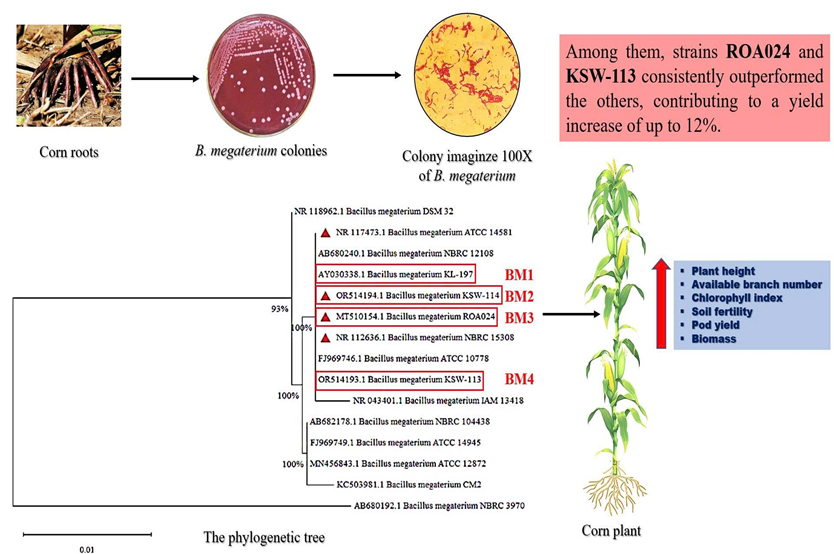
Intensive maize farming in tropical regions has led to increasing reliance on chemical fertilizers, which negatively impact soil fertility and sustainability. To develop more eco-friendly alternatives, this study aimed to isolate and evaluate indigenous Bacillus megaterium strains with plant growth-promoting potential from maize roots grown in high-input fields of An Giang Province, Vietnam. Ten endophytic bacterial isolates were initially screened based on morphological and biochemical traits. Four promising strains of Bacillus megaterium KL-197, KSW-114, ROA 024, and KSW-113 were identified via 16S rRNA sequencing and phylogenetic analysis. These strains were further tested for nitrogenase activity using the acetylene reduction assay and for their ability to tolerate varying temperatures and salt concentrations. High nitrogen-fixing potential and ammonia production were observed, particularly in strains ROA 024 and KSW-113. Field experiments were conducted using a randomized block design with 5 treatments (4 bacterial strains and a control) to assess effects on maize growth, yield, and seed quality. Inoculation with all 4 strains significantly improved plant height, chlorophyll content, and biomass. Strains ROA 024 and KSW-113 outperformed others, resulting in increased ear length, seed number, 1000-grain weight, and fresh ear yield achieving up to a 12% yield increase over the control. Protein content in maize grains also improved with inoculation, while lipid content remained unaffected. These findings demonstrate that the 4 newly identified native Bacillus megaterium strains, especially ROA 024 and KSW-113, possess strong nitrogen-fixing and growth-promoting capabilities under field conditions. The study highlights the potential application of these strains in biofertilizer development, offering a sustainable solution to enhance maize productivity while reducing dependence on synthetic nitrogen inputs.
HIGHLIGHTS
- Four novel Bacillus megaterium strains were isolated and identified from maize roots in intensive farming areas of Vietnam.
- The selected strains exhibited high nitrogenase activity and ammonia production, with strong thermal and salt tolerance.
- Field experiments showed that Bacillus megaterium ROA 024 and KSW-113 significantly increased maize yield by up to 12% over uninoculated controls.
- Inoculated plants demonstrated improved agronomic traits and grain quality, including higher protein content and biomass accumulation.
- The study highlights the potential of indigenous Bacillus megaterium strains as biofertilizer candidates for sustainable maize production.
GRAPHICAL ABSTRACT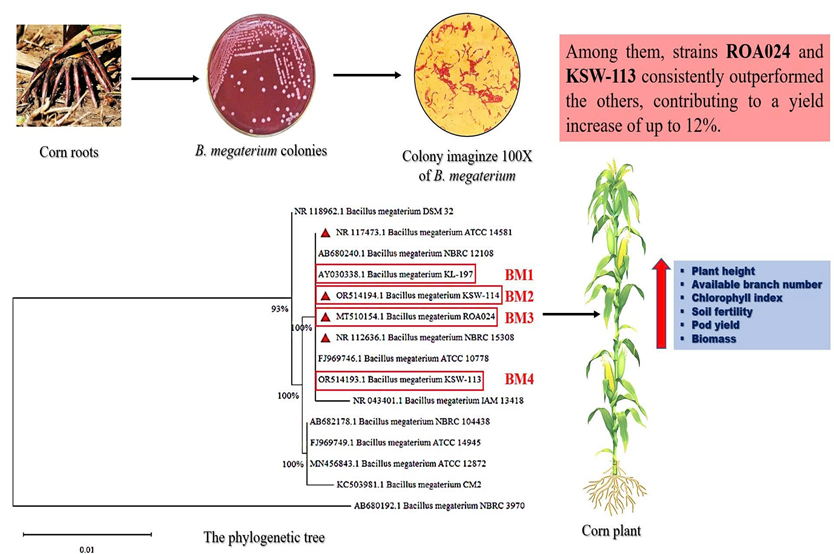
Downloads
References
OA Shalaby. Using Bacillus megaterium as a bio-fertilizer alleviates salt stress, improves phosphorus nutrition, and increases cauliflower yield. Journal of Plant Nutrition 2023; 47(6), 926-939.
Y Chen, A Nishihara and S Haruta. Nitrogen-fixing ability and nitrogen fixation-related genes of thermophilic fermentative bacteria in the genus caldicellulosiruptor. Microbes and Environments 2021; 36(2), ME21018.
K Ding, Y Tabuchi and T Makino. Effect of steam-processing of the Panax ginseng root on its inducible activity on granulocyte-colony stimulating factor secretion in intestinal epithelial cells in vitro. Journal of Ethnopharmacology 2022; 287, 114927.
Q Wei, Q Wei, J Xu, Y Liu, D Wang, S Chen, W Qian, M He, P Chen, X Zhou and Z Qi. Nitrogen losses from soil as affected by water and fertilizer management under drip irrigation: Development, hotspots and future perspectives. Agricultural Water Management 2024; 296, 108791.
LID Silva, MC Pereira, ÃMXD Carvalho, VH Buttrós, M Pasqual and J Dória. Phosphorus-solubilizing microorganisms: A key to sustainable agriculture. Agriculture 2023; 13(2), 462.
OO Babalola and AA Adedayo. Endosphere microbial communities and plant nutrient acquisition toward sustainable agriculture. Emerging Topics in Life Sciences 2023; 7(2), 207-217.
KL Rana, D Kour, T Kaur, R Negi, R Devi, N Yadav, PK Rai, S Singh, AK Rai, A Yadav, RZ Sayyed and AN Yadav. Endophytic nitrogen-fixing bacteria: Untapped treasurer for agricultural sustainability. Journal of Applied Biology Biotechnology 2023; 11(2), 75-93.
NV Chuong, TLK Tri and LM Tuan. Assessing the superiority of Bacillus songklensis strain kca6 along with lime and cow manure to increase white bean yield in cadmium contaminated soil. Australian Journal of Crop Science 2024; 18(11), 768-774.
M Anas, F Liao, KK Verma, MA Sarwar, A Mahmood, ZL Chen, Q Li, XP Zeng, Y Liu and YR Li. Fate of nitrogen in agriculture and environment: Agronomic, eco-physiological and molecular approaches to improve nitrogen use efficiency. Biological Research 2020; 53, 47.
LSM Geries and AY Elsadany. Maximizing growth and productivity of onion (Allium cepa L.) by Spirulina platensis extract and nitrogen-fixing endophyte Pseudomonas stutzeri. Archives of Microbiology 2021; 203(1), 169-118.
NV Chuong. Influences of Enterobacter cloacae strain fg 5-2 and its vermicompost and nitrogen fertilizer usage efficiency on groundnut yield. Trends in Sciences 2024; 21(9), 8039.
TC Setiawati, D Erwin, M Mandala and A Hidayatulah. Use of Bacillus as a plant growth-promoting rhizobacteria to improve phosphate and potassium availability in acidic and saline soils. KnE Life Sciences 2022; 7(3), 541-558.
APDD Silveira, RDPF Iório, FCC Marcos, AO Fernandes, SACDD Souza, EE Kurama and MAP Cipriano. Exploitation of new endophytic bacteria and their ability to promote sugarcane growth and nitrogen nutrition. Antonie van Leeuwenhoek 2019; 112(2), 283-295.
AC Parte, JS Carbasse, JP Meier-Kolthoff, LC Reimer and M Göker. List of prokaryotic names with standing in nomenclature (LPSN) moves to the DSMZ. International of Journal Systematic and Evolutionary Microbiology 2020; 70(11), 5607-5612.
R Biedendieck, T Knuuti, SJ Moore and D Jahn. The “beauty in the beast” - The multiple uses of Priestia megaterium in biotechnology. Applied Microbiology and Biotechnology 2021; 105(14-15), 5719-5737.
NV Chuong. The impact of Bacillus sp. NTLG2-20 and reduced nitrogen fertilization on soil properties and peanut yield. Communications in Science and Technology 2024; 9(1), 112-120.
NV Chuong. The impact of Klebsiella quasipneumoniae inoculation with nitrogen fertilization on baby corn yield and cob quality. Eurasian Journal of Soil Science 2023; 13(2), 133-138.
Y Zhao, X Mao, M Zhang, W Yang, HJ Di, L Ma, W Liu and B Li. The application of Bacillus megaterium alters soil microbial community composition, bioavailability of soil phosphorus and potassium, and cucumber growth in the plastic shed system of North China. Agriculture, Ecosystems and Environment 2021; 307, 107236.
CAD Oliveira-Paiva, D Bini, SMD Sousa, VP Ribeiro, FCD Santos, UGDP Lana, FFD Souza, EA Gomes and IE Marriel. Inoculation with Bacillus megaterium CNPMS B119 and Bacillus subtilis CNPMS B2084 improve P-acquisition and maize yield in Brazil. Frontiers in Microbiology 2024; 15, 1426166.
NV Chuong, NNP Trang, TT Liem and PTH Dang. Effect of Bacillus sonklengsis associated with cattle manure fertilization on the farmland health and peanut yield. International Journal of Agriculture and Biosciences 2025; 14(4), 629-636.
LR Massucato, SRDA Almeida, MB Silva, M Mosela, DM Zeffa, AF Nogueira, RBDL Filho, S Mian, AY Higashi, GM Teixeira, GD Shimizu, RM Giacomin, RC Fendrich, MV Faria, CA Scapim and LSA Gonçalves. Efficiency of combining strains Ag87 (Bacillus megaterium) and Ag94 (Lysinibacillus sp.) as phosphate solubilizers and growth promoters in maize. Microorganisms 2022; 10(7), 1401.
B Ssemugenze, A Ocwa, R Kuunya, C Gumisiriya, C Bojtor, J Nagy, A Széles and Á Illés. Enhancing maize production through timely nutrient supply: The role of foliar fertiliser application. Agronomy 2025; 15(1), 176.
RGP Shah, S Vyas, M Desai and K Rajput. Isolation and screening of plant growth promoting bacteria from fermented panchagavya. Bioscience Biotechnology Research Communications 2020; 13, 42-48.
JPS Guzmán, K Nguyen and SC Hart. Simple methods to remove microbes from leaf surfaces. Journal of Basic Microbiology 2020; 60(8), 730-734.
CI Nxumalo, LS Ngidi, JSE Shandu and TS Maliehe. Isolation of endophytic bacteria from the leaves of Anredera cordifolia CIX1 for metabolites and their biological activities. BMC Complementary Medicine and Therapies 2020; 20(1), 300.
HRMD Santos, CS Argolo, RC Argôlo-Filho and LL Loguercio. A 16S rDNA PCR-based theoretical to actual delta approach on culturable mock communities revealed severe losses of diversity information. BMC Microbiology 2029; 19(1), 74.
KC Goldfarb, U Karaoz, CA Hanson, CA Santee, MA Bradford, KK Treseder and EL Brodie. Differential growth responses of soil bacterial taxa to carbon substrates of varying chemical recalcitrance. Frontiers in Microbiology 2011; 2, 94.
N Saitou and M Nei. The neighbor-joining method: A new method for reconstructing phylogenetic trees. Molecular Biology and Evolution 1987; 4, 406-425.
K Tamura, D Peterson, N Peterson, G Stecher, M Nei and S Kumar. MEGA5: Molecular evolutionary genetics analysis using maximum likelihood, evolutionary distance, and maximum parsimony methods. Molecular Biology and Evolution 2011; 28(10), 2731-2739.
S Kumar, G Stecher, M Li, C Knyaza and K Tamura. Mega X: Molecular evolutionary genetics analysis across computing platforms. Molecular Biology and Evolution 2018; 35(6), 1547-1549.
NV Chuong and TLK Tri. Isolation and characterization identification of endophytic nitrogen-fixing bacteria from peanut nodules. International Journal of Microbiology 2024; 2024(1), 8973718.
A Datta, RK Singh and S Tabassum. Isolation, characterization and growth of Rhizobium strains under optimum conditions for effective biofertilizer production. International Journal of Pharmaceutical Sciences Review and Research 2015; 32(1), 199-208.
A Borah, R Das, R Mazumdar and D Thakur. Culturable endophytic bacteria of Camellia species endowed with plant growth promoting characteristics. Journal of Applied Microbiology 2019; 127(3), 825-844.
FM Soper, C Simon and V Jauss. Measuring nitrogen fixation by the acetylene reduction assay (ARA): Is 3 the magic ratio. Biogeochemistry 2021; 152, 345-351.
D Li, X Xu, Z Li, T Wang and C Wang. Detection methods of ammonia nitrogen in water: A review. Trends in Analytical Chemistry 2020; 127, 115890.
S Husseiny, T Dishisha, HA Soliman, R Adeleke and M Raslan. Characterization of growth promoting bacterial endophytes isolated from Artemisia annua L. South African Journal of Botany 2021; 143, 238-247.
NV Chuong and TLK Tri. Enhancing soil fertilizer and peanut output by utilizing endophytic bacteria and vermicompost on arsenic-contaminated soil. International Journal of Agriculture and Biosciences 2024; 13(4), 596-602.
N Van Chuong, TLK Tri, TM Vu, LM Tuan, TT Liem and Trang NNP. Isolation and identification of Bacillus aryabhattai M2C: its effects with vermicompost on yield and nutrients of peanut (Arachis hypogaea L.). International Journal of Microbiology 2025; 10 (2025), 9923279.
K Hrynkiewicz, S Patz and S Ruppel. Salicornia europaea L. as an underutilized saline-tolerant plant inhabited by endophytic diazotrophs. Journal of Advanced Research 2019; 19, 49-56.
NV Chuong. Influences of Enterobacter cloacae strain Fg 5-2 and its vermicompost and nitrogen fertilizer usage efficiency on groundnut yield. Trends in Sciences 2024; 21(9), 8039.
AJD Oliveira, TC Franco, LA Florentino and PRC Landgraf. Characterization of associative diazotrophic bacteria in torch ginger. Semina: Ciências Agrárias 2020; 41(6), 2815-2823.
RJ Akinrinlola, GY Yuen, RA Drijber and AO Adesemoye. Evaluation of Bacillus strains for plant growth promotion and predictability of efficacy by in vitro physiological traits. International Journal of Microbiology 2018; 3, 5686874.
S Lee, JA Kim, J Song, S Choe, G Jang and Y Kim. Plant growth-promoting rhizobacterium Bacillus megaterium modulates the expression of antioxidant-related and drought-responsive genes to protect rice (Oryza sativa L.) from drought. Frontiers in Microbiology 2024; 15, 1430546.
FX Nascimento, AG Hernández, BR Glick and MJ Rossi. Plant growth-promoting activities and genomic analysis of the stress-resistant Bacillus megaterium STB1, a bacterium of agricultural and biotechnological interest. Biotechnology Reports 2019; 25, e00406.
VC Nguyen. Effect of three different nitrogen rates and three rhizosphere N2- fixing bacteria on growth, yield and quality of peanuts. Trends in Sciences 2024; 21(3), 7281.
NV Chuong, NNP Trang and NV Thuan. Nitrogen fertilizer use reduction by two endophytic diazotrophic bacteria for soil nutrients and corn yield. Communications in Sciences and Technology 2024; 9(2), 348-355.
Q Zhu, J Zhou, M Sun, H Li, Y Han, J Lv, Y Li, X Zhang, TS George, W Liu, Z Wang and Y Sun. A newly isolated Bacillus megaterium OQ560352 promotes maize growth in saline soils by altering rhizosphere microbial communities and organic phosphorus utilization. Rhizosphere 2023; 27, 100746.
NNP Trang and NV Chuong. The enhancement of soil fertility and baby maize output by Streptomyces panayensis and vermicompost. Eurasian Journal of Soil Science 2025; 14(2), 140-148.
G Li, M Shi, W Wan, Z Wang, S Ji, F Yang, S Jin and J Zhang. Maize endophytic plant growth-promoting bacteria Peri bacillus simplex can alleviate plant saline and alkaline stress. International Journal of Molecular Sciences 2024; 25(20), 10870.
CAD Oliveira-Paiva, D Bini, SMD Sousa, VP Ribeiro, FCD Santos, UGDP Lana, FFD Souza, EA Gomes and IE Marriel. Inoculation with Bacillus megaterium CNPMS B119 and Bacillus subtilis CNPMS B2084 improve P-acquisition and maize yield in Brazil. Frontiers in Microbiology 2024; 15, 1426166.
Published
How to Cite
Issue
Section
License
Copyright (c) 2025 Walailak University

This work is licensed under a Creative Commons Attribution-NonCommercial-NoDerivatives 4.0 International License.





