
Dual Response Optimization of Ultrasound-Assisted Oil Extraction from Milkfish By-Products using D-Limonene as A Bio-Based Solvent
DOI:
https://doi.org/10.48048/tis.2024.8016Keywords:
Milkfish oil, Fatty acids, Omega-3 compounds, Response surface methodology, Ultrasound-assisted extractionAbstract
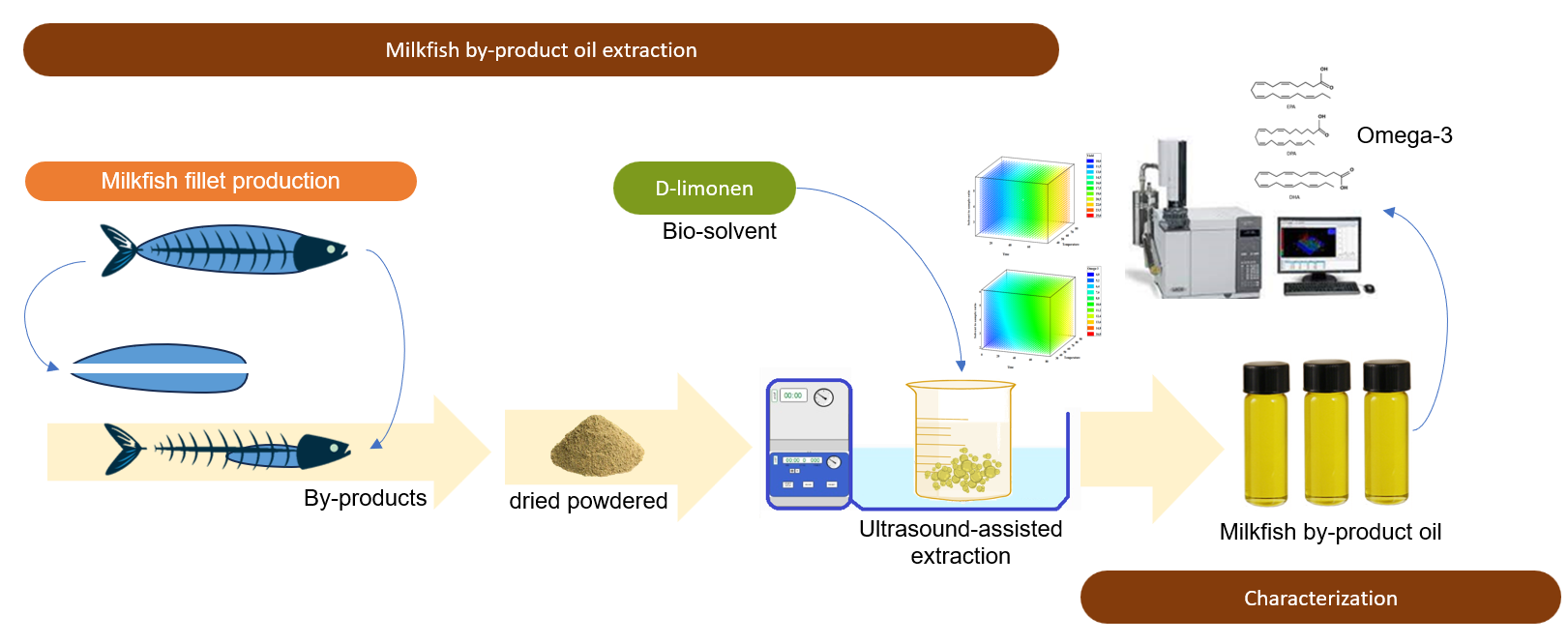
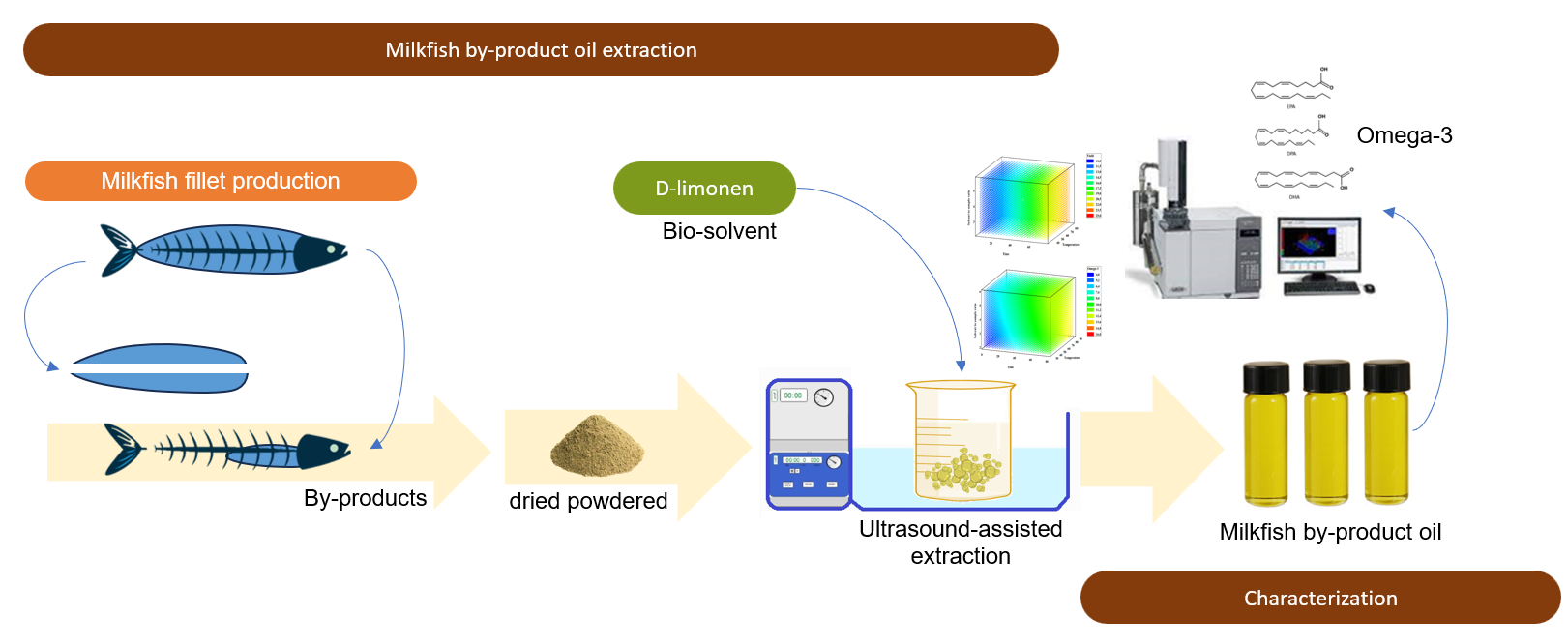
Fish oil has been reported to have positive health effects because it is rich in n-3 essential fatty acids. This study aimed to determine the optimal conditions for achieving a high oil yield and omega-3 content from milkfish by-products using ultrasound-assisted extraction (UAE) combined with a d-limonene solvent. The Box-Behnken design (BBD) combined with response surface methodology was successfully used to determine the optimum extraction conditions for omega-3 fatty acids based on several factors: Temperature (30, 60 and 90 °C), solvent-to-sample ratio (2:1, 4:1 and 6:1 mL/g) and time (6, 38 and 70 min). The ANOVA results showed that sonication time (p < 0.05) and temperature (p < 0.05) had a significant influence on omega-3 fatty acids and the yield of extracted oil. The optimal extraction conditions for UAE were 68 min, 84 °C, and a solvent-to-sample ratio of 3:1 mL/g resulting in high oil recovery (21.95 %) containing omega-3 compounds (12.50 %). Additionally, the resulting oil was also further characterized by quality parameters (acid, peroxide, anisidine-total oxidation and iodine values) as well as the fatty acid composition. The developed milkfish oil met the IFOS™ (International Fish Oil Standards) criteria hence applicable for industrial oil production.
HIGHLIGHTS
- Milkfish is extensively utilized to produce fillets, resulting in a variety of by-products.
- Milkfish by-products can be converted into fish oil, which is a source of omega-3 that benefits health.
- Ultrasound-assisted extraction (UAE) expedites fish oil extraction by shortening processing time.
- The optimal UAE conditions were 68 min, 84 °C, and solvent-to-sample ratio of 3:1 mL/g.
- D-limonene combined with UAE extracted fish oil rich in omega-3 (12.5 %) from milkfish by-products.
GRAPHICAL ABSTRACT
Downloads
References
FAO. The state of world fisheries and aquaculture 2022. Towards Blue Transformation. FAO, Rome, 2022.
LN Murthy, PA Padiyar, BM Rao, KK Asha, D Jesmi, PG Girija, MM Prasad and CN Ravishankar. Nutritional profile and heavy metal content of cultured milkfish (Chanos Chanos). Fishery Tech. 2016; 53, 245-9.
B Nieva-Echevarría, E Goicoechea and MD Guillén. Polyunsaturated lipids and vitamin A oxidation during cod liver oil in vitro gastrointestinal digestion. Antioxidant effect of added BHT. Food Chem. 2017; 232, 733-43.
PD Nichols, A McManus, K Krail, AJ Sinclair and M Miller. Recent advances in omega-3: Health benefits, Sources, products and bioavailability. Nutrients 2014; 6, 3727-33.
AN Ikhsan, F Syifa, M Mustafidah and A Rohman. Implementation of chemometrics as a solution to detecting and preventing falsification of herbal medicines in Southeast Asia: A review. J. Appl. Pharmaceut. Sci. 2021; 11, 139-48.
S Sarker. By-products of fish-oil refinery as potential substrates for biogas production in Norway: A preliminary study. Results Eng. 2020; 6, 100137.
J Bustamante, SV Stempvoort, M García-Gallarreta, JA Houghton, HK Briers, VL Budarin, AS Matharu and JH Clark. Microwave assisted hydro-distillation of essential oils from wet citrus peel waste. J. Cleaner Prod. 2016; 137, 598-605.
SX Liu and PK Mamidipally. Quality comparison of rice bran oil extracted with d-limonene and hexane. Cereal Chem. 2005; 82, 209-15.
R Ciriminna, A Scurria, AS Fabiano-Tixier, C Lino, G Avellone, F Chemat and M Pagliaro. Omega-3 extraction from anchovy fillet leftovers with limonene: Chemical, economic, and technical aspects. ACS Omega 2019; 4, 15359-63.
C Carrera, J Pastol, W Setyaningsih, A Ruiz-Rodríguez, M Ferreiro-González, GF Barbero and M Palma. Optimization by means of chemometric tools of an ultrasound-assisted method for the extraction of Betacyanins from red dragon fruit (Hylocereus polyrhizus). Agronomy 2021; 11, 1053.
A Prasetyaningrum, W Widayat, B Jos, R Ratnawati, T Riyanto, GR Prinanda, BUL Monde and EE Susanto. Optimization of sequential microwave-ultrasonic-assisted extraction of flavonoid compounds from Moringa oleifera. Trends Sci. 2023; 20, 6401.
HK Çavdar, H Bilgin, S Fadıloğlu and FM Yılmaz. Ultrasound- and microwave-assisted extraction facilitate oil recovery from gilthead seabream (Sparus aurata) by-products and enhance fish oil quality parameters. Eur. J. Lipid Sci. Tech. 2023; 125, 2200089.
S Abdullah, SKA Mudalip, SM Shaarani and NAC Pi. Ultrasonic extraction of oil from Monopterus albus: Effects of different ultrasonic power, solvent volume and sonication time. J. Appl. Sci. 2010; 10, 2713-6.
W Setyaningsih, E Duros, M Palma and CG Barroso. Optimization of the ultrasound-assisted extraction of melatonin from red rice (Oryza sativa) grains through a response surface methodology. Appl. Acoust. 2016; 103, 129-35.
R Ciriminna, F Meneguzzo, R Delisi and M Pagliaro. Enhancing and improving the extraction of omega-3 from fish oil. Sustain. Chem. Pharm. 2017; 5, 54-9.
Institute of Food Science and Technology. Oils and fats. Institute of Food Science and Technology, London, 2017.
LK Low and CS Ng. Preparation of methyl esters by Boron Trifluoride Method. In: H Hasegawa (Ed.). Laboratory Manual on Analytical Methods and Procedures for Fish and Fish Products. Marine Fisheries Research Department, Southeast Asian Fisheries Development Center, Singapore, 1987, p. C-11.1-C-11.2.
CD Tanzi, MA Vian, C Ginies, M Elmaataoui and F Chemat. Terpenes as green solvents for extraction of oil from microalgae. Molecules 2012; 17, 8196-205.
M Virot, V Tomao, C Ginies and F Chemat. Total lipid extraction of food using d-limonene as an alternative to n-hexane. Chromatographia 2008; 68, 311-3.
M Aissou, Z Chemat-Djenni, E Yara-Varón, AS Fabiano-Tixier and F Chemat. Limonene as an agro-chemical building block for the synthesis and extraction of bioactive compounds. Compt. Rendus Chem. 2017; 20, 346-58.
MM Cascant, C Breil, S Garrigues, MDL Guardia, AS Fabiano-Tixier and F Chemat. A green analytical chemistry approach for lipid extraction: Computation methods in the selection of green solvents as alternative to hexane. Anal. Bioanalytical Chem. 2017; 409, 3527-39.
AM Goula. Ultrasound-assisted extraction of pomegranate seed oil - kinetic modeling. J. Food Eng. 2013; 117, 492-8.
ÉO Barizão, JS Boeing, AC Martins, JV Visentainer and VC Almeida. Application of response surface methodology for the optimization of ultrasound-assisted extraction of pomegranate (Punica granatum L.) seed oil. Food Anal. Meth. 2015; 8, 2392-400.
S Samaram, H Mirhosseini, CP Tan, HM Ghazali, S Bordbar and A Serjouie. Optimisation of ultrasound-assisted extraction of oil from papaya seed by response surface methodology: Oil recovery radical scavenging antioxidant activity, and oxidation stability. Food Chem. 2015; 172, 7-17.
OK Topuz, A Kaya and AC Alp. Effect of extraction variables on the omega-3 eicosapentaenoic acid (EPA) content of (Nannochloropsis oculata) microalga oil. Sci. Bull. Ser. F Biotechnologies 2016; 20, 172-7.
W Kosasih, RT Rosmalina, C Risdian, S Priatni, W Kosasih and E Saepudin. Production of omega-3 fatty acids by enzymatic hydrolysis from lemuru fish by-products. Sains Malaysiana 2021; 50, 2271-82
BZ Tilinti, TB Ayichiluhim, AM Tura and R Duraisamy. Extraction and characterizations of omega 3-fatty acid from cat fish collected from Arba Minch Chamo Lake. Cogent Food Agr. 2023; 9, 2216042.
JW Tak, B Gupta, RK Thapa, KB Woo, SY Kim, TG Go, Y Choi, JY Choi, JH Jeong, HG Choi, CS Yong and JO Kim. Preparation and optimization of immediate release/sustained release bilayered tablets of loxoprofen using box-behnken design. AAPS PharmSciTech 2017; 18, 1125-34
N Hidayah, A Rohman, M Mustafidah and Irnawati. Physicochemical characterization and fatty acid profiles of fish oil from milkfish (Chanos chanos F.). Food Res. 2022; 6, 265-70.
A Kumar, MR Lindley and SS Mastana. A time efficient adaptation of GC-FID method for the analysis of PBMC lipid composition. J. Biochem. Tech. 2014; 5, 760-4.
A Rezvankhah, Z Emam-Djomeh, M Safari, G Askari and M Salami. Microwave-assisted extraction of hempseed oil: Studying and comparing of fatty acid composition, antioxidant activity, physiochemical and thermal properties with Soxhlet extraction. J. Food Sci. Tech. 2019; 56, 4198-210.
Nutrasource. What is IFOS™? Nutrasource, Guelph, Canada, 2024.
Downloads
Published
How to Cite
Issue
Section
License
Copyright (c) 2024 Walailak University

This work is licensed under a Creative Commons Attribution-NonCommercial-NoDerivatives 4.0 International License.





