
Evaluation of Anti-Escherichia coli K88 from Diarrhea Piglets and Phytochemicals of Galangal Rhizome Extracts
DOI:
https://doi.org/10.48048/tis.2024.7112Keywords:
Escherichia coli K88, Galangal rhizome, Phytochemicals, PigletsAbstract
This study investigated the antimicrobial effect of galangal rhizome extracts against Escherichia coli K88 from diarrhea pigs. Galangal rhizome was extracted with 4 solvents: Water, ethanol, methanol and ethyl acetate. The extracts determination against E. coli K88 by disc diffusion method, minimal inhibitory concentration (MIC) and minimal bactericidal concentration (MBC). Results showed that inhibition diameters of galangal extract with ethyl acetate against E. coli K88 was significantly higher than that of galangal extracted with water, ethanol and methanol. However, the inhibition was significantly lower than that of streptomycin drug. The MIC and MBC values of ethyl acetate extracts against E. coli K88 were 0.39 and 0.78 mg/mL, respectively. Standard bacteria, pathogenic S. aureus ATCC6538, also used for testing antibacterial effect of galangal extract revealed the ethanol and methanol and ethyl-acetate extracts antibacterial effect against S. aureus. The phytochemicals tests performed on the extracts of galangal rhizome confirms the presence phenolic compounds exhibited antimicrobial activity. This study demonstrated antibacterial efficacy of galangal extracted with ethyl acetate to further develop as a substitute for antibiotics.
HIGHLIGHTS
- The galangal rhizome extracted with ethyl acetate exhibited a strong antimicrobial effect against E. coli K88, which known to cause diarrhea in piglets
- The observed antibacterial effect of ethyl acetate extract of galangal was attributed to the high presence of specific compounds, namely phenol, 4-(2-propenyl), acetate, as well as 3 sesquiterpenoids compounds that were exclusively found in ethyl acetate extract
- These sesquiterpenoids include 3-(1,5-dimethyl-4-hexenyl)-6-methylene-1-cyclohexene; and 1,5-dimethyl-8-(methylethylidene)-1,5-cyclodecadiene and (-)-5-oxatricyclo[8.2.0.0(4,6)] dodecane, 12-trimethyl-9-methylene; and 3-phenyl-1,4(e)-dodecadiene
GRAPHICAL ABSTRACT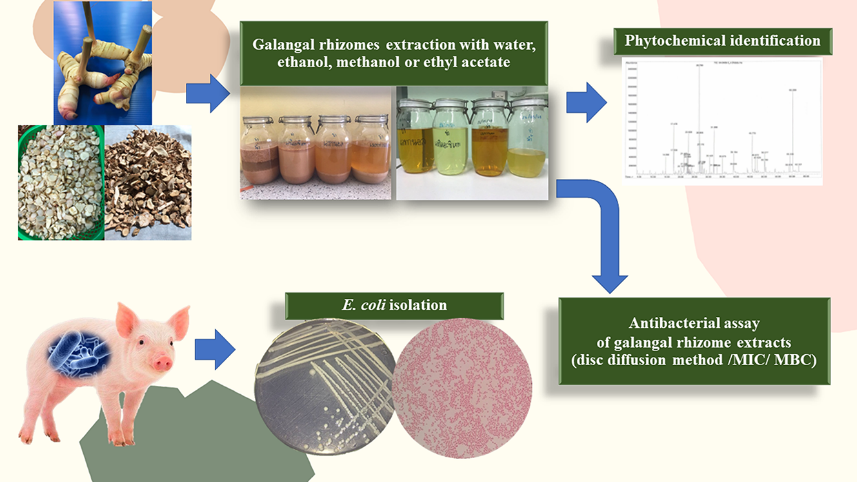
Downloads
References
JM Fairbrother, E Nadeau and CL Gyles. Escherichia coli in postweaning diarrhea in pigs: An update on bacterial types, pathogenesis, and prevention strategies. Anim. Health Res. Rev. 2005; 6, 17-39.
TPV Boeckel, C Brower, M Gilbert, BT Grenfell, SA Levin, TP Robinson, A Teillant and R Laxminarayan. Global trends in antimicrobial use in food animals. Proc. Natl. Acad. Sci. Unit. States Ame. 2015; 112, 5649-54.
RG Supar and BE Patten. Antimicrobial drug resistance in enterotoxigenic Escherichia coli K88, K99, F41 and 987P isolated from piglets in Indonesia. Penyakit Hewan 1990; 22, 13-9.
LL Founou, RC Founou and SY Essack. Antibiotic resistance in the food chain: A developing country-perspective. Front. Microbiol. 2016; 6, 1881-87.
CH Richter, B Custer, JA Steele, BA Wilcox and J Xu. Intensified food production and correlated risks to human health in the greater Mekong subregion: A systematic review. Environ. Health 2015; 14, 43.
BA Walther, C Boëte, A Binot, Y By, J Cappelle, J Carrique-Mas, M Chou, N Furey, S Kim, C Lajaunie, S Lek, P Meral, M Neang, BH Tan, C Walton and S Morand. Biodiversity and health: Lessons and recommendations from an interdisciplinary conference to advise Southeast Asian research, society and policy. Infect. Genet. Evol. 2016; 40, 29-46.
S Chowdhury, MM Hassan, M Alam, S Sattar, MS Bari, A Saifuddin and MA Hoque. Antibiotic residues in milk and eggs of commercial and local farms at Chittagong, Bangladesh. Vet. World 2015; 8, 467-71.
J Parekh, D Jadeja and S Chanda. Efficacy of aqueous and methanol extracts of some medicinal plants for potential antibacterial activity. Turk. J. Biol. 2005; 29, 203-10.
D Zhang, RY Gan, AK Farha, G Kim, OO Yang, XM Shi, CL Shi, QX Luo, XB Xu, HB Li and H Corke. Discovery of antibacterial dietary spices that target antibiotic-resistant bacteria. Microorganisms 2019; 7, 157.
SF Nabavi, AD Lorenzo, M Izadi, E Sobarzo-Sanchez, M Daglia and SM Nabavi. Antibacterial effects of cinnamon: From farm to food, cosmetic and pharmaceutical industries. Nutrients 2015; 7, 7729-48.
P Gupta, P Bhatter, D D’souza, M Tolani, P Daswani, P Tetali and T Birdi. Evaluating the anti-Mycobacterium tuberculosis activity of Alpinia galanga (L.) Willd. Axenically under reducing oxygen conditions and in intracellular assays. BMC Compl. Med. Ther. 2014; 14, 84.
T Juntachote, E Berghofer, S Siebenhandl and F Bauer. The antioxidative properties of Holy basil and Galangal in cooked ground pork. Meat Sci. 2006; 72, 446-56.
AR Khairullah, TI Solikhah, ANM Ansori, A Fadholly, SC Ramandinianto, R Ansharieta, A Widodo, KHP Riwu, N Putri, A Proboningrat, M Khaliim J Kusala, BW Rendragraha, A Rozaqi S Putra and A Anshori. A Review of an important medicinal plant Alpinia galanga (L.) Willd. Syst. Rev. Pharm. 2020; 11, 387-95.
H Itokawa, H Morita, T Sumitomo, N Totsuka and K Takeya. Antitumour principles from Alpinia galanga. Planta Med. 1987; 53, 32-3.
H Matsuda, T Morikawa, H Managi and M Yoshikawa. Antiallergic principles from Alpinia galanga: Structural requirements of phenylproponoids for inhibition of degranulation and release of TNF-α and lL-4 in RBL-2H3 cells. Bioorg. Med. Chem. Lett. 2003; 13, 3197-202.
S Mitsui, S Kobayashi, H Nagahori and A Ogiso. Constituents from seeds of Alpinia galanga wild and their anti-ulcer activities. Chem. Pharmaceut. Bull. 1976; 24, 2377-82.
AM Janssen and JJC Scheffer. Acetoxychavicol acetate, an antifungal component of Alpinia galanga. Planta Med. 1985; 6, 507-11.
H Elyani and R Risandiansyah. Antibacterial potential of four herbal plants (Syzygium cumini, Piper ornatum, Anredera cordifolia, and Alpinia galangan) against Staphylococcus aureus and Escherichia coli. J. Islam. Med. Res. 2017; 1, 26-33.
MF Alajmi, RA Mothana, AJ Al-Rehaily and JM Khaled. Antimycobacterial activity and safety profile assessment of Alpinia galanga and Tinospora cordifolia. Evid. Base. Compl. Alternative Med. 2018; 2018, 2934583.
Y Ye and B Li. 1’S-1’-Acetoxychavicol acetate isolated from Alpinia galangal inhibits human immunodeficiency virus type 1 replication by blocking Rev transport. J. Gen. Virol. 2006; 87, 2047-53.
H Al-Adhroey, ZM Nor, HM Al-Mekhlafi and R Mahmud. Median lethal dose, antimalarial activity, phytochemical screening and radical scavenging of methanolic Languas galanga rhizome extract. Molecules 2010; 15, 8366-76.
R Verma, G Mishra, P Singh, K Jha and R Khosa. Alpinia galanga-an important medicinal plant: A review. Der Pharmacia Sin. 2011; 2, 142-54.
GR Shetty and S Monisha. Pharmacology of an endangered medicinal plant Alpinia galanga-a review. Res. J. Pharmaceut. Biol. Chem. Sci. 2015; 6, 499-511.
SB Sanusi, A Bakar, M Fadzelly, M Mohamed, SF Sabran and MM Mainasara. Southeast asian medicinal plants as a potential source of antituberculosis agent. Evid. Base. Compl. Alternative Med. 2017; 2017, 7185649.
AM Paruch and T Mæhlum. Specific features of Escherichia coli that distinguish it from coliform and thermotolerant coliform bacteria and define it as the most accurate indicator of faecal contamination in the environment. Ecol. Indicat. 2012; 23, 140-2.
D Boonkusol. Effects of herb extracts on mortality of goat strongyles larva. Prawarun Agr. J. 2017; 14, 208-16.
D Boonkusol and W Tongbai. Antimicrobial activity of ethnotraditional herb extracts against coagulase-negative staphylococci (CNS) isolated from dairy cows with mastitis in Lopburi province, Thailand. Ann. Rom. Soc. Cell Biol. 2021; 25, 1145-53.
I Wiegand, K Hilpert and RE Hancock. Agar and broth dilution methods to determine the minimal inhibitory concentration (MIC) of antimicrobial substances. Nat. Protocol. 2008; 3, 163-75.
National Committee for Clinical Laboratory Standards. Performance standard for antimicrobial disk and dilution susceptibility test for bacteria isolated from animals and humans. National Committee for Clinical Laboratory Standards, Pennsylvania, 1997, p. 212-25.
JY Choi, NK Lee, YY Wang, JP Hong, SR Son, DH Gu, DS Jang and JH Choi. 1’-Acetoxyeugenol acetate isolated from Thai ginger induces apoptosis in human ovarian cancer cells by ROS production via NADPH oxidase. Antioxidants 2022; 11, 293.
AJ Oonmetta, T Suzuki, P Gasaluck and G Eumkeb. Antimicrobial properties and action of galanga (Alpinia galanga Linn.) on Staphylococcus aureus. LWT 2006; 39, 1214-20.
A Chouni and S Paul. A review on phytochemical and pharmacological potential of Alpinia galanga. Phcog. J. 2018; 10, 9-15.
TA Malik, AN Kamili, MZ Chishti, S Ahad, MA Tantry, PR Hussain and RK Johri. Breaking the resistance of Escherichia coli: Antimicrobial activity of Berberis lycium Royle. Microb. Pathog. 2017; 102, 12-20.
WY Hsu, A Simonne, A Weissman and JM Kim. Antimicrobial activity of greater galanga [Alpinia galanga (Linn.) Swartz.] flowers. Food Sci. Biotechnol. 2010; 19, 873-80.

Downloads
Published
How to Cite
Issue
Section
License
Copyright (c) 2023 Walailak University

This work is licensed under a Creative Commons Attribution-NonCommercial-NoDerivatives 4.0 International License.





