
Mechanistic Insights into Adsorption of Methylene Blue and Methyl Orange Using Cassava Rhizome Activated Carbon: Adsorption, Characterization and Reusability
DOI:
https://doi.org/10.48048/tis.2025.10751Keywords:
Cassava rhizome-activated carbon, Methylene blue and methyl orange dyes, Adsorption, Mechanism, ReusabilityAbstract
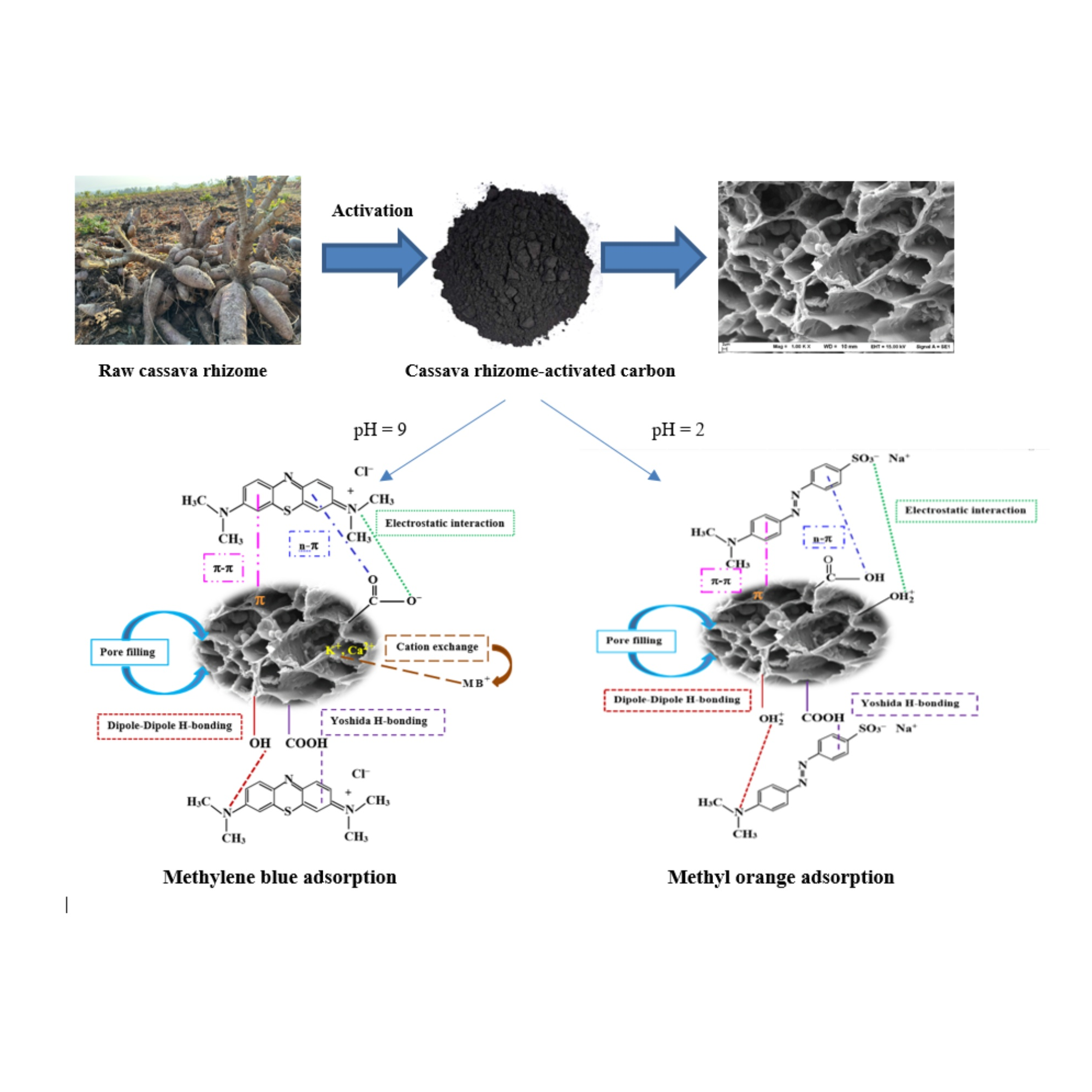
This study produced activated carbon from residual cassava rhizome using H3PO4 activation at 500 °C. The adsorbent was characterized via nitrogen adsorption-desorption, Fourier transform infrared spectroscopy, X-ray fluorescence spectroscopy, X-ray diffraction spectroscopy and scanning electron microscopy. Adsorption of methylene blue and methyl orange was examined using the batch method, with influencing factors including pH, contact time, initial dye concentration, and temperature. Optimal adsorption occurred at pH 9 and 360 min for methylene blue and pH 2 and 240 min for methyl orange. The Langmuir isotherm best described the adsorption behavior, yielding maximum capacities of 29.154 and 28.736 mg/g at 30 °C, respectively. Kinetic analysis confirmed the pseudo-second-order model for both dyes, while thermodynamic evaluation indicated an endothermic and spontaneous process at higher temperatures. Adsorption mechanisms involved Yoshida hydrogen bonding, dipole-dipole hydrogen bonding, n-π and π-π interactions, electrostatic interactions, ion exchange and pore filling. The adsorbent demonstrated efficient reusability through five cycles, employing 0.1 M HCl for methylene blue and 0.1 M NaOH for methyl orange removal. These findings suggest cassava rhizome-derived activated carbon as a cost-effective alternative for dye removal from aqueous solutions.
HIGHLIGHTS
- The cassava rhizome, classified as waste agricultural biomass, serves as the activated carbon for the adsorbent.
- Cassava rhizome-activated carbon demonstrates effective adsorption of dye solutions, including methylene blue (a cationic dye) and methyl orange (an anionic dye).
- Studies encompass the characterization of adsorbents, adsorption mechanisms, and reusability assessments.
GRAPHICAL ABSTRACT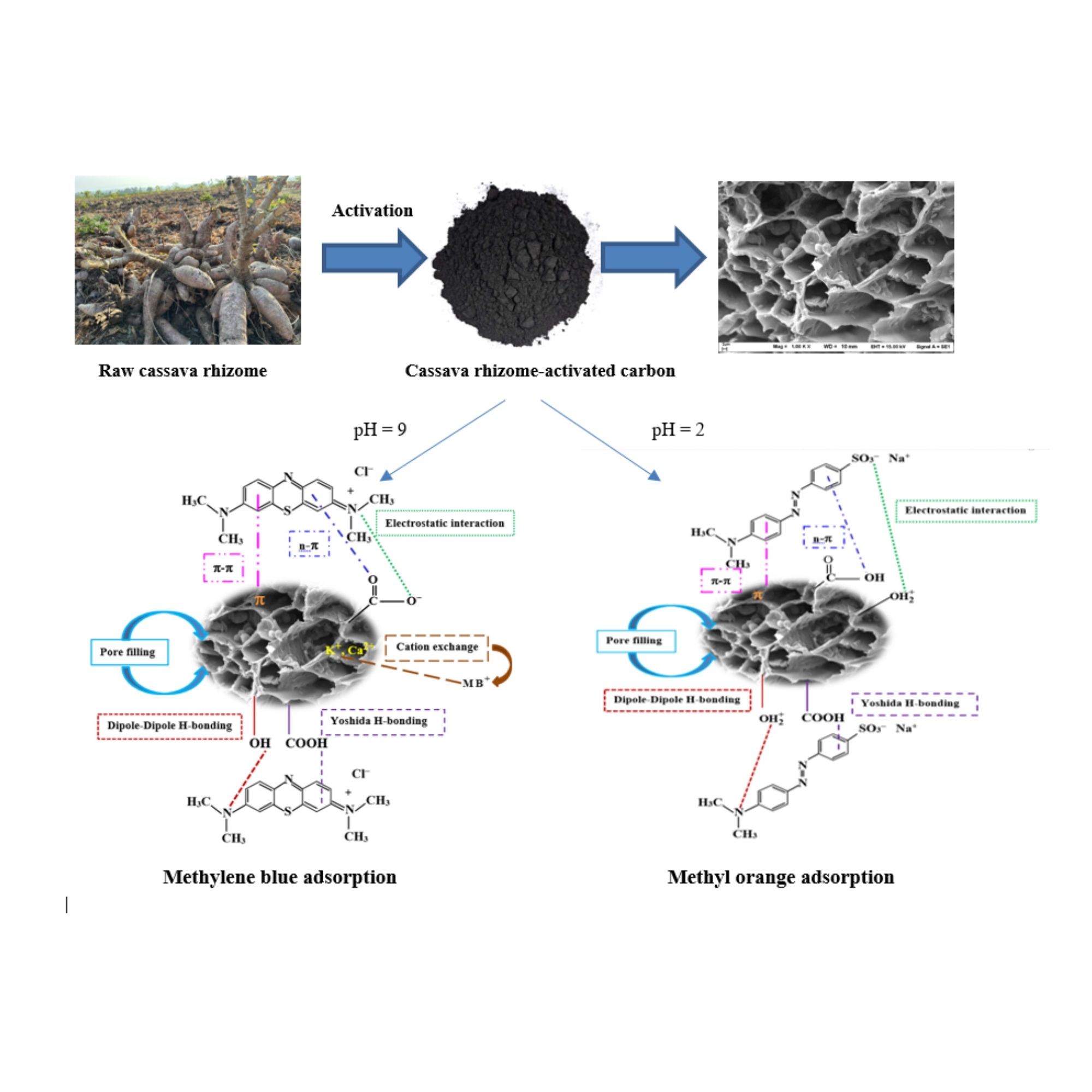
Downloads
References
NUM Nizam, MM Hanafiah, E Mahmoudi, AA Halim and AW Mohammad. The removal of anionic and cationic dyes from an aqueous solution using biomass-based activated carbon. Scientific Reports 2021; 11, 8623.
S Moosavi, CW Lai, S Gan, G Zamiri, OA Pivehzhani and MR Johan. Application of efficient magnetic particles and activated carbon for dye removal from wastewater. ACS Omega 2020; 5(33), 20684-20697.
K Kouhi, A Amouei, H Asgharnia, M Vosoughi, SH Fallah and M Shirmardi. Application of oak charcoal-based activated carbon for the removal of methylene blue dye from aqueous solutions: Kinetics, equilibrium and reusability studies. Water Practice & Technology 2023; 18(12), 3255-3270.
SP Mishra, AR Patra and S Das. Methylene blue and malachite green removal from aqueous solution using waste activated carbon. Biointerface Research in Applied Chemistry 2021; 11(1), 7410-7421.
D Dimbo, M Abewaa, E Adino, A Mengistu, T Takele, A Oro and M Rangaraju. Methylene blue adsorption from aqueous solution using activated carbon of spathodea campanulata. Results in Engineering 2024; 21, 101910.
GV Serban, VI Iancu, C Dinu, A Tenea, N Vasilache, I Cristea, M Niculescu, I Ionescu and FL Chiriac. Removal efficiency and adsorption kinetics of methyl orange from wastewater by commercial activated carbon. Sustainability 2023; 15(17), 12939.
J Fito, M Abewaa, A Mengistu, K Angassa, AD Ambaye, W Moyo and T Nkambule. Adsorption of methylene blue from textile industrial wastewater using activated carbon developed from rumex abyssinicus plant. Scientific Reports 2023; 13(1), 5427.
MC Silva, L Spessato, TL Silva, GK Lopes, HG Zanella, JT Yokoyama, AL Cazetta and VC Almeida. H3PO4–activated carbon fibers of high surface area from banana tree pseudo-stem fibers: Adsorption studies of methylene blue dye in batch and fixed bed systems. Journal of Molecular Liquids 2021; 324, 114771.
Z Heidarinejad, MH Dehghani, M Heidari, G Javedan, I Ali, and M Sillapaa. Methods for preparation and activation of activated carbon: A review. Environmental Chemistry Letters 2020; 18, 393-415.
NS Ali, NM Jabbar, SM Alardhi, HS Majdi and TM Albayati. Adsorption of methyl violet dye onto a prepared bio-adsorbent from date seeds: Isotherm, kinetics and thermodynamic studies. Heliyon 2022; 8(8), e10276.
IH Dakhil and AH Ali. Adsorption of methylene blue dye from industrial wastewater using activated carbon prepared from agriculture wastes. Desalination and Water Treatment 2021; 216, 372-378.
SA Mousavi, D Shahbazi, A Mahmoudi and P Darvishi. Methylene blue removal using prepared activated carbon from grape wood waste: Adsorption process analysis and modeling. Water Quality Research Journal 2022; 57(1), 1-19.
S Kanyakam, W Pimpa and P Tansupo. Effects of carbonization temperature on properties of activated carbon prepared from cassava rhizome waste disposal from starch industry. International Journal of Management and Applied Science 2017; 3(12), 1-3.
J Phuriragpitikhon, K Pluamjai, W Fuangchoonuch and L Chuenchom. Conversion of cassava rhizome into efficient carbonaceous adsorbents for removal of dye in water. Earth and environmental science. In: Proceedings of the 13th IMT-GT UNINET BIOSCIENCE International Conference, Songkhla, Thailand. 2022.
YY Tan, AAA Raman, MIIZ Abidin and A Buthiyappan. Sustainable dye adsorption using novel activated carbon prepared from passion fruit (Passiflora edulis) leaf: Mechanism and cost analysis. Industrial & Engineering Chemistry Research 2023; 62(36), 14507-14521.
HN Tran, W Ya-Fen, Y Sheng-Jie and C Huan-Ping. Insights into the mechanism of cationic dye adsorption on activated charcoal: The importance of π–π interactions. Process Safety and Environmental Protection 2017; 107, 168-180.
P Chukaew, K Nakason, S Kuboon, W Kraithong, B Panyapinyopol and V Kanokkantapong. Conversion of cassava rhizome to biocrude oil via hydrothermal liquefaction. International Energy Journal 2021; 21(3), 269-280.
K Nakason, P Khemthong, W Kraithong, P Chukaew, B Panyapinyopol, D Kitkaew and P Pavasant. Upgrading properties of biochar fuel derived from cassava rhizome via torrefaction: Effect of sweeping gas atmospheres and its economic feasibility. Case Studies in Thermal Engineering 2021; 23, 100823.
V Gajendiran, P Deivasigamani, S Sivamani and PM Sivakumar. A review on cassava residues as adsorbents for removal of organic and inorganic contaminants in water and wastewater. Journal of Chemistry 2023; 2023, 7891518.
A Kurniawan, AN Kosasih, J Febrianto, YH Ju, J Sunarso, N Indraswati and S Ismadji. Evaluation of cassava peel waste as lowcost biosorbent for Ni-sorption: Equilibrium, kinetics, thermodynamics and mechanism. Chemical Engineering Journal 2011; 172(1), 158-166.
NF Al-Harby, EF Albahly and NA Mohame. Kinetics, isotherm and thermodynamic studies for efficient adsorption of congo red dye from aqueous solution onto novel cyanoguanidine-modified chitosan adsorbent. Polymers 2021; 13(24), 4446.
N Atar, A Olgun, S Wang and S Liu. Adsorption of anionic dyes on boron industry waste in single and binary solutions using batch and fixed-bed systems. Journal of Chemical & Engineering Data 2011; 56(3), 508-516.
QT Tran, TH Do, XL Ha, TTA Duang, Mn Chu, VN Vu, HD Chau, TKN Tran and P Song. Experimental design, equilibrium modeling and kinetic studies on the adsorption of methylene blue by adsorbent: Activated carbon from durian shell waste. Materials Research 2022; 15, 8566.
A Kumar, S Prasad, PN Saxena, NG Ansari and DK Patel. Synthesis of alginate-based Fe3O4-MnO2 xerogel and its application for the concurrent elimination of Cr(VI) and Cd(II) from aqueous solution. ACS Omega 2021; 6, 3931-3945.
H Li, L Liu, J Cui, F Wang and F Zhang. High-efficiency adsorption and regeneration of methylene blue and aniline onto activated carbon from waste edible fungus residue and its possible mechanism. RSC Advances 2020; 10(24), 14262-14273.
S Fu, Q Fang, A Li, Z Li, J Han, X Dang and W Han. Accurate characterization of full pore size distribution of tight sandstones by low‐temperature nitrogen gas adsorption and high‐pressure mercury intrusion combination method. Energy Science & Engineering 2021; 9(1), 80-100.
R Mansour, MG Simeda and A Zaatout. Adsorption studies on brilliant green dye in aqueous solutions using activated carbon derived from guava seeds by chemical activation with phosphoric acid. Desalination and Water Treatment 2020; 202, 396-409.
C Wen, T Liu, D Wang, Y Wang, H Chen, G Luo, Z Zhou, C Li and M Xu. Biochar as the effective adsorbent to combustion gaseous pollutants: Preparation, activation, functionalization and the adsorption mechanisms. Progress in Energy and Combustion Science 2023; 99, 101098.
SD Rangu, PP Mon, PP Cho, UR Mudadla, HS Rangappa, S Duvvuri and S Challapalli. Simultaneous and efficient adsorption of methylene blue and methyl orange by low-cost adsorbent derived from waste tire. Environmental Science and Pollution Research International 2025. https://doi.org/10.1007/s11356-025-36122-y
S Biswas and U Mishra. Effective remediation of lead ions from aqueous solution by chemically carbonized rubber wood sawdust: Equilibrium, kinetics and thermodynamic study. Journal of Chemistry 2015; 2015(3), 1-8.
M Zięzio, B Charmas, K Jedynak, M Hawryluk and K Kucio. Preparation and characterization of activated carbons obtained from the waste materials impregnated with phosphoric acid (V). Applied Nanoscience 2020; 10, 4703-4716.
J Wang, R Wang, J Ma and Y Sun. Study on the application of shell-activated carbon for the adsorption of dyes and antibiotics. Water 2022; 14(22), 3752.
AS Elkholy, MS Yahia, MA Elnwawy, HA Gomaa and AS Elzaref. Synthesis of activated carbon composited with Egyptian black sand for enhanced adsorption performance toward methylene blue dye. Scientific Reports 2023; 13(1), 4209.
A Boukir, S Fellak and P Doumenq. Structural characterization of argania spinosa Moroccan wooden artifacts during natural degradation progress using infrared spectroscopy (ATR-FTIR) and x-ray diffraction (XRD). Heliyon. 2019; 9(5), e02477.
S Hmamouchi, Y Abbad, AE Yacoubi, A Boulouiz, B Sallek and BC El Idrissi. Optimization study of methylene blue dye adsorption on Chamaerops humilis fibers biosorption using a central composite design. Desalination and Water Treatment 2024; 320, 100824.
NV Hung, BTM Nguyet, NH Nghi, NM Thanh, NDV Quyen, VT Nguyen, DN Nhiem and DQ Khieu. Highly effective adsorption of organic dyes from aqueous solutions on longan seed-derived activated carbon. Environmental Engineering Research 2022; 28(3), 220116.
DH Nguyen, HN Tran, HP Chao and CC Lin. Effect of nitric acid oxidation on the surface of hydrochars to sorb methylene blue: An adsorption mechanism comparison. Adsorption Science & Technology 2019; 37(7-8), 607-622.
AA Fakunmoju, F Azaman, A Ai and S Hamzah. Methylene blue adsorption by chemical-activated Trichanthera gigantea leaf. Water Practice & Technology 2024; 19(11), 4522-4537.
J Zhou, M Li, Y Tao and L Zha. Study on the adsorption characteristics of methylene blue by magnesium-modified fly Ash. Molecules 2025; 30(5), 992.
A Keereerak and W Chinpa. A potential biosorbent from Moringa oleifera pod husk for crystal violet adsorption Kinetics, isotherms, thermodynamic and desorption studies. Journal of the Science Society of Thailand 2020; 46, 186-194.
CA Matias, LJGGD Oliveira, R Geremias and J Stolberg.Biosorption of rhodamine B from aqueous solution using Araucaria angustifolia sterile bracts. Revista Internacional de Contaminación Ambiental 2020; 36(1), 97-104.
Q Yao, Y Peng, M Chen, Y wang, J Ding, B Ma, Q Wang, S Lu and S Lu. One-step high efficiency synthesis of zeolite from fly ash by mechanochemical method as a low-cost adsorbent for cadmium removal. Journal of Environmental Chemical Engineering 2024; 12(1), 111877.
PS Kumar. Adsorption of Zn (II) ions from aqueous environment by surface modified strychnos potatorum seeds, a low-cost adsorbent. Polish Journal of Chemical Technology 2013; 15(3), 35-41.
A Bazan-Wozniak, J Cielecka-Piontek, A Nosal-Wiercińska and R Pietrzak. Adsorption of organic compounds on adsorbents obtained with the use of microwave heating. Materials 2022; 15(16), 5664.
MA Al-Ghouti and RS Al-Absi. Mechanistic understanding of the adsorption and thermodynamic aspects of cationic methylene blue dye onto cellulosic olive stones biomass from wastewater. Scientific Reports 2020; 10(1), 15928.
R Lafi, I Montasser and A Hafiane. Adsorption of congo red dye from aqueous solutions by prepared activated carbon with oxygen-containing functional groups and its regeneration. Adsorption Science & Technology 2019; 37(1-2), 160-181.
B Souad and M Nadir. Kinetic and thermodynamic study of methyl orange dye adsorption on zinc carbonyldiphthalate, an organometallic-based material prepared with a montmorillonite clay. Iranian Journal of Chemistry and Chemical Engineering 2023; 42(1), 123-138.
C Poornachandhra, RM Jayabalakrishnan, M Prasanthrajan, G Balasubramanian, A Lakshmanan, S Selvakumar and JE John. Cellulose-based hydrogel for adsorptive removal of cationic dyes from aqueous solution: Isotherms and kinetics. RSC Advances 2023; 13(7), 4757-4774.
M Turabık and B Gozmen. Removal of basic textile dyes in single and multi‐dye solutions by adsorption: Statistical optimization and equilibrium isotherm studies. CLEAN–Soil, Air, Water 2013; 41(11), 1080-1092.
J Phuriragpitikhon, K Pluamjai, W Fuangchoonuch and L Chuenchom. Conversion of cassava rhizome into efficient carbonaceous adsorbents for removal of dye in water. Earth and Environmental Science. In: Proceedings of the 13th IMT-GT UNINET BIOSCIENCE International Conference, Songkhla, Thailand. 2022.
M Ibrahim, M Souleiman and A Salloum. Methylene blue dye adsorption onto activated carbon developed from Calicotome villosa via H3PO4 activation. Biomass Conversion and Biorefinery 2023; 13, 12763-12776.
RH Khuluk, A Rahmat, Buhani and Suharso. Removal of methylene blue by adsorption onto activated carbon from coconut shell (Cocos nucifera L.). Indonesian Journal of Science and Technology 2019; 4(2), 229-240.
AK Anas, A Izzah, SY Pratama and FI Fajarwati. Removal of methylene blue using biochar from cassava peel (Manihot utilissima) modified by sodium dodecyl sulphate (SDS) surfactant. AIP Conference Proceedings 2020; 2229(1), 030024.
IGAK Suriadi, DNKP Negara, TGT Nindhia, IKA Atmika, IMDB Penindra and IMG Karohika. The Impact of activation heating rate on pore structure in Teak Sawdust-Derived activated carbon and its application in methylene blue adsorption. Trends in Sciences 2024; 21(9), 8110.
Y Dai and J Li. Adsorption behavior of methyl orange and methylene blue onto carbon material in aqueous solution. Desalination and Water Treatment 2020; 180, 387-397.
EHEL Khattabi, Y Rachdi, R Bussam, EH Mourid, Y Naimi, MEL Alouani and S Belaaouada. Enhanced elimination of methyl orange and recycling of an eco-friendly adsorbent activated carbon from aqueous solution. Russian Journal of Physical Chemistry B 2021; 15, S149-S159.
M El-Gamal, FM Mohamed, MA Mekewi, FS Hashem, MR El-Aassar and RE Khalifa. Adsorptive removal of Methyl orange from aqueous solutions by polyvinylidene fluoride tri-fluoro ethylene/carbon nanotube/kaolin nanocomposite: Kinetics, isotherm and thermodynamics. Desalination and Water Treatment 2020; 193, 142-151.
AA Hambisa, MB Regasa, HG Ejigu and CB Senbeto. Adsorption studies of methyl orange dye removal from aqueous solution using Anchote peel-based agricultural waste adsorbent. Applied Water Science 2023; 13, 24.
C Diaz-Uribe, J Ortiz, F Duran, W Vallejo and J Fals. Methyl orange adsorption on biochar obtained from Prosopis juliflora waste: Thermodynamic and kinetic study. ChemEngineering 2023; 7, 114.
AJ Jadhav and C Srivastava. Adsorbed solution theory based modeling of binary adsorption of nitrobenzene, aniline and phenol onto granulated activated carbon. Chemical Engineering Journal 2013; 229, 450-459.
Published
How to Cite
Issue
Section
License
Copyright (c) 2025 Walailak University

This work is licensed under a Creative Commons Attribution-NonCommercial-NoDerivatives 4.0 International License.





