
Spatiotemporal Analysis of Southeast Asian Lower Atmosphere using Historical Radiosonde Data
DOI:
https://doi.org/10.48048/tis.2023.6190Keywords:
Southeast Asian Lower Atmosphere, Radiosonde Data, Model Parameterization, Spatial Classification, Climate Variability, Transient SystemAbstract
This study utilized historical radiosonde data from 37 selected WMO stations to analyze the physical properties of Southeast Asian lower atmosphere in both spatial and temporal regimes. The proposed analysis method includes the estimation of static atmospheric parameters and their correlations, the trend analysis from the parameters’ time series, and the extraction of annual and interannual variations from the detrended parameters’ time series. The vertical structure analysis of temperature and pressure “profiles” (i.e., temperature and pressure as functions of altitude at a given time) shows that their residuals from the isentropic atmosphere are altitude-dependent and predictable. The correlation analysis between estimated parameters shows that the heat capacity ratio is a function of the environmental lapse rate, which can be used in the parameterization of the atmospheric model. The molar mass of the Southeast Asian lower atmosphere was also estimated from the parameterization to be 29.65 g/mol, slightly higher than that of the average value of dry air at 28.97 g/mol. The spatial analysis of their average values indicates that the Southeast Asian lower atmosphere can be zonally classified into the Northern Equatorial Subregion (NES) and Central Equatorial Subregion (CES), where their boundary is located between the latitude of 5° N to 10° N. The trend analysis of each parameter’s time series suggests that the Southeast Asian lower atmosphere is a transient system manipulated by climate oscillations and climate change. Their equilibrium values can be estimated using linear regression analysis. The results from the Lomb-Scargle periodogram analysis also suggest that the annual variation originated from the Brewer-Dobson Circulation (BDC) and the interannual variation was manipulated by climate oscillations such as the Quasi-biennial Oscillation (QBO). This knowledge can be used to adjust the isentropic model to suit applications requiring accurate approximation, parameterize the model without sacrificing accuracy, and study the effect of climate oscillations and climate change on the Southeast Asian lower atmosphere.
HIGHLIGHTS
- Time series of Southeast Asian lower atmosphere’s physical parameters were estimated from historical radiosonde data
- Southeast Asian lower atmosphere can be classified into Northern and Central Equatorial Subregions based on physical parameters
- Southeast Asian lower atmosphere is a transient system manipulated by climate oscillations and climate change
GRAPHICAL ABSTRACT 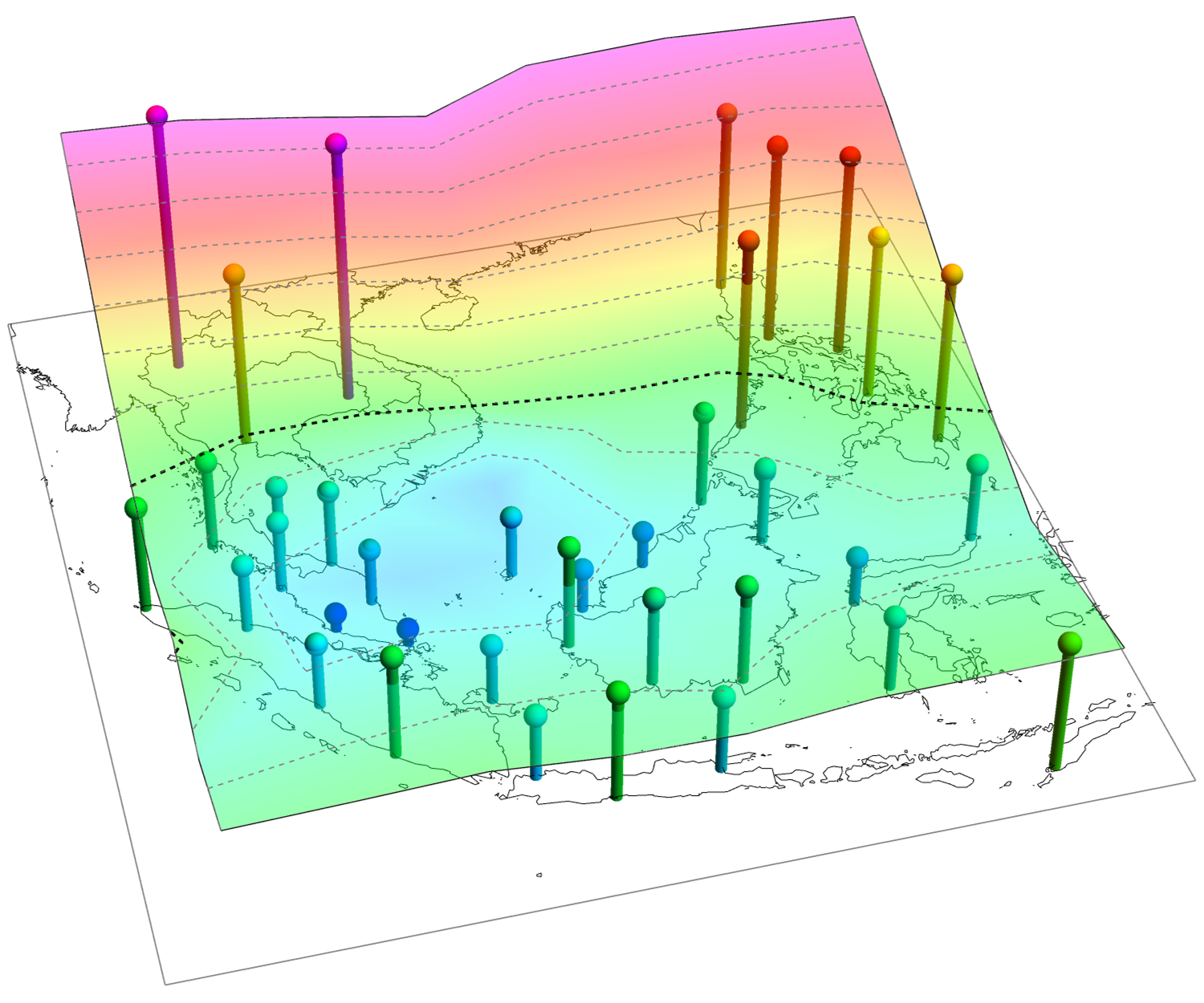
Downloads
References
G Zängl and KP Hoinka. The tropopause in the polar regions. J. Clim. 2001; 14, 3117-39.
WJ Randel, F Wu and W Rivera Rios. Thermal variability of the tropical tropopause region derived from GPS/MET observations. J. Geophys. Res. 2003; 108, 1-12.
J Kim and SW Son. Tropical cold-point tropopause: Climatology, seasonal cycle, and intraseasonal variability derived from COSMIC GPS radio occultation measurements. J. Clim. 2012; 25, 5343-60.
T Rieckh, B Scherllin-Pirscher, F Ladstädter and U Foelsche. Characteristics of tropopause parameters as observed with GPS radio occultation. Atmos. Meas. Tech. 2014; 7, 3947-58.
LL Pan, SB Honomichl, TV Bui, T Thornberry, A Rollins, E Hintsa and EJ Jensen. Lapse rate or cold point: The tropical tropopause identified by in situ trace gas measurements. Geophys. Res. Lett. 2018; 45, 10756-63.
HW Lewis. A robust method for tropopause altitude identification using GPS radio occultation data. Geophys. Res. Lett. 2009; 36, L12808.
T Schmidt, J Wickert and A Haser. Variability of the upper troposphere and lower stratosphere observed with GPS radio occultation bending angles and temperatures. Adv. Space Res. 2010; 46, 150-61.
RA Anthes. Exploring earth’s atmosphere with radio occultation: Contributions to weather, climate and space weather. Atmos. Meas. Tech. 2011; 4, 1077-103.
AK Steiner, BC Lackner, F Ladstädter, B Scherllin-Pirscher, U Foelsche and G Kirchengast. GPS radio occultation for climate monitoring and change detection. Radio Sci. 2011; 46, RS0D24.
DJ Seidel and WJ Randel. Variability and trends in the global tropopause estimated from radiosonde data. J. Geophys. Res. 2006; 111, D21101.
BD Santer, S Solomon, FJ Wentz, Q Fu, S Po-Chedley, C Mears, JF Painter and C Bonfils. Tropospheric warming over the past two decades. Sci. Rep. 2017; 7, 2336.
L Meng, J Liu, DW Tarasick, WJ Randel, AK Steiner, H Wilhelmsen, L Wang and L Haimberger. Continuous rise of the tropopause in the northern hemisphere over 1980-2020. Sci. Adv. 2021; 7, eabi8065.
BD Santer, TML Wigley, AJ Simmons, PW Kallberg, GA Kelly, SM Uppala, C Ammann, JS Boyle, W Bruggemann, C Doutriaux, M Fiorino, C Mears, GA Meehl, R Sausen, KE Taylor, WM Washington, MF Wehner and FJ Wentz. Identification of anthropogenic climate change using a second-generation reanalysis. J. Geophys. Res. 2004; 129, D21104.
T Schmidt, J Wickert, G Beyerle and S Heise. Global tropopause height trends estimated from GPS radio occultation data. Geophys. Res. Lett. 2008; 35, L11806.
G Gu and RF Adler. Precipitation and temperature variations on the interannual time scale: Assessing the impact of ENSO and volcanic eruptions. J. Clim. 2011; 24, 2258-70.
B Scherllin-Pirscher, C Deser, SP Ho, C Chou, W Randel and YH Kuo. The vertical and spatial structure of ENSO in the upper troposphere and lower stratosphere from GPS radio occultation measurements. Geophys. Res. Lett. 2012; 39, L20801.
I Durre, X Yin, RS Vose, S Applequist and J Arnfield. Enhancing the data coverage in the integrated global radiosonde archive. J. Atmos. Ocean. Technol. 2018; 35, 1753-70.
K Wolter and MS Timlin. El Nino/Southern Oscillation behavior since 1871 as diagnosed in an extended multivariate ENSO index (MEI.ext). Int. J. Climatol. 2011; 31, 1074-87.
HM van den Dool, S Saha and Å Johansson. Empirical orthogonal teleconnections, J. Clim. 2000; 13, 1421-35.
BD Santer, S Solomon, G Pallotta, C Mears, S Po-Chedley, Q Fu, F Wentz, C Zou, J Painter, I Cvijanovic and C Bonfils. Comparing tropospheric warming in climate models and satellite data. J. Clim. 2017; 30, 373-92.
RS Lindzen. An oversimplified picture of the climate behavior based on a single process can lead to distorted conclusions. Eur. Phys. J. Plus 2020; 135, 462.
S Miller. Applied thermodynamics for Meteorologists. Cambridge University Press, 2015.
M Ambaum. Thermal Physics of the Atmosphere. Wiley-Blackwell, 2010.
JT VanderPlas. Understanding the Lomb-Scargle periodogram. Astrophys. J. Suppl. Ser. 2018; 236, 16.
NI Fisher and PK Sen. Hoeffding’s independence test. In: NI Fisher and PK Sen (Eds.). The collected works of Wassily Hoeffding. Springer, 1994, p. 628-29.
E Yulaeva, JR Holton and JM Wallace. On the cause of the annual cycle in tropical lower-stratospheric temperatures. J. Atmos. Sci. 1994; 51, 169-74.
MF Stuecker, FF Jin and A Timmermann. El Niño-Southern Oscillation frequency cascade. Proc. Natl. Acad. Sci. 2015; 112, 13490-5.
JT Bruun, J Icarus Allen and TJ Smyth. Heartbeat of the Southern Oscillation explains ENSO climatic resonances. J. Geophys. Res. Oceans 2017; 122, 6746-72.
Y Feliks, J Small and M Ghil. Global oscillatory modes in high‑end climate modeling and reanalyses. Clim. Dyn. 2021; 57, 3385-411.
M Shangguan, W Wang and S Jin. Variability of temperature and ozone in the upper troposphere and lower stratosphere from multi-satellite observations and reanalysis data. Atmos. Chem. Phys. 2019; 19, 6659-79.
P Keckhut, C Cagnazzo, M-L Chanin, C Claud and A Hauchecorne. The 11-year solar-cycle effects on the temperature in the upper-stratosphere and mesosphere: Part I-Assessment of observations. J. Atmos. Sol. Terr. Phys. 2005; 67, 940-7.
D Shindell, D Rind, N Balachandran, J Lean and P Lonergan. Solar cycle variability, ozone, and climate. Science 1999; 67, 940-7.
WB White and Z Liu. Resonant excitation of the quasi-decadal oscillation by the 11-year signal in the Sun’s irradiance. J. Geophys. Res. Oceans 2008; 113, C01002.
GA Meehl, JM Arblaster, K Matthes, F Sassi and H van Loon. Amplifying the pacific climate system response to a small 11-year solar cycle forcing. Science 2009; 325, 1114-8.
S Misios, DM Mitchell, LJ Gray, K Tourpali, K Matthes, L Hood, H Schmidt, G Chiodo, R Thiéblemont, E Rozanov and A Krivolutsky. Solar signals in CMIP-5 simulations: Effects of atmosphere-ocean coupling. Q. J. R. Meteorol. Soc. 2016; 142, 928-41.

Downloads
Published
How to Cite
Issue
Section
License
Copyright (c) 2022 Walailak University

This work is licensed under a Creative Commons Attribution-NonCommercial-NoDerivatives 4.0 International License.





