
Spatial Classification of Diurnal Precipitation Cycle in the Tropical and Subtropical Regions Based on the Circular Statistical Analysis
DOI:
https://doi.org/10.48048/tis.2026.12518Keywords:
Precipitation, Diurnal Cycle, Circular Statistics, Spatial Classification, Tropical Climate, Rainfall Variability, Satellite Observation, Precipitation, Diurnal cycle, Circular statistics, Spatial classification, Tropical climate, Rainfall variability, Satellite observationAbstract
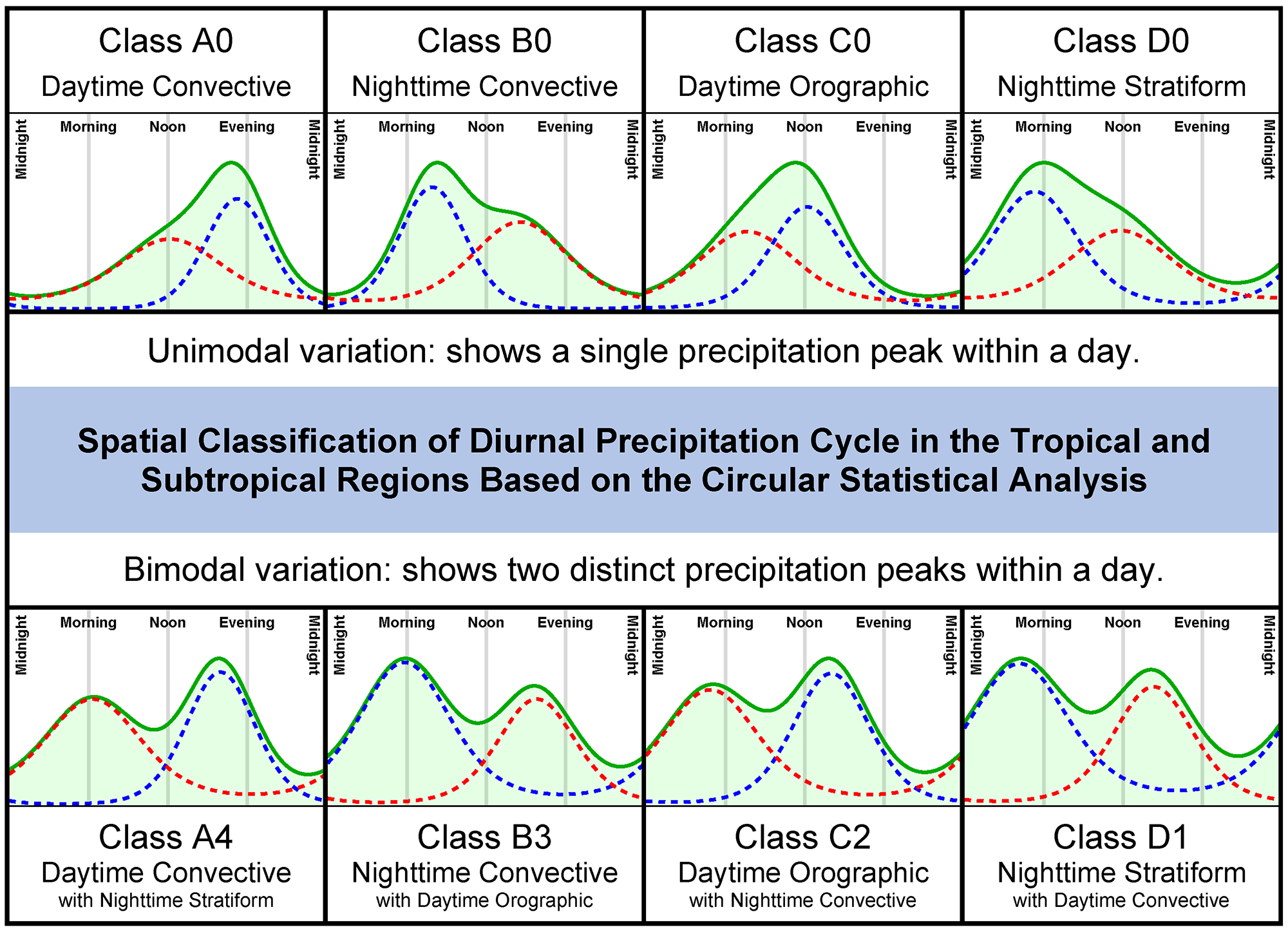
The impact of climate and weather on human existence is of utmost importance, as it shapes several aspects, such as human evolution, migration patterns, and social progress. Observing and comprehending precipitation patterns, especially the diurnal cycle, are imperative for effectively managing everyday activities. This study thoroughly examines diurnal precipitation patterns in tropical and subtropical regions through the utilization of a parametric approach based on the bimodal von Mises distribution. The research effectively creates a spatial classification criterion for diurnal precipitation, offering a simple but helpful tool for meteorological and climatological investigations. It helps identify the spatial extents of convective and stratiform precipitations and reveals the physical mechanisms behind the precipitation, such as over the complex mountaintop terrains. The user-friendliness and capacity to elucidate the bimodal characteristics of diurnal precipitation patterns also render this criterion a significant asset for academia and practitioners.
HIGHLIGHTS
- Introduces a circular statistical framework using the bimodal von Mises distribution to model diurnal precipitation patterns across tropical and subtropical regions.
- Demonstrates that the proposed method effectively captures both unimodal and bimodal rainfall variations, outperforming traditional harmonic approaches, particularly in representing asymmetric or dual-peak behaviors.
- Provides a spatial classification of diurnal precipitation into classes covering convective, orographic, and stratiform regimes, revealing clear land–ocean and topographic contrasts.
- Shows that continental regions exhibit afternoon and evening convective peaks, while oceanic areas are dominated by nocturnal and early-morning stratiform rainfall.
- Offers a quantitative tool for climatological and hydrological applications, supporting improved weather prediction, water-resource management, and climate-resilience planning.
GRAPHICAL ABSTRACT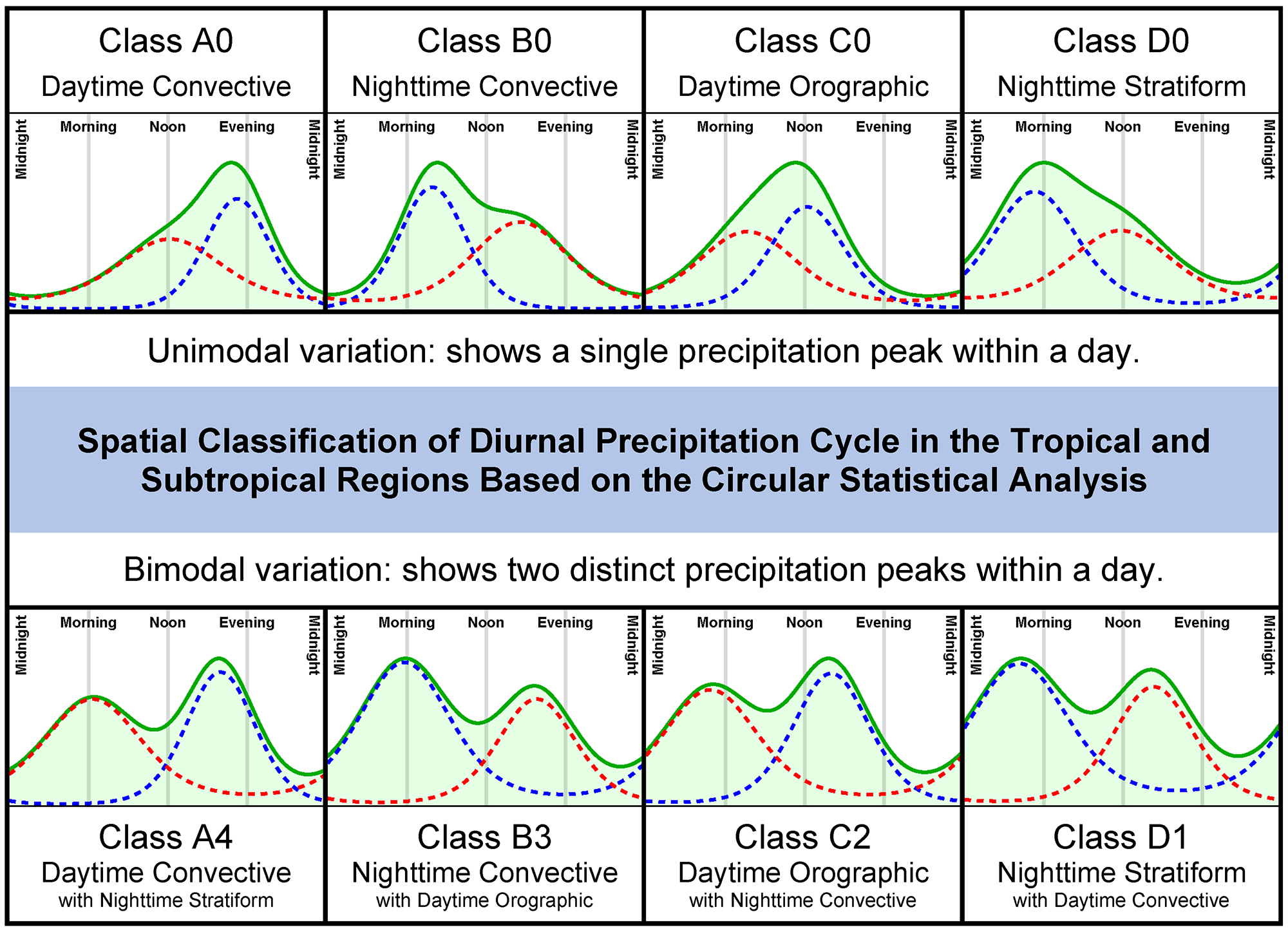
Downloads
References
GR McGregor and S Nieuwolt. Tropical climatology: An introduction to the climates of the low latitudes. 2nd ed. John Wiley & Sons, Chichester, 1998.
RG Barry and RJ Chorley. Atmosphere, weather and climate. 9th ed. Routledge, New York, 2010.
P Koad and K Jaroensutasinee. Annual cycle of tropical and subtropical precipitation estimated from TMPA 3B42 dataset. Asia-Pacific Journal of Atmospheric Sciences 2021; 57, 235-260.
T Chen, G Xia, LT Wilson, W Chen and D Chi. Trend and cycle analysis of annual and seasonal precipitation in Liaoning, China. Advances in Meteorology 2016; 2016, 5170563.
M Gehne, TM Hamill, GN Kiladis and KE Trenberth. Comparison of global precipitation estimates across a range of temporal and spatial scales. Journal of Climate 2016; 29(21), 7773-7795.
M Rusticucci and O Penalba. Interdecadal changes in the seasonal precipitation cycle over southern South America and their relationship with surface temperature. Climate Research 2000; 16(1), 1-15.
MF Rios Gaona and G Villarini. Characterization of the diurnal cycle of maximum rainfall in tropical cyclones. Journal of Hydrology 2018; 564, 997-1007.
S Tang, P Gleckler, S Xie, J Lee, M Ahn, C Covey and C Zhang. Evaluating the diurnal and semidiurnal cycle of precipitation in CMIP6 models using satellite- and ground-based observations. Journal of Climate 2021; 34(8), 3189-3210.
P Bechtold, JP Chaboureau, A Beljaars, AK Betts, M Köhler, M Miller and JL Redelsperger. The simulation of the diurnal cycle of convective precipitation over land in a global model. Quarterly Journal of the Royal Meteorological Society 2004; 130(604), 3119-3137.
S Ogino, DM Yamanaka, S Mori and J Matsumoto. Tropical coastal dehydrator in global atmospheric water circulation. Geophysical Research Letters 2017; 44(22), 11636-11643.
T Ohsawa, H Ueda, T Hayashi, A Watanabe and J Matsumoto. Diurnal variations of convective activity and rainfall in tropical Asia. Journal of the Meteorological Society of Japan 2001; 79(1), 333-352.
S Yang and EA Smith. Convective–stratiform precipitation variability at seasonal scale from 8 yr of TRMM observations: Implications for multiple modes of diurnal variability. Journal of Climate 2008; 21(16), 4087-4114.
H He and F Zhang. Diurnal variations of warm-season precipitation over Northern China. Monthly Weather Review 2010; 138(4), 1017-1025.
S Sugimoto, K Ueno, H Fujinami, T Nasuno, T Sato and HG Takahashi. Cloud-resolving-model simulations of nocturnal precipitation over the Himalayan slopes and foothills. Journal of Hydrometeorology 2021; 22(12), 3171-3188.
R Yu, J Li, H Chen and W Yuan. Progress in studies of the precipitation diurnal variation over contiguous China. Journal of Meteorological Research 2014; 28, 877-902.
S Yang and EA Smith. Mechanisms for diurnal variability of global tropical rainfall observed from TRMM. Journal of Climate 2006; 19(20), 5190-5226.
P Koad, S Somchuea, J Weekaew and J Kongsen. Spatiotemporal analysis of Southeast Asian lower atmosphere using historical radiosonde data. Trends in Sciences 2023; 20(1), 6190.
F Dong, X Zhi, S Zhu, L Zhang, F Ge, Y Fan, Y Lyu, J Wang and K Fraedrich. Principal modes of diurnal cycle of rainfall over South China during the presummer rainy season. Journal of Climate 2023; 36(8), 2457-2470.
F Dong, X Zhi, L Zhang and C Ye. Diurnal variations of coastal boundary layer jets over the northern South China Sea and their impacts on the diurnal cycle of rainfall over southern China during the early-summer rainy season. Monthly Weather Review 2021; 149(10), 3341-3363.
TT Warner, BE Mapes and M Xu. Diurnal patterns of rainfall in northwestern South America. Part II: Model simulations. Monthly Weather Review 2003; 131(5), 813-829.
H Bai, G Deranadyan, C Schumacher, A Funk, C Epifanio, A Ali, E Endarwin, F Radjab, R Adriyanto, N Nurhayati, Y Nugraha and A Fauziah. Formation of nocturnal offshore rainfall near the west coast of Sumatra: Land breeze or gravity wave? Monthly Weather Review 2021; 149(3), 715-731.
S Gao, X Cui and X Li. A modeling study of diurnal rainfall variations during the 21-day period of TOGA COARE. Advances in Atmospheric Sciences 2009; 26, 895-905.
A Dai. Global precipitation and thunderstorm frequencies. Part II: Diurnal variations. Journal of Climate 2001; 14(6), 1112-1128.
CH Sui, KM Lau, YN Takayabu and DA Short. Diurnal variations in tropical oceanic cumulus convection during TOGA COARE. Journal of the Atmospheric Sciences 1997; 54(5), 639-655.
C Liu and E Zipser. Diurnal cycles of precipitation, clouds, and lightning in the tropics from 9 years of TRMM observations. Geophysical Research Letters 2008; 35(4), 04819.
GJ Huffman, DT Bolvin, EJ Nelkin, DB Wolff, RF Adler, G Gu, Y Hong, KP Bowman and EF Stocker. The TRMM Multi-satellite Precipitation Analysis (TMPA): Quasi-global, multiyear, combined-sensor precipitation estimates at fine scales. Journal of Hydrometeorology 2007; 8(1), 38-55.
GJ Huffman, DT Bolvin, D Braithwaite, K Hsu, R Joyce, C Kidd, EJ Nelkin, S Sorooshian and J Tan. NASA Global Precipitation Measurement (GPM) Integrated Multi-Satellite Retrievals for GPM (IMERG). National Aeronautics and Space Administration, Washington DC, 2025.
A Miniak-Górecka, K Podlaski and T Gwizdałła. Using k-means clustering in Python with periodic boundary conditions. Symmetry 2022; 14(6), 1237.
M Vejmelka, P Musilek, M Palus and E Pelikan. K-means clustering for problems with periodic attributes. International Journal of Pattern Recognition and Artificial Intelligence 2009; 23(4), 721-743.
R Yu, W Yuan, J Li and Y Fu. Diurnal phase of late-night against late-afternoon of stratiform and convective precipitation in summer southern contiguous China. Climate Dynamics 2010; 35, 567-576.
YG Yang and J Slingo. The diurnal cycle in the tropics. Monthly Weather Review 2001; 129(4), 784-801.
KMR Hunt, AG Turner and RKH Schiemann. Katabatic and convective processes drive two preferred peaks in the precipitation diurnal cycle over the Central Himalaya. Quarterly Journal of the Royal Meteorological Society 2022; 148(745), 1731-1751.
JHR Jr and C Hohenegger. Diurnal circulation adjustment and organized deep convection. Ruppert and hohenegger 2018; 31(12), 4899-4916.
R Shevchenko, C Hohenegger and M Schmitt. Impact of diurnal warm layers on atmospheric convection. Journal of Geophysical Research: Atmospheres 2023; 128(14), 2022JD038473.
P Singh and V Matsumoto. Diurnal variation in summer precipitation over the central Tibetan Plateau. Journal of Geophysical Research: Atmospheres 2009; 114(20), 20107.
RA Houze Jr. Orographic effects on precipitating clouds. Reviews of Geophysics 2012; 50(1), 1001.
Published
How to Cite
Issue
Section
License
Copyright (c) 2025 Walailak University

This work is licensed under a Creative Commons Attribution-NonCommercial-NoDerivatives 4.0 International License.





