
In Vitro Propagation and Histochemical Analysis of Launaea sarmentosa (Willd.) Kuntze
DOI:
https://doi.org/10.48048/tis.2023.5729Keywords:
Tissue culture, Plant histochemistry, Micropropagation, Medicinal plant, Coastal plant, LinharnAbstract
Launaea sarmentosa (Willd.) Kuntze., an edible perennial herb, is critically considered an endangered species due to its habitat destruction. In vitro L. sarmentosa propagation was therefore conducted to preserve this plant. Two types of explants including leaf and stolon were applied to induce the multiple shoots by culturing on Murashige and Skoog (MS) medium supplemented with BA (0, 1, and 2 mg/L) and 2,4-D (0, 1, 2, and 4 mg/L). The optimal shoot induction medium for both explants was MS medium containing 2 mg/l BA (presented 100 % shoot induction). Roots were induced by various types and concentrations of auxins [1-naphthalene acetic acid (NAA), indole-3-acetic acid (IAA), and indole-3-butyric acid (IBA)]. The highest percentage of rooting (70.00 ± 11.05 %) was obtained from stolon-derived shoots on MS medium supplemented with 0.1 mg/l IAA. One-hundred percent survivability was presented after transforming plantlets into a mixture of soil, sand, and peat moss (1:1:1). Starch, protein, and lipid were accumulated in leaves detected by histochemical technique. The obtained information will be a useful tool for mass propagation of L. sarmentosa and to obtain basic knowledge for plant accumulating substances.
HIGHLIGHTS
- This paper highlights 2 types of sarmentosa explant including leaves and stolons have great potential to produce multiple shoots after inoculation in MS medium adding BA. All regenerated plants get success for acclimatization and transplantation to the greenhouse. In vitro plantlets of L. sarmentosa leaves accumulated fat, protein and carbohydrate which might be related with precursor of medicinal properties
GRAPHICAL ABSTRACT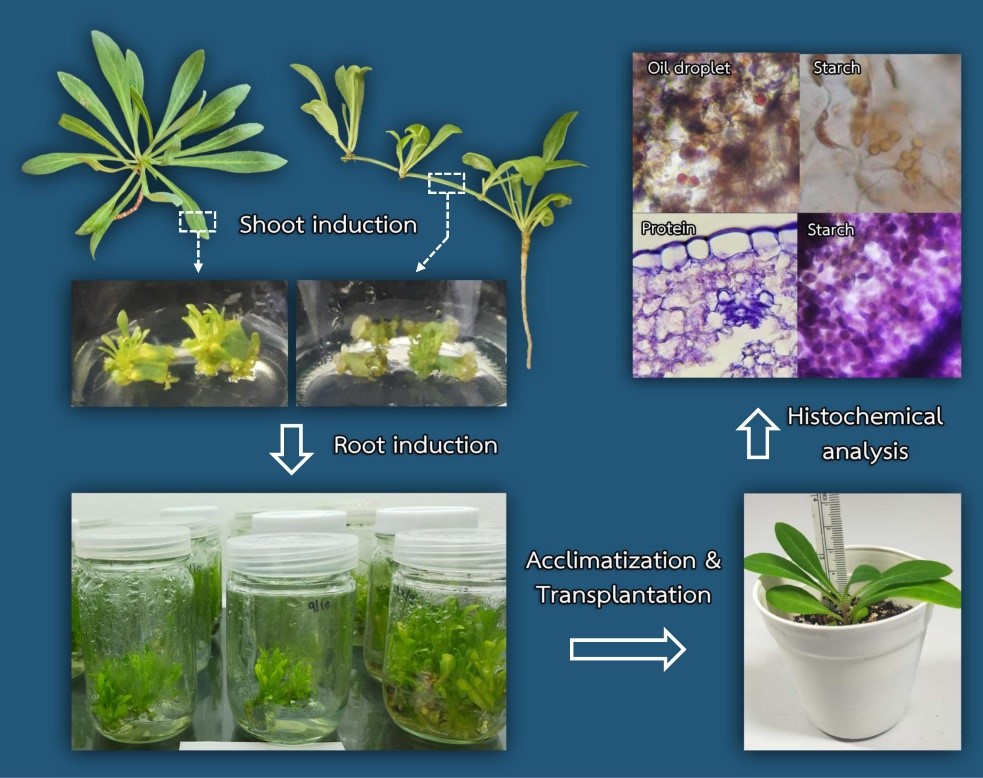
Downloads
References
H Koyama, S Bunwong, P Pornpongrungrueng and DJN Hind. Flora of Thailand. Vol 13. Part 2. The Forest Herbarium, Royal Forest Department, Bangkok, 2016, p. 349-350.
L Llorens, L Gil and H Boira. Reproductive biology of Launaea cervicornis: A key stone species of the Balearic coastal shrublands. Flora Morphol. Distribution Funct. Ecol. Plants 2009; 204, 456-62.
AB Cheriti, M Belboukhari, N Belboukhari and H Djeradi. Phytochemical and biological studies on Launaea Cass. Genus (Asteraceae) from Algerian Sahara. Curr. Top. Phytochem. 2012; 11, 67-80.
GS Raju, MR Moghal, MS Hossain, M Hassan, M Billan, SK Ahamed and M Rana. Assessment of pharmacological activities of two medicinal plant of Bangladesh: Launeae sarmentosa and Aegialitis rotundifolia roxb in the management of pain, pyrexia and inflammation. Biol. Res. 2014; 47, 55.
Y Salih, CR Harisha, VJ Shukla and R Acharya. Pharmacognostical evaluation of Launaea sarmentosa (Willd.) Schultz-bip. ex Kuntze root. Ayu 2014; 34, 90-4.
D Hayasaka, K Goka, W Thawatchai and K Fujiwara. Ecological impacts of the 2004 Indian Ocean tsunami on coastal sand-dune species on Phuket Island, Thailand. Biodivers. Conserv. 2012; 21, 1971-85.
C Suksamran, P Somnak and S Samakkit. Effect of calcium oxide on growth and sensory quality of Linharn (Lanaea sarmentosa). Thai Sci. Tech. J. 2020; 29, 148-56.
F Ambajo and JM Matheka. Micropropagation of Launaea cornuta - an important indigenous vegetable and medicinal plant. Afr. J. Biotechnol. 2016; 15, 1726-30.
A Mahesh, D Thangadurai and G Melchias. Rapid in vitro plant regeneration from leaf explants of Launaea sarmentosa (Willd.) Schultz-bip. ex Kuntze. Biol. Res. 2012; 45, 131-6.
T Murashige and F Skoog. A revised medium for rapid growth and bioassays with tobacco tissue cultures. Physiol. Plantarum. 1962; 15, 473-97.
E Strasburger. Handbook of practical botany. George Allen and Company, London, 1913, p. 16-25.
WA Jensen. Botanical histochemistry: Principles and practice. WH Freeman and Co, San Francisco, 1962, p. 175-256.
DA Johansen. Plant microtechnique. McGraw-Hill Publishing, London, 1940, p. 68-94.
M Sirijan, M Pipattanawong and P Chaiprasart. Effect of 1-naphthalene acetic acid and 6-benzyladenine on micropropagation of strawberry cultivar ‘Praratchatan No.80’. Agr. Nat. Resour. 2019; 53, 355-63.
JL Morre, HR Permingeat, MV Romagnoli, CM Heisterborg and RH Vallejos. Multiple shoot induction and plant regeneration from embryonic axes of cotton. Plant Cell Tissue Org. 1998; 54, 131-6.
P Mangene, PW Mokwala and RV Nikolova. In vitro multiple shoot induction in Soybean. Int. J. Agr. Biol. 2015; 17, 838-42.
APK Ling, KP Tan and S Hussein. Comparative effects of plant growth regulators on leaf and stem explants of Labisia pumila var. alata. J Zhejiang Univ. Sci. B 2013; 14, 621-31.
SS Bhojwani and MK Razdan. Plant tissue culture: Theory and practice. Elsevier, Amsterdam, The Netherlands, 1996, p. 95-125.
YT Tsai and KY To. Plant regeneration from leaf explants of the medicinal herb Wedelia chinensis. Horticulture 2021; 7, 407.
H Motte, D Vereecke, D Geelen and S Werbrouck. The molecular path to in vitro shoot regeneration. Biotechnol Adv. 2014; 32, 107-21.
W Wu, K kang and H Wei. The diverse roles of cytokinins in regulating leaf development. Horticult. Res. 2021; 8, 118.
A Hilae and S Te-chato. Effects of carbon sources and strength of MS medium on germination of somatic embryos of oil palm (Elaeis quineensis Jacq.). Songklanakarin J. Sci. Tech. 2005; 27, 629-35.
E Epstein and J Ludwig-Müller. Indole-3-butyric acid in plants: Occurrence, synthesis, metabolism and transport. Physiol. Plantarum. 1993; 88, 382-9.
M Štefančič, F Štampar and G Osterc. Influence of IAA and IBA on root development and quality of Prunus ‘GiSelA 5’ leafy cuttings. Hortscience 2005; 40, 2052-2055.
CG Pinheiro, JMS Oliveira and BM Heinzmann. Histological and histochemical characterization of leaves and petals of the endangered native Brazilian species Hesperozygis ringens (Benth.) Epling. Flora 2018; 239, 1-10.
NR Lersten, AR Czlapinski, JD Curtis, R Freckmann and HT Horner. Oil bodies in leaf mesophyll cells of angiosperms: overview and a selected survey. Am. J. Bot. 2006; 93, 1731-9.
TL Shimada, Y Takano, T Shimada, M Fujiwara, Y Fukao, M Mori, Y Okazaki, K Saito, R Sasaki, K Aoki and I Hara-Nishimura. Leaf oil body functions as a subcellular factory for the production of a phytoalexin in Arabidopsis. Plant Physiol. 2014; 164, 105-18.
KD Chapman, JM Dyer and RT Mullen. Biogenesis and functions of lipid droplets in plants. J. Lipid Res. 2012; 53, 215-26.
OO Kunle. Starch source and its impact on pharmaceutical applications. In: M Emeje (Ed.). Chemical properties of starch. IntechOpen, London, 2019.

Downloads
Published
How to Cite
Issue
Section
License
Copyright (c) 2022 Walailak University

This work is licensed under a Creative Commons Attribution-NonCommercial-NoDerivatives 4.0 International License.





