
First Investigation of Seasonal Changes in the Ecological and Anatomical Traits of Launaea sarmentosa (Willd.) Kuntze (Compositae) on the Andaman Coasts, Thailand
DOI:
https://doi.org/10.48048/tis.2025.10050Keywords:
Climate parameters, Coastal vegetation, Plant anatomy, Seasonal variation, Soil propertiesAbstract
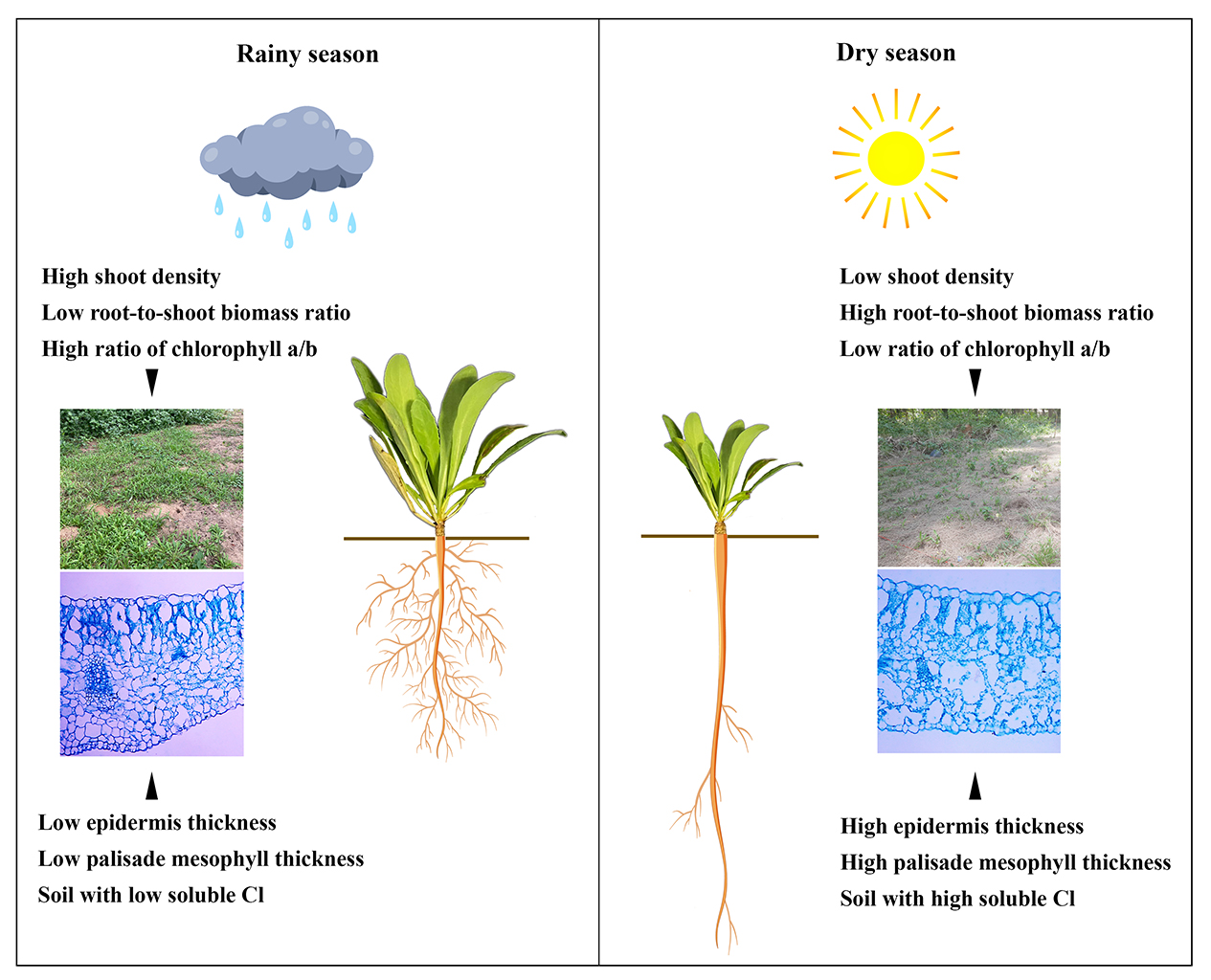
Launaea sarmentosa (Willd.) Kuntze, a creeping herb native to the Andaman coasts of Southern Thailand, faces significant threats from habitat loss and environmental changes following the 2004 tsunami. This study investigated its ecological and anatomical characteristics across 4 coastal sites in Phuket and Phang-Nga Provinces. The parameters were categorized into 4 groups: plant traits (including photosynthetic pigment contents and anatomical features), upper soil layer features (e.g., sand, clay, chloride, magnesium, and pH), lower soil layer features (e.g., sand, silt, nitrogen, phosphorus, calcium, chloride, and magnesium), and climatic variables (air temperature and relative humidity). Sampling was conducted during the rainy season (November 2023) and the dry season (April 2024). Results revealed significant seasonal and site-specific differences in plant traits. Shoot density and below-ground fresh weight were highest during the rainy season and at sites with moderate sunlight. The chlorophyll a/b ratio varied significantly between seasons and sites, while the total chlorophyll/carotenoid ratio differed between sites only. Leaf anatomical features also showed seasonal variation, with upper and lower epidermis thickness, mesophyll thickness, and upper epidermal cell area being greater in the dry season, while the lower epidermal cell area remained unchanged. In the upper-layer soil, chloride content was influenced by season, while sand, clay, magnesium, and pH varied significantly between sites. In the lower-layer soil, sand, silt, chloride, and magnesium varied seasonally, while nitrogen, phosphorus, and calcium showed site-specific differences. Climatic factors also showed both seasonal and spatial variability, with cooler temperatures and higher humidity during the rainy season, particularly at moderately sunny sites. In summary, L. sarmentosa appears to favor conditions with partial sunlight, moist soils, and clay-rich substrates. These conditions were associated with greater shoot density and biomass. The findings highlight the role of seasonal and site-specific factors and offer useful guidance for conservation and coastal ecosystem management.
HIGHLIGHTS
- Seasonal variation affects shoot density, the below/aboveground biomass ratio, the chlorophyll a/b ratio, as well as the thickness of the leaf epidermis and mesophyll in Launaea sarmentosa.
- Site-specific variation also influences the growth of sarmentosa, which favors moderately sunny environments.
- Soil properties at the study sites were investigated for the first time. In the upper layer, Cl serves as a seasonal predictor, while soil pH, organic matter, P, K, Ca, and Mg act as site predictors. In the lower layer, Cl and Mg vary temporally, while N, P, and Ca vary spatially.
- The present study emphasizes the need for habitat conservation to protect natural populations of sarmentosa.
GRAPHICAL ABSTRACT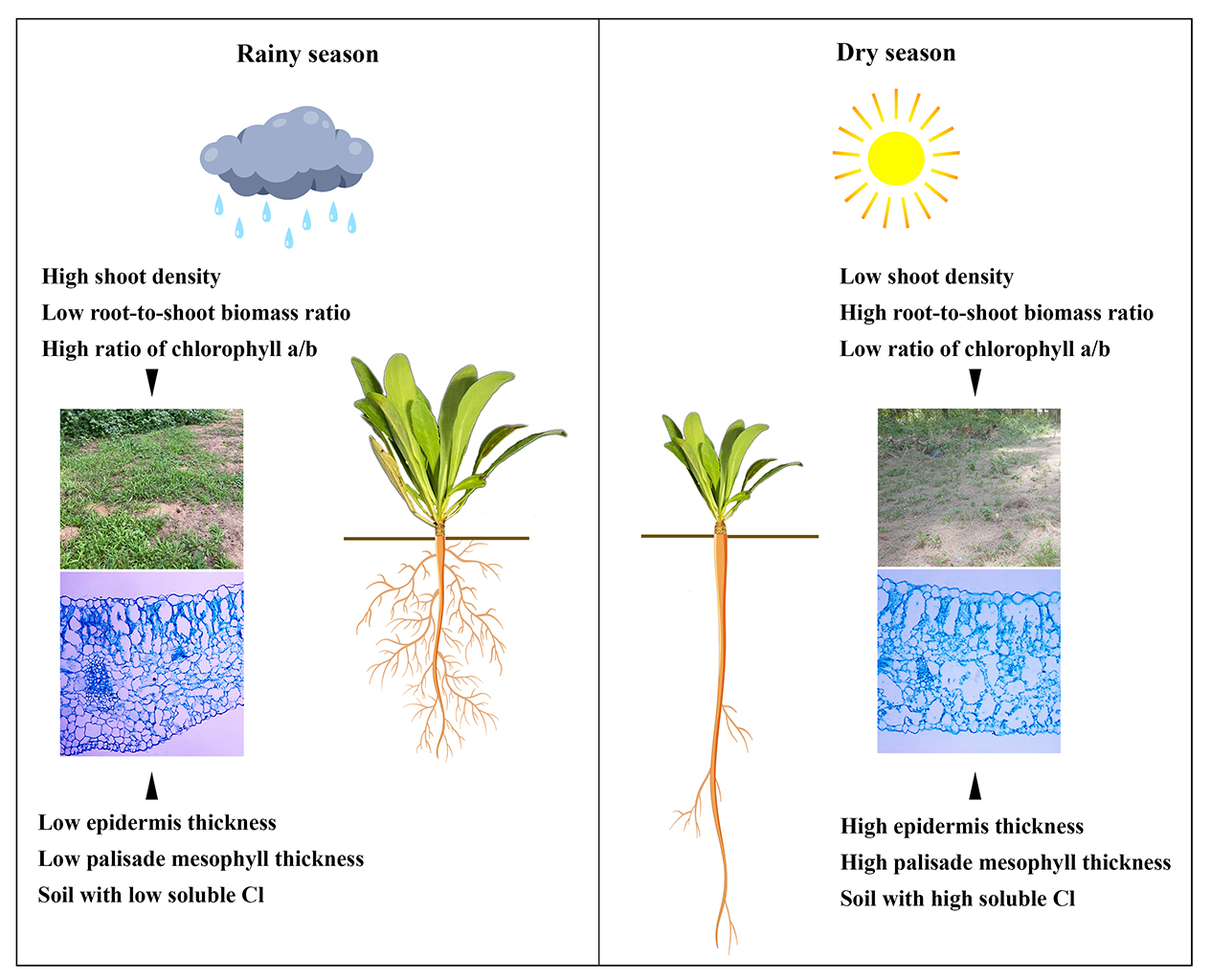
Downloads
References
The World Checklist of Vascular Plants, Available at https://powo.science.kew.org/taxon/urn:lsid:ipni.org:names:113642-3, accessed March 2024.
H Koyama, S Bunwong, P Pornpongrungrueng and DJN Hind. Flora of Thailand, Vol. 13, Part 2: Compositae (Asteraceae). Royal Forest Department, Bangkok, 2016, p. 349-350.
LT Them, PTN Dung, PTN Trinh, QT Hung, LNT Vi, NT Tuan, TD Lam, VT Nguyen and LT Dung. Saponin, polyphenol, flavonoid content and α-glucosidase inhibitory activity, antioxidant potential of Launaea sarmentosa leaves grown in Ben Tre province, Vietnam. IOP Conference Series: Materials Science and Engineering 2019; 542, 012036.
QC Nguyen, TD Binh, R Kusunoki, TLA Pham, YDH Nguyen, TT Nguyen, K Kanaori and K Kamei. Effects of Launaea sarmentosa extract on lipopolysaccharide-induced inflammation via suppression of NF-κB/MAPK signaling and Nrf2 activation. Nutrients 2020; 12, 2586.
Y Salih, CR Harisha, VJ Shukla and R Acharya. Pharmacognostical evaluation of Launaea sarmentosa (Willd.) Kuntze root. International Quarterly Journal of Research in Ayurveda 2013; 34(1), 90-94.
P Mistra, DD Toppo, N Gupta, D Chakrabarty and R Tuli. Effect of antioxidants and associated changes in antioxidant enzymes in controlling browning and necrosis of proliferating shoots of elite Jatropha curcas L. Biomass Bioenergy 2010; 34, 1861-1869.
R Core Team. R: A language and environment for statistical computing. Vienna: R Foundation for Statistical Computing; 2023. Available at: https://www.R-project.org, accessed March 2024
W Revelle. Psych: Procedures for Psychological, Psychometric, and Personality Research. R package version 2.3.3. Northwestern University, Evanston, Illinois; 2023. Available at: https://CRAN.R-project.org/package=psych, accessed March 2024.
D Lüdecke. Performance: An R package for assessment, comparison, and testing of statistical models. Journal of Open Source Software 2021; 6(60), 3139.
V Prapasanobol. Biological activities and phytochemical screening of Launaea sarmentosa root. Science and Technology Nakhon Sawan Rajabhat University Journal 2018; 10(11), 89-100.
C Sorce, S Bottega and C Spanò. Seasonal and microclimatic influences on the ecophysiology of Mediterranean coastal dune plants. Estuarine, Coastal and Shelf Science 2019; 219, 317-327.
M Zunzunegui, MP Esquivias and JB Gallego-Fernández. Spatial and seasonal patterns of water use in Mediterranean coastal dune vegetation. Plant Soil 2022; 477, 807-828.
D Guasconi, S Manzzoni and G Hugelius. Climate-dependent response of root and shoot biomass to drought duration and intensity in grasslands: A meta-analysis. Science of the Total Environment 2023; 903, 166209.
A Eziz, Z Yan, D Tian, W Han, Z Tang and J Fang. Drought effect on plant biomass allocation: A meta-analysis. Ecology and Evolution 2017; 7, 11002-11010.
J Dusek and J Kvet. Seasonal dynamics of dry weight, growth rate, and root/shoot ratio in different-aged seedlings of Salix caprea. Biologia, Bratislava 2006; 61(4), 441-447.
RF Evert. Esau’s Plant Anatomy: Meristems, Cells, and Tissues of the Plant Body: Their Structure, Function, and Development. 3rd eds. John Wiley & Sons, New Jersey, 2006.
KR Mendes, W Batista-Silva, J Dias-Pereira, MPS Pereira, EV Souza, JE Serrão, JAA Granja, EC Pereira, DJ Gallacher, PR Mutti, DTC da Silva, RSS Júnior, GB Costa, BG Bezerra, CMS e Silva and MF Pompelli. Leaf plasticity across wet and dry seasons in Croton blanchetianus (Euphorbiaceae) in a tropical dry forest. Scientific Reports 2022; 12, 954.
E Richetti, AJ Poletto, AC Rodrigues, FMC Oliveira and MG Lusa. Anatomical adaptations of plants within the Southern Brazil coast. Flora 2025; 323, 152661.
BJ Kim, SH Yim, YS Sim and YS Choo. Photosynthetic characteristics and chlorophyll of Vitex rotundifolia in coastal sand dunes. Journal of Ecology and Environment 2023; 47, 10.
A Kyparissis, P Drilias and Y Manetas. Seasonal fluctuations in photoprotective (xanthophyll cycle) and photoselective (chlorophylls) capacity in eight Mediterranean plant species belonging to two different growth forms. Australian Journal of Plant Physiology 2000; 27, 265-272.
S Yan, L Zhai, Q Deng, D Pan, S Gao and C Zou. Spatial-temporal dynamics of soil chloride distribution in a coastal saline plain: implication for ocean and climate influences. Journal of Soils and Sediments 2017; 18, 586-598.
PJ White and MR Broadley. Chloride in soils and its uptake and movement within the plant: A review. Annals of Botany 2001; 88(6), 967-988.
CM Geilfus. Chloride: from nutrient to toxicant. Plant and Cell Physiology 2018; 59(5), 877-886.
N Farhat, A Elkhouni, W Zorrig, A Smaoui, C Abdelly and M Rabhi. Effects of magnesium deficiency on photosynthesis and carbohydrate partitioning. Acta Physiologiae Plantarum 2016; 38, 145.
R Bordoloi, B Das, G Yam, PK Pandey and OP Tripathi. Modeling of water holding capacity using readily available soil characteristics. Agricultural Research 2019; 8(3), 347-355.
NK Fageria, VC Baligar and RB Clark. Micronutrients in crop production. Advances in Agronomy 2002; 77, 185-268.
Additional Files
Published
How to Cite
Issue
Section
License
Copyright (c) 2025 Walailak University

This work is licensed under a Creative Commons Attribution-NonCommercial-NoDerivatives 4.0 International License.





