
Increasing the Sensitivity of Polymer Optical Fiber Sensing Element in Detecting Humidity: Combination of Macro and Micro Bendings
DOI:
https://doi.org/10.48048/tis.2022.3200Keywords:
Polymer optical fiber, Humidity sensor, Macro bending, Micro bending, SensitivityAbstract
Humidity sensing is essential in various fields, including industrial processes, agriculture, engineering, and health. A material suitable as a sensing element for humidity detecting is polymer optical fiber (POF). In this study, a combination of micro and macro bendings was proposed to increase the sensitivity of the sensing element. The sensing element was constructed by peeling the out-most coating of the POF, but keeping intact the cladding and core. The macro bending was done upon the peeled part of the POF by making a circular form with varying diameter of 3.5, 4.0 and 4.5 cm. The micro bending was constructed by making a local bent via subjecting to electrical discharge flame from an inductor generator with varying number of micro bendings, i.e., 1, 2 and 3. The sensing element was then tested for its sensitivity as a humidity sensor. The sensing element was positioned inside a self-custom made humidity measurement box consisting of a hygrometer and a pipe to stream water vapor inside the box. The normalized power was measured by varying the % humidity inside the box. In general, the result showed that increasing the humidity caused the normalized lupower to decrease, hence increasing the power loss of the sensing element. Moreover, the sensitivity of the sensing element was increased 10 times for the combined micro and macro bendings compared to a sensing element without micro bendings.
HIGHLIGHTS
- In this study, we increase the sensitivity of a polymer optical fiber (POF) sensing element via a combination of micro and macro bendings. The sensing element is constructed by peeling the out-most coating of the POF, but keeping the cladding and core
- The macro bending is done upon the peeled part of the POF in a circular form. The micro bending is constructed by making a local bent via subjecting to electrical discharge flame from an inductor generator
- The sensing element is then tested for its sensitivity as a humidity sensor. The sensing element is put inside a self-custom made humidity box. The normalized power was measured by varying the % humidity inside the box
- The result shows that increasing the humidity causes the normalized power to decrease, hence increasing the power loss of the sensing element. Moreover, the sensitivity of the sensing element is increased 10 times for the combined micro and macro bendings compared to a sensing element without micro bendings
GRAPHICAL ABSTRACT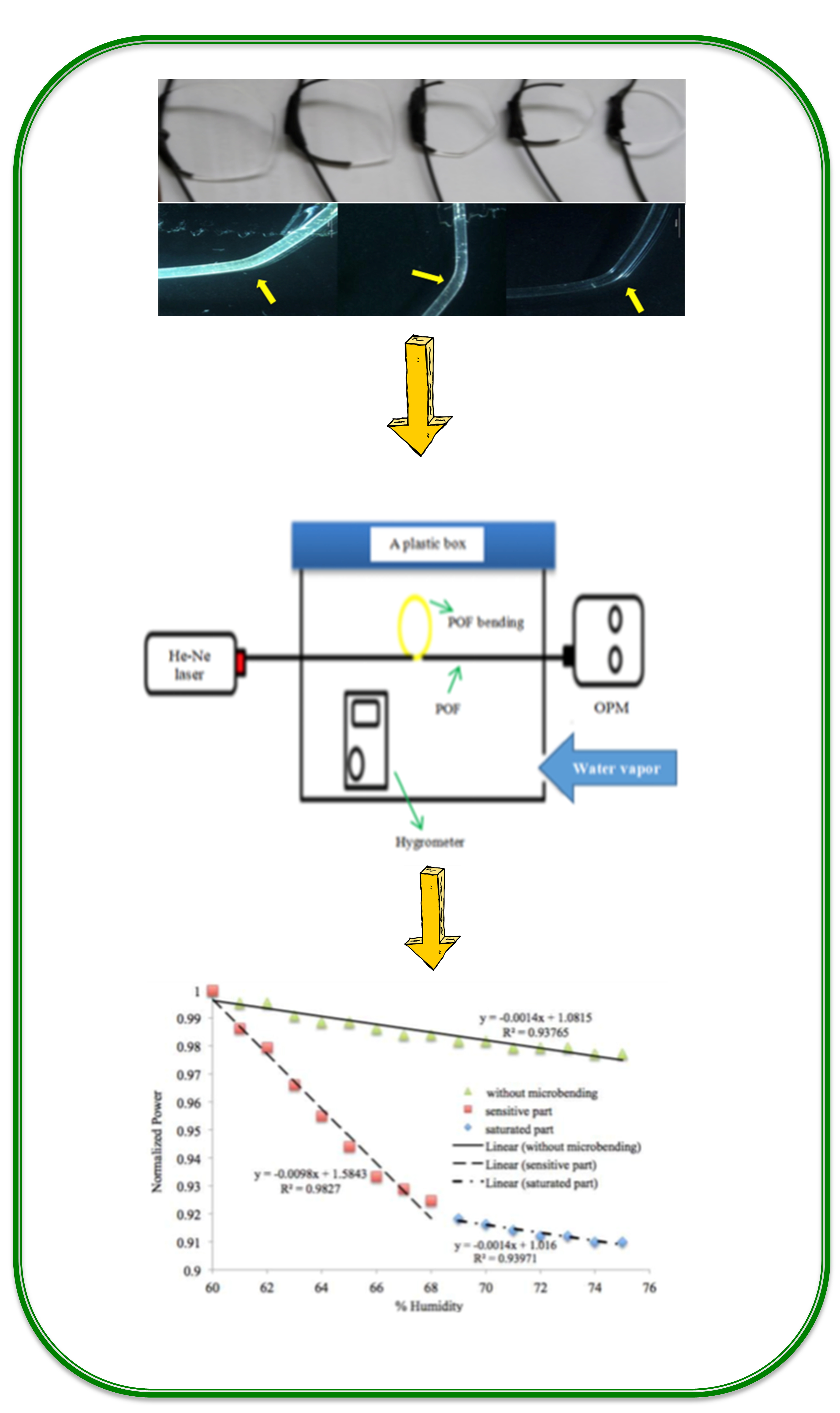
Downloads
References
J Ascorbe, JM Corres, FJ Arregui and IR Matias. Recent developments in fiber optics humidity sensors. Sensors 2017; 17, 893.
S Liehr, M Breithaupt and K Krebber. Distributed humidity sensing in PMMA optical fibers at 500 nm and 650 nm wavelengths. Sensors 2017; 17, 738.
TL Yeo, T Sun and KTV Grattan. Fibre-optic sensor technologies for humidity and moisture measurement. Sensor. Actuator. A Phys. 2008; 144, 280-95.
A Leal-Junior, A Frizerra-Neto, C Marques and MJ Pontes. Measurement of temperature and relative humidity with polymer optical fiber sensors based on the induced stress-optic effect. Sensors 2018; 18, 916.
M Batumalay, SW Harun, F Ahmad, RM Nor, NR Zulkepely and H Ahmad. Study of a fiber optic humidity sensor based on agarose gel. J. Mod. Optic. 2013; 61, 244-8.
L Xu, JC Fanguy, K Soni and S Tao. Optical fibre humidity sensor based on evanescent wave scattering. Optic. Lett. 2004; 29, 1191-3.
J Mathew, KJ Thomas, VPN Nampoori and P Radhakrishnan. A comparative study of fiber optic humidity sensors based on Chitosan and Agarose. Sensor. Transducers J. 2007; 84, 1633-40.
DS Monteroand and C Vazquez. Polymer optical fiber intensity-based sensor for liquid-level measurements in volumetric flasks for industrial application. Sensor Networks. 2012; 2012 ,618136,
N Arumnika and H Kuswanto. The influence of curvature configuration on the characteristic of alcohol gel insertion jacket of polymer optical fiber liquid level sensor. J. Phys. Conf. Ser. 2018; 1011, 012053.
J Zhao, T Bao and T Kundu. Wide range fiber displacement sensor based on bending loss. J. Sensor. 2016; 2016, 4201870.
P Wang, K Ni, B Wang, Q Ma and W Tian. Methylcellulose coated humidity sensor based on Michelson interferometer with thin-corefiber. Sensor. Actuator. A Phys. 2019; 288, 75-8.
Z Guo, F Chu, J Fan, Z Zhang, Z Bian, G Li and X Song. Study of macro-bending biconical tapered plastic optical fiber for relative humidity sensing. Sensor. Rev. 2018; 39, 352-7.
M Hernaez, B Acevedo, AG Mayes and S Melendi-Espina. High-performance optical fiber humidity sensor based on lossy mode resonance using a nanostructured polyethylenimine and gaphene oxide coating. Sensor. Actuator. B Chem. 2019; 286, 408-14.
Z Harith, M Batumalay, N Irawati, SW Harun, H Arof and H Ahmad. Relative humidity sensor employing tapered plastic optical fiber coated with seeded Al-doped ZnO. Optik 2017; 144, 257-62.
WH Lu, LW Chen, WF Xie and YC Chen. A sensing element based on a bent and elongated grooved polymer optical fiber. Sensors 2012; 12, 7485-95.
S Muto, O Suzuki and TA Amano. Plastic optical fibre sensor for real-time humidity monitoring. Meas. Sci. Tech. 2003; 746, 746-50.
Z Guo, F Chu, J Fan, Z Zhang, Z Bian, G Li and X Song. Study of macro-bending biconical tapered plastic optical fiber for relative humidity sensing. Sensor. Rev. 2019; 39, 352-7.
W Chen, Z Chen, Y Zhang, H Li and Y Lian. Agarose coated macro-bend fiber sensor for relative humidity and temperature measurement at 2 m. Opt. Fiber Tech. 2019; 50, 118-24.
L Cheng, Y Li, Y Ma, M Li and F Tong. The sensing principle of a new type of crack sensor based on linear macro-bending loss of an optical fiber and its experimental investigation. Sensor. Actuator. A Phys. 2018; 272, 53-61.
L Meng, L Wang, H Xiong, H Wang and X Guo. An investigatin in the influence of helical structure n bend loss of pavement optical fiber sensor. Optik 2019; 183, 189-99.
J Zubia and J Arrue. Plastic optical fibers: An introduction to their technological processes and applications. Opt. Fiber Tech. 2001; 7, 101-40.
T Watanabe, N Ooba, Y Hida and M Hikita. Influence of humidity on refractive index of polymers for optical waveguide and its temperature dependence. Appl. Phys. Lett. 1998; 72, 1533-5.
X Xing, J Zhang, L Wang, J Pei and X Chen. Effects of bending radius and fiber-crack angle on polymer optical fiber loss for potential application in pavement crack monitoring. J. Test. Eval. 2021; 49, 96-108.
B Lustermann, BM Quandt, S Ulrich, F Spano, RM Rossi and LF Boesel. Experimental determination and ray-tracing simulation of bending losses in melt-spun polymer optical fibres. Sci. Rep. 2020; 10, 11885.
SK Khijwania, KL Srinivasan and JP Singh. An evanescent-wave optical fiber relative humidity sensor with enhanced sensitivity. Sensor. Actuator. B Chem. 2005; 104, 217-22.

Downloads
Published
How to Cite
Issue
Section
License

This work is licensed under a Creative Commons Attribution-NonCommercial-NoDerivatives 4.0 International License.





