
Graphite Exfoliation using MnO2 Paste via Sonication in Irradiated Water for Volumetric-Shrinkage Resistant Sponge
DOI:
https://doi.org/10.48048/tis.2022.2996Keywords:
Graphite exfoliation, Resistant sponge, Water irradiation, Audio sonicationAbstract
Graphite exfoliation has been the main mechanism to produce graphene material and its derivatives, such as graphene oxide (GO) and reduced GO (rGO). This study was aimed to exfoliate graphite using MnO2 paste in Zinc-Carbon (ZnC) battery wastes via audio sonication in X-ray irradiated water. The exfoliated graphite (EG) sample was then characterized using UV-Vis spectrophotometry, FTIR spectroscopy, XRD, and SEM. The EG sample was utilized as an additive for producing sponge with heat-induced volumetric-shrinkage resistance property. The irradiated water was obtained by exposing X-ray radiation upon distilled water. The graphite and K2MnO4 were mixed in the irradiated water followed by audio sonication accompanied by stirring and heating. The K2MnO4 was obtained from the MnO2 paste added with KOH. The UV-Vis results showed a shouldering peak at 271 nm indicating that the graphite was succesfully exfoliated. The FTIR test showed the presence of hydroxyl, C-O, CO2, N-O, and C=C functional groups. The XRD showed a peak at 12° for the EG sample similar to the XRD peak of GO. The SEM images showed layers of graphene flakes. The threshold temperature values of the sponge, sponge with EG (sponge+EG), and sponge with graphite (sponge+graphite) were 399.20, 271.03, and 414.82 °C, respectively. The sponge+EG underwent less volume shrinkage compared to ordinary sponge and sponge+graphite, which confirms its volume shrinkage resistant upon heating.
HIGHLIGHTS
- We have exfoliated graphite using MnO2 paste obtained from ZnC battery wastes via audio sonication in X-ray irradiated water
- The UV-Vis characterization of the exfoliated graphite shows a shouldering peak at 271 nm. The FTIR test shows the presence of hydroxyl, C-O, CO2, N-O, and C=C functional groups. The XRD diffractogram shows a peak at 12° of an amorphous material. Finally, the SEM image shows layers of graphene flakes
- The exfoliated graphite is used as an additive to produce a volume-shrinkage resistant sponge, which underwent less volume shrinkage compared to ordinary sponge and sponge with graphite
GRAPHICAL ABSTRACT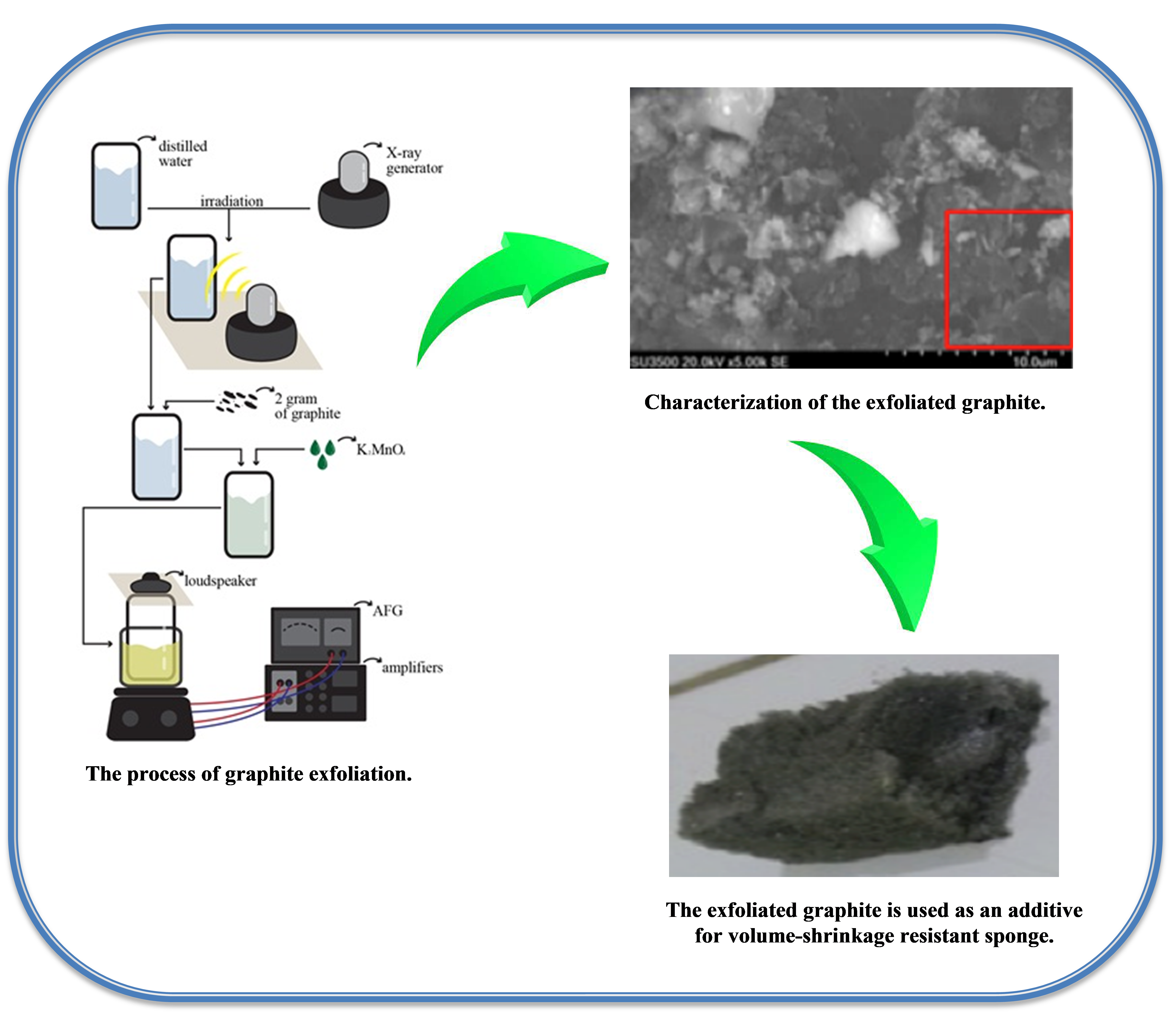
Downloads
References
B Zhan, C Li, J Yang, G Jenkins, W Huang and X Dong. Graphene field‐effect transistor and its application for electronic sensing. Small 2014; 10, 4042-65.
Z Khan, TR Chetia, AK Vardhaman, D Barpuzary, CV Sastri and M Qureshi. Visible light assisted photocatalytic hydrogen generation and organic dye degradation by CdS-metal oxide hybrids in presence of graphene oxide. RSC Adv. 2012; 2, 12122-8.
B Paulchamy, G Arthi and BD Lignesh. A simple approach to stepwise synthesis of graphene oxide nanomaterial. J. Nanomed. Nanotechnol. 2015; 6, 1000253.
A Ciesielski and P Samorì. Graphene via sonication assisted liquid-phase exfoliation. Chem. Soc. Rev. 2014; 43, 381-98.
X Li, L Colombo and RS Ruoff. Graphene films: Synthesis of graphene films on copper foils by chemical vapor deposition. Adv. Mater. 2016; 28, 6247-52.
S Chen, J Zhu, X Wu, Q Han and X Wang. Graphene oxide-MnO2 nanocomposites for supercapacitors. ACS Nano 2010; 4, 2822-30.
K Noiroj, P Intarapong, A Luengnaruemitchai and S Jai-In. A comparative study of KOH/Al2O3 and KOH/NaY catalysts for biodiesel production via transesterification from palm oil. Renew. Energ. 2009; 34, 1145-50.
A Alighardashi, Kashitarash, Z Esfahani and F Najafi. Efficiency evaluation of nitrate removal from synthetic solution by dendrimer-graphene oxide nano-composite activated with HCl. J. Water Wastewater 2019; 30, 101-6
WSB Dwandaru, BW Pratama, RI Wisnuwijaya, LD Parwati, DS Khaerudini, Supardi and Suparno. Mixing of graphite with x-ray irradiated water towards the exfoliation of graphene layers. Nanosci. Nanotechnol. Asia 2020; 10, 548-56.
WSB Dwandaru, LD Parwati and RI Wisnuwijaya. Formation of graphene oxide from carbon rods of zinc-carbon battery wastes by audiosonic sonication assisted by commercial detergent. Nanotechnol. Precis. Eng. 2019; 2, 89-94.
SL Caer. Water radiolysis: Influence of oxide surfaces on H2 production under ionizing radiation. Water 2011; 3, 235-53.
PM Fernández, RLJ Cruz, LE García-Cambronero, C Díaz and MA Navacerrada. García-Cambronero, C Díaz and MA Navacerrada. Sound absorption properties of aluminium sponges manufactured by infiltration process. Adv. Mater. Res. 2010; 146-147, 1651-4.
M Sharma, J Eastridge and C Mudd. Effective household disinfection methods of kitchen sponges. Food Contr. 2009; 20, 310-3.
S Jiang, B Uch, S Agarwal and A Greiner. Ultralight, thermally insulating, compressible polyimide fiber assembled sponges. ACS Appl. Mater. Interfac. 2017; 9, 32308-15.
AM Lazim, DL Musbah, CC Chin, I Abdullah, MHA Mustapa and A Azfaralariff. Oil removal from water surface using reusable and absorptive foams via simple fabrication of liquid natural rubber (LNR). Polym. Test 2019; 73, 39-50.
S Kovačević and D Ujević. Seams in car seat coverings: Properties and performance. In: I Jones and GK Stylios (Eds.). Joining textiles principle and applications. Woodhead Publishing, Sawston, United Kingdom, 2013, p. 478-506.
NAS Helal. Studies of different germination media and package on squash and snake cucumber sprouts. Middle East J. Appl. Sci. 2016; 6, 374-8.
D Zhao, Z Zhao, X Dai, S Wang, S Liu and Y Liu. Study on mechanical properties of a novel polyurethane sponge magnetorheological elastomers in compressive mode. Mater. Res. Express 2019; 6, 116101.
Y Zhang, J Guan, J Wu, S Ding, J Yang, J Zhang, J Zhang, A Dong and L Deng. N-alkylated chitosan/graphene oxide porous sponge for rapid and effective hemostasis in emergency situations. Carbohydr. Polym. 2019; 219, 405-13.
H Xu, Y Li, NJ Huang, ZR Yu, PH Wang, ZH Zhang, QQ Xia, LX Gong, SN Li, L Zhao, GD Zhang and LC Tang. Temperature-triggered sensitive resistance transition of graphene oxide wide-ribbons wrapped sponge for fire ultrafast detecting and early warning. J. Hazard. Mater. 2019; 363, 286-94.
H Wang, X Zhang, N Wang, Y Li, X Feng, Y Huang, C Zhao, Z Liu, M Fang, G Ou, H Gao, X Li and H Wu. Ultralight, scalable, and high-temperature-resilient ceramic nanofiber sponges. Sci. Adv. 2017; 3, e1603170.
SM Shin, G Senanayake, JS Sohn, JG Kang, DH Yang and TH Kim. Separation of zinc from spent zinc-carbon batteries by selective leaching with sodium hydroxide. Hydrometallurgy 2009; 96, 349-53.
M Bera, C Yadav, P Gupta and PK Maji. Facile one-pot synthesis of graphene oxide by sonication assisted mechanochemical approach and its surface chemistry. J. Nanosci. Nanotechnol. 2018; 18, 902-12.
N Pan, D Guan, T He, R Wang, I Wyman, Y Jin and C Xia. Removal of Th4+ ions from aqueous solutions by graphene oxide. J. Radioanal. Nucl. Chem. 2013; 298, 1999-2008.
R Krishna, E Titus, O Okhay, JC Gil, J Ventura and EV Ramana. Rapid electrochemical synthesis of hydrogenated graphene oxide using ni nanoparticles. Int. J. Electrochem. Sci. 2014; 9, 4045-69.
MK Rabchinskii, VV Shnitov, AT Dideikin, AE Aleksenskii, SP Vul, MV Baidakova, II Pronin, DA Kirilenko, PN Brunkov, J Weise and SL Molodtsov. Nanoscale perforation of graphene oxide during photoreduction process in the argon atmosphere. J. Phys. Chem. C 2016; 120, 28261-69.
Y Zhang, W Hu, B Li, C Peng, C Fan and Q Huang. Synthesis of polymer-protected graphene by solvent-assisted thermal reduction process. Nanotechnology 2011; 22, 345601-6.
Sudesh, N Kumar, S Das, C Bernard and GD Varma. Effect of graphene oxide doping on superconducting properties of bulk MgB2. Supercond. Sci. Tech. 2013; 26, 095008.
FT Johra, JW Lee and WG Jung. Facile and safe graphene preparation on solution based platform. J. Ind. Eng. Chem. 2014; 20, 2883-7.
R Siburian, H Sihotang, S Raja, Lumban, M Supeno and C Simanjuntak. New route to synthesize of graphene nano sheets. Orient. J. Chem. 2018; 34, 182-7.
ACD Moraes, BA Lima, AFD Faria, M Brocchi and OL Alves. Graphene oxide-silver nanocomposite as a promising biocidal agent against methicillin-resistant Staphylococcus aureus. Int. J. Med. 2015; 10, 6847-61.
F Fauzi, F Azizi, MM Musawwa and WSBD Dwandaru. Synthesis and characterizations of reduced graphene oxide prepared by microwave irradiation with sonication. J. Phys. Sci. 2021; 32, 1-13.
J Franklin. Arguments whose strength depends on continuous variation. J. Informal Logic 2013; 33, 33-56.
Downloads
Published
How to Cite
Issue
Section
License

This work is licensed under a Creative Commons Attribution-NonCommercial-NoDerivatives 4.0 International License.





