
Kinetics, Isotherms and Thermodynamic Studies on Removal of Divalent Copper using Mallet Flower Leaf Powder as Bio-Adsorbent
DOI:
https://doi.org/10.48048/tis.2021.1431Keywords:
Biosorption, Copper, FTIR, Heavy metals, Mallet Flower Leaf Powder (MFLP)Abstract
The effectiveness and efficacy of Mallet Flower Leaf Powder (MFLP) as a bio-sorbent for the removal of heavy metal copper ions from the aqueous solutions have been studied. Experiments were conducted varying the pH, agitation time, temperature, biosorbent size and dosage as parameters. Speed of the mixing is kept at 200 rpm. The analysis of copper was done by using Atomic Absorption Spectrophotometer (AAS). The adsorption of copper was found to be dependent on pH and a maximum removal of 98.78 % was obtained at an optimum pH of 6.0. The optimum biosorbent dosage was 1 g for an agitation time of 40 min. The biosorption data obtained were validated for the best isotherm. The data collected were verified with the available adsorption isotherms. Experimental data obtained was well represented by Langmuir (RL = 0.161, qm = 5.96 mg/g, R2 = 0.9142), Freundlich (n = 0.64, Kf = 0.79L/g, R2 = 0.9995) and Tempkin (R2 = 0.9083, bT = 267.63) isotherms, indicating favorable biosorption. The experimental data obtained were tested for the best fit and the Freundlich Model has yielded the best correlation with the highest regression coefficient, R2 = 0.9844. Kinetic data has also been presented using thermodynamic analysis and the pseudo second order model was found to be the best fit with a correlation coefficient of 0.999. For the removal of copper from the solution, bioadsorbent showed a maximum adsorption capacity of 5.96 mg/g.
HIGHLIGHTS
- Removal of divalent copper from the aqueous solution using Mallet Flower Leaf powder
- Atomic Absorption Spectroscopy, Scanning Electron Microscopy and Fourier transform infrared analysis were used to characterize the Mallet Flower Leaf Powder
- Kinetic data has been presented using thermodynamic analysis and the pseudo second order model was found to be the best fit with a correlation coefficient of 0.999
- The maximum adsorption capacity of MFLP for copper was found to be 5.96 mg/gm
GRAPHICAL ABSTRACT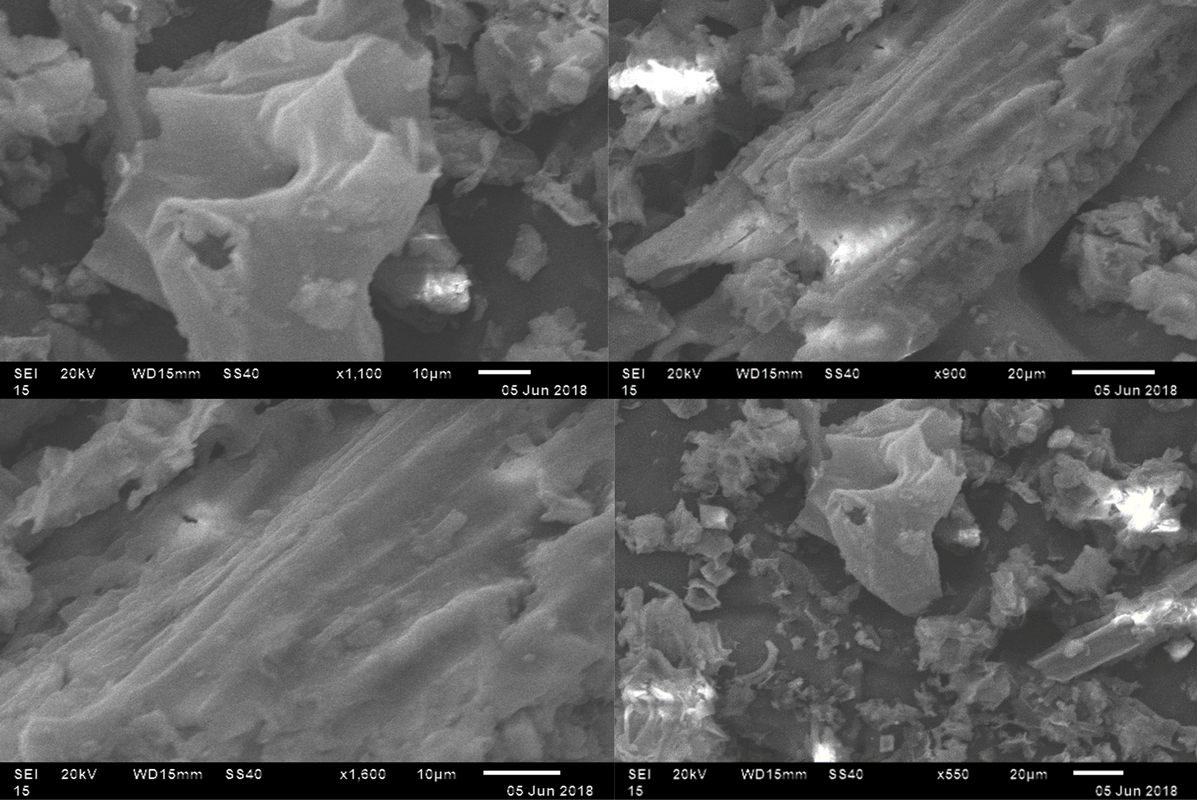
Downloads
References
AAS Al-Gheethi, I Norli, J Lalung, AM Azlan, ZAN Farehah and MOA Kadir. Biosorption of heavy metals and cephalexin from secondary effluents by tolerant bacteria. J. Clean Tech. Environ. Pol. 2014; 16, 137-48.
AH Sulaymon, AA Mohammed and TJ Al-Musawi. Competitive biosorption of lead, cadmium, copper, and arsenic ions using algae. Int. J. Environ. Sci. Poll. Res. 2013; 20, 3011-23.
A Witek-Krowiak. Application of beech sawdust for removal of heavy metals from water: Biosorption and desorption studies. Eur. J. Wood Wood Prod. 2013; 71, 227-36.
A Hussain, J Maitra and KA Khan. Development of biochar and chitosan blend for heavy metals uptake from synthetic and industrial wastewater. J. App. Water Sci. 2017; 7, 4525-37.
A Yazdani, M Sayadi and A Heidari. Green biosynthesis of palladium oxide nanoparticles using dictyota indica seaweed and its application for adsorption. J. Water Environ. Nanotech. 2018; 3, 337-47.
B Krishna and P Venkateswarlu. Influence of Ficus religioso leaf powder on biosorption of cobalt. Indian J. Chem. Tech. 2011; 18, 381-90.
A Celik and A Demirbas. Removal of heavy metal ions from aqueous solutions via adsorption onto modified lignin from pulping wastes. Energ. Sourc. 2005; 27, 67-77.
DS Malik, CK Jain and AK Yadav. Removal of heavy metals from emerging cellulosic low-cost adsorbents: A review. J. App. Water Sci. 2017; 7, 2113-36.
D Dutta, SK Roy, B Das and AK Talukdar. Removal of Cu(II) and Pb(II) from aqueous solutions using nanoporous materials. J. Phy. Chem. A 2018; 92, 976-83.
E Bazrafshan, L Mohammadi, AA Moghaddam and A HosseinMahvi. Heavy metals removal from aqueous environments by electrocoagulation process - a systematic review. J. Environ. Health Sci. Eng. 2015; 13, 74-9.
F Migahed, A Abdelrazak and G Fawzy. Batch and continuous removal of heavy metals from industrial effluents using microbial consortia. Int. J. Environ. Sci. Tech. 2017; 14, 1169-80.
H Gao, R Tayebee, MF Abdizadeh, E Mansouri, M Latifnia and Z Pourmojahed. The efficient biogeneration of Ag and NiO nanoparticles from VPLE and a study of the anti-diabetic properties of the extract. RSC Adv. 2020; 10, 3005-12.
H Rezaei. Biosorption of chromium by using Spirulina sp. Arabian J. Chem. 2016; 9, 846-53.
IH Ali and HA Alrafai. Kinetic, isotherm and thermodynamic studies on biosorption of chromium (VI) by using activated carbon from leaves of Ficus nitida. Chem. Central J. 2016; 10, 36-42.
KC Khulbe and T Matsuura. Removal of heavy metals and pollutants by membrane adsorption techniques. J. App. Water Sci. 2018; 8, 19-27.
RM Kakhki, R Tayebee, M Mohammadpour and F Ahsani. Fast and highly efficient removal of anionic organic dyes with a new Cu modified nanoclinoptilolite. J. Inclusion Phenom. Macrocyclic Chem. 2018; 91, 133-9.
M Athar, U Farooq, SZ Ali and M Salman. Insight into the binding of copper(II) by non-toxic biodegradable material (Oryzasativa): Effect of modification and interfering ions. J. Clean Tech. Environ. Pol. 2014; 16, 579-90.
MH Sayadi, N Salmani, A Heidari and MR Rezaei. Bio-synthesis of palladium nanoparticle using Spirulina platensis alga extract and its application as adsorbent. Surface. Interfac. 2018; 10, 136-43.
MH Sayadi, O Rashki and ES Shahri. Application of modified Spirulina platensis and Chlorella vulgaris powder on the adsorption of heavy metals from aqueous solutions. J. Environ. Chem. Eng. 2019; 7, 103-69.
N Prakash, M Soundarrajan, SA Vendan, PN Sudha and NG Renganathan. Contemplating the feasibility of vermiculate blended chitosan for heavy metal removal from simulated industrial wastewater. J. App. Water Sci. 2017; 7, 4207-18.
DV Padma and SVAR Sastry. Biosorption of hexavalent chromium using mallet flower leaves powder as adsorbent. TEST Eng. Manag. 2020; 83, 15714-29.
DV Padma and SVAR Sastry. Biosorption of divalent copper from aqueous solution using mallet flower leaves powder as adsorbent. Int. J. Environ. Waste Manag. 2021, https://doi.org/10.1504/IJEWM.2022.10036313.
DV Padma and SVAR Sastry. Kinetic studies on simultaneous biosorption of divalent copper and hexavalent chromium using mallet flower leaf powder. J. Water Environ. Nanotech. 2020; 5, 204-17.
S Moulay and N Bensacia. Removal of heavy metals by homolytically functionalized poly (acrylic acid) with hydroquinone. Int. J. Ind. Chem. 2016; 7, 369-89.
SVAR Sastry. Green synthesis and characterization of silver nano particles. J. Water Environ. Nanotech. 2020; 5, 81-91.
SVAR Sastry and BS Rao. Studies on adsorption of Cu(II) using spent tea extract (STE) from industrial wastewater. J. Fut. Eng. Tech. 2016; 11, 31-5.
SVAR Sastry and BS Rao. Determination of adsorption kinetics for removal of copper from wastewater using Spent Tea Extract (STE). J. Fut. Eng. Tech. 2017; 12, 27-32.
SVAR Sastry, BS Rao and DV Padma. Studies on selective batch adsorption of Cu(II) and Cr(VI) from aqueous solution. TEST Eng. Manag. 2020; 83, 6794-7.
H Shekari, MH Sayadi, MR Rezaei and A Allahresani. Synthesis of nickel ferrite/titanium oxide magnetic nanocomposite and its use to remove hexavalent chromium from aqueous solutions. Surface. Interfac. 2017; 8, 199-205.
S Huang and G Lin. Biosorption of Hg(II) and Cu(II) by biomass of dried Sargassum fusiform in aquatic solution. J. Environ. Health Sci. Eng. 2015; 13, 21-9.
S Choudhary, V Goyal and S Singh. Removal of Copper(II) and Chromium(VI) from aqueous solution using sorghum roots (S. bicolor): A kinetic and thermodynamic study. J. Clean Tech. Environ. Pol. 2014; 17, 1039-51.
S Iram, R Shabbir, H Zafar and M Javaid. Biosorption and bioaccumulation of copper and lead by heavy metal resistant fungal isolates. Arabian J. Sci. Eng. 2015; 40, 1867-73.
R Tayebee. Acid-thermal activated nanobentonite as an economic industrial adsorbent for malachite green from aqueous solutions: Optimization, isotherm, and thermodynamic studies. J. Water Environ. Nanotech. 2018; 3, 40-50.
R Tayebeea and N Mollaniab. Bio-removal of carcinogenic Cr(VI) by whole cells and cell-free extracts of a new native and highly chromate-resistant Enterobacter sp. Desalin. Water Treat. 2018; 111, 258-66.
VE Pakade, TD Ntuli and AE Ofomaja. Biosorption of hexavalent chromium from aqueous solutions by Macadamia nutshell powder. J. App. Water Sci. 2017; 7, 3015-30.
WJ Weber, JC Morris and J Sanit. Kinetics of adsorption on carbon from solution. J. Sanitary Eng. Div. Am. Soc. Civ. Eng. 1963; 89, 31-8.
XW Ang, VS Sethu, JM Andresen and MS Kumar. Copper(II) ion removal from aqueous solutions using biosorption technology: Thermodynamic and SEM-EDX studies. J. Clean Tech. Environ. Pol. 2013; 15, 401-7.
Z Sfaksi, N Azzouz, AA Wahab. Removal of chromium from water by cork waste. Arabian J. Chem. 2014; 7, 37-42.
Downloads
Published
How to Cite
Issue
Section
License

This work is licensed under a Creative Commons Attribution-NonCommercial-NoDerivatives 4.0 International License.





