
Sono-Fenton Delignification of Rice Straw Using Fe3O4/GO Nanocatalyst: Process Optimization via Central Composite Design, Reaction Kinetics, and Activation Thermodynamics
DOI:
https://doi.org/10.48048/tis.2027.14254Keywords:
Sono-Fenton, Rice straw, Delignification, Fe3O4/GO, Central composite design, Reaction kinetics, Activation thermodynamics, Sustainable Development Goals (SDGs)Abstract
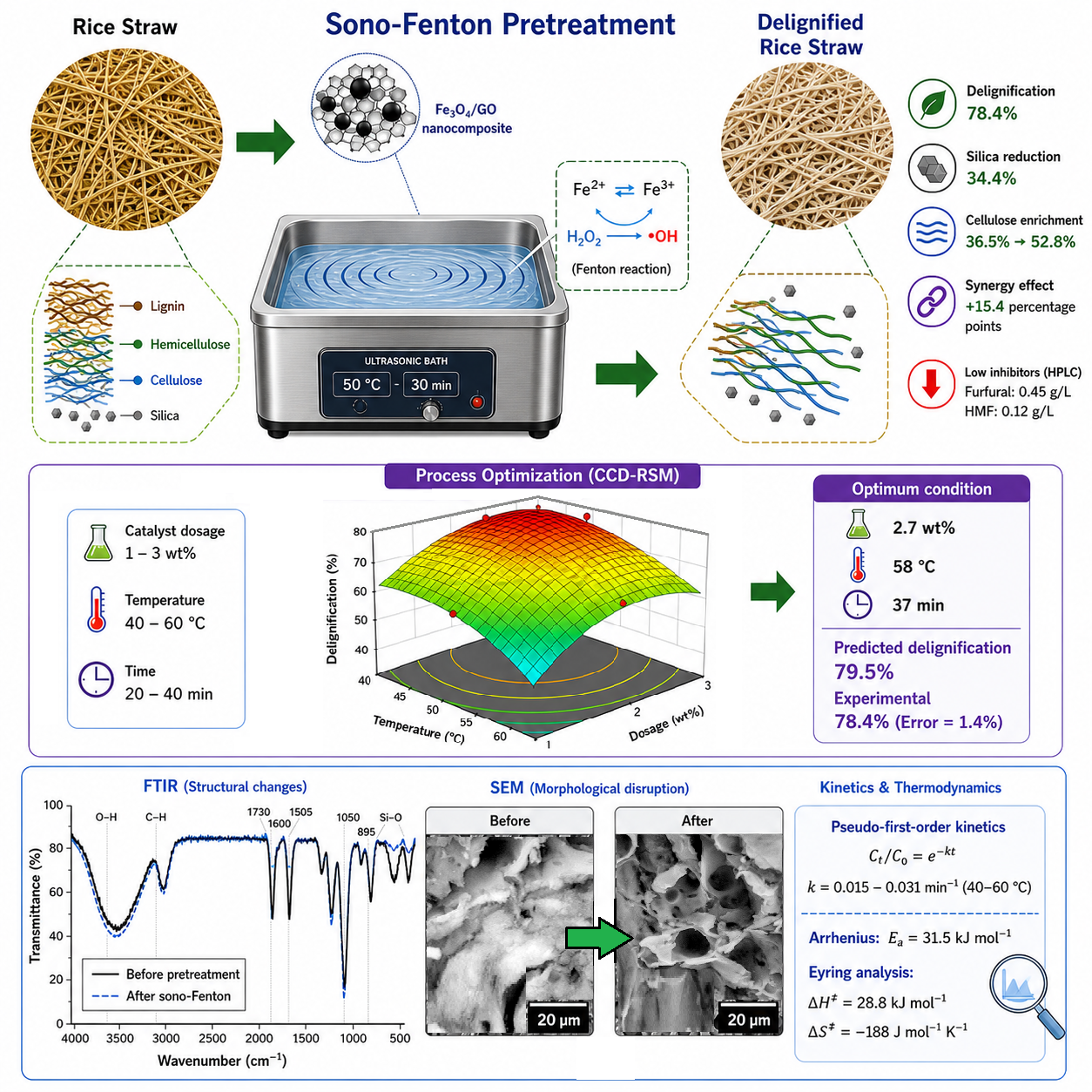
Rice straw is an abundant lignocellulosic residue whose recalcitrant lignin-silica matrix limits enzymatic conversion to glucose. In this study, a sono-Fenton heterogeneous system employing Fe3O4/GO nanocomposite as a magnetically recoverable catalyst was developed for rice straw delignification. A face-centered Central Composite Design with three factors—catalyst dosage (1 - 3 wt%), temperature (40 - 60 °C), and time (20 - 40 min)—was applied to optimize the process. The full quadratic model exhibited excellent predictive performance (R2 = 0.993, R2adj = 0.987, R2pred = 0.956) with non-significant lack of fit. Optimum conditions (2.7 wt%, 58 °C, 37 min) yielded 78.4% delignification with a prediction error of only 1.5%. Temperature was the most influential factor. The synergistic effect of ultrasonic cavitation and Fenton catalysis exceeded the sum of individual treatments by 15.4 percentage points. Delignification kinetics followed pseudo-first-order behaviour with rate constants of 0.015 - 0.031 min−1 over 40 - 60 °C. Arrhenius analysis yielded Ea = 31.5 kJ/mol, while Eyring analysis provided ΔH‡ = 28.8 kJ/mol and ΔS‡ = −222 J·mol−1·K−1, confirming a chemically controlled, associative mechanism. FTIR spectra confirmed selective lignin removal and partial silica disruption, while SEM revealed pronounced morphological disruption. HPLC analysis of the filtrate showed inhibitor concentrations were below reported inhibitory thresholds. Notably, the process reduced silica by 34.4% while enriching cellulose from 36.5% to 52.8%. These findings establish Fe3O4/GO as an effective sono-Fenton catalyst for rice straw delignification, providing integrated kinetic, thermodynamic, and structural evidence for rational process design in lignocellulosic biorefinery applications.
HIGHLIGHTS
- Fe₃O₄/GO nanocatalyst achieved 78.4% delignification of rice straw via sono-Fenton process
- CCD face-centered optimization identified temperature as the most influential parameter
- Synergy of ultrasonic and Fenton catalysis exceeded additive effect by 15.4 percentage points
- Pseudo-first-order kinetics with Eₐ = 31.5 kJ/mol confirmed chemical reaction-controlled process
- FTIR and SEM evidenced lignin removal, silica disruption, and cellulose enrichment
GRAPHICAL ABSTRACT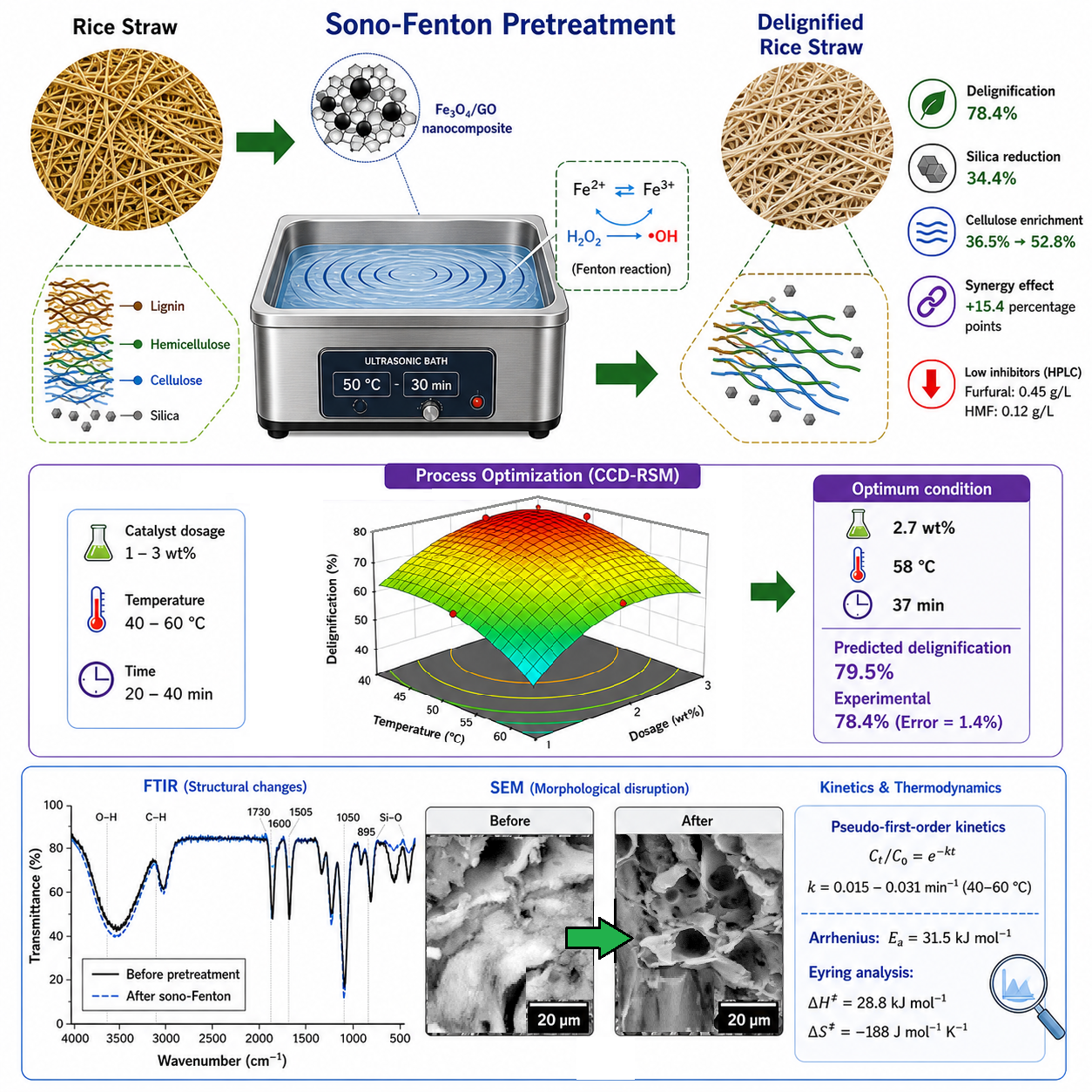
Downloads
References
Food and Agriculture Organization of the United Nations. World food and agriculture - Statistical yearbook 2020. FAO, Rome, Italy, 2020.
T Lepage, M Kammoun, Q Schmetz and A Richel. Biomass-to-hydrogen: A review of main routes production, processes evaluation and techno-economical assessment. Biomass Bioenergy 2021; 144, 105920.
Q Huang, YP Tang, ZF Zhang, Z Wang and L Dai. Catalytic asymmetric transformation of platform chemicals derived from lignocellulosic biomass. Chemical Communications 2025; 61(50), 8960-8968.
TK Tran, CK Trinh, GH Tran, TL Luong, AT Nguyen, HJ Leu, VD Le and N Kim. The utilization of rice straw (Oryza Sativa L.) as a green catalyst in the enhanced production of hydrogen via the thermochemical conversion process of shrimp farm sludge. International Journal of Hydrogen Energy 2024; 52, 32-45.
J Sun, R Ding and J Yin. Pretreatment corn ingredient biomass with high pressure CO2 for conversion to fermentable sugars via enzymatic hydrolysis of cellulose. Industrial Crops and Products 2022; 177, 114518.
G Sharma, M Kumar, AK Pandey, S Kumari, A Singh, NA Ansari and NA Gaur. Pretreatment technologies for valorisation of lignocellulosic biomass towards sustainable biorefineries: Comprehensive insights and advances. Bioresource Technology Reports 2025; 32, 102336.
H Ardhiansyah, M Kusumaningrum, ZAS Bahlawan, H Prasetiawan, F Savanti and HA Fauziyyah. Green pretreatment techniques for enhanced delignification of lignocellulosic biomass: A case study of biomass waste in Indonesia. IOP Conference Series: Earth and Environmental Science 2024; 1381, 012034.
A Kheto, A Chaudhari, S Manikpuri, R Sehrawat, K Gul, L Kumar and KA Khan. Effect of ultrasonic-pretreatment on soaking kinetics, nutritional, anti-nutritional, and functional properties of guar seeds. LWT 2024; 213, 117046.
Z Qin, L Cheng, L Liu, R Zhang, S Zhao and L Ma. Combined effects of organic solvent and ultrasonic pretreatments on cellulose fiber extraction from hemp. Industrial Crops and Products 2024; 220, 119436.
AY Ghjeer and AH Abbar. A comparative study of four technologies (Fenton, Sono-Fenton (SF), Electro-Fenton (EF), and Sono-Electro-Fenton (SEF)) for hospital wastewater treatment. Case Studies in Chemical and Environmental Engineering 2023; 8, 100519.
RF Abbas, MJM Hassan and AM Rheima. Adsorption of fast green dye onto Fe3O4 MNPs and GO/Fe3O4 MNPs synthesized by photo-irradiation method: Isotherms, thermodynamics, kinetics, and reuse studies. Sustainable Chemistry for the Environment 2024; 6, 100104.
M Moghaddam-Manesh, R Darvishi, A Barati, A Moshkriz and M Seyedsharifi. Synthesis of novel Fe3O4@gly@Indole@CuNO3 magnetic nanoparticle as high-performance antibiotic absorbent, antimicrobial agent, and reusable magnetic Nano catalyst. Journal of Environmental Chemical Engineering 2025; 13(1), 114970.
SIA Shah, W Ahmad, M Anwar, R Shah, JA Khan, NS Shah, A Al-Anazi and C Han. Synthesis, properties, and applications of Fe3O4 and Fe3O4-based nanocomposites: A review. Applied Catalysis O: Open 2025; 203, 207049.
C Donga, SB Mishra, LN Ndlovu, AS Abd-El-Aziz, AT Kuvarega and AK Mishra. Magnetic magnetite-graphene oxide (Fe3O4-GO) nanocomposites for removal of dyes from aqueous solution. Journal of Inorganic and Organometallic Polymers and Materials 2024; 34, 4192-4202.
J Waluyo, FC Abimanyu, FY Widharmo, SH Pranolo, M Kaavessina, I Kurnia and IT Purba. Co-precipitated magnetic graphene oxide nanocomposites for methyl orange uptake: Isotherm, kinetic, and regeneration. Results in Chemistry 2025; 18, 102790.
H Ardhiansyah, TD Kusworo and AC Kumoro. Enhanced structural stability of Fe3O4/GO–PEG nanocomposite for ultrasonic pretreatment applications. Trends in Sciences 2026; 23(6), 12444.
PJV Soest, JB Robertson and BA Lewis. Methods for dietary fiber, neutral detergent fiber, and nonstarch polysaccharides in relation to animal nutrition. Journal of Dairy Science 1991; 74(10), 3583-3597.
Technical Association of the Pulp and Paper Industry. Acid-insoluble ash in wood and pulp (TAPPI T 244 cm-99). TAPPI, Karnataka, India, 1999.
L Segal, JJ Creely, AE Martin Jr and CM Conrad. An empirical method for estimating the degree of crystallinity of native cellulose using the x-ray diffractometer. Textile Research Journal 1959; 29(10), 786-794.
MC Maguyon-Detras, MVP Migo, NV Hung and M Gummert. Thermochemical Conversion of Rice Straw. Springer, Switzerland, 2019, p. 43-64.
M Munoz, ZM de Pedro, JA Casas and JJ Rodriguez. Preparation of magnetite-based catalysts and their application in heterogeneous Fenton oxidation - A review. Applied Catalysis B: Environmental 2015; 176-177, 249-265.
S Merouani, A Dehane, O Hamdaoui and M Ashokkumar. Review of ultrasonication-assisted Fenton processes for degrading aqueous pollutants. Ultrasonics Sonochemistry 2026; 124, 107725.
Y Kawamata, T Yoshikawa, H Aoki, Y Koyama, Y Nakasaka, M Yoshida and T Masuda. Kinetic analysis of delignification of cedar wood during organosolv treatment with a two-phase solvent using the unreacted-core model. Chemical Engineering Journal 2019; 368, 71-78.
S Sarma, VK Dubey and VS Moholkar. Kinetic and thermodynamic analysis (with statistical optimization) of hydrogen production from crude glycerol using Clostridium pasteurianum. International Journal of Hydrogen Energy 2016; 41(44), 19972-19989.
MJ Taherzadeh and K Karimi. Enzyme-based hydrolysis processes for ethanol from lignocellulosic materials: A Review. BioResources 2007; 2(4), 707-738.
E Palmqvist and B Hahn-Hägerdal. Fermentation of lignocellulosic hydrolysates. II: Inhibitors and mechanisms of inhibition. Bioresource Technology 2000; 74(1), 25-33.
LJ Jönsson and C Martín. Pretreatment of lignocellulose: Formation of inhibitory by-products and strategies for minimizing their effects. Bioresource Technology 2016; 199, 103-112.
EJ Yazdi, GJW Euverink and J Yue. Pretreatment and enzymatic hydrolysis of tertiary cellulose for glucose production. Industrial Crops and Products 2025; 237, 122144.
M Schwanninger, JC Rodrigues, H Pereira and B Hinterstoisser. Effects of short-time vibratory ball milling on the shape of FT-IR spectra of wood and cellulose. Vibrational Spectroscopy 2004; 36(1), 23-40.
P Basnet, PK Jha, A Gupta and S Chatterjee. Synergistic effect of Tea-phytochemicals, Noble metals and Zno Nano-Photo-Composites for combating resistance of bacterial growth. Journal of Nano Research 2021; 70, 53-66.
PK Jha, W Khongnakorn, C Chawenjkigwanich, MS Chowdhury and K Techato. Eco-friendly reduced graphene oxide nanofilter preparation and application for iron removal. Separations 2021; 8(5), 68.
PK Jha, C Chawengkijwanich, K Techato, W Limbut and M Luengchavanon. Callistemon viminalis leaf extract mediated biosynthesis of Ag, rGO-Ag-ZnO nanomaterials for catalytic PEM fuel cell application. Trends in Sciences 2022; 19(11), 493.
SS Singh, LT Lim and A Manickavasagan. Ultrasound-assisted alkali-urea pre-treatment of Miscanthus × giganteus for enhanced extraction of cellulose fiber. Carbohydrate Polymers 2020; 247, 116758.
T Chiranjeevi, AJ Mattam, KK Vishwakarma, A Uma, VCR Peddy, S Gandham and HR Velankar. Assisted single-step acid pretreatment process for enhanced delignification of rice straw for bioethanol production. ACS Sustainable Chemistry & Engineering 2018; 6(7), 8762-8774.
ACF Louis, S Venkatachalam and S Gupta. Innovative strategy for rice straw valorization into nanocellulose and nanohemicellulose and its application. Industrial Crops and Products 2022; 179, 114695.
YK Ravi, S Kavitha, S Palani, G Kumar and RJ Banu. Ultrasonic induced mechanoacoustic effect on delignification of rice straw for cost effective biopretreatment and biomethane recovery. Sustainable Energy & Fuels 2021; 5(6), 1832-1844.
Z Ziaei-Rad, M Pazouki, J Fooladi, M Azin, SN Gummadi and A Allahverdi. Investigation of a robust pretreatment technique based on ultrasound-assisted, cost-effective ionic liquid for enhancing saccharification and bioethanol production from wheat straw. Scientific Reports 2023; 13, 446.
Downloads
Published
How to Cite
Issue
Section
License
Copyright (c) 2026 Walailak University

This work is licensed under a Creative Commons Attribution-NonCommercial-NoDerivatives 4.0 International License.