
Response Surface Optimization of Citronella Oil Encapsulation using Gum Arabic as Biopesticide
DOI:
https://doi.org/10.48048/tis.2025.10329Keywords:
Biopesticide, Citronella Oil, Encapsulation, Coacervation, Biopesticide, Citronella oil, Encapsulation, CoacervationAbstract
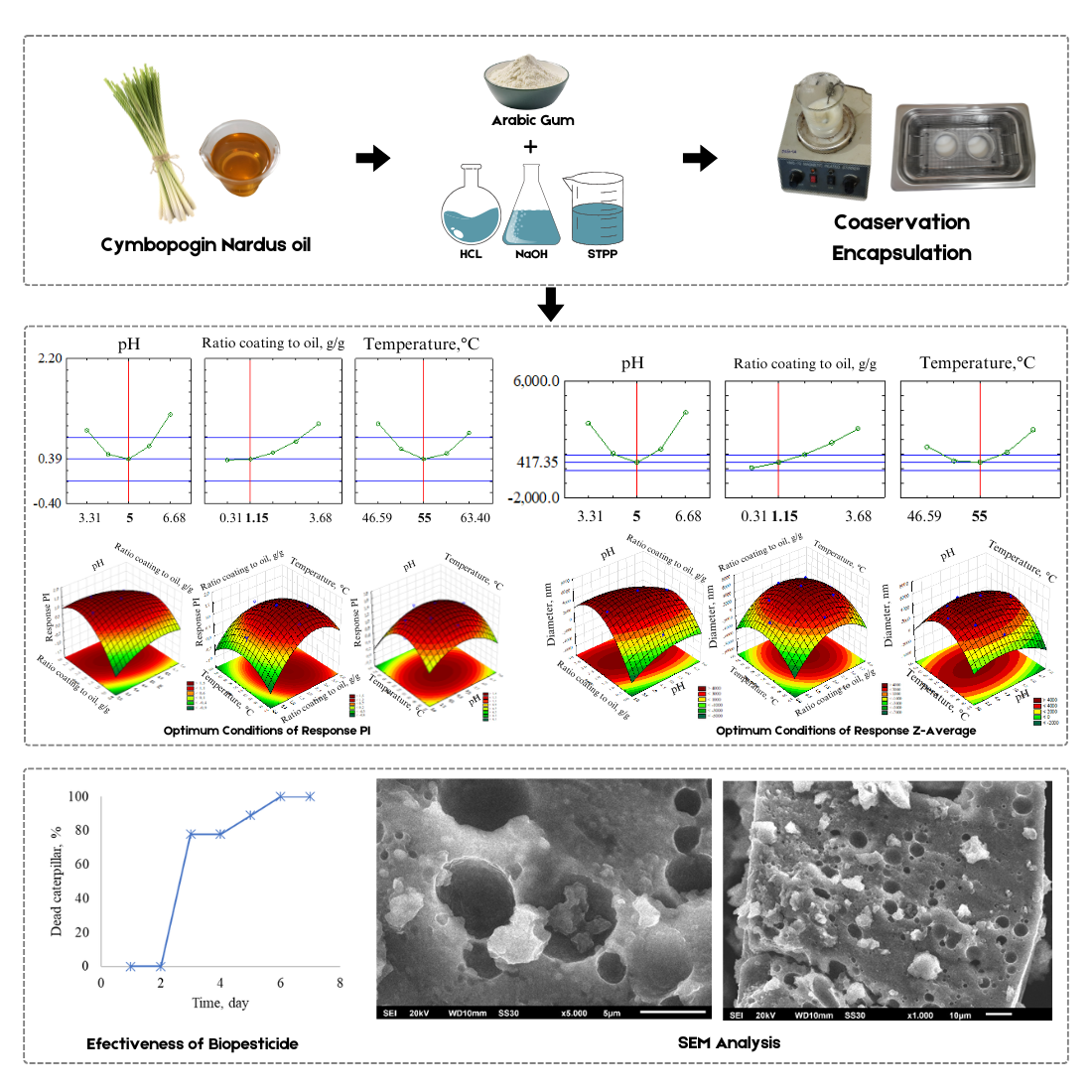
The use of chemical pesticides negatively impacts the environment, health, and ecosystems, necessitating safer alternatives such as biopesticides. This study aimed to determine the effects and optimal conditions of pH, temperature, and coating-to-oil ratio on the distribution and encapsulation size result. Encapsulation was done by dissolving, gum Arabic as coating agent in water and mixed at 50 °C. This solution was then combined with citronella oil and vigorously mixed. pH and temperature of the solution were adjusted to form microdroplets. Finally, a crosslinking agent was added to solidify the droplets, and they were further processed to remove air bubbles. Response Surface Methodology was employed to optimize the distribution and encapsulation size, resulting optimum conditions were achieved at pH 5, coating to oil ratio of 1.159:1 (gum arabic to essential oil, g/g), and a temperature of 55 °C. Efficacy tests revealed that citronella oil biopesticide killed 77.85% of Spodoptera exigua pests on day 3, compared to 55.85% in the control group without biopesticide. This study demonstrates the potential of citronella oil biopesticide as an alternative to chemical pesticides.
HIGHLIGHTS
- The study successfully optimized the encapsulation process of citronella oil-based biopesticides using response surface methodology (RSM).
- Optimal conditions were determined at pH 5, temperature 55 °C, and a coating-to-oil ratio of 1:1.591 g/g, achieving a uniform particle size.
- The encapsulated biopesticide effectively controlled Spodoptera litura, reaching 80% mortality by day 4 and 100% by day 7.
- The optimized formulation yielded a PI of 0.39 and a Z-Average particle size of 417.35 nm, ensuring enhanced stability and efficacy.
GRAPHICAL ABSTRACT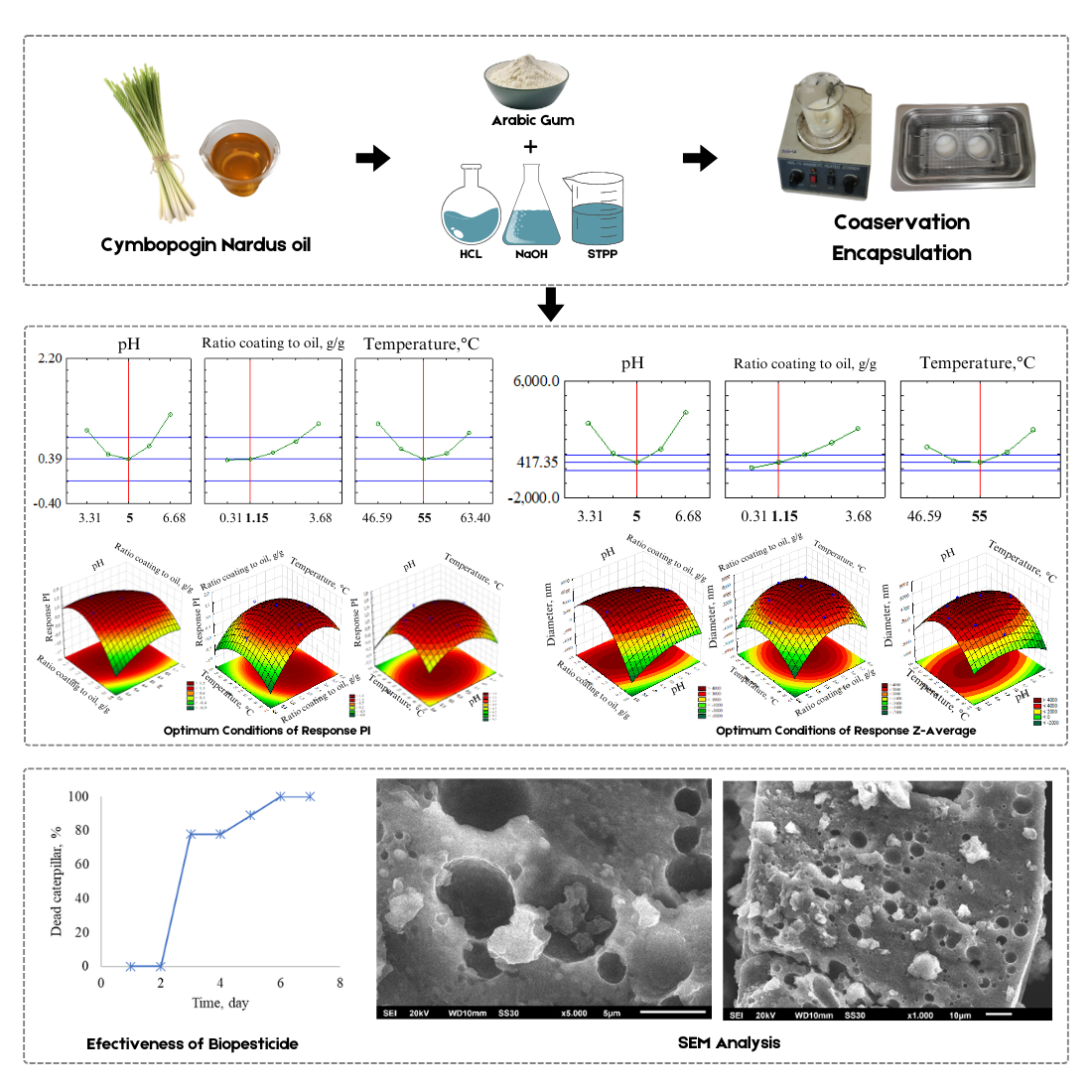
Downloads
References
CM Viana, D Freire, P Abrantes, J Rocha and P Pereira. Agricultural land systems importance for supporting food security and sustainable development goals: A systematic review. Science of the Total Environment 2022; 806, 150718.
M Tudi, H Daniel Ruan, L Wang, J Lyu, R Sadler, D Connell, C Chu and DT Phung. Agriculture development, pesticide application and its impact on the environment. International Journal of Environmental Research and Public Health 2021; 18, 1112.
MF Ahmad, FA Ahmad, AA Alsayegh, M Zeyaullah, AM AlShahrani, K Muzammil, AA Saati, S Wahab, EY Elbendary, N Kambal, MH Abdelrahman and S Hussain. Pesticides impacts on human health and the environment with their mechanisms of action and possible countermeasures. Heliyon 2024; 10(7), e29128.
S Barathi, N Sabapathi, S Kandasamy and J Lee. Present status of insecticide impacts and eco-friendly approaches for remediation-a review. Environmental Research 2024; 240, 117432.
W Aktar, D Sengupta and A Chowdhury. Impact of pesticides use in agriculture: Their benefits and hazards. Interdisciplinary Toxicology 2009; 2(1), 1-12.
A Alengebawy, ST Abdelkhalek, SR Qureshi and MQ Wang. Heavy metals and pesticides toxicity in agricultural soil and plants: Eecological risks and human health implications. Toxics 2021; 9, 42.
VM Pathak, VK Verma, BS Rawat, B Kaur, N Babu, A Sharma, S Dewali, M Yadav, R Kumari, S Singh, A Mohapatra, V Pandey, N Rana and JM Cunil. Current status of pesticide effects on environment, human health and it’s eco-friendly management as bioremediation: A comprehensive review. Frontiers in Microbiology 2022; 13, 962619.
MS Ayilara, BS Adeleke, SA Akinola, CA Fayose, UT Adeyemi, LA Gbadegesin, RK Omole, RM Johnson, QO Uthman and OO Babalola. Biopesticides as a promising alternative to synthetic pesticides: A case for microbial pesticides, phytopesticides, and nanobiopesticides. Frontiers in Microbiology 2023; 14, 1040901.
A Khursheed, MA Rather, V Jain, AR Wani, S Rasool, R Nazir, NA Malik and SA Majid. Plant based natural products as potential ecofriendly and safer biopesticides: A comprehensive overview of their advantages over conventional pesticides, limitations and regulatory aspects. Microbial Pathogenesis 2022; 173, 105854.
NL Arpiwi, IK Muksin and NL Kartini. Essential oil from Cymbopogon nardus and repellant activity against aedes aegypti. Biodiversitas 2020; 21(8), 3873-3878.
MŞŞ Demirak and E Canpolat. Plant-based bioinsecticides for mosquito control: Impact on insecticide resistance and disease transmission. Insects 2022; 13(2), 162.
I Sari, M Misrahanum, M Faradilla, CM Ayuningsih and H Maysarah. Antibacterial activity of citronella essential oil from Cymbopogon nardus (L.) Rendle) against methicillin resistant Staphylococcus aureus. Indonesian Journal of Pharmaceutical and Clinical Research 2022; 5(1), 16-22.
MA Manaf, I Subuki, J Jai, R Raslan and AN Mustapa. Encapsulation of volatile citronella essential oil by coacervation: Efficiency and release study. IOP Conference Series: Materials Science and Engineering 2018; 358(1), 012072.
N Nezamdoost-Sani, S Amiri and AM Khaneghah. The application of the coacervation technique for microencapsulation bioactive ingredients: A critical review. Journal of Agriculture and Food Research 2924; 18, 101431.
LCD Silva, RM Castelo, HN Cheng, A Biswas, RF Furtado and CR Alves. Methods of microencapsulation of vegetable oil: Principles, stability and applications - a minireview. Food Technology and Biotechnology 2022; 60(3), 308-320.
B Solomon, FF Sahle, T Gebre-Mariam, K Asres and RHH Neubert. Microencapsulation of citronella oil for mosquito-repellent application: Formulation and in vitro permeation studies. European Journal of Pharmaceutics and Biopharmaceutics 2912; 80(1), 61-66.
FRA Aziz, J Jai, R Raslan and I Subuki. Microencapsulation of citronella oil by complex coacervation using chitosan-gelatin (b) system: Operating design, preparation and characterization. MATEC Web of Conferences 2016; 69, 04002.
A Rungwasantisuk and S Raibhu. Application of encapsulating lavender essential oil in gelatin/gum-arabic complex coacervate and varnish screen-printing in making fragrant gift-wrapping paper. Progress in Organic Coatings 2020; 149, 105924.
K Mirlohi and WCB McTigue. Coacervation for biomedical applications: Innovations involving nucleic acids. Soft Matter 2024; 21, 8-26.
A Pujiastuti, E Cahyono and W Sumarni. Enkapsulation of citronellal from citronella oil using B-cyclodextrin and its application as mosquito (Aedes aegypti) reppelent. In: Proceedings of the 3rd International Conference on Mathematics, Science and Education, Semarang, Indonesia. 2016, p. 5-11.
GEP Box and KB Wilson. On the experimental attainment of optimum conditions. In: S Kotz and NL Johnson (Eds.). Breakthroughs in statistics. Springer, New York, 1992, p. 270-310.
AD Myttenaere, B Golden, BL Grand and F Rossi. Mean absolute percentage error for regression models. Neurocomputing 2019; 192, 38-48.
JS Armstrong and F Collopy. Error measures for generalizing about forecasting methods: Empirical comparisons. International Journal of Forecasting 1992; 8(1), 69-80.
M Azhar, PP Widagdo and A Krisma. Perbandingan metode double exponential smoothing dan triple exponential smoothing dalam parameter tingkat error Mean Absolute Percentage Error (MAPE) dan means absolute deviation (MAD). Prosiding Seminar Nasional Ilmu Komputer dan Teknologi Informasi 2019; 4(2), 81-87.
SN Telikepalli, OS Kumru, C Kalonia, R Esfandiary, SB Joshi, CR Middaugh and DB Volkin. Structural characterization of IgG1 mAb aggregates and particles generated under various stress conditions srivalli. Journal of Pharmaceutical Sciences 2014; 103(4), 796-809.
J Liu, SM Louie, J Zhao, X Gao and Y Hu. Aggregation of varied organic coated magnetite nanoparticles: Adsorbed mass and thickness of coatings and interactions with natural organic matter. Science of the Total Environment 2022; 831, 154976.
PD Yates, GV Franks, S Biggs and GJ Jameson. Heteroaggregation with nanoparticles: Effect of particle size ratio on optimum particle dose. Colloids and Surfaces A: Physicochemical and Engineering Aspects 2005; 255(1-3), 85-90.
K Pélissier and D Thierry. Powder and high-solid coatings as anticorrosive solutions for marine and offshore applications? A review. Coatings 2020; 10(10), 916.
MR Bonner. The importance of controlling coating temperature in UV applications. RadTech 2014; 586, 1-11.
S Siegrist, P Nandi, RK Kothandaraman, A Abdessalem, AN Tiwari and F Fu. Understanding coating thickness and uniformity of blade-coated SnO2 electron transport layer for scalable perovskite solar cells. Solar RRL 2023; 7(14), 2300273.
IR Singh and AK Pulikkal. Preparation, stability and biological activity of essential oil-based nano emulsions: A comprehensive review. OpenNano 2022; 8, 100066.
D Lin, AL Kelly and S Miao. The impact of pH on mechanical properties, storage stability and digestion of alginate-based and soy protein isolate-stabilized emulsion gel beads with encapsulated lycopene. Food Chemistry 2021; 372, 131262.
Y Xu, X Yan, H Zheng, J Li, X Wu, J Xu, Z Zhen and C Du. The application of encapsulation technology in the food Industry: Classifications, recent Advances, and perspectives. Food Chemistry X 2023; 21, 101240.
GQ Huang, JX Xiao, L Jia and J Yang. Complex coacervation of O-carboxymethylated chitosan and gum arabic. International Journal of Polymeric Materials and Polymeric Biomaterials 2015; 64(4), 198-204.
MG Carneiro-da-Cunha, MA Cerqueira, BWS Souza, JA Teixeira and AA Vicente. Influence of concentration, ionic strength and pH on zeta potential and mean hydrodynamic diameter of edible polysaccharide solutions envisaged for multinanolayered films production. Carbohydrate Polymers 2011; 85(3), 522-528.
YL Du, GQ Huang, HO Wang and JX Xiao. Effect of high coacervation temperature on the physicochemical properties of resultant microcapsules through induction of Maillard reaction between soybean protein isolate and chitosan. Journal of Food Engineering 2018; 234, 91-97.
Y Wang and T Monetta. Systematic study of preparation technology, microstructure characteristics and mechanical behaviors for SiC particle-reinforced metal matrix composites. Journal of Materials Research and Technology 2023; 25, 7470-7497.
JS Kumar, PS Paul, G Raghunathan and DG Alex. A review of challenges and solutions in the preparation and use of magnetorheological fluids. International Journal of Mechanical and Materials Engineering 2019; 14(1), 1-18.
F Fadilah, EDA Febriani, E Kurniasari, R Nurfikhri and TS Sirait. Encapsulation of Rice Bran Oil (RBO) by complex coacervation using glutaraldehyde as crosslinking agent. Equilibrium Journal of Chemical Engineering 2023; 7(2), 167.
M Fuchs, C Turchiuli, M Bohin, ME Cuvelier, C Ordonnaud, MN Peyrat-Maillard and E Dumoulin. Encapsulation of oil in powder using spray drying and fluidised bed agglomeration. Journal of Food Engineering 2006; 75(1), 27-35.
KA AlMuhaysh, A Sergis and Y Hardalupas. Effects of pH and nanoparticle concentration on Al2O3-H2O nanofluid stability. International Journal of Thermophysics 2025; 46(6), 82.
S Sivalingam, G Golla, L Arunachalam, T Singh, G Karthikeyan, A Shanthi and K Malaichamy. Encapsulation of essential oil to prepare environment friendly nanobio-fungicide against Fusarium oxysporum f.sp. lycopersici: An experimental and molecular dynamics approach. Colloids and Surfaces A: Physicochemical and Engineering Aspects 2024; 681, 132681.
PAO Carmona, RV Tonon, RLD Cunha and MD Hubinger. Influence of emulsion properties on the microencapsulation of orange essential oil by spray drying. Journal of Colloid Science and Biotechnology 2013; 2(2), 130-139.
Published
How to Cite
Issue
Section
License
Copyright (c) 2025 Walailak University

This work is licensed under a Creative Commons Attribution-NonCommercial-NoDerivatives 4.0 International License.





