Comparative analysis of Antioxidants, Antibacterial and Anti-inflammatory Activities of Six Ginger Rhizome Extracts using Aqueous and Ethanolic Solvents
DOI:
https://doi.org/10.48048/tis.2027.14238Keywords:
Ginger, Antioxidants, Anti-inflammatory, Antibacterial, Ginger, Antioxidants, Anti-inflammatory, Antibacterial, Rhizome extracts, Curcuma aromatica, Zingiber montanum, RAW 264.7 macrophages, Nitric oxideAbstract
Ginger rhizomes are rich in a variety of bioactive compounds and have several therapeutic properties. However, the pharmacological potential of local varieties from the regions of biodiversity remains to be explored. To overcome this, the present study analyzed and systematically classified the total phenolic content (TPC), antioxidant, antibacterial and anti-inflammatory properties of twelve extract samples from six local ginger rhizomes using water and ethanol as extraction solvents. Quantitative results showed that TPC of ethanolic extract of Curcuma aromatic Salisb. (5.87 mg/g extract) was higher than other extracts measured by Folin-Ciocalteu method. In antioxidant assays, the ethanolic extract of Curcuma aeruginosa Roxb. was the most potent DPPH radical scavenger (IC50 of 0.66 mg/mL), whereas the aqueous extract of Zingiber montanum (J.Koenig) Link ex A.Dietr. showed the highest ferrous ion-chelating ability (IC50 of 0.14 mg/mL). Antibacterial screening using disc diffusion method revealed that only the ethanolic extract of C. aromatica was effective in inhibiting Bacillus subtilis TISTR 1248 (MIC of 25.63 mg/mL; MBC of 205.00 mg/mL). SEM analysis confirmed significant disruption of bacterial cell wall. Moreover, the anti-inflammatory evaluation on LPS-induced RAW 264.7 macrophages indicated that Z. montanum ethanolic extract decreased nitric oxide production by 75% without cytotoxicity, with cell viability remaining over 80%. The detailed classification analysis clearly identified the ethanolic extracts of C. aromatica, Z. montanum, and C. aeruginosa as the most suitable and effective candidates for targeted antibacterial, anti-inflammatory and radical-scavenging product applications, respectively. This knowledge provides an important scientific baseline for the development of standardized, high value therapeutic formulations from local traditional herbs.
HIGHLIGHTS
- Six ginger rhizome extracts were evaluated using water and ethanol as extraction solvents. Ethanol extracts generally showed higher bioactivity than aqueous extracts.
- aromatica exhibited the highest total phenolic content and strongest antibacterial activity.
- aeruginosa and Z. montanum showed strong antioxidant and anti-inflammatory properties.
- Extracts maintained high cell viability in RAW 264.7 macrophage cells, indicating low cytotoxicity.
- The study supports the potential of ginger extracts in developing antioxidant, anti-inflammatory, and antibacterial herbal products.
GRAPHICAL ABSTRACT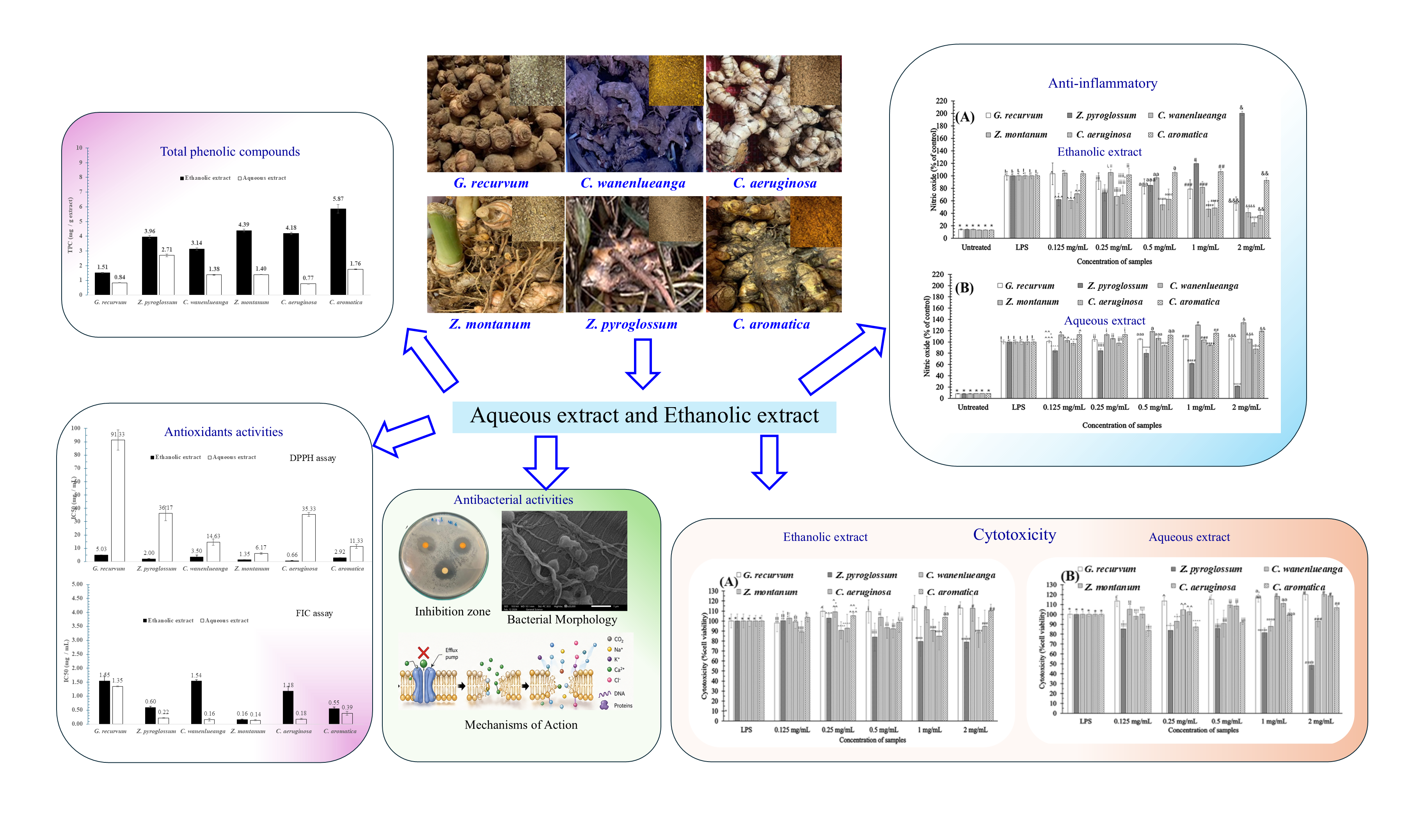
Downloads
References
LG Aregawi, TG Gebremeskel and C Zoltan. Preventive and therapeutic effects of ginger on bowel disease: A review of clinical trials. Pharmacological Research-Modern Chinese Medicine 2024; 12, 100457.
K Srinivasan. Ginger rhizomes (Zingiber officinale): A spice with multiple health beneficial potentials. PharmaNutrition 2017; 5(1), 18-28.
N Hongsuwan, R Intaket, K Srithupthai, K Thuma, S Phanraksa and P Tangsuwannakun. Survey of the utilization of herbs in a family forest: Case study of Mr. Chuangchan Usaprom’s family forest. Journal of Thai Traditional and Alternative Medicine 2020; 18(3), 625-637.
A Saengwong, W Phakdeekul and W Kedthongma. Development strategic of Sakonnakhon herbal city. Research and Development Health System Journal 2019; 13(1), 551-561.
UN Prakash and K Srinivasan. Fat digestion and absorption in spice‐pretreated rats. Journal of the Science of Food and Agriculture 2012; 92(3), 503-510.
UNS Prakash and K Srinivasan. Enhanced intestinal uptake of iron, zinc and calcium in rats fed pungent spice principles–piperine, capsaicin and ginger (Zingiber officinale). Journal of Trace Elements in Medicine and Biology 2013; 27(3), 184-190.
ESM ElRokh, NAZ Yassin, SMA El-Shenawy and BMM Ibrahim. Antihypercholesterolaemic effect of ginger rhizome (Zingiber officinale) in rats. Inflammopharmacology 2010; 18(6), 309-315.
PB Naidu, VS Uddandrao, RR Naik, P Suresh, B Meriga, MS Begum, R Pandiyan and G Saravanan. Ameliorative potential of gingerol: Promising modulation of inflammatory factors and lipid marker enzymes expressions in HFD induced obesity in rats. Molecular and Cellular Endocrinology 2016; 419, 139-147.
F Shidfar, A Rajab, T Rahideh, N Khandouzi, S Hosseini and S Shidfar. The effect of ginger (Zingiber officinale) on glycemic markers in patients with type 2 diabetes. Journal of Complementary and Integrative Medicine 2015; 12(2), 165-170.
MS Abdelhamid, MH Sherif, HR Abaza, LM El‐Maghraby, SH Watad and AE Awad. Zingiber officinale extract maximizes the efficacy of simvastatin as a hypolipidemic drug in obese male rats. Food Science & Nutrition 2024; 12(3), 1940-1954.
OR Justo, PU Simioni, DL Gabriel, WMDSC Tamashiro, PDTV Rosa and ÂM Moraes. Evaluation of in vitro anti-inflammatory effects of crude ginger and rosemary extracts obtained through supercritical CO2 extraction on macrophage and tumor cell line: The influence of vehicle type. BMC Complementary and Alternative Medicine 2015; 15, 390.
I Bischoff-Kont and R Fürst. Benefits of ginger and its constituent 6-shogaol in inhibiting inflammatory processes. Pharmaceuticals 2021; 14(6), 571.
M Akimoto, M Iizuka, R Kanematsu, M Yoshida and K Takenaga. Anticancer effect of ginger extract against pancreatic cancer cells mainly through reactive oxygen species-mediated autotic cell death. PLoS One 2015; 10(5), e0126605.
AP Wardana, AN Kristanti, NS Aminah, MZ Fahmi, M Raoov and Indriani. Breast cancer chemoprevention from nano Zingiber officinale roscoe. International Journal of Nanomedicine 2024; 19, 11039-11053.
F Ayustaningwarno, G Anjani, AM Ayu and V Fogliano. A critical review of Ginger’s (Zingiber officinale) antioxidant, anti-inflammatory, and immunomodulatory activities. Frontiers in Nutrition 2024; 11, 1364836.
KR Shanmugam, K Mallikarjuna, N Kesireddy and KS Reddy. Neuroprotective effect of ginger on anti-oxidant enzymes in streptozotocin-induced diabetic rats. Food and Chemical Toxicology 2011; 49(4), 893-897.
DDCH Rampengan, RA Syahputra, P Halim, DA Kumalawati, RN Ramadhan, R Surya, E Wiyarta, HK Permatasari, RR Tjandrawinata, NA Taslim, B Kim, TE Tallei, A Tsopmo and F Nurkolis. Red ginger confers antioxidant activity, inhibits lipid and sugar metabolic enzymes, and downregulates miR-21/132 expression. Journal of Agriculture and Food Research 2024; 18, 101526.
S Preecharram, S Posoongnoen, T Thummawongsa, T Sripakdee, S Tawil, N Poomsuk and J Jandaruang. Proximate composition and antioxidant activity of young flattened rice (Khao-Mao). Trends in Sciences 2023; 20(4), 6575.
S Preecharram, S Phosri, T Theansungnoen, W Roschat, S Arthan, S Lasopha and J Jandaruang. Nutritional values and their potential applications in food products of krabok seed (Irvingia malayana). Trends in Sciences 2024; 21(1), 7316.
S Preecharram, S Posoongnoen, T Thummavongsa, W Pasom, S Panyakom, T Sripakdee and J Jandaruang. Values, bioactive compound, antioxidant activities of brown rice and germinated brown rice, and the pellet products. Creative Science 2025; 17(1), 257996.
S Preecharram, P Jearranaiprepame, S Daduang, Y Temsiripong, T Somdee, T Fukamizo, J Svasti, T Araki and S Thammasirirak. Isolation and characterisation of crocosin, an antibacterial compound from crocodile (Crocodylus siamensis) plasma. Animal Science Journal 2010; 81, 393-401.
C Joubouhi, JDD Tamokou, D Ngnokam, L Voutquenne-Nazabadioko and JR Kuiate. Iridoids from Canthium subcordatum iso-butanol fraction with potent biological activities. BMC Complementary and Alternative Medicine 2017; 17, 17.
J Jandaruang, S Phosri, N Poomsuk, S Arthan, S Posoongnoen, T Thummavongsa, K Siriwong and S Preecharram. Bioactivities of leaf extracts from Urceola polymorpha (Pierre) DJ Middleton & Livsh., Hyptis suaveolens (L.) Poit, and Passiflora foetida L. leaf: Antioxidant, antibacterial, cytotoxic and anti-tyrosinase potential with molecular docking analysis. Trends in Sciences 2025; 22(8), 10162.
S Phosri, P Mahakunakorn, J Lueangsakulthai, N Jangpromma, P Swatsitang, S Daduang, A Dhiravisit and S Thammasirirak. An investigation of antioxidant and anti-inflammatory activities from blood components of crocodile (Crocodylus siamensis). The Protein Journal 2014; 33(5), 484-492.
S Aryal, MK Baniya, K Danekhu, P Kunwar, R Gurung and N Koirala. Total phenolic content, flavonoid content and antioxidant potential of wild vegetables from Western Nepal. Plants 2019; 8(4), 96.
OC Adebooye, R Vijayalakshmi and V Singh. Peroxidase activity, chlorophylls and antioxidant profile of two leaf vegetables (Solanum nigrum L. and Amaranthus cruentus L.) under six pretreatment methods before cooking. International Journal of Food Science & Technology 2008; 43(1), 173-178.
MK Uddin, AS Juraimi, ME Ali and MR Ismail. Evaluation of antioxidant properties and mineral composition of purslane (Portulaca oleracea L.) at different growth stages. International Journal of Molecular Sciences 2012; 13(8), 10257-10267.
SC Burri, A Ekholm, Å Håkansson, E Tornberg and K Rumpunen. Antioxidant capacity and major phenol compounds of horticultural plant materials not usually used. Journal of Functional Foods 2017; 38(A), 119-127.
NK Alqahtani, ZA Salih, SA Asiri, A Siddeeg, SAD Elssiddiq, TM Alnemr and HM Habib. Optimizing physicochemical properties, antioxidant potential, and antibacterial activity of dry ginger extract using sonication treatment. Heliyon 2024; 10(16), e36473.
U Kumar, I Kumar, PK Singh, JS Yadav, A Dwivedi, P Singh, S Mishra and RK Sharma. Total phenolic content and antioxidant activities in methanol extracts of medicinal herbs from Indo-Gangetic plains of India. Journal of Applied Biology & Biotechnology 2024; 12(4), 89-99.
S Khokhar and RKO Apenten. Iron binding characteristics of phenolic compounds: Some tentative structure–activity relations. Food Chemistry 2003; 81(1), 133-140.
DP Wibowo, R Mariani, SU Hasanah and DL Aulifa. Chemical constituents, antibacterial activity and mode of action of Elephant ginger (Zingiber officinale var. Officinale) and Emprit ginger rhizome (Zingiber officinale var. Amarum) essential oils. Pharmacognosy Journal 2020; 12(2), 404-409.
QQ Mao, XY Xu, SY Cao, RY Gan, H Corke, T Beta and HB Li. Bioactive compounds and bioactivities of ginger (Zingiber officinale Roscoe). Foods 2019; 8(6), 185.
S Revathi and N Malathy. Antibacterial activity of rhizome of Curcuma aromatica and partial purification of active compounds. Indian Journal of Pharmaceutical Sciences 2013; 75(6), 732-735.
A Ghasemzadeh, HZE Jaafar, A Baghdadi and A Tayebi-Meigooni. Formation of 6-, 8- and 10-shogaol in ginger through application of different drying methods: Altered antioxidant and antimicrobial activity. Molecules 2018; 23(7), 1646.
S Phewphong, W Roschat, J Jandaruang, T Leelatam, S Arthan, N Poomsuk, A Thammayod, B Maneerat, A Namthaisong, K Siriwong and V Promarak. Analysis of volatile organic compounds, antioxidant, tyrosinase inhibitory, and antimicrobial activities of essential oils from citronella grass and kaffir lime. Trends in Sciences 2025; 22(4), 9434.
S Pandidan and A Mechler. Latest developments on the mechanism of action of membrane disrupting peptides. Biophysics Reports 2021; 7(3), 173-184.
YJ Surh. Molecular mechanisms of chemopreventive effects of selected dietary and medicinal phenolic substances. Mutation Research/Fundamental and Molecular Mechanisms of Mutagenesis 1999; 428(1-2), 305-327.
X Zheng, R Wen, Y Liu, L Gan, Q Zhang, Y Jiang and P Tu. Nitric oxide inhibitory phenolic constituents isolated from the roots and rhizomes of Notopterygium incisum. Bioorganic Chemistry 2022; 128, 106060.
YC Chen, SC Shen, WR Lee, WC Hou, LL Yang and TJ Lee. Inhibition of nitric oxide synthase inhibitors and lipopolysaccharide induced inducible NOS and cyclooxygenase‐2 gene expressions by rutin, quercetin, and quercetin pentaacetate in RAW 264.7 macrophages. Journal of Cellular Biochemistry 2001; 82(4), 537-548.
Downloads
Published
How to Cite
Issue
Section
License
Copyright (c) 2026 Walailak University

This work is licensed under a Creative Commons Attribution-NonCommercial-NoDerivatives 4.0 International License.