Synergistic Antibacterial Activity of Polyherbal Combination of Orthosiphon aristatus (Blume) Miq., Sonchus arvensis L., and Curcuma longa L. Extracts against Pseudomonas aeruginosa Associated with Urinary Tract Infections
DOI:
https://doi.org/10.48048/tis.2026.14169Keywords:
Antibacterial, Orthosiphon aristatus (kumis kucing), Sonchus arvensis (tempuyung), Curcuma longa (turmeric), Urinary tract infections (UTI)Abstract
Urinary tract infections (UTI) remain one of the most prevalent infectious diseases globally and are closely linked to nephrolithiasis (kidney stones). These infections are typically caused by bacteria, which results in urinary flow obstruction. This growing concern over antibiotic failure has intensified the search for safe and effective phytotherapeutic alternatives. Thus, this study aimed to explore the antimicrobial properties of the leaves of Orthosiphon aristatus (Blume) Miq. (kumis kucing; OA) and Sonchus arvensis L. (tempuyung; SA) and the rhizome of turmeric (Curcuma longa L.; CL) against 5 microorganisms commonly implicated in UTI. Plant materials were extracted using ethanol and characterized via thin-layer chromatography. Antibacterial activities were tested by using the disc diffusion method at varying concentrations and combinations. Chromatographic analysis identified predictive key bioactive constituents, namely, sinensetin in OA, luteolin in SA, and curcumin in CL. Antibacterial assays against Pseudomonas aeruginosa showed that single extracts OA, SA, and CL possessed low antibacterial activity. Interestingly, the addition of CL significantly enhanced antibacterial activity. The 1:1:1 combination yielded the highest synergistic zone of inhibition (3.81 ± 0.52); however, it remained lower than that of chloramphenicol as a positive control. No activity was observed against Staphylococcus aureus, Proteus mirabilis, Escherichia coli, and Candida albicans. The findings provide a scientific basis for the traditional use of OA and SA in treating urinary tract complications while highlighting the significant role of CL in enhancing antibacterial potency related to P. aeruginosa infection.
HIGHLIGHTS
- The triple combination of aristatus, S. arvensis, and C. longa shows anti-bacterial synergism against P. aeruginosa.
- Polyherbal formulations at a 1:1:1 ratio is more effective than single-extract treatments in suppressing the growth aeruginosa.
- TLC analysis identified sinensetin, luteolin, and curcumin as the primary bioactive markers driving the antibacterial activity.
- longa serves as a critical potentiator in the blend, likely enhancing the permeability and susceptibility of the bacterial cells.
GRAPHICAL ABSTRACT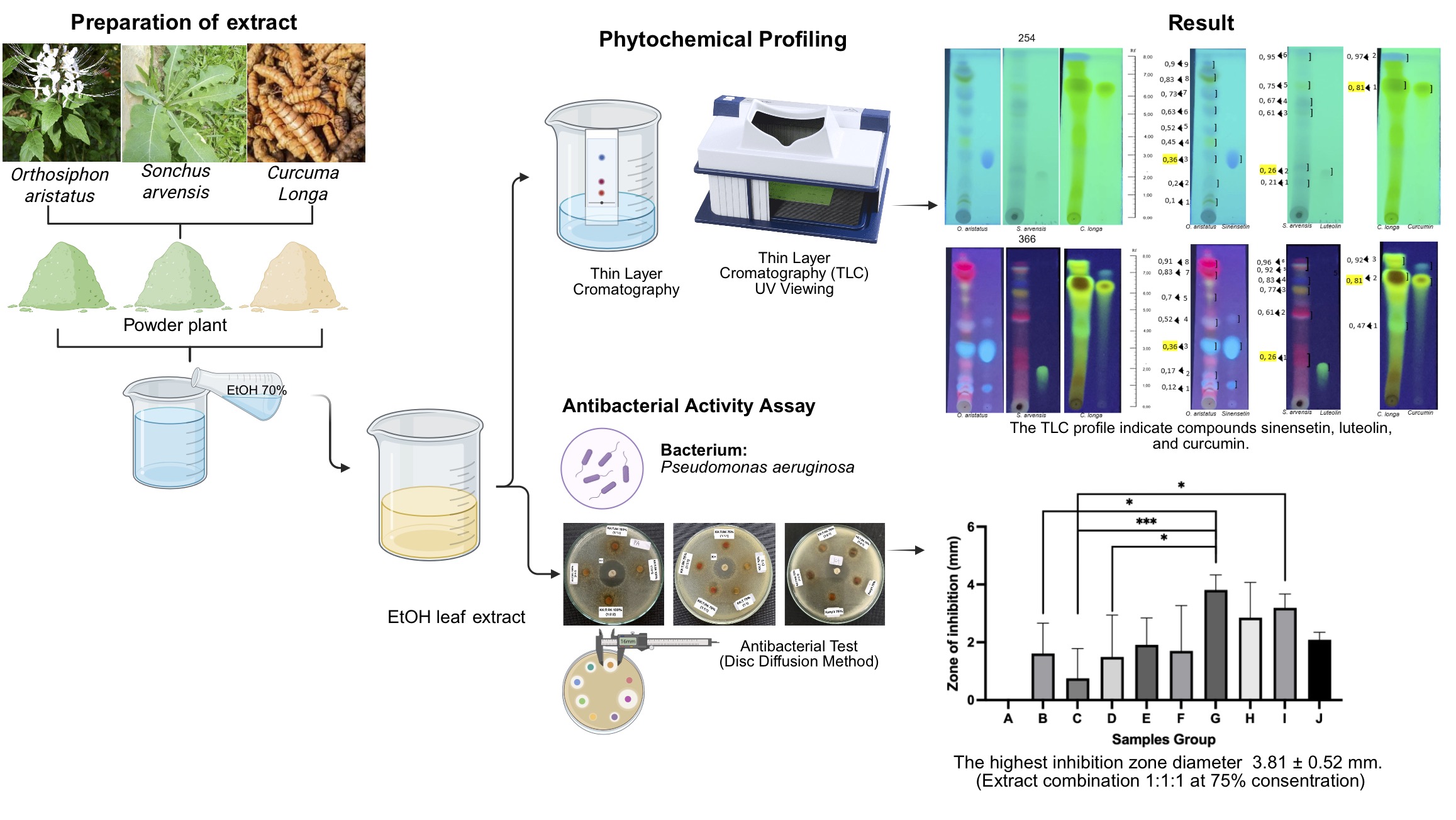
Downloads
References
E Rando, F Giovannenze, R Murri and E Sacco. A review of recent advances in the treatment of adults with complicated urinary tract infection. Expert Review of Clinical Pharmacology 2022; 15(9), 1053-1066.
A Razi, A Ghiaei, FK Dolatabadi and R Higuchi. Unraveling the association of bacteria and urinary stones in patients with urolithiasis: An update review article. Frontiers in Medicine 2024; 11, 1401808.
J Josephs-Spaulding, TJ Krogh, HC Rettig, M Lyng, M Chkonia, S Waschina, S Graspeuntner, J Rupp, J Møller-Jensen and C Kaleta. Recurrent urinary tract infections: Unraveling the complicated environment of uncomplicated rUTIs. Frontiers in Cellular and Infection Microbiology 2021; 11, 562525.
JC Nickel. Management of urinary tract infections: Historical perspective and current strategies: Part 2--Modern management. The Journal of Urology 2005; 173(1), 27-32.
Y He, J Zhao, L Wang, C Han, R Yan, P Zhu, T Qian, S Yu, X Zhu and W He. Epidemiological trends and predictions of urinary tract infections in the Global Burden of Disease Study 2021. Scientific Reports 2025; 15(1), 4702.
N Sathe, P Beech, L Croft, C Suphioglu, A Kapat and E Athan. Pseudomonas aeruginosa: Infections and novel approaches to treatment. Infectious Medicine 2023; 2(3), 178-194.
G Mancuso, A Midiri, E Gerace, M Marra, S Zummo and C Biondo. Urinary tract infections: The current scenario and future prospects. Pathogens 2023; 12(4), 623.
LM Nolan and LP Allsopp. Antimicrobial weapons of Pseudomonas aeruginosa. Advances in Experimental Medicine and Biology 2022; 1386, 223-256.
C Hickey, B Schaible, S Nguyen, D Hurley, S Srikumar, S Fanning, E Brown, B Crifo, D Matallanas, S McClean, CT Taylor and K Schaffer. Increased virulence of bloodstream over peripheral isolates of P. aeruginosa identified through post-transcriptional regulation of virulence factors. Frontiers in Cellular and Infection Microbiology 2018; 8, 357.
D Reynolds and M Kollef. The epidemiology and pathogenesis and treatment of Pseudomonas aeruginosa infections: An update. Drugs 2021; 81(18), 2117-2131.
F Khan. Multifaceted strategies for alleviating Pseudomonas aeruginosa infection by targeting protease activity: Natural and synthetic molecules. International Journal of Biological Macromolecules 2024; 278, 134533.
K Ashraf, S Sultan and A Adam. Orthosiphon stamineus Benth. is an outstanding food medicine: Review of phytochemical and pharmacological activities. Journal of Pharmacy and Bioallied Sciences 2018; 10(3), 109-118.
WH Xu, HT Wang, Y Sun, ZC Xue, ML Liang and WK Su. Antihyperuricemic and nephroprotective effects of extracts from Orthosiphon stamineus in hyperuricemic mice. Journal of Pharmacy and Pharmacology 2020; 72(4), 551-560.
NA Abd Aziz, R Hasham, MR Sarmidi, SH Suhaimi and MKH Idris. A review on extraction techniques and therapeutic value of polar bioactives from Asian medicinal herbs: Case study on Orthosiphon aristatus, Eurycoma longifolia and Andrographis paniculata. Saudi Pharmaceutical Journal 2021; 29(2), 143-165.
MB Ambursa, MNG Rahman, SA Sulaiman, AD Zakaria, MAD Daud, Z Zakaria, Z Zahari and MPK Wong. An in vitro study of Orthosiphon stamineus (Misai Kucing) standardized water extract as a chemolytic agent in urolithiasis. Journal of Pharmacy and Bioallied Sciences 2021; 13(4), 373-379.
MA Alshawsh, MA Abdulla, S Ismail, ZA Amin, SW Qader, HA Hadi and NS Harmal. Free radical scavenging, antimicrobial and immunomodulatory activities of Orthosiphon stamineus. Molecules 2012; 17(5), 5385-5395.
MA Hossain and SMM Rahman. Isolation and characterisation of flavonoids from the leaves of medicinal plant Orthosiphon stamineus. Arabian Journal of Chemistry 2015; 8(2), 218-221.
JB do Nascimento and JGM da Costa. Flavonoids: A review of antibacterial activity against Gram-negative bacteria. International Journal of Microbiology 2025; 2025, 9961121.
NF Shamsudin, QU Ahmed, S Mahmood, SAA Ali Shah, A Khatib, S Mukhtar, MA Alsharif, H Parveen and ZA Zakaria. Antibacterial effects of flavonoids and their structure-activity relationship study: A comparative interpretation. Molecules 2022; 27(4), 1149.
N Suliska, N Kurniati and EY Sukandar. Anredera cordifolia (Ten.) Steenis and Sonchus arvensis L. inhibit gentamicin-induced nephrotoxicity: The role of urinary N-acetyl beta-D-glucosaminidase. Journal of Reports in Pharmaceutical Sciences 2021; 10, 256-260.
N Parisa, R Hidayat, Z Maritska and BA Prananjaya. Evaluation of the anti-gout effect of Sonchus arvensis on monosodium urate crystal-induced gout arthritis via anti-inflammatory action - an in vivo study. Medicine and Pharmacy Reports 2021; 94(3), 358-365.
A Rosyidah, S Widyarti and S Rahayu. The effect of Calcusol™ to the plasma free radical and serum creatinin in Mus musculus nephrolithiasis model. Journal of Tropical Life Science 2013; 3(3), 143-148.
D Zheng, C Huang, H Huang, Y Zhao, MRU Khan, H Zhao and L Huang. Antibacterial mechanism of curcumin: A review. Chemistry and Biodiversity 2020; 17(8), e2000171.
C Dai, J Lin, H Li, Z Shen, Y Wang, T Velkov and J Shen. The natural product curcumin as an antibacterial agent: Current achievements and problems. Antioxidants 2022; 11(3), 459.
Z Li, B Qu, L Zhou, Chen H, J Wang, W Zhang and C Chen. A new strategy to investigate the efficacy markers underlying the medicinal potentials of Orthosiphon stamineus Benth. Frontiers in Pharmacology 2021; 12, 748684.
K Sheng, J You, S Tian, Y Lu, J Wu and J Zhang. Optimization of extraction process for flavonoids from Sonchus oleraceus L. and evaluation of anti-inflammatory activity of luteoloside. Molecules 2026; 31(7), 1105.
L Zeng, T Yang, K Yang, G Yu, J Li, W Xiang and H Chen. Efficacy and safety of curcumin and Curcuma longa extract in the treatment of arthritis: A systematic review and meta-analysis of randomized controlled trial. Frontiers in Immunology 2022; 13, 891822.
RH Andira, W Yuniati and A Tjitraresmi. Review: Isolasi, analisis, aktivitas farmakologi dan toksisitas sinensetin (in Indonesian). Indonesian Journal of Biological Pharmacy 2024; 4(1), 53-61.
K Kartini, RE Putri and R Budiono. Quantification of sinensetin in Orthosiphon stamineus from various phytogeographical zones in Indonesia. Journal of Applied Pharmaceutical Science 2023; 13(03), 183-191.
NP Ramadhani, YB Murti and AP Gani. Profiling rosmarinic acid and sinensetin content of Orthosiphon aristatus from 3 different locations with variety ethanol concentration. Journal of Food and Pharmaceutical Sciences 2024; 12(2), 116-124.
S Fauziah, P Melati, AH Mulyati, M Rafi and E Rohaeti. Thin layer chromatography fingerprint analysis of tempuyung (Sonchus arvensis L.). Jurnal Kimia Sains dan Aplikasi 2023; 26(5), 187-193.
AP Aswathi, SB Raghav and D Prasath. Assessment of genetic variation in turmeric (Curcuma longa L.) varieties based on morphological and molecular characterization. Genetic Resources and Crop Evolution 2023; 70(1), 147-158.
NAM Helmy, AF Basyony, STK Tohamy and SA Zaki. Effective therapeutic strategies against Pseudomonas aeruginosa and Burkholderia cepacia complex infections. Scientific Reports 2025; 15(1), 41462.
A Elfadadny, RF Ragab, M AlHarbi, F Badshah, E Ibáñez-Arancibia, A Farag, AO Hendawy, PR De los Ríos-Escalante, M Aboubakr, SA Zakai and WM Nageeb. Antimicrobial resistance of Pseudomonas aeruginosa: Navigating clinical impacts, current resistance trends, and innovations in breaking therapies. Frontiers in Microbiology 2024; 15, 1374466.
MM Hasan, P Roy, M Alam, MdM Hoque and W Zzaman. Antimicrobial activity of peels and physicochemical properties of juice prepared from indigenous citrus fruits of Sylhet region, Bangladesh. Heliyon 2022; 8(7), e09948.
YOD Nganso, EMS Tchana, AD Kahouo, AG à N Amang, K Abah, H Fomena and H Mamoudou. Inhibitory effect and antimicrobial activity of secondary metabolites of Khaya senegalensis (Desr.) A. Juss. (Meliaceae). Science Journal of Chemistry 2020; 8(4), 81-94.
SS Patel, A Acharya, RS Ray, R Agrawal, R Raghuwanshi and P Jain. Cellular and molecular mechanisms of curcumin in prevention and treatment of disease. Critical Reviews in Food Science and Nutrition 2020; 60(6), 887-939.
HB De Silva, Y Dai, S Homer-Vanniasinkam and M Edirisinghe. Antimicrobial effect of spices and their phytochemicals: A novel approach to overcoming antibiotic resistance. MedComm 2026; 7(4), e70680.
ME Abd El-Hack, MT El-Saadony, AA Swelum, M Arif, MM Abo Ghanima, M Shukry, A Noreldin, AE Taha and KA El-Tarabily. Curcumin, the active substance of turmeric: Its effects on health and ways to improve its bioavailability. Journal of the Science of Food and Agriculture 2021; 101(14), 5747-5762.
F Apriliani, Suwendar and BTU Laksono. Uji aktivitas antibakteri ekstrak etanol dan fraksi ekstrak daun kumis kucing (Orthosiphon stamineus) terhadap Escherichia coli secara in vitro menggunakan metode mikrodilusi (in Indonesian). Bandung Conference Series: Pharmacy 2024; 4(2), 305-312.
[86] MAE Mohammed, YA Ali, TE Hagr, SY Altay, RA Musa and HM Hamadnalla. Phytochemical screening, antimicrobial and antioxidant activities of Sonchus oleraceus L. (leaves) extracts. Journal of Pharmaceutical Research & Reports 2020; 1(1), 1-4.
NN Zulkefle, N Zainal, DK Wahyuni, S Mahmood, KDR Ramarao and KL Chin. Antimicrobial properties of Sonchus species: a review. Asian Pacific Journal of Tropical Biomedicine 2025; 15(5), 177.
S Sethupathy, KG Prasath, S Ananthi, S Mahalingam, SY Balan and SK Pandian. Proteomic analysis reveals modulation of iron homeostasis and oxidative stress response in Pseudomonas aeruginosa PAO1 by curcumin inhibiting quorum sensing regulated virulence factors and biofilm production. Journal of Proteomics 2016; 145, 112-126.
A Shariati, E Asadian, F Fallah, T Azimi, A Hashemi, J Yasbolaghi Sharahi and M Taati Moghadam. Evaluation of nano-curcumin effects on expression levels of virulence genes and biofilm production of multidrug-resistant Pseudomonas aeruginosa isolated from burn wound infection in Tehran, Iran. Infection and Drug Resistance 2019; 12, 2223-2235.
A Shukla, G Shukla, P Parmar, B Patel, D Goswami and M Saraf. Exemplifying the next generation of antibiotic susceptibility intensifiers of phytochemicals by LasR-mediated quorum sensing inhibition. Scientific Reports 2021; 11(1), 22421.
S Fernandes, A Borges, IB Gomes, SF Sousa and M Simões. Curcumin and 10-undecenoic acid as natural quorum sensing inhibitors of LuxS/AI-2 of Bacillus subtilis and LasI/LasR of Pseudomonas aeruginosa. Food Research International 2023; 165, 112519.
A Shariati, M Noei, M Askarinia, A Khoshbayan, A Farahani and Z Chegini. Inhibitory effect of natural compounds on quorum sensing system in Pseudomonas aeruginosa: A helpful promise for managing biofilm community. Frontiers in Pharmacology 2024; 15, 1350391.
Downloads
Published
How to Cite
Issue
Section
License
Copyright (c) 2026 Walailak University

This work is licensed under a Creative Commons Attribution-NonCommercial-NoDerivatives 4.0 International License.