
The Active Fraction of Physalis angulata Linn. Increases PPARγ and GLUT4 mRNA Expression in an In Vitro Insulin-Resistant C2C12 Cells
DOI:
https://doi.org/10.48048/tis.2026.12840Keywords:
P. angulata active fraction, Insulin resistance, GLUT4, PPAR, Good health and well-being, C2C12 myotubes, Palmitate-induced insulin resistanceAbstract
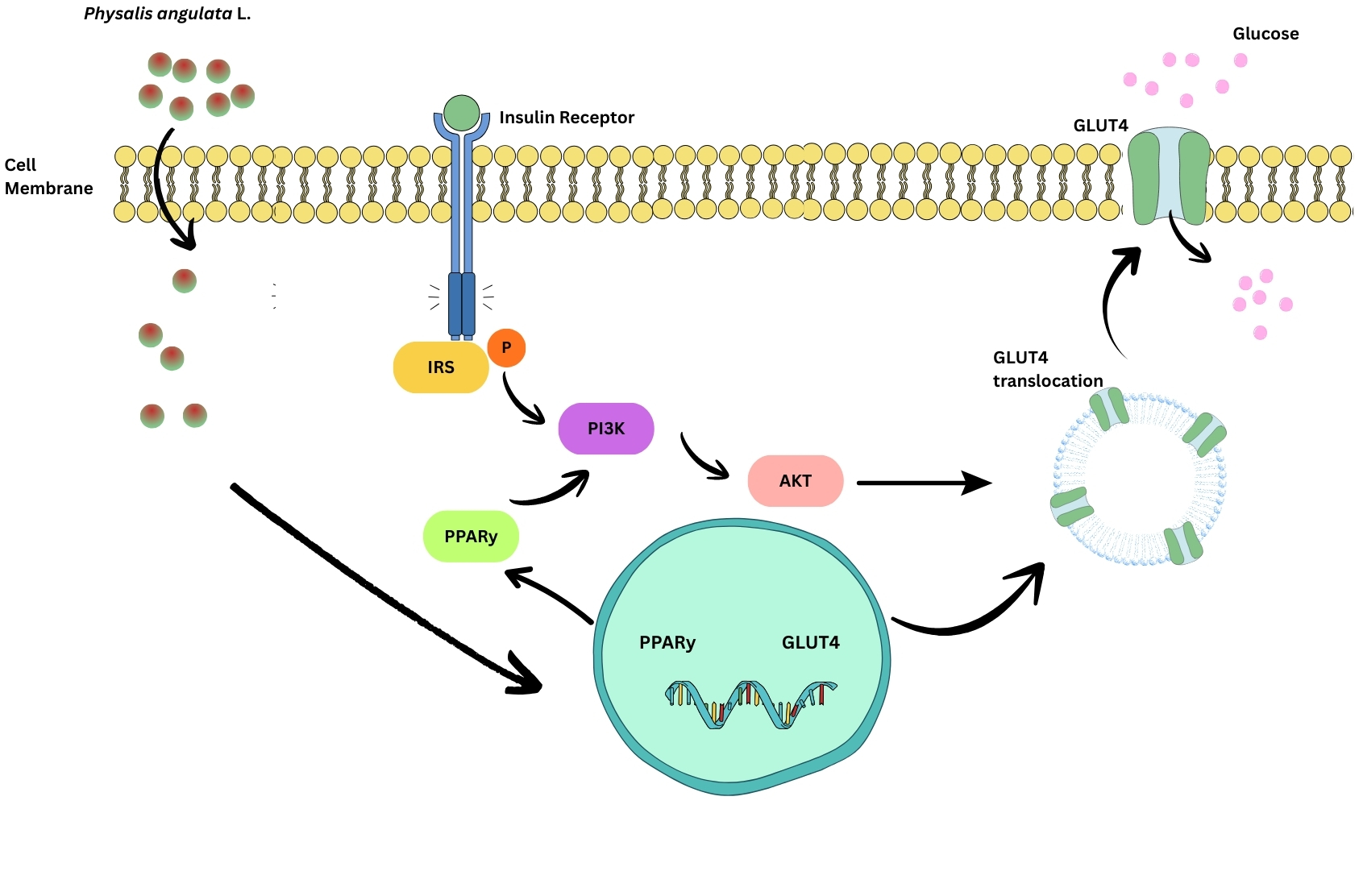
Insulin resistance, a key feature of type 2 diabetes, is characterized by impaired glucose uptake associated with dysregulation of PPARγ and GLUT4. This study investigated the effects of the active fraction of Physalis angulata Linn. (P. angulata), commonly known as ciplukan, on PPARγ and GLUT4 mRNA expression in an in vitro insulin-resistant C2C12 cell model. Insulin resistance was induced using palmitate, followed by treatment with the active fraction of P. angulata (100 μg/mL) for 4, 12, and 24 h. PPARγ and GLUT4 mRNA expression levels were quantified using reverse transcription quantitative real-time polymerase chain reaction (RT-qPCR). The active fraction of P. angulata significantly increased PPARγ mRNA expression at 4, 12, and 24 h and GLUT4 mRNA expression at 12 h compared with the control group (p < 0.05). These results demonstrate a time-dependent upregulation of genes involved in lipid metabolism and glucose transport in insulin-resistant C2C12 cells. The findings suggest that the active fraction of P. angulata may influence the expression of PPARγ and GLUT4 mRNA in insulin-resistant C2C12 cells, warranting further investigation.
HIGHLIGHTS
- Physalis angulata is traditionally known for its antidiabetic potential.
- Fraction Physalis angulata enhanced PPARγ and GLUT4 gene expression in insulin-resistant C2C12 myotubes.
- The study provides preliminary insight into its potential cellular effects.
GRAPHICAL ABSTRACT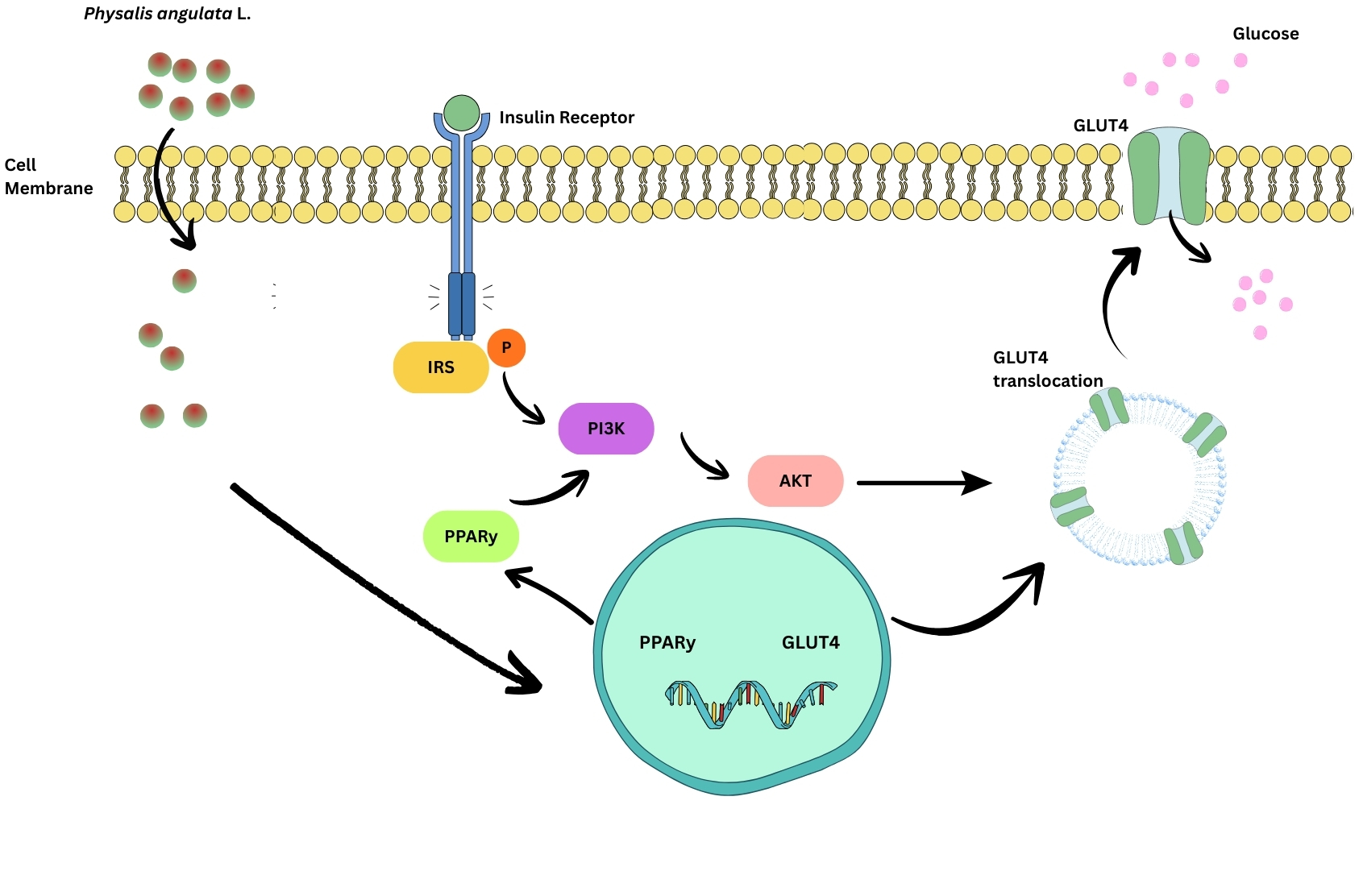
Downloads
References
D Lindarto, E Decroli, H Permana, KW Sucipto, Y Kusnadi, Budiman, MR Ikhsan, L Sasiarini and H Sanusi. Pedoman Pengelolaan dan Pencegahan Diabetes Melitus Tipe 2 di Indonesia 2021. Perkumpulan Endokrinologi Indonesia, Indonesia, 2021.
WHO, Available at: https://www.who.int/health-topics/diabetes#tab=tab_1, accessed July 2023.
U Galicia-Garcia, A Benito-Vicente, S Jebari, A Larrea-Sebal, H Siddiqi, KB Uribe, H Ostolaza and C Martín. Pathophysiology of type 2 diabetes mellitus. International Journal of Molecular Sciences 2020; 21(17), 6275.
K Ahmad, S Shaikh, JH Lim, SS Ahmad, HJ Chun, EJ Lee and I Choi. Therapeutic application of natural compounds for skeletal muscle-associated metabolic disorders: A review on diabetes perspective. Biomedicine & Pharmacotherapy 2023; 168, 115642.
S Estrada-Soto, K Ornelas-Mendoza, G Navarrete-Vázquez, F Chávez-Silva, JC Almanza-Pérez, R Villalobos-Molina, E Ortiz-Barragán, H Loza-Rodríguez, JC Rivera-Leyva, A Flores-Flores, I Perea-Arango, JG Rodríguez-Carpena and G Ávila-Villarreal. Insulin sensitization by PPARγ and GLUT-4 overexpression/translocation mediates the antidiabetic effect of Plantago australis. Pharmaceuticals 2023; 16(4), 535.
MSH Wahyuningsih, KSS Wiwekananda, APR Putri, DAA Nugrahaningsih and MM Yuniyanti. Bioassay guided fractionation of Ciplukan (Physalis angulata L.) monitored by glucose consumption assay and thin layer chromatography on myoblast cells. Traditional Medicine Journal 2023; 28(1), 22-30.
FB Papilaya, MSH Wahyuningsih and RA Syarif. Active fraction of Ciplukan (Physalis angulate L.) increases phosphorylation on IRS-1 Tyr-612 and Akt Ser-473 in 24-hour incubation time. Journal of Applied Pharmaceutical Science 2025; 15(5), 121-128.
R Rakhmawati, ST Wahyudi, MSH Wahyuningsih, Mustofa and AH Sadewa. GC-MS and in silico analyses revealed the potential inhibitory activity of compounds isolated from Ciplukan herb (Physalis angulata L.) targeting GLUT-4 receptors. Journal of Applied Pharmaceutical Science 2024; 14(8), 142-149.
YC Prasetyo. Efek fraksi aktif herba Ciplukan (Physalis Angulata Linn) terhadap konsumsi glukosa sel C2C12 Myotube: Kajian pada model resistensi insulin secara in vitro. Universitas Gadjah Mada, Indonesia, 2023.
Ensembl, Transcript: Exons - Mus musculus (ENSMUST00000000450). Available at: https://asia.ensembl.org/Mus_musculus/Transcript/Exons?db=core;g=ENSMUSG00000000440;r=6:115337912-115467360;t=ENSMUST00000000450, accessed April 2024.
Y Xing, J Zhang, H Wei, H Zhang, Y Guan, X Wang and X Tong. Reduction of the PI3K/Akt related signaling activities in skeletal muscle tissues involves insulin resistance in intrauterine growth restriction rats with catch-up growth. PLoS One 2019; 14(5), 0216665.
CY Wong, H Al-Salami and CR Dass. C2C12 cell model: Its role in understanding of insulin resistance at the molecular level and pharmaceutical development at the preclinical stage. Journal of Pharmacy and Pharmacology 2020; 72(12), 1667-1693.
MH Abu Bakar, KA Shariff, JS Tan and LK Lee. Celastrol attenuates inflammatory responses in adipose tissues and improves skeletal muscle mitochondrial functions in high fat diet-induced obese rats via upregulation of AMPK/SIRT1 signaling pathways. European Journal of Pharmacology 2020; 883, 173371.
KC Anderson, J Liu and Z Liu. Interplay of fatty acids, insulin and exercise in vascular health. Lipids in Health and Disease 2025; 24(4), 1-13.
Y Geng, KN Faber, VE de Meijer, H Blokzijl and H Moshage. How does hepatic lipid accumulation lead to lipotoxicity in non ‑ alcoholic fatty liver disease? Hepatology International 2021; 15(1), 31-35.
WT Chuang, CC Yen, CS Huang, HW Chen and CK Lii. Benzyl isothiocyanate ameliorates high-fat diet-induced hyperglycemia by enhancing Nrf2-dependent antioxidant defense-mediated IRS-1/AKT/TBC1D1 signaling and GLUT4 expression in Skeletal Muscle. Journal of Agricultural and Food Chemistry 2020; 68(51), 15228-15238.
G Taheripak, N Sabeti, N Najar, Z Razavi, S Saharkhiz and I Alipourfard. SIRT1 activation attenuates palmitate induced apoptosis in C2C12 muscle cells. Molecular Biology Reports 2024; 51(1), 354.
VL Tokarz, S Mylvaganam and A Klip. Palmitate-induced insulin resistance causes actin filament stiffness and GLUT4 mis-sorting without altered Akt signalling. Journal of Cell Science 2023; 136(21), 261300.
S Dewanjee, P Paul, TK Dua, S Bhowmick and A Saha. Chapter 38 - Big leaf mahogany seeds: Swietenia macrophylla seeds offer possible phytotherapeutic intervention against diabetic pathophysiology. Academic Press, Massachusetts, 2020, p. 543-565.
B Salehi, C Quispe, J Sharifi-Rad, N Cruz-Martins, M Nigam, AP Mishra, DA Konovalov, V Orobinskaya, IM Abu-Reidah, W Zam, F Sharopov, T Venneri, R Capasso, W Kukula-Koch, A Wawruszak and W Koch. Phytosterols: From preclinical evidence to potential clinical applications. Frontiers in Pharmacology 2021; 11, 599959.
Published
How to Cite
Issue
Section
License
Copyright (c) 2026 Walailak University

This work is licensed under a Creative Commons Attribution-NonCommercial-NoDerivatives 4.0 International License.





