
Glinus oppositifolius (L.) Aug. DC. Ethanolic Extract Attenuates Hydrogen Peroxide-Induced Oxidative Stress and Modulates Apoptosis-Related Gene Expression in HepG2 Cells via Activation of the Nrf2-ARE Signaling Pathway
DOI:
https://doi.org/10.48048/tis.2027.14114Keywords:
Glinus oppositifolius, Hepatoprotection, Oxidative Stress, Nrf2-ARE pathway, Apoptosis, HepG2 cells, Antioxidant enzymes, Glinus oppositifolius, Hepatoprotection, Oxidative stress, Nrf2-ARE pathway, Apoptosis, HepG2 cells, Antioxidant enzymesAbstract
Oxidative stress plays a pivotal role in the development of liver damage, and natural antioxidants have emerged as promising candidates for its prevention. Therefore, this study investigated the protective effects and mechanisms of the Thai local Glinus oppositifolius (Linn.) Aug. DC. ethanolic extract (GOE) against hydrogen peroxide (H2O2)-induced oxidative stress in HepG2 cells. GOE pretreatment at 3.125 - 25 µg/mL protected the cells against H2O2-induced oxidative stress without causing cytotoxicity and significantly reduced intracellular reactive oxygen species (ROS) levels. The extract also showed anti-inflammatory activity by decreasing nitric oxide (NO) production in lipopolysaccharide (LPS)-induced RAW 264.7 cells. Metabolomic profiling analysis revealed that GOE contained a wide range of bioactive metabolites, with phenylpropanoids, flavonoids, terpenoids, and saponins as the major groups likely contributing to its biological activity. Network pharmacology analysis suggested that the protective effect of GOE was associated with the regulation of apoptosis and the Nrf2-ARE signaling pathway. Albiflorin, oleanolic acid, vitexin, isovitexin, acetyl-vitexin, and agnuside are candidate contributors to the protective effect of GOE. Real-time PCR further indicated that GOE modulated apoptosis by downregulating TNF-α, p53, Bax, and Casp3, while upregulating Bcl-2 gene expression. In addition, GOE modulated the Nrf2-ARE signaling pathway by reducing Keap1 and increasing Nrf2, SOD, CAT, HO-1, and NQO1 gene expression. Overall, GOE appears to be a promising source of bioactive phytochemicals for protection against ROS-induced hepatic oxidative stress and may have potential for further pharmaceutical and nutraceutical investigation.
HIGHLIGHTS
- GOE protects HepG2 cells against H2O2-induced ROS and oxidative stress.
- GOE reduces NO production in LPS-induced RAW 264.7 macrophages.
- Flavonoids, terpenoids, and saponins were putatively identified in GOE.
- Albiflorin, oleanolic acid, vitexin derivatives, and agnuside are candidate compounds in GOE.
- GOE modulates apoptosis and Nrf2-ARE signaling-related gene in HepG2 cells.
GRAPHICAL ABSTRACT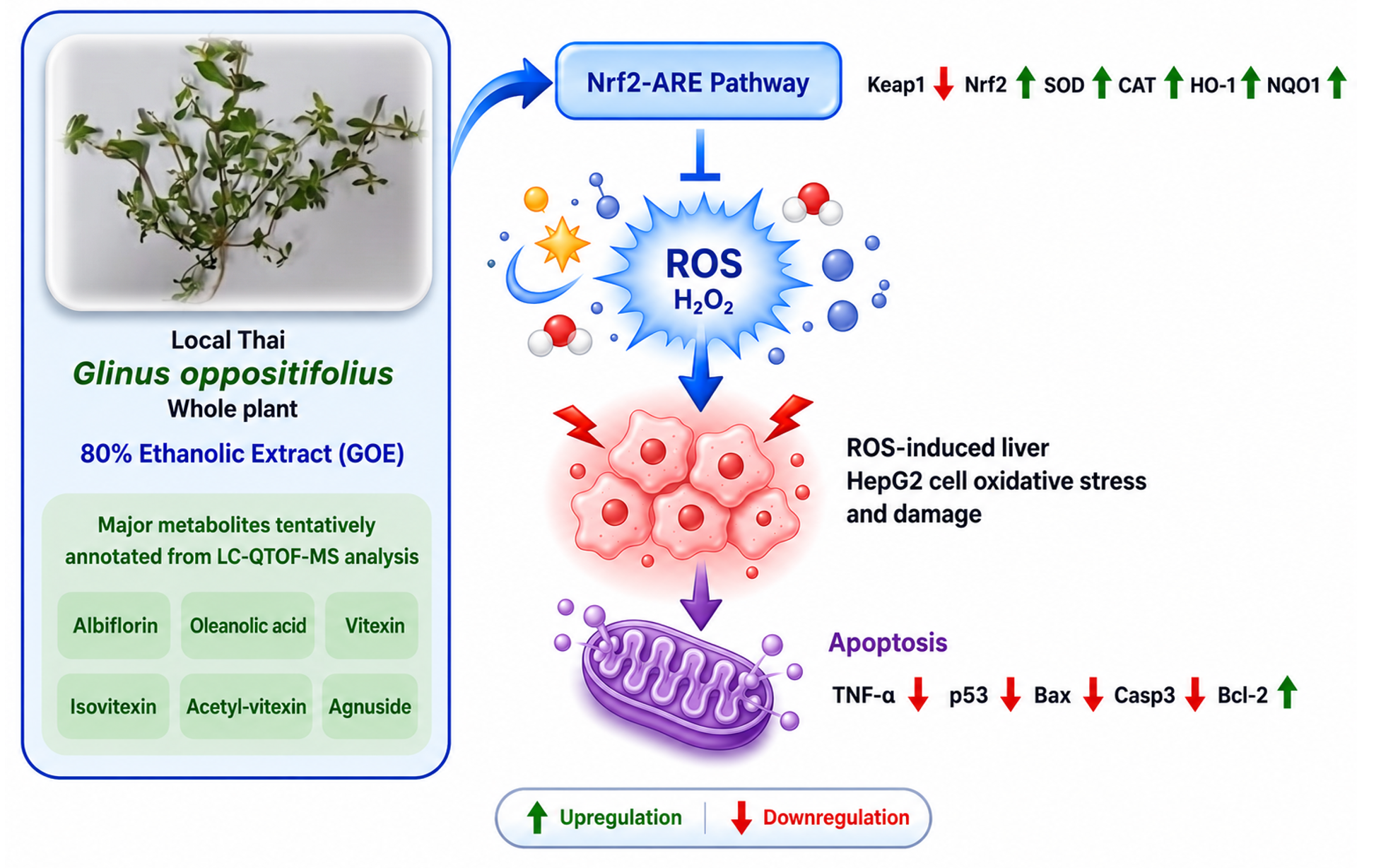
Downloads
References
VP Reddy. Oxidative stress in health and disease. Biomedicines 2023; 11(11), 2925.
A Allameh, R Niayesh-Mehr, A Aliarab, G Sebastiani and K Pantopoulos. Oxidative stress in liver pathophysiology and disease. Antioxidants 2023; 12(9), 1653.
L Conde de la Rosa, L Goicoechea, S Torres, C Garcia-Ruiz and JC Fernandez-Checa. Role of oxidative stress in liver disorders. Livers 2022; 2(4), 283-314.
P Banerjee, N Gaddam, V Chandler and S Chakraborty. Oxidative stress-induced liver damage and remodeling of the liver vasculature. The American Journal of Pathology 2023; 193(10), 1400-1414.
Y Zhou, X Hu, S Zhong, W Yu, J Wang, W Zhu, T Yang, G Zhao, Y Jiang and Y Li. Effects of continuous LPS induction on oxidative stress and liver injury in weaned piglets. Veterinary Sciences 2022; 10(1), 22.
K Nakadate, H Saitoh, M Sakaguchi, F Miruno, N Muramatsu, N Ito, K Tadokoro and K Kawakami. Advances in understanding lipopolysaccharide-mediated hepatitis: Mechanisms and pathological features. Current Issues in Molecular Biology 2025; 47(2), 79.
J Zhou, Q Zheng and Z Chen. The Nrf2 pathway in liver diseases. Frontiers in Cell and Developmental Biology 2022; 10, 826204.
W Tu, H Wang, S Li, Q Liu and H Sha. The anti-inflammatory and anti-oxidant mechanisms of the Keap1/Nrf2/ARE signaling pathway in chronic diseases. Aging and Disease 2019; 10(3), 637-651.
TX Tee, LT Kee, TT Chai, HC Yam, HM Reza, FC Wong, JX Law and SA Tan. Plant-derived Nrf2 activators to enhance liver antioxidative and regenerative potentials. Revista Brasileira de Farmacognosia 2025; 35(1), 61-77.
L Zorem, B Bohia, Lalrokimi, R Lalmuanpuii, F Lalremruati, A Fanai, N Lalhriatpuii, C Lalmuansangi, L Tochhawng, H Lalruatsanga, PK Singh and Zothanpuia. Ethnobotanical validation and phytochemical profiling of Glinus oppositifolius (L.) Aug. DC used by indigenous tribes of Mizoram. Discover Food 2026; 6(1), 91.
N Hoque, MR Habib, MZ Imam, J Ahmed and M Sohel. Analgesic and anti-inflammatory potential of methanolic extract of Glinus oppositifolius L. Australian Journal of Basic and Applied Sciences 2011; 5, 729-733.
C Das, G Ghosh, G Rath, D Das, B Kar, D Pradhan, VK Rai, TK Rajwar, J Halder and P Dash. Chemometric profiling and anti-arthritic activity of aerial parts of Glinus oppositifolius (L.) Aug. DC. Journal of Ethnopharmacology 2024; 328, 117991.
SY Sheu, CH Yao, YC Lei and TF Kuo. Recent progress in Glinus oppositifolius research. Pharmaceutical Biology 2014; 52(8), 1079-1084.
JJ Chen, CS Yang, YH Chen, CY Chao, YC Chen and YH Kuo. New triterpenoids and anti-inflammatory constituents from Glinus oppositifolius. Molecules 2023; 28(7), 2903.
M Feoktistova, P Geserick and M Leverkus. Crystal violet assay for determining viability of cultured cells. Cold Spring Harbor Protocols 2016; 2016(4), pdb.prot087379.
E García-Pérez, D Ryu, C Lee and HJ Lee. Ochratoxin a induces oxidative stress in HepG2 cells by impairing the gene expression of antioxidant enzymes. Toxins 2021; 13(4), 271.
KJ Livak and TD Schmittgen. Analysis of relative gene expression data using real-time quantitative PCR and the 2(-Delta Delta C(T)) Method. Methods 2001; 25(4), 402-408.
LW Sumner, A Amberg, D Barrett, MH Beale, R Beger, CA Daykin, TW Fan, O Fiehn, R Goodacre, JL Griffin, T Hankemeier, N Hardy, J Harnly, R Higashi, J Kopka, AN Lane, JC Lindon, P Marriott, AW Nicholls, MD Reily, JJ Thaden and MR Viant. Proposed minimum reporting standards for chemical analysis Chemical Analysis Working Group (CAWG) Metabolomics Standards Initiative (MSI). Metabolomics 2007; 3(3), 211-221.
H Tsugawa, T Cajka, T Kind, Y Ma, B Higgins, K Ikeda, M Kanazawa, J VanderGheynst, O Fiehn and M Arita. MS-DIAL: Data-independent MS/MS deconvolution for comprehensive metabolome analysis. Nature Methods 2015; 12(6), 523-526.
S Kim, J Chen, T Cheng, A Gindulyte, J He, S He, Q Li, BA Shoemaker, PA Thiessen, B Yu, L Zaslavsky, J Zhang and EE Bolton. PubChem 2025 update. Nucleic Acids Research 2024; 53(D1), D1516-D1525.
D Gfeller, O Michielin and V Zoete. Shaping the interaction landscape of bioactive molecules. Bioinformatics 2013; 29(23), 3073-3079.
G Stelzer, N Rosen, I Plaschkes, S Zimmerman, M Twik, S Fishilevich, T Iny Stein, R Nudel, I Lieder, Y Mazor, S Kaplan, D Dahary, Y Warshawsky, A Guan-Golan, A Kohn, N Rappaport, M Safran and D Lancet. The GeneCards suite: From gene data mining to disease genome sequence analyses. Current Protocols in Bioinformatics 2016; 54(1), 1-30.
M Safran, N Rosen, M Twik, R BarShir, TI Stein, D Dahary, S Fishilevich and D Lancet. The GeneCards suite. In: I Abugessaisa and T Kasukawa (Eds.). Practical guide to life science databases. Springer Nature, Singapore, 2021, p. 27-56.
JC Oliveros. An interactive tool for comparing lists with Venn’s diagrams. Available at: https://bioinfogp.cnb.csic.es/tools/venny/index.html, accessed April 2026.
D Szklarczyk, R Kirsch, M Koutrouli, K Nastou, F Mehryary, R Hachilif, AL Gable, T Fang, NT Doncheva, S Pyysalo, P Bork, LJ Jensen and C von Mering. The STRING database in 2023: Protein-protein association networks and functional enrichment analyses for any sequenced genome of interest. Nucleic Acids Research 2023; 51(D1), D638-D646.
H Alothaid. Evaluation of cytotoxicity, oxidative stress and organ-specific effects of activated carbon from Al-Baha date palm kernels. Saudi Journal of Biological Sciences 2022; 29(9), 103387.
J Lee, J Kim, R Lee, E Lee, TG Choi, AS Lee, YI Yoon, GC Park, JM Namgoong, SG Lee and E Tak. Therapeutic strategies for liver diseases based on redox control systems. Biomedicine & Pharmacotherapy 2022; 156, 113764.
J Jodynis-Liebert and M Kujawska. Biphasic dose-response induced by phytochemicals: Experimental evidence. Journal of Clinical Medicine 2020; 9(3), 718.
R Jia, J Du, L Cao, Y Li, O Johnson, Z Gu, G Jeney, P Xu and G Yin. Antioxidative, inflammatory and immune responses in hydrogen peroxide-induced liver injury of Tilapia (GIFT, Oreochromis niloticus). Fish & Shellfish Immunology 2019; 84, 894-905.
IP Miller, I Pavlović, B Poljšak, D Šuput and I Milisav. Beneficial role of ROS in cell survival: Moderate increases in H2O2 production induced by hepatocyte isolation mediate stress adaptation and enhanced survival. Antioxidants 2019; 8(10), 434.
KA Kumar, MU Maheswari, AT Sivashanmugam, VS Devi, N Subhashini and TK Ravi. Free radical scavenging and antioxidant activities of Glinus oppositifolius (carpet weed) using different in vitro assay systems. Pharmaceutical Biology 2009; 47(6), 474-482.
M Gupta, UK Mazumder, PK Haldar, L Manikandan, GP Senthilkumar and CC Kandar. Hepatoprotective activity of methanol extracts of Glinus oppositifolius and Trianthema decandra against paracetamol induced liver damage. Advances in Traditional Medicine 2007; 7(1), 74-78.
MJ Page, DB Kell and E Pretorius. The role of lipopolysaccharide-induced cell signalling in chronic inflammation. Chronic Stress 2022; 6, 24705470221076390.
N Hue, V Thuy, N Thu, V Diep, N Hang, N Van, T Luc, N Thi Van Anh, T Hien and D Ha. Anti-inflammatory activity in RAW 264.7 cells by standardized extracts and the isolated compound from Glinus oppositifolius. IOSR Journal of Pharmacy 2023; 13(12), 17-25.
V Alexandru, A Miron and V Bild. Preliminary research concerning antinociceptive and antiinflammatory effects of two extracts from Glinus oppositifolius (L.) Aug. DC. Revista Medico-Chirurgicala 2014; 118, 866-872.
P Phucharoenrak, C Muangnoi and D Trachootham. Metabolomic analysis of phytochemical compounds from ethanolic extract of lime (Citrus aurantifolia) peel and its anti-cancer effects against human hepatocellular carcinoma cells. Molecules 2023; 28(7), 2965.
F Traore, R Faure, E Ollivier, M Gasquet, N Azas, L Debrauwer, A Keita, P Timon-David and G Balansard. Structure and antiprotozoal activity of triterpenoid saponins from Glinus oppositifolius. Planta Medica 2000; 66(4), 368-371.
CY Ragasa, DL Espineli, EH Mandia, MJ Don and CC Shen. A new triterpene from Glinus oppositifolius. Chinese Journal of Natural Medicines 2012; 10(4), 284-286.
S Chhanda, T Muslim and M Rahman. Phytochemical studies on Glinus oppositifolius (L.) Aug. DC. Dhaka University Journal of Science 2015; 62(1), 45-48.
P Sahakitpichan, W Disadee, S Ruchirawat and T Kanchanapoom. L-(-)-(N-trans-cinnamoyl)-arginine, an acylamino acid from Glinus oppositifolius (L.) Aug. DC. Molecules 2010; 15(9), 6186-6192.
K Jomova, SY Alomar, R Valko, J Liska, E Nepovimova, K Kuca and M Valko. Flavonoids and their role in oxidative stress, inflammation, and human diseases. Chemico-Biological Interactions 2025; 413, 111489.
Q Zheng, T Wang, S Wang, Z Chen, X Jia, H Yang, H Chen, X Sun, K Wang, L Zhang and F Fu. The anti-inflammatory effects of saponins from natural herbs. Pharmacology & Therapeutics 2025; 269, 108827.
A Daina, O Michielin and V Zoete. SwissTargetPrediction: Updated data and new features for efficient prediction of protein targets of small molecules. Nucleic Acids Research 2019; 47(W1), W357-W364.
W Huang, Y Zhong, B Gao, B Zheng and Y Liu. Nrf2-mediated therapeutic effects of dietary flavones in different diseases. Frontiers in Pharmacology 2023; 14, 1240433.
YR Li, GH Li, MX Zhou, L Xiang, DM Ren, HX Lou, XN Wang and T Shen. Discovery of natural flavonoids as activators of Nrf2-mediated defense system: Structure-activity relationship and inhibition of intracellular oxidative insults. Bioorganic & Medicinal Chemistry 2018; 26(18), 5140-5150.
A Gugliandolo, P Bramanti and E Mazzon. Activation of Nrf2 by natural bioactive compounds: A promising approach for stroke? International Journal of Molecular Sciences 2020; 21(14), 4875.
Y Liao, F Lv, T Quan, C Wang and J Li. Flavonoids in natural products for the therapy of liver diseases: Progress and future opportunities. Frontiers in Pharmacology 2024; 15, 1485065.
YN Li, Y Guo, M Xi, P Yang, XY Zhou, S Yin, CX Hai, JG Li and XJ Qin. Saponins from Aralia taibaiensis attenuate D-galactose-induced aging in rats by activating FOXO3a and Nrf2 pathways. Oxidative medicine and cellular longevity 2014; 2014, 320513.
H Zhang, J Wang, W Lang, H Liu, Z Zhang, T Wu, H Li, L Bai and Q Shi. Albiflorin ameliorates inflammation and oxidative stress by regulating the NF-κB/NLRP3 pathway in Methotrexate-induced enteritis. International Immunopharmacology 2022; 109, 108824.
C Park, HJ Cha, DG Kim, SH Hong, SK Moon, CY Jin, GY Kim, HS Kim, NY Lee, JH Shim and YH Choi. Albiflorin, a monoterpene glycoside, protects myoblasts against hydrogen peroxide-induced apoptosis by activating the Nrf2/HO-1 axis. Biomolecules & Therapeutics 2025; 33(4), 716-727.
SA Reisman, LM Aleksunes and CD Klaassen. Oleanolic acid activates Nrf2 and protects from acetaminophen hepatotoxicity via Nrf2-dependent and Nrf2-independent processes. Biochemical pharmacology 2009; 77(7), 1273-1282.
A Günther and B Bednarczyk-Cwynar. Oleanolic acid: A promising antioxidant-sources, mechanisms of action, therapeutic potential, and enhancement of bioactivity. Antioxidants 2025; 14(5), 598.
W Yan, J Cheng and B Xu. Dietary flavonoids vitexin and isovitexin: New insights into their functional roles in human health and disease prevention. International Journal of Molecular Sciences 2025; 26(14), 6997.
BT Lam, HT Ly, HT Tran and VM Le. Investigation of the main active ingredients of Vitex rotundifolia L.f and assessment of their contribution to the activity of this species. Pharmacological Research - Modern Chinese Medicine 2025; 15, 100608.
R Gnanarajan, D Uvarajan, N Ravichandran, PA Karuppusamy, K Krishnamoorthy, B Vellingiri and A Narayanasamy. Agnuside enhances neuronal survival and cognitive function by modulating PI3K/AKT/mTOR signaling in Aluminium Chloride induced Alzheimer’s disease. Progress in Neuro-Psychopharmacology and Biological Psychiatry 2025; 142, 111532.
A Guerrache and O Micheau. TNF-related apoptosis-inducing ligand: Non-apoptotic signalling. Cells 2024; 13(6), 521.
Q Hao, J Chen, H Lu and X Zhou. The ARTS of p53-dependent mitochondrial apoptosis. Journal of Molecular Cell Biology 2023; 14(10), mjac074.
M Fuertes-Agudo, M Luque-Tévar, C Cucarella, P Martín-Sanz and M Casado. Advances in understanding the role of NRF2 in liver pathophysiology and its relationship with hepatic-specific cyclooxygenase-2 expression. Antioxidants 2023; 12(8), 1491.
N Li, L Hao, S Li, J Deng, F Yu, J Zhang, A Nie and X Hu. The NRF-2/HO-1 signaling pathway: A promising therapeutic target for metabolic dysfunction-associated steatotic liver disease. Journal of Inflammation Research 2024; 17, 8061-8083.
E Martindah, AR Khairullah, R Widiastuti, A Andriani, R Damayanti, I Mustofa, S Mulyati, M Sukmanadi, BWK Wardhani, RZ Ahmad, AO Akintunde, BP Pratama, I Melati, DAA Kurniasih, ANM Ansori, W Yulianti, M Nirwan and S Wibowo. Oxidative stress: Molecular mechanisms, role in pathology, and therapeutic implications. Trends in Sciences 2025; 22(12), 11462.
S Anwar, T Sarwar, AA Khan and AH Rahmani. Therapeutic applications and mechanisms of Superoxide Dismutase (SOD) in different pathogenesis. Biomolecules 2025; 15(8), 1130.
R Liu, J Yang, Y Li, J Xie and J Wang. Heme oxygenase-1: The roles of both good and evil in neurodegenerative diseases. Journal of Neurochemistry 2023; 167(3), 347-361.
D Siegel, DL Gustafson, DL Dehn, JY Han, P Boonchoong, LJ Berliner and D Ross. NAD(P)H: Quinone oxidoreductase 1: Role as a superoxide scavenger. Molecular Pharmacology 2004; 65(5), 1238-1247.
WS Lee, W Ham and J Kim. Roles of NAD(P)H: Quinone oxidoreductase 1 in diverse diseases. Life 2021;11(12), 1301.
SM Shin, JH Yang and SH Ki. Role of the Nrf2-ARE pathway in liver diseases. Oxidative Medicine and Cellular Longevity 2013; 2013, 763257.
JS Park, N Rustamov and YS Roh. The roles of NRF2-regulated oxidative stress and mitochondrial quality control in chronic liver diseases. Antioxidants 2023; 12(11), 1928.
Downloads
Published
How to Cite
Issue
Section
License
Copyright (c) 2026 Walailak University

This work is licensed under a Creative Commons Attribution-NonCommercial-NoDerivatives 4.0 International License.