Curcuma comosa Diarylheptanoids Attenuate LPS-induced Neuroinflammatory Responses via NF-κB Signaling in Microglial Cells: Comparison with Genistein and Estrogen
DOI:
https://doi.org/10.48048/tis.2027.14105Keywords:
Curcuma comosa, iNOS, COX-2, PGE2, Curcuma comosa, Diarylheptanoid, Compound 049, Compound 092, Estrogen, Genistein, iNOS, COX-2, NF-κB, Microglial activationAbstract
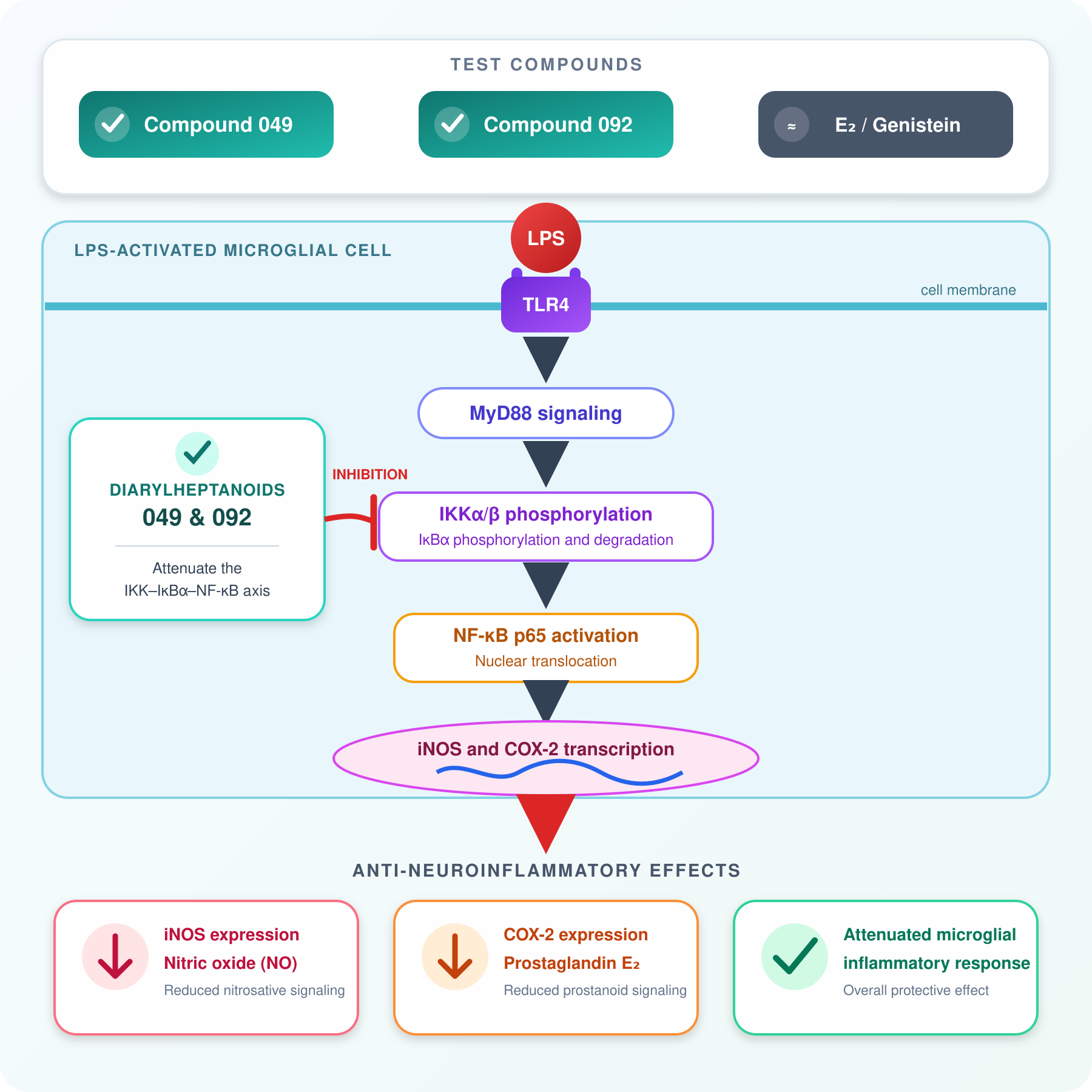
Microglial activation is a hallmark of neuroinflammation in several neurodegenerative disorders, including Parkinson’s disease (PD), Alzheimer’s disease (AD), and AIDS dementia complex. Inhibition of excessive production of pro-inflammatory mediators represents a promising strategy for mitigating neuroinflammatory responses. In menopausal women, declining estrogen levels are associated with increased neuroinflammation and a higher risk of neurodegenerative disorders. Although estrogen replacement therapy exerts anti-inflammatory effects, concerns regarding adverse events have prompted interest in alternative interventions. This study investigated the anti-inflammatory mechanisms of two diarylheptanoids isolated from Curcuma comosa (compounds 049 and 092) in comparison with genistein and estrogen in an LPS-induced microglial activation model. Compounds 049 and 092, as well as genistein and estrogen, significantly reduced nitric oxide (NO) and prostaglandin E2 (PGE2) production, accompanied by downregulation of inducible nitric oxide synthase (iNOS) and cyclooxygenase-2 (COX-2) at both mRNA and protein levels. These effects were associated with reduced phosphorylation of IKKα/IKKβ, IκBα, and NF-κB p65. Collectively, the findings indicate that C. comosa diarylheptanoids attenuate microglial inflammatory responses through modulation of NF-κB-associated signaling pathways. Under the experimental conditions employed, compounds 049 and 092 exhibited anti-inflammatory effects comparable to those observed with genistein and estrogen, supporting further investigation of their neuroprotective potential.
HIGHLIGHTS
- This study provides the first direct comparison of Curcuma comosa-derived diarylheptanoids (compounds 049 and 092) with genistein and estrogen in an LPS-induced microglial activation model.
- Compounds 049 and 092 inhibit LPS-induced NO and PGE2 production in HAPI microglial cells without reducing cell viability.
- Both diarylheptanoids downregulate iNOS and COX-2 expression at the mRNA and protein levels.
- Compounds 049 and 092 attenuate LPS-induced phosphorylation of IKKα//IKKβ, IκBα, and NF-κB p
- Their anti-inflammatory profiles are broadly comparable to those of genistein and estrogen, supporting further investigation of their potential as modulators of neuroinflammation.
GRAPHICAL ABSTRACT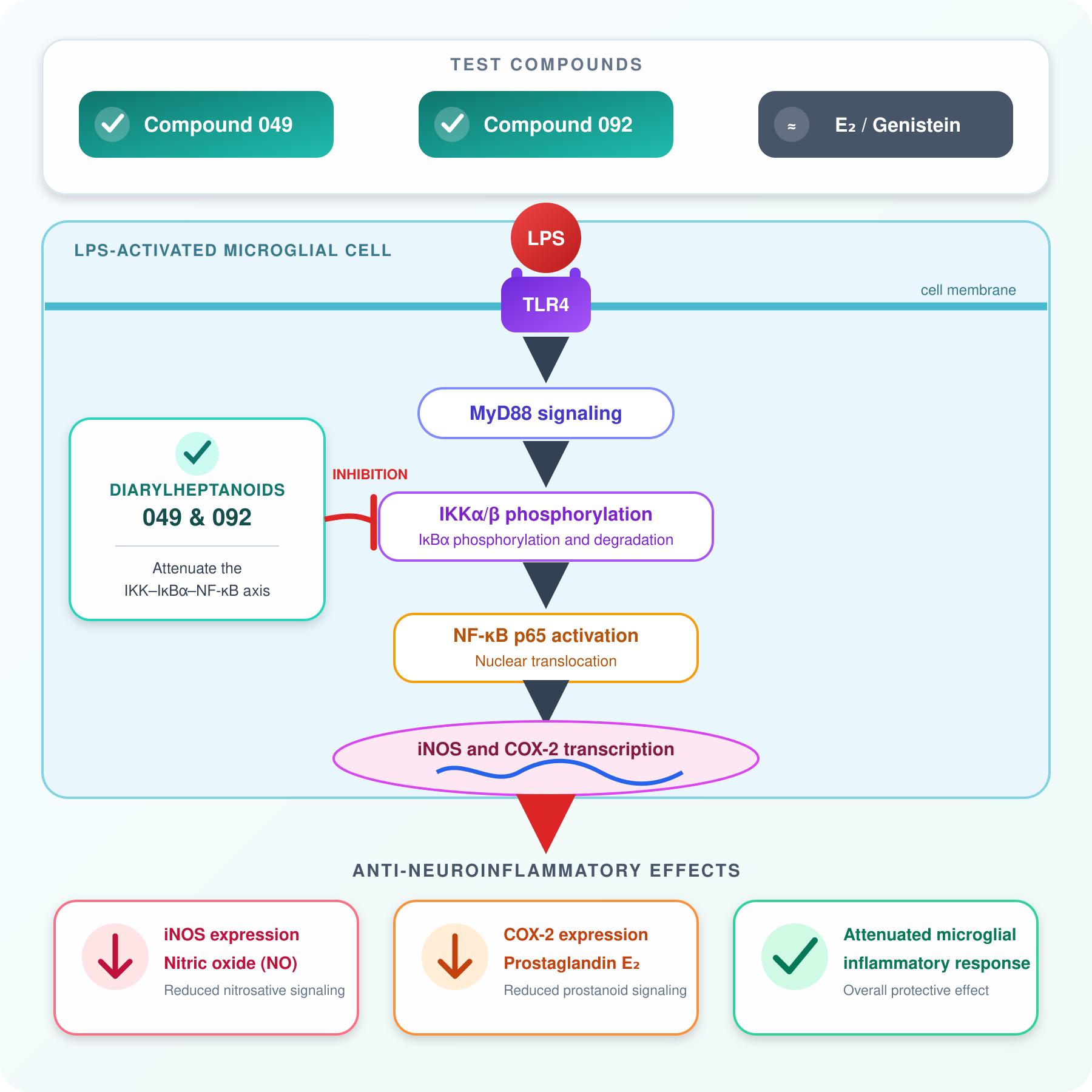
Downloads
References
UK Hanisch. Microglia as a source and target of cytokines. Glia 2002; 40(2), 140-155.
L Minghetti and G Levi. Microglia as effector cells in brain damage and repair: Focus on prostanoids and nitric oxide. Progress in Neurobiology 1998; 54(1), 99-125.
PD Drew, JA Chavis and R Bhatt. Sex steroid regulation of microglial cell activation: Relevance to multiple sclerosis. Annals of the New York Academy of Sciences 2003; 1007, 329-334.
F Gonzalez-Scarano and G Baltuch. Microglia as mediators of inflammatory and degenerative diseases. Annual Review of Neuroscienc 1999; 22, 219-240.
B Liu and JS Hong. Role of microglia in inflammation-mediated neurodegenerative diseases: Mechanisms and strategies for therapeutic intervention. The Journal of Pharmacology and Experimental Therapeutics 2003; 304(1), 1-7.
K Nakajima and S Kohsaka. Functional roles of microglia in the brain. Neuroscience Research Journal 1993; 17(3), 187-203.
HM Gao, B Liu, W Zhang and JS Hong. Critical role of microglial NADPH oxidase-derived free radicals in the in vitro MPTP model of Parkinson’s disease. The FASEB Journal 2003; 17(13), 1954-1956.
PL McGeer, C Schwab, A Parent and D Doudet. Presence of reactive microglia in monkey substantia nigra years after 1-methyl-4-phenyl-1,2,3,6-tetrahydropyridine administration. Annals of Neurology 2003; 54(5), 599-604.
EG McGeer and PL McGeer. Inflammatory processes in Alzheimer’s disease. Progress in Neuro-Psychopharmacology and Biological Psychiatry 2003; 27(5), 741-749.
PL McGeer, S Itagaki, BE Boyes and EG McGeer. Reactive microglia are positive for HLA-DR in the substantia nigra of Parkinson’s and Alzheimer’s disease brains. Neurology 1988; 38(8), 1285-1291.
PL McGeer and EG McGeer. Inflammation and neurodegeneration in Parkinson’s disease. Parkinsonism & Related Disorders 2004; 10(S1), S3-S7.
ML Block, L Zecca and JS Hong. Microglia-mediated neurotoxicity: Uncovering the molecular mechanisms. Nature Reviews Neuroscience 2007; 8(1), 57-69.
P Eikelenboom and WA van Gool. Neuroinflammatory perspectives on the two faces of Alzheimer’s disease. Journal of Neural Transmission 2004; 111(3), 281-294.
HM Gao, B Liu, W Zhang and JS Hong. Novel anti-inflammatory therapy for Parkinson’s disease. Trends in Pharmacological Sciences 2003; 24(8), 395-401.
B Liu, HM Gao, JY Wang, GH Jeohn, CL Cooper and JS Hong. Role of nitric oxide in inflammation-mediated neurodegeneration. Annals of the New York Academy of Sciences 2002; 962(1), 318-331.
H Lee, YO Kim, H Kim, SY Kim, HS Noh, SS Kang, GJ Cho, WS Choi and K Suk. Flavonoid wogonin from medicinal herb is neuroprotective by inhibiting inflammatory activation of microglia. The FASEB Journal 2003; 17(13), 1943-1944.
T Tikka, BL Fiebich, G Goldsteins, R Keinanen and J Koistinaho. Minocycline, a tetracycline derivative, is neuroprotective against excitotoxicity by inhibiting activation and proliferation of microglia. Journal of Neuroscience 2001; 21(8), 2580-2588.
JH Yoon, HJ Lim, HJ Lee, HD Kim, R Jeon and JH Ryu. Inhibition of lipopolysaccharide-induced inducible nitric oxide synthase and cyclooxygenase-2 expression by xanthanolides isolated from Xanthium strumarium. Bioorganic & Medicinal Chemistry Letters 2008; 18(6), 2179-2182.
G Bonizzi and M Karin. The two NF-kappaB activation pathways and their role in innate and adaptive immunity. Trends Immunol 2004; 25(6), 280-288.
Q Li and IM Verma. NF-kappaB regulation in the immune system. Nature Reviews Immunology 2002; 2(10), 725-734.
B O’Sullivan, AG Thompson and R Thomas. NF-kappa B as a therapeutic target in autoimmune disease. Expert Opin Ther Targets 2007; 11(2), 111-122.
S Olivier, P Robe and V Bours. Can NF-kappaB be a target for novel and efficient anti-cancer agents? Biochemical Pharmacology 2006; 72(9), 1054-1068.
SF Liu, AG Malik and R Thomas. NF-kappa B activation as a pathological mechanism of septic shock and inflammation. American Journal of Physiology-Lung Cellular and Molecular Physiology 2006; 290(4), L622-L645.
TM Lindstrom and PR Bennett. The role of nuclear factor kappa B in human labour. Reproduction 2005; 130(5), 569-581.
MS Hayden and S Ghosh. Signaling to NF-kappaB. Genes & Development 2004; 18(18), 2195-2224.
M Lappas, M Permezel, HM Georgiou and GE Rice. Nuclear factor kappa B regulation of proinflammatory cytokines in human gestational tissues in vitro. Biology of Reproduction 2002; 67(2), 668-673.
YJ Surh, KS Chun, HH Cha, SS Han, YS Keum, KK Park and SS Lee. Molecular mechanisms underlying chemopreventive activities of anti-inflammatory phytochemicals: Down-regulation of COX-2 and iNOS through suppression of NF-kappa B activation. Mutation Research - Fundamental and Molecular Mechanisms of Mutagenesis 2001; 480-481, 243-268.
B Tian and AR Brasier. Identification of a nuclear factor kappa B-dependent gene network. Recent Progress in Hormone Research 2003; 58, 95-130.
WK Jung, YW Ahn, SH Lee, YH Choi, SK Kim, SS Yea, I Choi, SG Park, SK Seo, SW Lee and IW Choi. Ecklonia cava ethanolic extracts inhibit lipopolysaccharide-induced cyclooxygenase-2 and inducible nitric oxide synthase expression in BV2 microglia via the MAP kinase and NF-kappaB pathways. Food and Chemical Toxicology 2009; 47(2), 410-417.
HJ Lim, HS Lee and JH Ryu. Suppression of inducible nitric oxide synthase and cyclooxygenase-2 expression by tussilagone from Farfarae flos in BV-2 microglial cells. Archives of Pharmacal Research 2008; 31(5), 645-652.
DO Moon, YH Choi, ND Kim, YM Park and GY Kim. Anti-inflammatory effects of beta-lapachone in lipopolysaccharide-stimulated BV2 microglia. International Immunopharmacology 2007; 7(4), 506-514.
KN Nam, MS Son, JH Park and EH Lee. Shikonins attenuate microglial inflammatory responses by inhibition of ERK, Akt, and NF-kappaB: Neuroprotective implications. Neuropharmacology 2008; 55(5), 819-825.
S Usman and AC Mondal. Menopause triggers microglia-associated neuroinflammation in Parkinson’s disease. Brain Research 2025; 1859, 149649.
M Canonico, E Oger, G Plu-Bureau, J Conard, G Meyer, H Levesque, N Trillot, MT Barrellier, D Wahl, J Emmerich and PY Scarabin. Hormone therapy and venous thromboembolism among postmenopausal women: Impact of the route of estrogen administration and progestogens: The ESTHER study. Circulation 2007; 115(7), 840-845.
VB Gencel, MM Benjamin, SN Bahou and RA Khalil. Vascular effects of phytoestrogens and alternative menopausal hormone therapy in cardiovascular disease. Mini-Reviews in Medicinal Chemistry 2012; 12(2), 149-174.
JC Cain. Miroestrol: An oestrogen from the plant Pueraria mirifica. Nature 1960; 188, 774-777.
P Piyachaturawat, S Ercharuporn and A Suksamrarn. Estrogenic activity of Curcuma comosa extract in rats. Asia Pacific Journal of Pharmacology 1995; 10(3-4), 121-126.
N Jantaratnotai, P Utaisincharoen, P Piyachaturawat, S Chongthammakun and Y Sanvarinda. Inhibitory effect of Curcuma comosa on NO production and cytokine expression in LPS-activated microglia. Life Sciences 2006; 78(6), 571-577.
A Sodsai, P Piyachaturawat, S Sophasan, A Suksamrarn and M Vongsakul. Suppression by Curcuma comosa Roxb. of pro-inflammatory cytokine secretion in phorbol-12-myristate-13-acetate stimulated human mononuclear cells. International Immunopharmacology 2007; 7(4), 524-531.
A Thampithak, Y Jaisin, B Meesarapee, S Chongthammakun, P Piyachaturawat, P Govitrapong, P Supavilai and Y Sanvarinda. Transcriptional regulation of iNOS and COX-2 by a novel compound from Curcuma comosa in lipopolysaccharide-induced microglial activation. Neuroscience Letters 2009; 462(2), 171-175.
N Jantaratnotai, P Utaisincharoen, P Sanvarinda, A Thampithak and Y Sanvarinda. Phytoestrogens mediated anti-inflammatory effect through suppression of IRF-1 and pSTAT1 expressions in lipopolysaccharide-activated microglia. International Immunopharmacology 2013; 17(2), 483-488.
YX Goh, J Jalil, KW Lam, K Husain and CM Premakumar. Genistein: A Review on its Anti-inflammatory properties. Frontiers in Pharmacology 2022; 13, 820969.
ZR Du, Y Gu, XM Xie, M Zhang, GY Jiang and WF Chen. GPER and IGF-1R mediate the anti-inflammatory effect of genistein against lipopolysaccharide (LPS)-induced nigrostriatal injury in rats. The Journal of Steroid Biochemistry and Molecular Biology 2021; 214, 105989.
JW Jeong, HH Lee, MH Han, GY Kim, WJ Kim and YH Choi. Anti-inflammatory effects of genistein via suppression of the toll-like receptor 4-mediated signaling pathway in lipopolysaccharide-stimulated BV2 microglia. Chemico-Biological Interactions 2014; 212, 30-39.
A Suksamrarn, M Ponglikitmongkol, K Wongkrajang, A Chindaduang, S Kittidanairak, A Jankam, B Yingyongnarongkul, N Kittipanumat, R Chokchaisiri, P Khetkam and P Piyachaturawat. Diarylheptanoids, new phytoestrogens from the rhizomes of Curcuma comosa: Isolation, chemical modification and estrogenic activity evaluation. Bioorganic & Medicinal Chemistry 2008; 16(14), 6891-6902.
ZMK Aung, N Jantaratnotai, P Piyachaturawat and P Sanvarinda. A pure compound from Curcuma comosa Roxb. protects neurons against hydrogen peroxide-induced neurotoxicity via the activation of Nrf-2. Heliyon 2022; 8(11), e11228.
N Jiamvoraphong, N Jantaratnotai, P Sanvarinda, P Tuchinda, P Piyachaturawat, A Thampithak and P Sanvarinda. Concurrent suppression of NF-kappaB, p38 MAPK and reactive oxygen species formation underlies the effect of a novel compound isolated from Curcuma comosa Roxb. in LPS-activated microglia. Journal of Pharmacy and Pharmacology 2017; 69(7), 917-924.
G Ji, Y Zhang, Q Yang, S Cheng, J Hao, X Zhao and Z Jiang. Genistein suppresses LPS-induced inflammatory response through inhibiting NF-kappaB following AMP kinase activation in RAW 264.7 macrophages. PLoS One 2012; 7(12), e53101.
W Winuthayanon, P Piyachaturawat, A Suksamrarn, M Ponglikitmongkol, Y Arao, SC Hewitt and KS Korach. Diarylheptanoid phytoestrogens isolated from the medicinal plant Curcuma comosa: Biologic actions in vitro and in vivo indicate estrogen receptor-dependent mechanisms. Environmental Health Perspectives 2009; 117(7), 1155-1161.
K Bhukhai, K Suksen, N Bhummaphan, K Janjorn, N Thongon, D Tantikanlayaporn, P Piyachaturawat, A Suksamrarn and A Chairoungdua. A phytoestrogen diarylheptanoid mediates estrogen receptor/Akt/glycogen synthase kinase 3beta protein-dependent activation of the Wnt/beta-catenin signaling pathway. Journal of Biological Chemistry 2012; 287(43), 36168-36178.
W Winuthayanon, K Suksen, C Boonchird, A Chuncharunee, M Ponglikitmongkol, A Suksamrarn and P Piyachaturawat. Estrogenic activity of diarylheptanoids from Curcuma comosa Roxb. Requires metabolic activation. Journal of Agricultural and Food Chemistry 2009; 57(3), 840-845.
F Yang, E Tang, K Guan and CY Wang. IKK beta plays an essential role in the phosphorylation of RelA/p65 on serine 536 induced by lipopolysaccharide. The Journal of Immunology 2003; 170(11), 5630-5635.
B Moosmann and C Behl. The antioxidant neuroprotective effects of estrogens and phenolic compounds are independent from their estrogenic properties. Proceedings of the National Academy of Sciences of the United States of America 1999; 96(16), 8867-8872.
Downloads
Published
How to Cite
Issue
Section
License
Copyright (c) 2026 Walailak University

This work is licensed under a Creative Commons Attribution-NonCommercial-NoDerivatives 4.0 International License.