
LC-HRMS-MS Profiling and Partial Estrogen Agonist Evaluation of Iresine Diffusa Ethyl Acetate Extract in Prepubertal Rats Model
DOI:
https://doi.org/10.48048/tis.2027.14084Keywords:
Partial estrogen agonist, Iresine diffusa, Prepubertal rat, Estrogen, LH, FSH, ProgesteroneAbstract
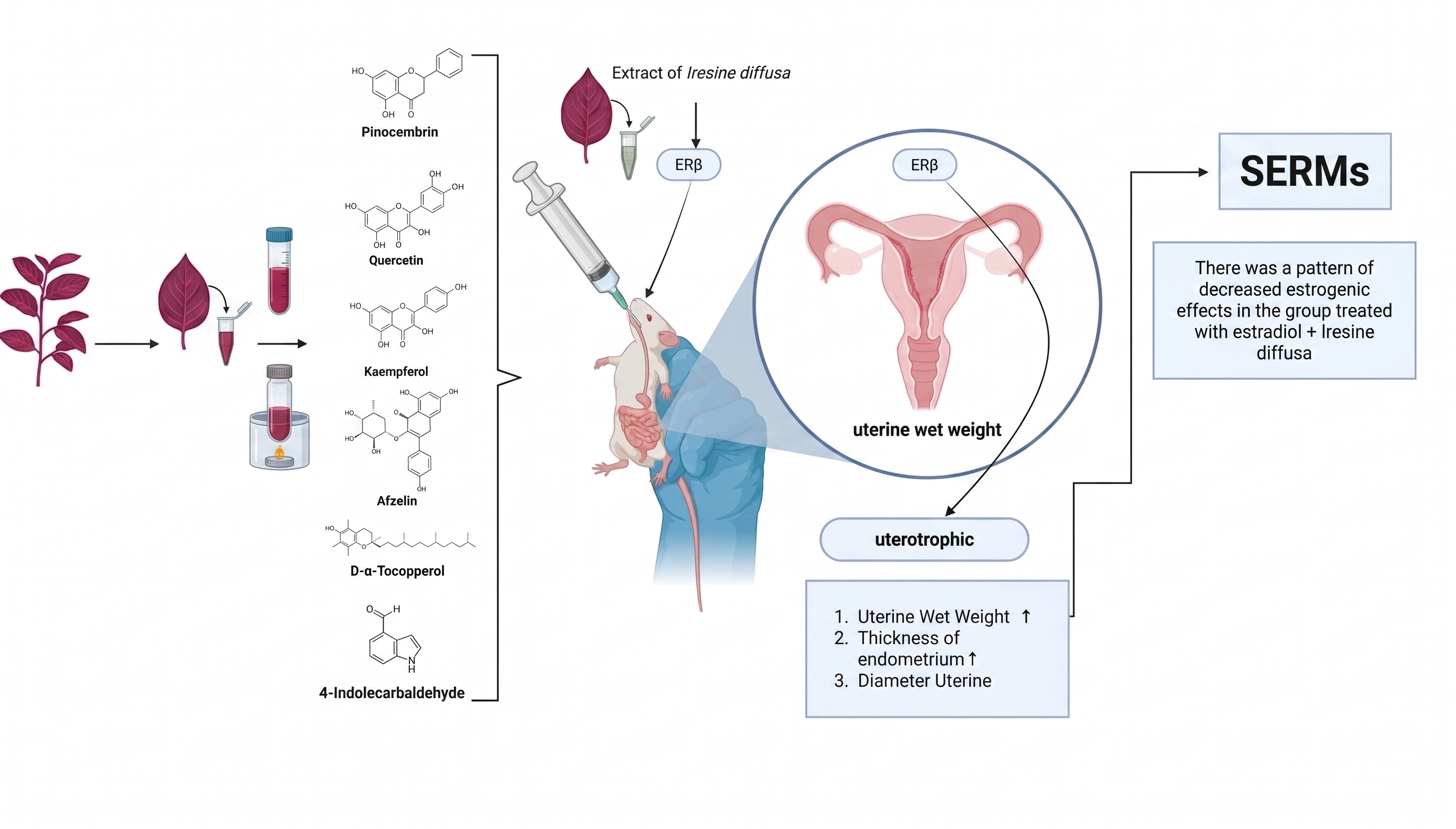
Ethnopharmacological studies on Iresine diffusa and prior research on its phytochemicals have identified potential estrogenic effects. This study aims to evaluate the partial estrogen agonist effects of Iresine diffusa ethyl acetate extract (IDEA) in a prepubertal mouse model as a candidate selective estrogen receptor modulator (SERM). SERMs are of interest because they selectively modulate estrogenic responses in specific tissues, thereby enabling therapeutic interventions with minimal side effects. The in vivo study involved 19-day-old prepubertal female rats, with no established hormonal production, and was divided into eight groups, each consisting of five rats. These included a normal group, an estradiol control group, three IDEA groups with estradiol to identify antiestrogenic effects, and three IDEA groups without estradiol to identify estrogenic effects. Samples were administered orally for 16 days. Observed parameters included vaginal cytology smears, wet weight of the uterus, histological analysis of the uterus and ovaries, and hormone levels (estrogen, luteinizing hormone/LH, follicle-stimulating hormone/FSH, and progesterone). All data were analyzed by one-way ANOVA using GraphPad Prism. Differences with p-values less than 0.05 were considered statistically significant. LC-HRMS-MS phytochemical screening of IDEA revealed the presence of Kaempferol, Bakuchiol, and Afzelin. Cytological observations in the estrogenic test group showed a high number of cornified cells (+++), whereas in the antiestrogenic group, they were present in lower numbers (++). Evaluation of partial estrogenic agonist activity in prepubertal rats revealed differences in uterine wet weight (UWW), endometrial thickness, uterine diameter, follicular maturity in the ovaries, and higher hormone levels in both the estrogenic test group (IDEA) and the antiestrogenic test group (Estradiol+IDEA) compared to the Normal group (PEN), with significant differences (p < 0.05). The findings regarding partial estrogen agonism were confirmed and show the illustration of the effect of partial agonism by the results of each parameter test in the antiestrogenic test group (estradiol+IDEA), which showed lower mean values compared to the estrogenic test group.
HIGHLIGHTS
- LC-HRMS-MS profiling of Iresine diffusa extract (IDEA) identified key phytoestrogenic flavonoids, including kaempferol, quercetin, and afzelin.
- IDEA exhibited dose-dependent estrogenic activity in prepubertal rats by promoting vaginal cell cornification and uterine proliferation.
- Under estradiol co-treatment, IDEA significantly reduced uterine hypertrophy, demonstrating selective estrogen receptor modulator (SERM)-like properties.
- IDEA stimulated ovarian follicle maturation and modulated serum gonadotropins (LH/FSH) and steroid hormones in a controlled, submaximal manner.
GRAPHICAL ABSTRACT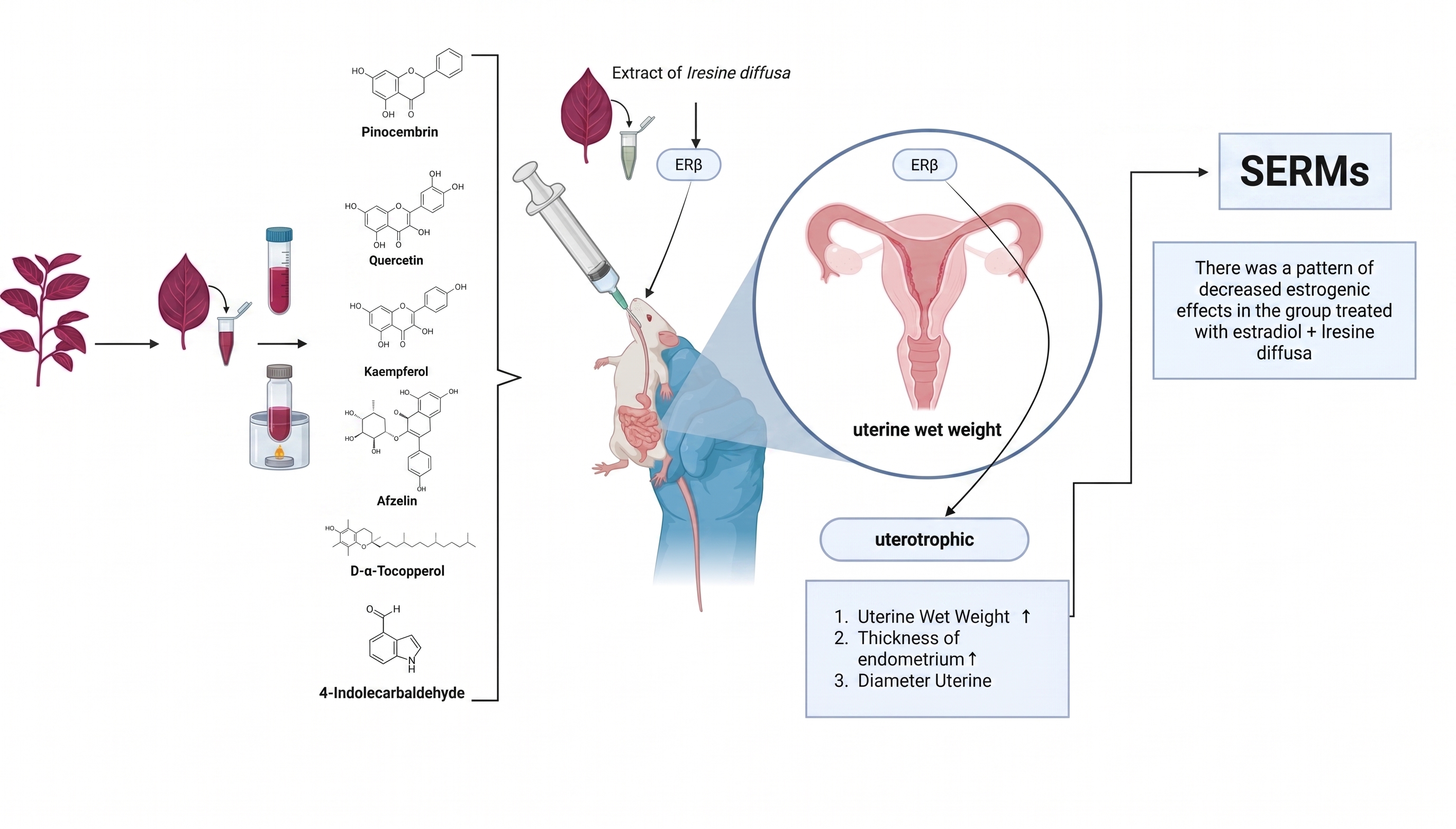
Downloads
References
M Ghanavati, Y Khorshidi, M Shadnoush, ME Akbari, SH Ardehali, Y Chavarri-Guerra, A Akbari, R Barragan-Carrillo, MA Amlashi, Z Javid and J Rahmani. Tamoxifen use and risk of endometrial cancer in breast cancer patients: A systematic review and dose-response meta-analysis. Cancer Reports 2023; 6(4), e1806.
C Dipankar, S Murugan and PU Devi. Review on medicinal and pharmacological properties of Iresine herbstii, Chrozophora rottleri and Ecbolium linneanum. African Journal of Traditional, Complementary and Alternative Medicines 2011; 8(5), 124-129.
D Mouttet, M Laé, M Caly, D Gentien, S Carpentier, H Peyro-Saint-Paul, A Vincent-Salomon, R Rouzier, B Sigal-Zafrani, X Sastre-Garau and F Reyal. Estrogen-receptor, progesterone-receptor and HER2 status determination in invasive breast cancer. concordance between immuno-histochemistry and MapQuantTM microarray based assay. PLoS One 2016; 11(2), e0146474.
NY Paniagua-Zambrana, RW Bussmann and C Romero. Iresine diffusa Humb. & Bonpl. ex Willd. Iresine herbstii Hook Amaranthaceae. Springer Nature, Switzerland, 2020, p. 991-995.
R Matsushima-Nishiwaki, N Yamada, Y Hattori, Y Hosokawa, J Tachi, T Hori and O Kozawa. SERMs (selective estrogen receptor modulator), acting as estrogen receptor β agonists in hepatocellular carcinoma cells, inhibit the transforming growth factor-α-induced migration via specific inhibition of AKT signaling pathway. PLoS One 2022; 17(1), e0262485.
CT Stork, M Bocek, MP Crossley, J Sollier, LA Sanz, F Chédin, T Swigut and KA Cimprich. Co-transcriptional R-loops are the main cause of estrogen-induced DNA damage. eLife 2016; 5, e17548.
C Nencini, F Cavallo, G Bruni, A Capasso, V de Feo, L de Martino, Giorgio and L Micheli. Affinity of Iresine herbstii and Brugmansia arborea extracts on different cerebral receptors. Journal of Ethnopharmacology 2006; 105(3), 352-357.
SRD Johnston. Endocrinology and hormone therapy in breast cancer: Selective oestrogen receptor modulators and downregulators for breast cancer - have they lost their way? Breast Cancer Research 2005; 7, 119.
S Martinkovich, D Shah, SL Planey and JA Arnott. Selective estrogen receptor modulators: Tissue specificity and clinical utility. Clinical Interventions in Aging 2014; 9, 1437-1452.
HY Ma, S Chen, LL Lu, W Gong and AH Zhang. Raloxifene in the treatment of osteoporosis in postmenopausal women with end-stage renal disease: A systematic review and meta-analysis. Hormone and Metabolic Research 2021; 53(11), 730-737.
AI Suárez. New biflavonoids from Iresine diffusa. Revista de la Facultad de Farmacia 2022; 85(1y2), 91-99.
M Srinivasan. A comparative study on staining techniques for vaginal exfoliative cytology of rat. Journal of Pharmacology & Clinical Research 2017; 3(3), 555615.
OECD, Terms & Conditions, Available at: http://www.oecd.org/termsandconditions, accessed July 2025.
Y Li, H Zeng and J Fu. Preovulatory progesterone levels are the top indicator for ovulation prediction based on machine learning model evaluation: A retrospective study. Journal of Ovarian Research 2024; 17, 169.
S Yani, T Opik, R Siti, K Ida and P Epa. In silico analysis of kaempferol as a competitor of estrogen on estrogen receptor alpha of endometrial cancer. Journal of Physics: Conference Series 2019; 1402, 066109.
Fadilah, BC Edina, RA Rahmawati, L Wiyono, L Erlina, RI Paramita and A Tedjo. Molecular dynamic of pinostrobin and pinocembrin from Kaempferia pandurata Roxb. towards Estrogen Receptor Positive (ESR) and Estrogen Receptor Negative (VEGFR) of Breast Cancer. Asian Journal of Pharmaceutics Supplementary Issue 2018; 12(4), 1473-1480.
S Özsoy, G Soykut and E Becer. Quercetin: A phytochemical with pro-apoptotic effects in colon cancer cells. Cyprus Journal of Medical Sciences 2022; 7(5), 587-592.
I Setyawati, NI Wiratmini and I Narayani. Estrogen hormone level of prepubertal female rat treated with Calliandra calothyrsus ethanolic leaf extract. Journal of Physics: Conference Series 2018; 983, 012190.
J Łuczak, M Bagłaj, R Ciaputa, A Szymerowski and M Nowak. Does open ovarian biopsy in prepubertal age affect ovarian reserve in a rat model? Journal of Pediatric Surgery 2021; 56(2), 360-367.
JM Goldman, SC Laws, SK Balchak, RL Cooper and RJ Kavlock. Endocrine-disrupting chemicals: Prepubertal exposures and effects on sexual maturation and thyroid activity in the female rat. A focus on the EDSTAC recommendations. Critical Reviews in Toxicology 2000; 30(2), 135-196.
JM Oliveira, IM Oliveira, HK Sleiman, GOD Forno, MA Romano and RM Romano. Consumption of soy isoflavones during the prepubertal phase delays puberty and causes hypergonadotropic hypogonadism with disruption of hypothalamic-pituitary gonadotropins regulation in male rats. Toxicology Letters 2022; 369, 1-11.
R Pelayo, H Marina, A Suárez-Vega, G Hervás, C Esteban-Blanco, B Gausseres, G Foucras, JJ Arranz and B Gutiérrez-Gil. Influence of a temporary restriction of dietary protein in prepubertal ewe lambs on first lactation milk traits and response to a mammary gland inflammatory challenge. Research in Veterinary Science 2023; 159, 57-65.
L Zhou, KY Wong, W Yu, CCW Poon, H Xiao, CO Chan, DKW Mok, Y Zhang and MS Wong. Selective estrogen receptor modulator-like activities of Herba epimedii extract and its interactions with tamoxifen and raloxifene in bone cells and tissues. Frontiers in Pharmacology 2020; 11, 571598.
GS Bustani and HFK Alghetaa. Aryl hydrocarbon receptor signaling in male fertility: Protective role of resveratrol and disruptive effects of CH223191 in adult male rats. Veterinary World 2025; 18(5), 1274-1287.
S Huang, B Qi, L Yang, X Wang, J Huang, Y Zhao, Y Hu and W Xiao. Phytoestrogens, novel dietary supplements for breast cancer. Biomedicine & Pharmacotherapy 2023; 160, 114341.
S Goel, R Sharma, A Hamilton and J Beith. LHRH agonists for adjuvant therapy of early breast cancer in premenopausal women. Cochrane Database of Systematic reviews 2009; 2009(4), CD004562.
W Wang, C Zhang, Y Fan, S Yue, Y Yang, R Liu, L Zhang, T Wang and F Fu. Dopamine receptor agonist rotigotine-loaded microspheres ameliorates sexual function deteriorated by fluoxetine in depression rats. ASN Neuro 2021; 13(1), 17590914211052862.
TM Borjeson, J Pang, JG Fox and A García. Administration of luteinizing hormone releasing hormone agonist for synchronization of estrus and generation of pseudopregnancy for embryo transfer in rats. Journal of the American Association for Laboratory Animal Science 2014; 53(3), 232-237.
K El-Sayed, DA Ali, SA Maher, D Ghareeb, S Selim, S Albogami, E Fayad and E Kolieb. Prophylactic and ameliorative effects of PPAR-γ agonist pioglitazone in improving oxidative stress, germ cell apoptosis and inflammation in gentamycin-induced testicular damage in adult male albino rats. Antioxidants 2022; 11(2), 191.
JM Bazioli, JH Costa, L Shiozawa, ALTG Ruiz, MA Foglio and JE de Carvalho. Anti-estrogenic activity of guajadial fraction, from guava leaves (Psidium guajava L.). Molecules 2020; 25(7), 1525.
J Gorzkiewicz, G Bartosz and I Sadowska-Bartosz. The potential effects of phytoestrogens: The role in neuroprotection. 2021; 26(10), 2954.
VP Chavda, AZ Chaudhari, PC Balar, A Gholap and LK Vora. Phytoestrogens: Chemistry, potential health benefits, and their medicinal importance. Phytotherapy Research 2024; 38(6), 3060-3079.
NN Suhaimi, MN Waras and NM Ansor. Association between phytoestrogen consumption and female reproductive health: A systematic review of experimental models. Ibnosina Journal of Medicine and Biomedical Sciences 2023; 15, 152-160.
HK Patel and T Bihani. Selective estrogen receptor modulators (SERMs) and selective estrogen receptor degraders (SERDs) in cancer treatment. Pharmacology & Therapeutics 2018; 186, 1-24.
HS Chung, HS Lee and K Park. Estrogen modulates epithelial progenitor cells in rat vagina. Investigative and Clinical Urology 2021; 62(3), 349-353.
I Falsetti, G Palmini, C Aurilia, S Donati, T Iantomasi and ML Brandi. Selective estrogen receptor modulators in post-menopausal osteoporosis. International Journal of Bone Fragility 2022; 2(3), 93-96.
QN Khusmitha, EHW Putri, Nurdiana and NP Sari. Potential effects of tempeh extract on ovarian folliculogenesis in female wistar rats. Journal of Research in Midwifery and Healthcare 2025; 1(1), 14-19.
O Karlsson, K Kultima, H Wadensten, A Nilsson, E Roman, PE Andrén and EB Brittebo. Neurotoxin-induced neuropeptide perturbations in striatum of neonatal rats. Journal of Proteome Research 2013; 12(4), 1678-1690.
M Levi, R Shalgi and I Ben-Aharon. Pretreatment with gonadotropin-releasing hormone antagonist protects against chemotherapy-induced testicular damage in mice. Therapeutic Advances in Medical Oncology 2022; 14, 17588359221113274.
HQ Wang, WD Zhang, B Yuan and JB Zhang. Advances in the regulation of mammalian follicle-stimulating hormone secretion. Animals 2021; 11(4), 1134.
Downloads
Published
How to Cite
Issue
Section
License
Copyright (c) 2026 Walailak University

This work is licensed under a Creative Commons Attribution-NonCommercial-NoDerivatives 4.0 International License.