Antioxidant Effects of Rhodiola Heterodonta, Silybum Marianum, and Morus. Nigra Extracts on Oxidative Stress Biomarkers in Alloxan-induced Diabetic Rats
DOI:
https://doi.org/10.48048/tis.2027.14083Keywords:
Diabetes mellitus, Alloxan, Oxidative stress, Antioxidant plant extracts, MDA, SOD, Catalase, Mitochondrial lipid peroxidation, DPPHAbstract
Oxidative stress critically contributes to the pathogenesis of diabetes mellitus. This study evaluated the effects of three antioxidant plant extracts Rhodiola heterodonta (Hook.f. & Thomson) Boriss. (Crassulaceae), Silybum marianum (L.) Gaertn. (Asteraceae), and Morus nigra L. (Moraceae) on oxidative stress markers in alloxan-induced diabetic rats. Male outbread rats (180 - 220 g) were injected intraperitoneally with alloxan monohydrate (140 mg/kg) to induce diabetes over 14 days. Blood glucose levels and urine biochemical parameters were monitored during this period. Rats were then orally treated with the plant extracts at dose 75 mg/kg for 14 days. On day 29, animals were sacrificed, and oxidative stress biomarkers including malondialdehyde (MDA), superoxide dismutase (SOD), catalase (CAT), and mitochondrial lipid peroxidation were measured. In vitro DPPH assay confirmed the extracts’ radical-scavenging activity. Treatment with all three extracts significantly reduced oxidative stress in a dose-dependent manner by enhancing antioxidant enzyme activities and lowering lipid peroxidation. Among the extracts, Rhodiola heterodonta showed the strongest protective effect. These results suggest that Rhodiola heterodonta, Silybum marianum, and Morus nigra extracts have notable antioxidant potential and may improve oxidative stress parameters in diabetes.
HIGHLIGHTS
- Alloxan-induced diabetes increased oxidative stress and lipid peroxidation in rats.
- Rhodiola heterodonta, Silybum marianum, and Morus nigra showed strong antioxidant activity.
- Plant extracts enhanced antioxidant defense through increased SOD and CAT activities.
- Treatment with the extracts reduced MDA levels and oxidative damage in diabetic rats.
- Rhodiola heterodonta exhibited the most pronounced protective effect against oxidative stress.
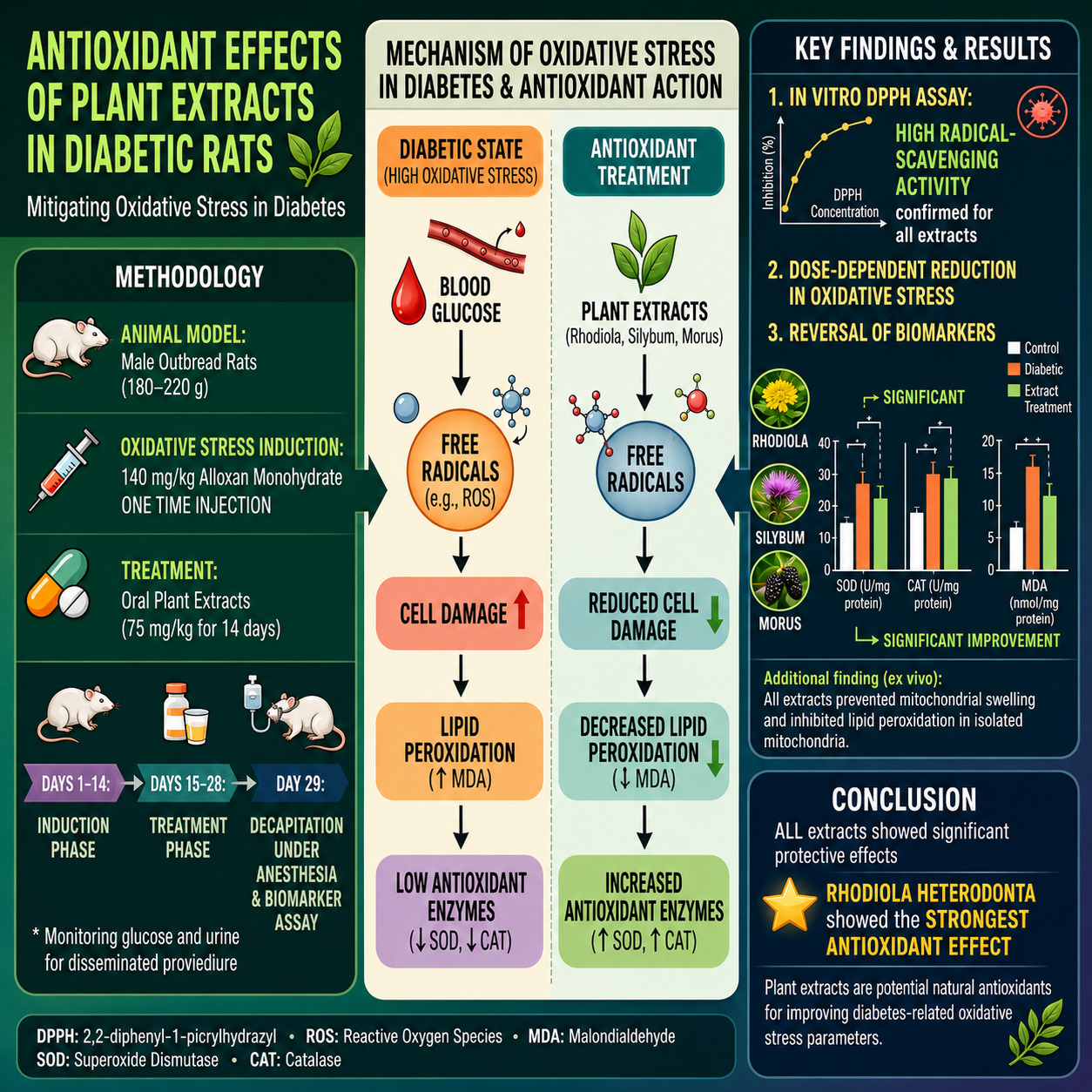
GRAPHICAL ABSTRACT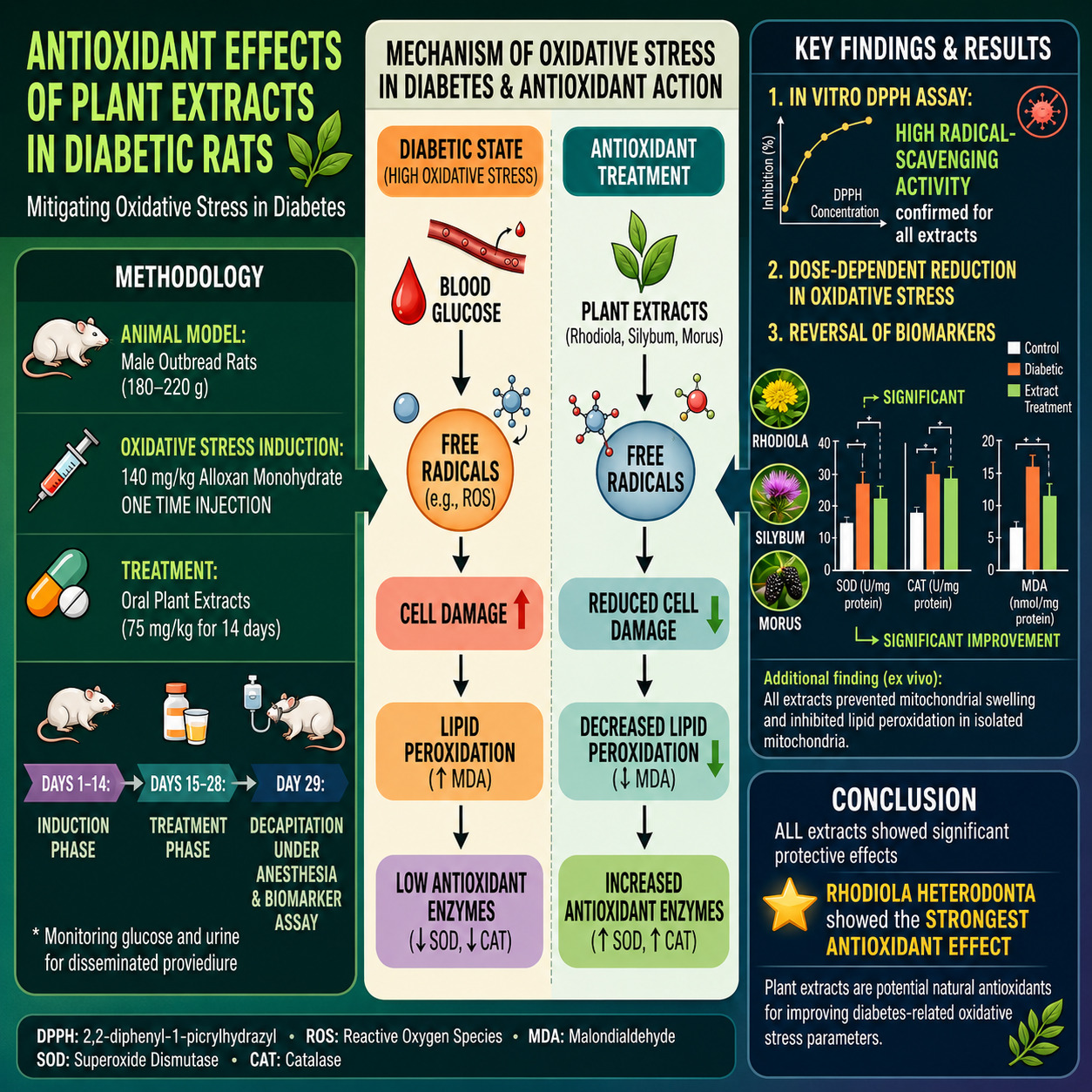
Downloads
References
A Abdullaev, I Abdullaev, A Bogbekov, U Gayibov, S Omonturdiev, S Gayibova, M Turahodjayev, K Ruziboev and T Aripov. Antioxidant potential of Rhodiola heterodonta extract: Activation of Nrf2 pathway via integrative in vivo and in silico studies. Trends in Science 2025; 22(5), 9521.
AA Abdullaev, DR Inamjanov, DS Abduazimova, SZ Omonturdiyev, UG Gayibov, SN Gayibov and TF Aripov. Silybum marianum’s impact on physiological alterations and oxidative stress in diabetic rats. Biomed Pharmacol Journal 2024; 17(2), 1291-1300.
D Pitocco, M Tesauro, R Alessandro, G Ghirlanda and C Cardillo. Oxidative stress in diabetes: Implications for vascular and other complications. International Journal of Molecular Science 2013; 14(11), 21525-21550.
MR Zaripova, SN Gayibova, RR Makhmudov, AA Mamadrahimov, NL Vypova, UG Gayibov, SM Miralimova and TF Aripov. Characterization of rhodiola heterodonta (Crassulaceae): Phytocomposition, antioxidant and antihyperglycemic activities. Preventive Nutrition and Food Science 2024; 29(2), 135-145.
A Abdullaev, U Gayibov, S Gayibova, D Abduazimova, S Omonturdiev and T Aripov. Molecular and biochemical insights into Morus nigra extract: Its role in antioxidant defense and vascular protection. Journal of Biomedical Science Research 2025; 7(3), 208.
European Union. Directive 2010/63/EU on the protection of animals used for scientific purposes. Official Journal of the European Union 2010; L276, 33-79.
VI Ribachenko, NS Il’kevich, G Shreder, AF Dmitruk, KYU Chotiy and VA Borovik. Study of reactions of gossypol with 2,2-diphenyl-1-picrylhydrazyl. Scientific Papers of Donetsk National Technical University 2007; 119(9), 77.
TS Omolaoye, BT Skosana and SSD Plessis. Diabetes mellitus- induction: Effect of different streptozotocin doses on male reproductive parameters. Acta Histochem 2018; 120(2), 103-109.
PC Liao, C Bergamini, R Fato, LA Pon and F Pallotti. Isolation of mitochondria from cells and tissues. Methods Cell Biology 2020; 155, 3-31.
CH Shen. Quantification and analysis of proteins. Diagnostic Molecular Biology 2019. https://api.semanticscholar.org/CorpusID:187812904
RL Heath and L Packer. Photoperoxidation in isolated chloroplasts. Archives of Biochemistry and Biophysics 1968; 125(1), 189-198.
MS Bagul, SB Kokate and AR Juvekar. Protective effect of polyherbal formulation in diabetes-induced oxidative stress. Pharmacognosy Magazine 2008; 4(15), 19-23.
MH Hadwan. New method for assessment of serum catalase activity. Indian Journal of Science Technology 2016; 9(4), 1.
JT Litchfield and F Wilcoxon. A simplified method of evaluating dose-effect experiments. Journal of Pharmacology and Experimental Therapeutics 1949; 96(2), 99-113.
S Bhat, M Rehman and MV Simha. Comparative study of antioxidant properties of aqueous leaves extract and biogenic silver nanoparticles using Hibiscus species and Trachyspermum species. International Journal of Environmental Sciences 2025; 11(165), 855-863.
HPS Makkar. Quantification of tannins in tree and shrub foliage. Springer Dordrecht, Netherlands, 2003.
HPS Makkar, P Siddhuraju and K Becker. Plant secondary metabolites. Humana Press, Totowa, 2007.
L Gil-Martínez, N Mut-Salud, JA Ruiz-García, A Falcón-Piñeiro, M Maijó-Ferré, A Baños, JMDL Torre-Ramírez, E Guillamón, V Verardo and AM Gómez-Caravaca. Phytochemicals determination and antioxidant, antimicrobial, anti-inflammatory and anticancer activities of blackberry fruits. Foods 2023; 12(7), 1505.
MN Mugale, K Dev, BS More, VS Mishra, KR Washimkar, K Singh, R Maurya, SK Rath, D Chattopadhyay and N Chattopadhyay. A comprehensive review on preclinical safety and toxicity of medicinal plants. Clinical Complementary Medicine and Pharmacology 2024; 4(1), 100129.
AG Atanasov, B Waltenberger, EM Pferschy-Wenzig, T Linder, C Wawrosch, P Uhrin, V Temml, L Wang, S Schwaiger, EH Heiss, JM Rollinger, D Schuster, JM Breuss, V Bochkov, MD Mihovilovic, B Kopp, R Bauer, VM Dirsch and H Stuppner. Discovery and resupply of pharmacologically active plant-derived natural products: A review. Biotechnology Advances 2015; 33(8), 1582-1614.
TF Aripov, UG Gayibov, SN Gaibova, AA Abdullaev, DS Abduazimova, YI Oshchepkova and SI Salikhov. In Vitro antioxidant and antiradical activity of rutan, a polyphenolic extract from the tannic sumach (Rhus coriaria L.) leaves. Russian Journal of Bioorganic Chemistry 2025; 51, 3077-3085.
RM Ibrahim, HM Abdelhafez, SAE El-Shamy, FA Eid and A Mashaal. Arabic gum ameliorates systemic modulation in Alloxan monohydrate-induced diabetic rats. Scientific Reports 2023; 13(1), 5005.
MA El-Missiry, AI Othman and MA Amer. L-Arginine ameliorates oxidative stress in alloxan-induced experimental diabetes mellitus. Journal of Applied Toxicology 2004; 24(2), 93-97.
LB Ceretta, GZ Réus, HM Abelaira, KF Ribeiro, G Zappellini, FF Felisbino and J Quevedo. Increased oxidative stress and imbalance in antioxidant enzymes in the brains of alloxan-induced diabetic rats. Experimental Diabetes Research 2012; 2012, 302682.
AP Halestrap. What is the mitochondrial permeability transition pore? Journal of Molecular and Cellular Cardiology 2009; 46(6), 821-831.
RJ Mailloux. Mitochondrial ROS production. Antioxidants 2020; 9(6), 472.
CMO Volpe, PH Villar-Delfino, PMF Anjos and JA Nogueira-Machado. Cellular death, reactive oxygen species (ROS) and diabetic complications. Cell Death & Disease 2018; 9(2), 119.
OM Ighodaro and OA Akinloye. Antioxidant enzymes role. Alexandria Journal of Medicine 2018; 54(4), 287-293.
M Sharifi-Rad, NVA Kumar, P Zucca, EM Varoni, L Dini, E Panzarini, J Rajkovic, PVT Fokou, E Azzini, I Peluso, AP Mishra, M Nigam, YE Rayess, ME Beyrouthy, L Polito, M Iriti, N Martins, M Martorell, AO Docea, WN Setzer, D Calina, WC Cho and J Sharifi-Rad. Lifestyle, oxidative stress, and antioxidants: Back and forth in the pathophysiology of chronic diseases. Frontiers in Physiology 2020; 11, 694.
L Abenavoli, AA Izzo, N Milić, C Cicala, A Santini and R Capasso. Milk thistle (Silybum marianum): A concise overview on its chemistry, pharmacological, and nutraceutical uses in liver diseases. Phytotherapy Research 2018; 32(11), 2202-2213.
B Jan, R Parveen, S Zahiruddin, MU Khan, S Mohapatra and S Ahmad. Nutritional constituents of mulberry and their potential applications in food and pharmaceuticals: A review. Saudi Journal of Biological Sciences 2021; 28(7), 3909-3921.
Downloads
Published
How to Cite
Issue
Section
License
Copyright (c) 2026 Walailak University

This work is licensed under a Creative Commons Attribution-NonCommercial-NoDerivatives 4.0 International License.