
Enhanced Mechanical and Bioactive Properties of PVA/CMC/Sericin Hydrogel Facial Masks Containing Pomegranate Extract Fabricated via Freeze–Thaw Technique
DOI:
https://doi.org/10.48048/tis.2027.14059Keywords:
Freeze–thaw technique, Polyvinyl alcohol/Carboxymethyl cellulose, Silk sericin, Pomegranate extract, Antioxidant activity, Antityrosinase activity, Hydrogel facial mask, Freeze-thaw technique, Polyvinyl alcohol/Carboxymethyl cellulose, Silk sericin, Pomegranate extract, Antioxidant activity, Antityrosinase activity, Hydrogel facial maskAbstract
Hydrogel-based facial masks deliver bioactive compounds with favorable skin adhesion and hydration; however, enhancing their mechanical and functional properties remains a challenge. This study developed bioactive polyvinyl alcohol (PVA)/carboxymethyl cellulose (CMC) hydrogels incorporating pomegranate (PG) extract and silk sericin (SS) for cosmetics. The hydrogels were fabricated using a freeze-thaw process (three cycles: −20 °C 20 h; 27 ± 3 °C 4 h). Evaluations included antioxidant and antityrosinase activities, ATR-FTIR, thermal (DSC/TGA), mechanical, adhesion, morphological, in vitro release, and cytotoxicity. Stability studies were conducted at 4, 30, and 40 °C for three months. Results demonstrated that PG extract and SS contributed significant antioxidant and antityrosinase activities. ATR-FTIR confirmed molecular interactions within the network. Morphological analysis revealed a dense internal structure that became more compact with SS incorporation. Despite this, all formulations maintained a high water content (~87%), ensuring optimal hydration. The incorporation of SS significantly improved mechanical properties, with compressibility ranging from 43 to 46 N·s and hardness from 104 to 112 N, while maintaining suitable skin adhesion (0.080 - 0.167 kPa). Furthermore, SS effectively modulated the biphasic in vitro PG release, with the H-SS5% formulation providing an optimal balance by minimizing the initial burst while sustaining high bioactive delivery. Indirect cytotoxicity evaluation confirmed excellent biocompatibility, with >80% viability in NCTC clone 929 and HDFa cells after 48 h of incubation. The slightly yellow hydrogels were appropriate for cosmetics, and 4 °C storage best preserved visual properties. In conclusion, the developed PVA/CMC hydrogels loaded with PG extract and SS exhibit favorable bioactivity, mechanical performance, safety, and potential applicability as facial masks.
HIGHLIGHTS
- Bioactive hydrogels were developed using pomegranate extract and silk sericin for facial mask applications.
- The materials demonstrated antioxidant and antityrosinase activities relevant to cosmetic use.
- Incorporation of silk sericin improved mechanical strength while maintaining skin adhesion.
- Freeze–thaw fabrication enabled the formation of stable PVA/CMC hydrogel networks without chemical crosslinkers.
- Refrigerated storage at 4℃ better preserved the hydrogel appearance and stability over time.
GRAPHICAL ABSTRACT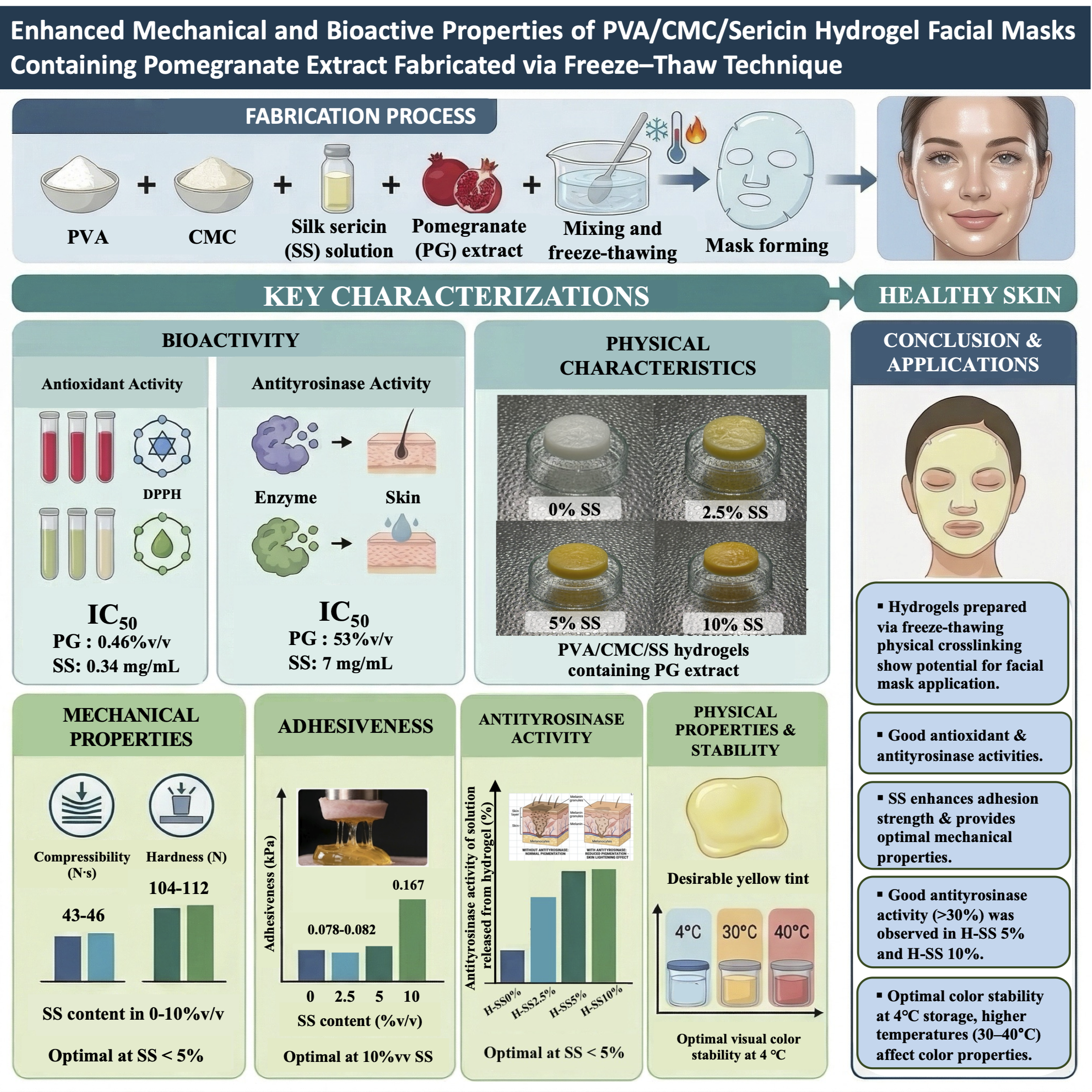
Downloads
References
Transparency Market Research, Available at: https://www.transparencymarketresearch.com, accessed March 2026.
E Caló and VV Khutoryanskiy. Biomedical applications of hydrogels: A review of patents and commercial products. European Polymer Journal 2015; 65, 252-267.
E Bilgi, EH Gokce, E Bayir, A Sendemir, KO Ozer and EEH Tuna. Bacterial cellulose based facial mask with antioxidant property and high moisturizing capacity. Cellulose 2021; 28, 10399-10414.
H Rao and JBL Tan. Polysaccharide-based hydrogels for atopic dermatitis management: A review. Carbohydrate Polymers 2025; 349, 122966.
W Hu, Z Wang, Y Xiao, S Zhang and J Wang. Advances in crosslinking strategies of biomedical hydrogels. Biomaterials Science 2019; 7(3), 843-855.
WX Waresindo, HR Luthfianti, A Priyanto, DA Hapidin, D Edikresnha, AH Aimon, T Suciati and Khairurrijal. Freeze–thaw hydrogel fabrication method: Basic principles, synthesis parameters, properties, and biomedical applications. Materials Research Express 2023; 10(2), 024003.
H Adelnia, R Ensandoost, SS Moonshi, JN Gavgani, EI Vasafi and TH Ta. Freeze/thawed polyvinyl alcohol hydrogels: Present, past and future. European Polymer Journal 2022; 164, 110974.
EA Kamoun, ERS Kenawy and X Chen. A review on polymeric hydrogel membranes for wound dressing applications: PVA-based hydrogel dressings. Journal of Advanced Research 2017; 8(3), 217-233.
H Dai, Y Huang and H Huang. Eco-friendly polyvinyl alcohol/carboxymethyl cellulose hydrogels reinforced with graphene oxide and bentonite for enhanced adsorption of methylene blue. Carbohydrate Polymers 2018; 185, 1-11.
V Tyagi and A Thakur. Carboxymethyl cellulose-polyvinyl alcohol based materials: A review. Materials Today: Proceedings 2023. https://doi.org/10.1016/j.matpr.2023.01.042
Y Sun, F Shi, R Tian, X Zhao, Q Li, C Song, Y Du, X He and J Fu. Fabrication of versatile polyvinyl alcohol and carboxymethyl cellulose-based hydrogels for information hiding and flexible sensors: Heat-induced adjustable stiffness and transparency. International Journal of Biological Macromolecules 2023; 253(3), 126950.
AAP Mansur, MA Rodrigues, NSV Capanema, SM Carvalho, DA Gomes and HS Mansur. Functionalized bioadhesion-enhanced carboxymethyl cellulose/polyvinyl alcohol hybrid hydrogels for chronic wound dressing applications. RSC Advances 2023; 13(19), 13156-13168.
V Sethi, M Kaur, A Thakur, P Rishi and A Kaushik. Unravelling the role of hemp straw derived cellulose in CMC/PVA hydrogel for sustained release of fluoroquinolone antibiotic. International Journal of Biological Macromolecules 2022; 222, 844-855.
JK Liu. Natural products in cosmetics. Natural Products and Bioprospecting 2022, 12, 40.
S Gilotra, D Chouhan, N Bhardwaj, SK Nandi and BB Mandal. Potential of silk sericin based nanofibrous mats for wound dressing applications. Materials Science and Engineering: C 2018; 90, 420-432.
M Saad, LM El-Samad, RA Gomaa, M Augustyniak and MA Hassan. A comprehensive review of recent advances in silk sericin: Extraction approaches, structure, biochemical characterization, and biomedical applications. International Journal of Biological Macromolecules 2023; 250, 126067.
S Mohanty, A Mishra, N Gupta, B Varunteja, T Mukherjee, P Pradhan, A Kumari, N Nayak, A Sahu, PK Prabhakar and MA Ansari. Sericin as a next-generation biomaterial: Properties, applications, and future prospects. International Journal of Biological Macromolecules 2025; 319(2), 145393.
HR Rahimi, M Arastoo and SN Ostad. A comprehensive review of Punica granatum (Pomegranate) properties in toxicological, pharmacological, cellular and molecular biology researches. Iranian Journal of Pharmaceutical Research 2012; 11(2), 385-400.
JH Ruan, J Li, G Adili, GY Sun, M Abuduaini, R Abdulla, M Maiwulanjiang and HA Aisa. Phenolic compounds and bioactivities from pomegranate (Punica granatum L.) peels. Journal of Agricultural and Food Chemistry 2022; 70(12), 3678-3686.
J Du, H Wang, L Zhong, S Wei, X Min, H Deng, X Zhang, M Zhong and Y Huang. Bioactivity and biomedical applications of pomegranate peel extract: A comprehensive review. Frontiers in Pharmacology 2025; 16, 1569141.
Y Tumbarski, I Ivanov, R Vrancheva, N Mazova and K Nikolova. Pomegranate peels: A promising source of biologically active compounds with potential application in cosmetic products. Cosmetics 2025; 12(4), 169.
EM Akl, MS Hasanin and S Dacrory. Skin mask hydrogel-based natural sources: Characterization and biological properties evaluations. Bioactive Carbohydrates and Dietary Fibre 2023; 29, 100355.
M Shi, S Wu, M Xie, R Xiong, A Yang and C Huang. A biocompatible anti-aging gel mask prepared with sappanwood extract and sodium carboxymethyl cellulose, exhibiting antioxidant and antibacterial properties. International Journal of Biological Macromolecules 2025; 322(1), 146588.
D Puspitasari, AM Anwar, DSG Ananda, G Reza, A Jusuf and LATW Asri. Porous Sericin/PVA/Moringa oleifera hydrogels: Physical properties and hyperelastic model. Procedia Structural Integrity 2024; 52, 410-417.
LM El-Samad, MA Hassan, AA Basha, S El-Ashram, EH Radwan, KKA Aziz, TM Tamer, M Augustyniak and AE Wakil. Carboxymethyl cellulose/sericin-based hydrogels with intrinsic antibacterial, antioxidant, and anti-inflammatory properties promote re-epithelization of diabetic wounds in rats. International Journal of Pharmaceutics 2022; 629, 122328.
F Jokar, S Rahaiee, M Zare, MN Kenari and N Mirzakhani. Bioactive wound dressing using bacterial cellulose/dextran biopolymers loaded with pomegranate peel extract: Preparation, characterization and biological properties. Journal of Drug Delivery Science and Technology 2023; 84, 104461.
DF Ferreira, TM da Silva, RCG de Melo, KA Bastos, JGM Ucella-Filho, JA Severi, JCO Villanova and JA Resende. Development of a gel formulation with pomegranate peel extract (Punica granatum L.) for antimicrobial and wound healing action. South African Journal of Botany 2024; 173, 284-294.
A Kaolaor, K Kiti, P Pankongadisak and O Suwantong. Camellia oleifera oil-loaded chitosan nanoparticles embedded in hydrogels as cosmeceutical products with improved biological properties and sustained drug release. International Journal of Biological Macromolecules 2024; 275(1), 133560.
XC Bo, DC Wang, YX Liu and MH Li. Degradable cellulose/polylactic acid facial masks with antibacterial and antioxidant action from pomegranate extract. Cellulose 2023; 30, 6959-6970.
P Pankongadisak and O Suwantong. The potential use of thermosensitive chitosan/silk sericin hydrogels loaded with longan seed extract for bone tissue engineering. RSC Advances 2018; 8(70), 40219-40231.
P Pankongadisak, K Kiti, J Yang, L Grøndahl and O Suwantong. Multifunctional injectable self-healing hydrogels based on quaternized chitosan-gallic acid and oxidized pectin for use in wound management. International Journal of Biological Macromolecules 2026; 348, 150746.
OA Fawole, NP Makunga and UL Opara. Antibacterial, antioxidant and tyrosinase-inhibition activities of pomegranate fruit peel methanolic extract. BMC Complementary and Alternative Medicine 2012; 12, 200.
X Cao, X Ding, R Chen, Y Li, A Tehoungue, W Huang, G Kang, G Zhang and Y Zhang. Explore the antioxidative and tyrosinase inhibitory activity of green sericin resources from different fibroin-deficient silkworm varieties. Journal of Food Measurement and Characterization 2025; 19, 593-602.
S Napavichayanun, W Bonani, Y Yang, A Motta and P Aramwit. Fibroin and polyvinyl alcohol hydrogel wound dressing containing silk sericin prepared using high-pressure carbon dioxide. Advances in Wound Care 2019; 8(9), 452-462.
E Mitani, Y Ozaki and H Sato. Two types of C=O⋯HO hydrogen bonds and OH⋯OH (dimer, trimer, oligomer) hydrogen bonds in PVA with 88% saponification/PMMA and PVA with 99% saponification/PMMA blends and their thermal behavior studied by infrared spectroscopy. Polymer 2022; 246, 124725.
M Yooyod, GM Ross, N Limpeanchob, N Suphrom, S Mahasaranon and S Ross. Investigation of silk sericin conformational structure for fabrication into porous scaffolds with poly(vinyl alcohol) for skin tissue reconstruction. European Polymer Journal 2016; 81, 43-52.
CM Hassan and NA Peppas. Structure and applications of poly(vinyl alcohol) hydrogels produced by conventional crosslinking or by freezing/thawing methods. Springer, Germany, 2000, p. 37-65.
T Siritientong, J Ratanavaraporn, T Srichana and P Aramwit. Preliminary characterization of genipin-cross-linked silk sericin/poly(vinyl alcohol) films as two-dimensional wound dressings for the healing of superficial wounds. BioMed Research International 2013; 2013, 904314.
NA Dahlan, J Pushpamalar, AK Veeramachineni and S Muniyandy. Smart hydrogel of carboxymethyl cellulose grafted carboxymethyl polyvinyl alcohol and properties studied for future material applications. Journal of Polymers and the Environment 2018; 26, 2061-2071.
L Ricci, E Umiltà, MC Righetti, T Messina, C Zurlini, A Montanari, S Bronco and M Bertoldo. On the thermal behavior of protein isolated from different legumes investigated by DSC and TGA. Journal of the Science of Food and Agriculture 2018; 98(14), 5368-5377.
Q He, D Huang, J Yang, Y Huang and S Wang. Dual cross-link networks to preserve physical interactions induced by soaking methods: Developing a strong and biocompatible protein-based hydrogel. ACS Applied Bio Materials 2019; 2(8), 3352-3361.
D Kundu, A Jayaraman and CK Sen. Clinical measurement of transepidermal water loss. Advances in Wound Care 2026; 15(2), 73-90.
R Fatahian, A Fatahian, E Fatahian and H Fatahian. A critical review on application of silk sericin and its mechanical properties in various industries. Journal of Research and Applications in Mechanical Engineering 2021; 9(2), 1-11.
HY Wang, HD Wang and YQ Zhang. A mechanically robust PVA-xylosylated sericin composite hydrogel membrane with enhanced biocompatibility by unidirectional dehydration through nanopore. Polymer Testing 2023; 124, 108062.
M Shitole, S Dugam, R Tade and S Nangare. Pharmaceutical applications of silk sericin. Annales Pharmaceutiques Françaises 2020; 78(6), 469-486.
I Duggal, AN Martinez, NR Richbourg and NA Peppas. Network theory and recent developments in networks formed by the freeze–thawing process. Polymer 2026; 344, 129385.
H Xue, J Feng, Y Tang, X Wang, J Tang, X Cai and H Zhong. Research progress on the interaction of the polyphenol–protein–polysaccharide ternary systems. Chemical and Biological Technologies in Agriculture 2024; 11, 95.
CC Lin and AT Metters. Hydrogels in controlled release formulations: Network design and mathematical modeling. Advanced Drug Delivery Reviews 2006; 58(12-13), 1379-1408.
WHD Jong, JW Carraway and RE Geertsma. In vivo and in vitro testing for the biological safety evaluation of biomaterials and medical devices. In: JP Boutrand (Ed.). Biocompatibility and performance of medical devices. 2nd ed. Woodhead Publishing, Cambridge, 2020, p. 123-166.
S Ferreyra, R Bottini and A Fontana. Temperature and light conditions affect stability of phenolic compounds of stored grape cane extracts. Food Chemistry 2023; 405, 134718.
S Pandit, S Kumar, D Ganguly, P Sardar, S Nandi, M Mandal, S Chattopadhyay, A Roy, D Pradhan and RK Das. Freeze–thaw-induced, metal ion cross-linked, mechanically robust, and highly stretchable composite poly(vinyl alcohol) hydrogels for flexible electronic applications. ACS Applied Polymer Materials 2024; 6(13), 7631-7647.
JL Holloway, AM Lowman and GR Palmese. The role of crystallization and phase separation in the formation of physically cross-linked PVA hydrogels. Soft Matter 2013; 9(3), 826-833.
YN Jo, BD Park and IC Um. Effect of storage and drying temperature on the gelation behavior and structural characteristics of sericin. International Journal of Biological Macromolecules 2015; 81, 936-941.
MGA Vieira, MA da Silva, LO dos Santos and MM Beppu. Natural-based plasticizers and biopolymer films: A review. European Polymer Journal 2011; 47(3), 254-263.
H Levine and L Slade. Water as a plasticizer: Physico-chemical aspects of low-moisture polymeric systems. Cambridge University Press, Cambridge, 1988, p. 79-185.
NE Suyatma, L Tighzert, A Copinet and V Coma. Effects of hydrophilic plasticizers on mechanical, thermal, and surface properties of chitosan films. Journal of Agricultural and Food Chemistry 2005; 53(10), 3950-3957.
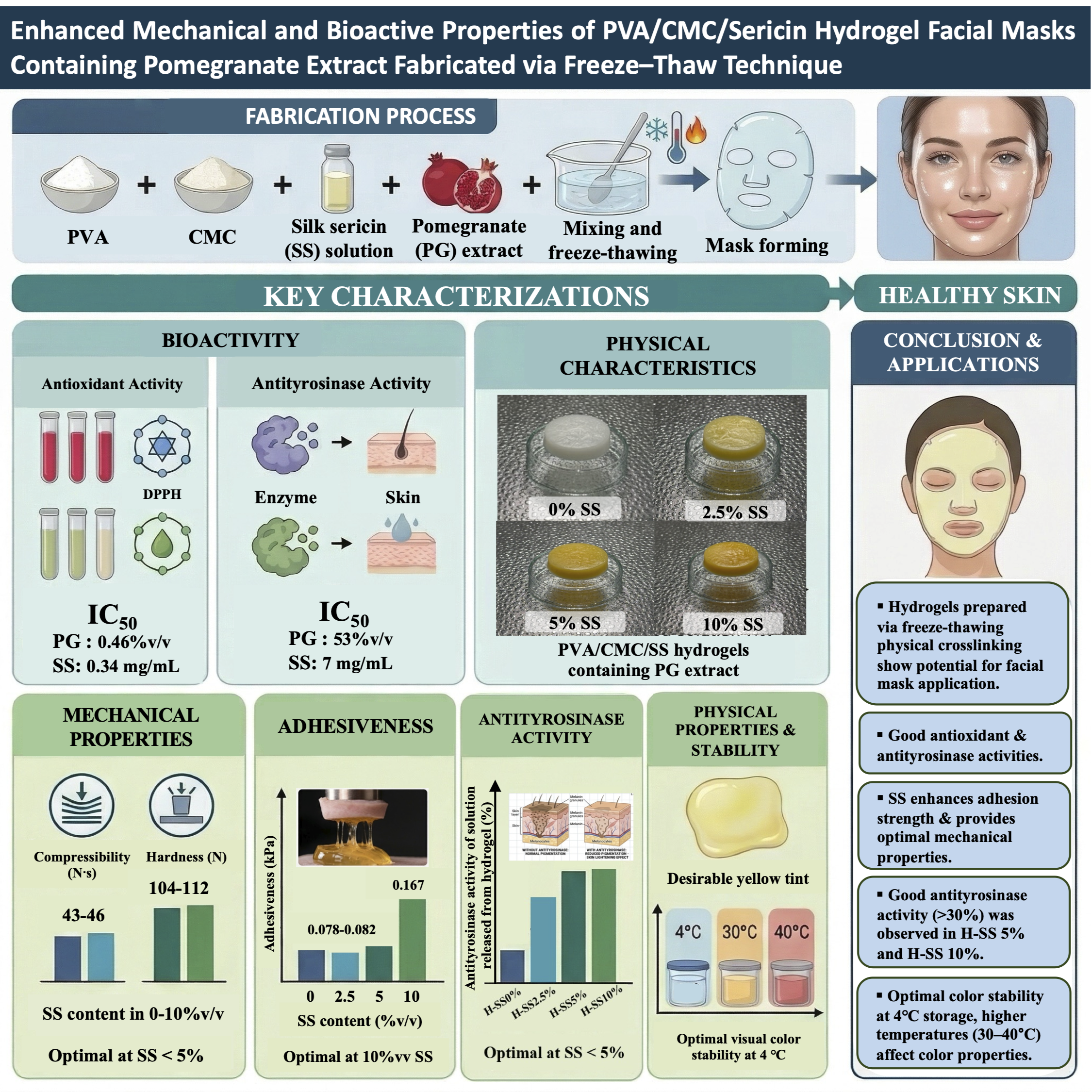
Downloads
Published
How to Cite
Issue
Section
License
Copyright (c) 2026 Walailak University

This work is licensed under a Creative Commons Attribution-NonCommercial-NoDerivatives 4.0 International License.