
High-Temperature Activation-Induced Structural Evolution and Electrochemical Behavior of N-Doped Carbon from Coffee Waste
DOI:
https://doi.org/10.48048/tis.2026.14056Keywords:
Waste coffee ground, Nitrogen dopant, Thermal activation, Structural evolution, Activated carbons, Electrochemical propertiesAbstract
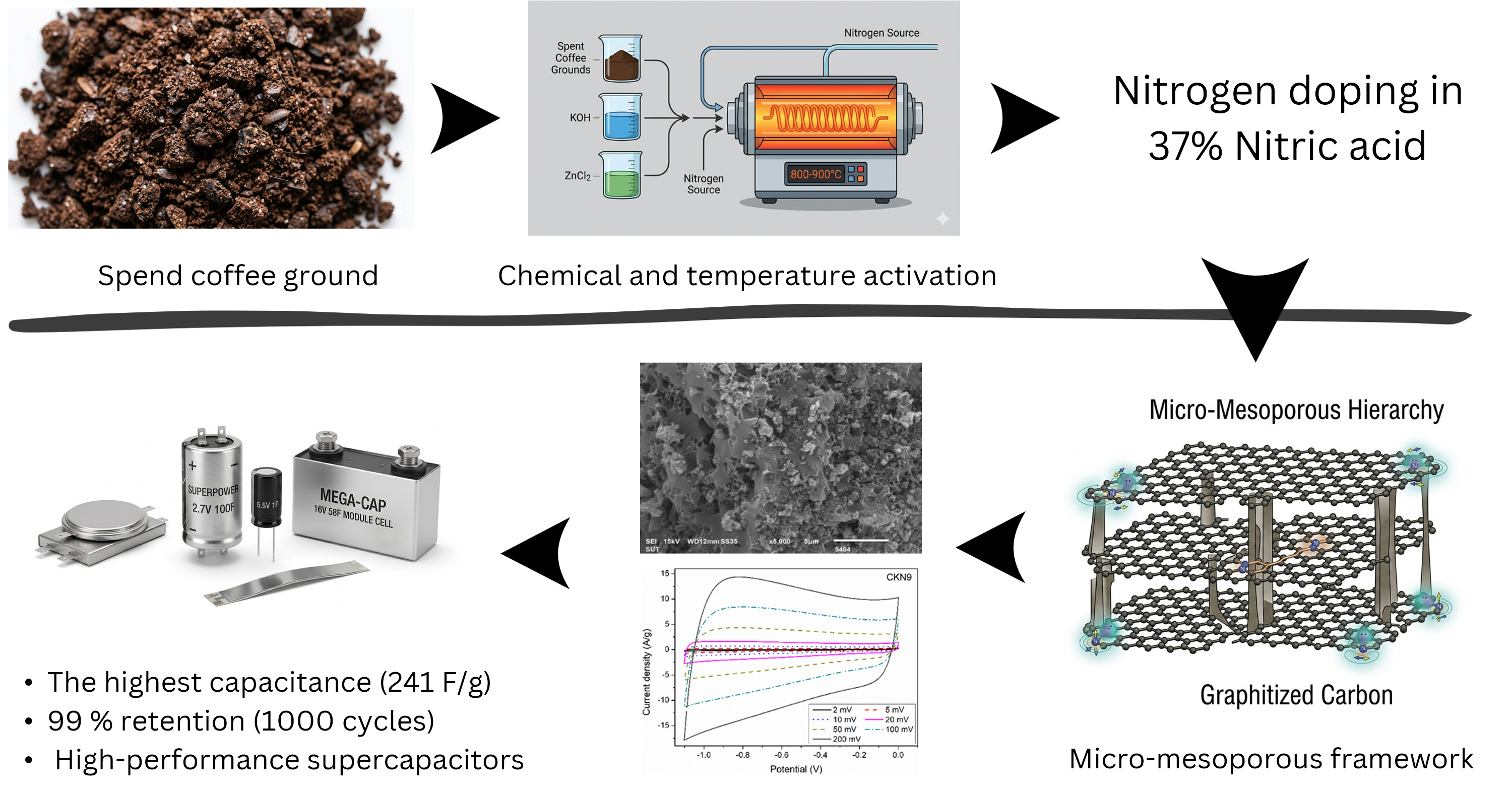
This study reveals that N-doping significantly enhances surface polarity, making coffee-derived carbon a competitive candidate for supercapacitors. Nitrogen-doped activated carbons were synthesized from waste coffee grounds through chemical activation using KOH and ZnCl2 at 800 and 900 °C. The effects of activation temperature and chemical agents on the structural, textural, and electrochemical properties were systematically investigated. Increasing activation temperature promoted graphitization and optimized the micro-mesoporous hierarchy. Nitrogen doping introduced abundant pyridinic- and graphitic-N sites, enhancing surface polarity and electrical conductivity. Among all samples, the 900 °C-activated and N-doped sample exhibited the highest BET surface area (1,250 m²/g) and a well-developed pore network, resulting in a superior specific capacitance of 241 F/g and 99% retention after 1,000 charge-discharge cycles. XPS analysis confirmed the dominance of pyridinic and graphitic nitrogen species, which enhanced electrical conductivity and ion accessibility. The combined effects of nitrogen doping and optimized activation conditions led to higher energy density and rate capability, demonstrating the potential of biomass-derived carbons for high-performance supercapacitors. The study provides a scalable and eco-efficient strategy for valorizing coffee waste into energy storage materials, contributing to clean energy, innovation and infrastructure, and responsible production and consumption.
HIGHLIGHTS
- Coffee waste valorized as precursor for N-doped activated carbon electrodes
- Activation temperature and agent strongly influence pore structure and chemistry
- High-temperature KOH activation yields optimal micro-mesoporous framework
- CKN9 shows the highest capacitance (241 F/g) and 99% retention after 1,000 cycles
- Demonstrates a scalable and eco-friendly route for high-performance supercapacitors
GRAPHICAL ABSTRACT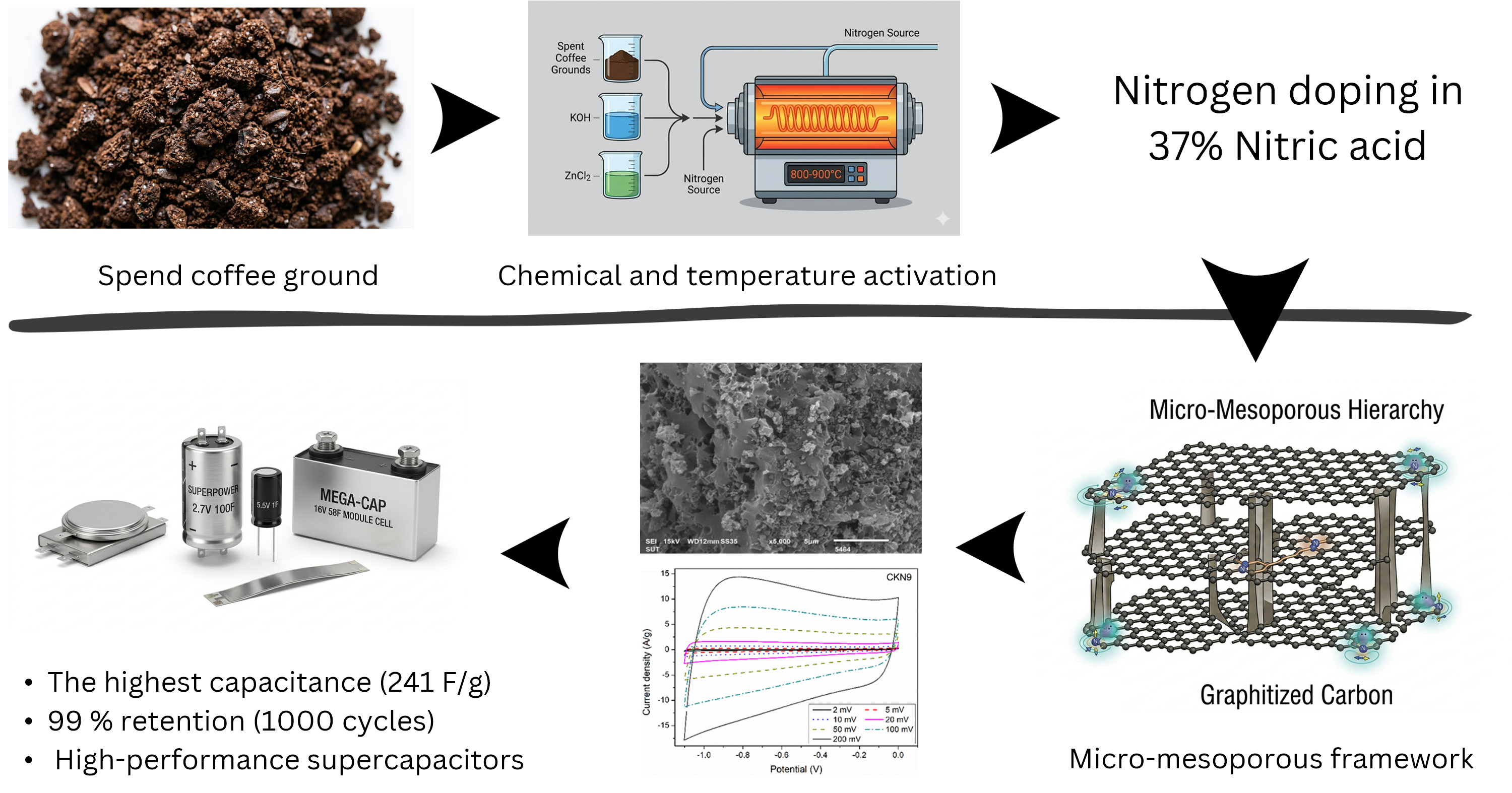
Downloads
References
P Putra. Preparation of activated carbon from coffee grounds as a supercapacitor electrode: Pembuatan karbon aktif dari ampas kopi sebagai elektroda superkapasitor (in Indonesian). Sunan Kalijaga Journal of Physics 2025; 7(1), 1-6.
CH Wang, WC Wen, HC Hsu and BY Yao. High-capacitance KOH-activated nitrogen-containing porous carbon material from waste coffee grounds in supercapacitor. Advanced Powder Technology 2016; 27(4), 1387-1395.
R Farma, RI Julita, I Apriyani, A Awitdrus and E Taer. ZnCl2-assisted synthesis of coffee bean bagasse-based activated carbon as a stable material for high-performance supercapacitors. Materials Today: Proceedings 2023; 87, 25-31.
O Khadka, U Lawaju, S Koju, RC Rai, ML Nakarmi and P Joshi. Activated carbon derived from coffee waste as supercapacitor electrode material. Scientific World 2024; 17(17), 19-26.
S Mukhiemer, A Daraghmah, H Nassar, S Hussain, H Lim, H Han, TW Kim and HS Hilal. Physically and chemically activated carbon from coffee waste in high performance supercapacitor electrodes. Physical Sciences 2024. https://doi.org/10.20944/preprints202410.0924.v1
M Marpongahtun, AH Siregar, AR Liandi, A Daulay, S Salmiati, AS Prayugo and R Annisa. A green approach to N, S-doped carbon dots from Jengkol peel (Archidendron pauciflorum) for ratiometric sensing of Amaranth dye. Trends in Sciences 2025; 22(9), 10340.
K Pandey and HK Jeong. Coffee waste-derived porous carbon based flexible supercapacitors. Chemical Physics Letters 2022; 809, 140173.
M Biegun, A Dymerska, X Chen and E Mijowska. Study of the active carbon from used coffee grounds as the active material for a high-temperature stable supercapacitor with ionic-liquid electrolyte. Materials 2020; 13(18), 3919.
TX Shang and XJ Jin. Waste particleboard-derived nitrogen-containing activated carbon through KOH activation for supercapacitors. Journal of Solid State Electrochemistry 2016; 20(7), 2029-2036.
C Yang, Y Liu, C Ma, M Norton and J Qiao. Preparing desirable activated carbons from agricultural residues for potential uses in water treatment. Waste and Biomass Valorization 2015; 6(6), 1029-1036.
C Lu, Z Yu, X Zhang and X Ma. ZnCl2-KOH modulation of biomass-derived porous carbon for supercapacitors. Energy Sources, Part A: Recovery, Utilization, and Environmental Effects 2024; 46(1), 2212-2222.
J Li, K Han, D Wang, Z Teng, Y Cao, J Qi, M Li and M Wang. Fabrication of high performance structural N-doped hierarchical porous carbon for supercapacitors. Carbon 2020; 164, 42-50.
D Tang, L Lu, Z Luo, B Yang, J Ke, W Lei, H Zhen, Y Zhuang, J Sun, K Chen and J Sun. Heteroatom-doped hierarchically porous biochar for supercapacitor application and phenol pollutant remediation. Nanomaterials 2022; 12(15), 2586.
R Hossain, RK Nekouei, I Mansuri and V Sahajwalla. In-situ O/N-heteroatom enriched activated carbon by sustainable thermal transformation of waste coffee grounds for supercapacitor material. Journal of Energy Storage 2021; 33, 102113.
S Hussain, A Oyebade, MR Hossain, F Abbas and N Siraj. Carbon-based anode materials for metal-ion batteries: Current status, challenges, and future directions. Batteries 2025; 11(12), 444.
Y Wang, T Liu, X Lin, H Chen, S Chen, Z Jiang, Y Chen, J Liu, J Huang and M Liu. Self-templated synthesis of hierarchically porous N-doped carbon derived from biomass for supercapacitors. ACS Sustainable Chemistry & Engineering 2018; 6(11), 13932-13939.
R Jangra, P Mahendia, M Karakoti, NG Sahoo, A Srivastava, OP Sinha, TD Clemons, U Deshpande and S Mahendia. ZnCl2-assisted conversion of nitrogen-containing biomass carbon from marigold flower: Toward highly porous activated nitrogen-doped carbon for low ESR and enhanced energy density supercapacitors. Journal of Energy Storage 2024; 75, 109728.
R Sharma, M Khalid and MY Ismail. Enhancing surface properties of circular carbon biochar derived from spent coffee beans through ZnCl2/KOH activation. BioEnergy Research 2024; 18(1), 2.
Y Ma. Comparison of activated carbons prepared from wheat straw via ZnCl2 and KOH activation. Waste and Biomass Valorization 2017; 8(3), 549-559.
Y Wan, Y Hu and W Zhou. Catalytic mechanism of nitrogen-doped biochar under different pyrolysis temperatures: The crucial roles of nitrogen incorporation and carbon configuration. Science of The Total Environment 2022; 816, 151502.
P Simon and Y Gogotsi. Materials for electrochemical capacitors. Nature Materials 2008; 7(11), 845-854.
TE Rufford, D Hulicova-Jurcakova, Z Zhu and GQ Lu. Nanoporous carbon electrode from waste coffee beans for high performance supercapacitors. Electrochemistry Communications 2008; 10(10), 1594-1597.
TE Rufford, D Hulicova-Jurcakova, E Fiset, Z Zhu and GQ Lu. Double-layer capacitance of waste coffee ground activated carbons in an organic electrolyte. Electrochemistry Communications 2009; 11(5), 974-977.
Z Geng, Q Xiao, D Wang, G Yi, Z Xu, B Li and C Zhang. Improved electrochemical performance of biomass-derived nanoporous carbon/sulfur composites cathode for lithium-sulfur batteries by nitrogen doping. Electrochimica Acta 2016; 202, 131-139.
SG Kandalkar, DS Dhawale, CK Kim and CD Lokhande. Chemical synthesis of cobalt oxide thin film electrode for supercapacitor application. Synthetic Metals 2010; 160(11-12), 1299-1302.
S Ye, J Feng and P Wu. Deposition of three-dimensional graphene aerogel on nickel foam as a binder-free supercapacitor electrode. ACS Applied Materials & Interfaces 2013; 5(15), 7122-7129.
J Choi, C Zequine, S Bhoyate, W Lin, X Li, P Kahol and R Gupta. Waste coffee management: Deriving high-performance supercapacitors using nitrogen-doped coffee-derived carbon. C 2019; 5(3), 44.
P Yuan, J Mo, X Sha, X Liu, L Xiao and G Chen. Temperature-modulated nitrogen-doped porous carbon derived from coffee grounds as an anode for high-performance lithium-ion batteries. Diamond and Related Materials 2025; 152, 111921.
V Thithai, X Jin, MA Ahmed and JW Choi. Physicochemical properties of activated carbons produced from coffee waste and empty fruit bunch by chemical activation method. Energies 2021; 14(11), 3002.
VN Toan, DHM Nguyen, LH Minh, HN Tran, TTA Hoa, STH Thai, LTM My, TP Nguyen, PT Trung and VTT Ho. High surface of activated carbon derived from waste coffee sludge by hydrothermal process at low temperature, Available at: https://papers.ssrn.com/sol3/papers.cfm?abstract_id=5222533, accessed January 2026.
Q Jiang, Z Zhang, S Yin, Z Guo, S Wang and C Feng. Biomass carbon micro/nano-structures derived from ramie fibers and corncobs as anode materials for lithium-ion and sodium-ion batteries. Applied Surface Science 2016; 379, 73-82.
C Choi, SD Seo, BK Kim and DW Kim. Enhanced lithium storage in hierarchically porous carbon derived from waste tea leaves. Scientific Reports 2016; 6(1), 39099.
A Das, S Pisana, B Chakraborty, S Piscanec, SK Saha, UV Waghmare, KS Novoselov, HR Krishnamurthy, AK Geim, AC Ferrari and AK Sood. Monitoring dopants by Raman scattering in an electrochemically top-gated graphene transistor. Nature Nanotechnology 2008; 3(4), 210-215.
DNKP Negara, IM Widiyarta, IGAK Suriadi, IGK Dwijana, IMDB Penindra, IGNPT Tenaya, IGK Sukadana and AS Ferdinand. Development of mesoporous activated carbons derived from brewed coffee waste for CO2 adsorption. EUREKA: Physics and Engineering 2023; 2, 17-27.
HS Karapınar. Adsorption performance of activated carbon synthesis by ZnCl2, KOH, H3PO4 with different activation temperatures from mixed fruit seeds. Environmental Technology 2022; 43(9), 1417-1435.
TX Shang, RQ Ren, YM Zhu and XJ Jin. Oxygen-and nitrogen-co-doped activated carbon from waste particleboard for potential application in high-performance capacitance. Electrochimica Acta 2015; 163, 32-40.
H Chen, H Wei, N Fu, W Qian, Y Liu, H Lin and S Han. Nitrogen-doped porous carbon using ZnCl2 as activating agent for high-performance supercapacitor electrode materials. Journal of Materials Science 2018; 53(4), 2669-2684.
Q Abbas, R Raza, I Shabbir and AG Olabi. Heteroatom doped high porosity carbon nanomaterials as electrodes for energy storage in electrochemical capacitors: A review. Journal of Science: Advanced Materials and Devices 2019; 4(3), 341-352.
N Chalmpes, I Tantis, AW Alsmaeil, BS Aldakkan, A Dimitrakou, MA Karakassides, CE Salmas and EP Giannelis. Elevating waste biomass: Supercapacitor electrode materials derived from spent coffee grounds. Energy & Fuels 2025; 39(2), 1305-1315.
YH Chiu and LY Lin. Effect of activating agents for producing activated carbon using a facile one-step synthesis with waste coffee grounds for symmetric supercapacitors. Journal of the Taiwan Institute of Chemical Engineers 2019; 101, 177-185.
E del Ángel Meraz and AP Aguirre. Supercapacitors for storing energy from coffee bean waste. Renewable Energy, Biomass & Sustainability 2020; 2(2), 7-15.
JW Lee, AS Hall, JD Kim and TE Mallouk. A facile and template-free hydrothermal synthesis of Mn3O4 nanorods on graphene sheets for supercapacitor electrodes with long cycle stability. Chemistry of Materials 2012; 24(6), 1158-1164.
H Wang, Z Zhang, Y Li, D Pei, S Wan, Y Li and H Lu. Facile fabrication of N-doped carbon derived from kiwi fruit peel for advanced supercapacitor. Academic Journal of Science and Technology 2023; 4(2), 78-82.
W Li, D Chen, Z Li, Y Shi, Y Wan, J Huang, J Yang, D Zhao and Z Jiang. Nitrogen enriched mesoporous carbon spheres obtained by a facile method and its application for electrochemical capacitor. Electrochemistry Communications 2007; 9(4), 569-573.
H Chen, F Sun, J Wang, W Li, W Qiao, L Ling and D Long. Nitrogen doping effects on the physical and chemical properties of mesoporous carbons. The Journal of Physical Chemistry C 2013; 117(16), 8318-8328.
Y Zhao, L Huang and G Sun. Preparation of high-performance KOH-activated biochar from agricultural waste (Sapindus mukorossi) and its application in organic dye removal. Sustainability 2025; 17(19), 8674.
C Schneidermann, C Kensy, P Otto, S Oswald, L Giebeler, D Leistenschneider, S Grätz, S Dörfler, S Kaskel and L Borchardt. Nitrogen-doped biomass-derived carbon formed by mechanochemical synthesis for lithium-sulfur batteries. ChemSusChem 2019; 12(1), 310-319.
Downloads
Published
How to Cite
Issue
Section
License
Copyright (c) 2026 Walailak University

This work is licensed under a Creative Commons Attribution-NonCommercial-NoDerivatives 4.0 International License.