
Effective CuSO4 Concentration on Phase Formation and Optical Characteristics of Electrodeposited Ni-Cu Alloy
DOI:
https://doi.org/10.48048/tis.2025.8897Keywords:
Ni-Cu Alloy, Film, Electrodeposition, Phase formation, Optical Characteristics, X-ray Diffraction, Scanning Electron Microscopy, Ni-Cu Alloy, Film, Electrodeposition, Phase formation, Optical characteristics, X-ray diffraction, Scanning Electron MicroscopyAbstract
Ni-Cu alloys play a critical role in various industrial applications due to their exceptional characteristics. Despite extensive study of these alloys for their mechanical and corrosion characteristics, their optical properties have received limited attention. In this research, the electrodeposition of Ni-Cu alloy coatings was conducted using copper sulfate concentrations ranging from 1.25 to 10 g/L, leading to successful film formation with various phases. XRD examination associated with the Rietveld calculation exhibited modified phase fraction, crystallite size, micro-strain, and lattice constant. Scanning Electron Microscopy (SEM) analysis revealed a different thickness and a dendritic microstructure. As an increase in CuSO4, there was observed an increase in the values of the absorption edge (showing 1.61 - 1.90 eV), texture coefficient (0.46 - 0.82), and film thickness (0.63 - 1.74 µm). These various morphologies enhanced the material’s properties. In more added CuSO4 samples, the coatings significantly reveal a modification in the crystal, film growth, and optical properties. The advancements in visible light absorption suggest an enhanced coating for optical technology applications.
HIGHLIGHTS
- The texture coefficient (TC) values of the (111) plane of Cu81Ni0.19 phase were found to increase with higher CuSO4 concentrations. Specifically, the TC values for 1.25Cu-Ni, 2.5Cu-Ni, 5.0Cu-Ni, 7.5Cu-Ni, and 10Cu-Ni were 0.46, 0.48, 0.77, 0.77, and 0.82, respectively. These values, all below 1, indicate low crystallinity but show a trend of increasing crystallinity with higher CuSO4 concentrations.
- The film thickness also increased with higher CuSO4 The thicknesses were 0.63 µm for 1.25Cu-Ni, 0.65 µm for 2.5Cu-Ni, 1.36 µm for 5.0Cu-Ni, 1.54 µm for 7.5Cu-Ni, and 1.74 µm for 10Cu-Ni.
- The grain morphology of the coatings evolved from small, elongated platelets in lower CuSO4 concentrations to larger, more dendritic structures at higher concentrations. This change in morphology is attributed to the increased CuSO4 concentration, which affects the crystal growth mechanisms during electroplating.
GRAPHICAL ABSTRACT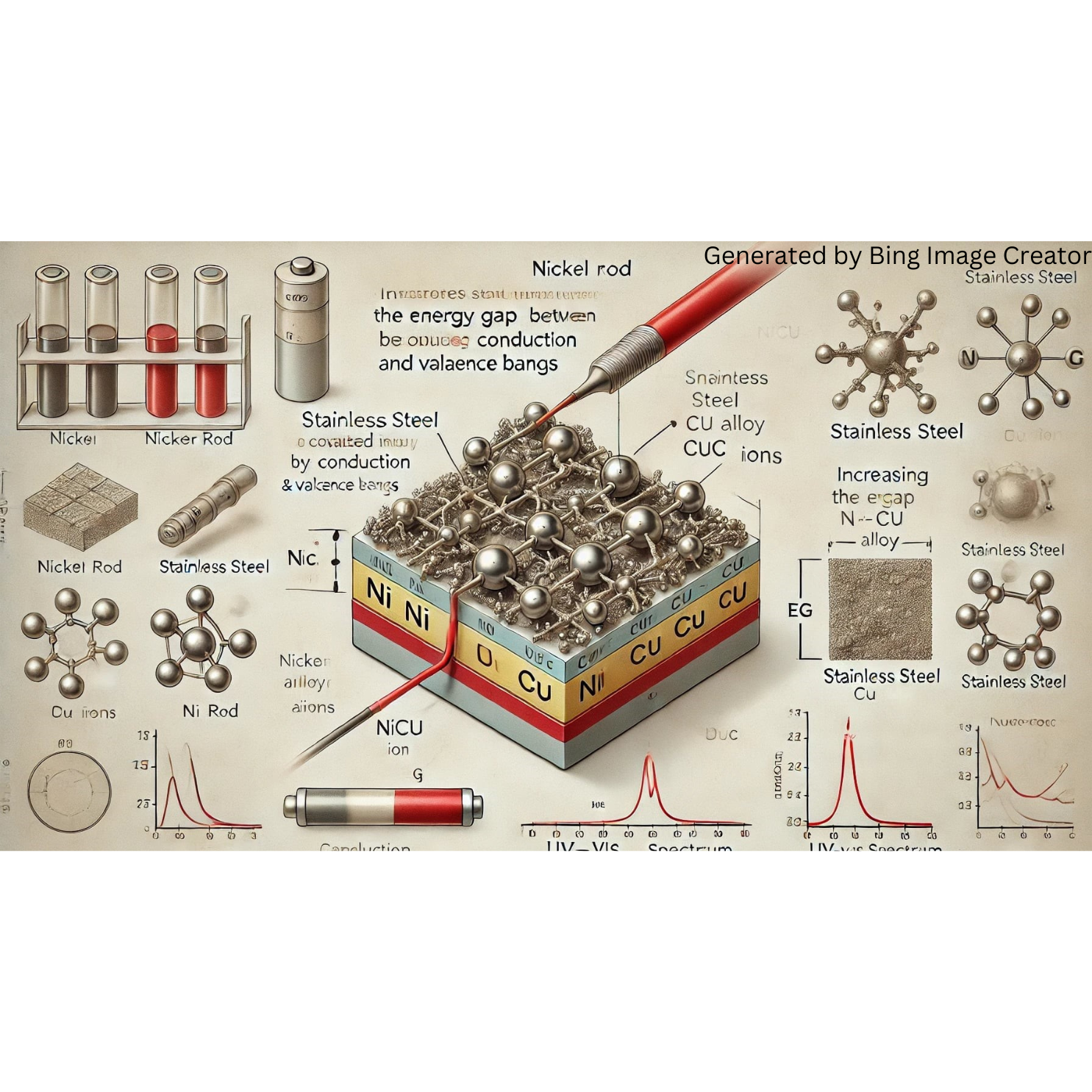
Downloads
References
RS Yang, MT Li, CH Liu, XJ Cui and YZ Jin. The synthesis of Cu0.81Ni0.19 intermetallics by mechanical alloying. Advanced Materials Research 2012; 496, 379-382.
X Wang, J Bai, M Zhang, Y Chen, L Fan, Z Yang, J Zhang and R Guan. A comparison between porous to fully dense electrodeposited CuNi films: Insights on electrochemical performance. Nanomaterials 2023; 13(3), 491.
E Casado-Rivera, DJ Volpe, L Alden, C Lind, C Downie, T Vázquez-Alvarez, ACD Angelo, FJ DiSalvo and HD Abruña. Electrocatalytic activity of ordered intermetallic phases for fuel cell applications. Journal of the American Chemical Society 2004; 126(12), 4043-4049.
R Solmaz, A Döner and G Kardaş. Electrochemical deposition and characterization of NiCu coatings as cathode materials for hydrogen evolution reaction. Electrochemistry Communications 2008; 10(12), 1909-1911.
W Jesus, V Silva, H Souza, T Costa, O Rocha, L Nascimento and A Silva. Thermal and microstructural characterization of the multicomponent alloy Al33wt%Cu1wt%Ni-1.2 wt%Ta solidified with transient heat flow. Trends in Sciences 2024; 21(9), 8029.
GN Flint and CP Cutler. Nickel metal and alloys. In: JJ Hostynek and HI Maibach (Eds.). Nickel and the skin: Absorption, immunology, epidemiology, and metallurgy. CRC Press, Florida, 2002, p. 219-238.
KRM Rao. Corrosion resistance of high entropy alloys. In: K Kumar, BS Babu and JP Davim (Eds.). Coatings: Materials forming, machining and tribology. Springer, Cham, Switzerland, 2021, p. 81-115.
V Dalouji and S Goudarzi. MWNTs on NiCu-a-C: H substrates: Study of optical linear equations, optical density, steepness and electron-phonon interaction. Molecular Crystals and Liquid Crystals 2022; 746(1), 79-92.
M Pinna, AWW Wei, D Spanu, J Will, T Yokosawa, E Spiecker, S Recchia, P Schmuki and M Altomare. Amorphous NiCu thin films sputtered on TiO2 nanotube arrays: A noble‐metal free photocatalyst for hydrogen evolution. ChemCatChem 2022; 14(23), e202201052.
B Zhao, W Zhao, G Shao, B Fan and R Zhang. Morphology-control synthesis of a core-shell structured NiCu alloy with tunable electromagnetic-wave absorption capabilities. ACS Applied Materials & Interfaces 2015; 7(23), 12951-12960.
K Tewari, D Thapliyal, CK Bhargava, S Verma, A Mehra, S Rana, AK Gautam, GD Verros and RK Arya. Innovative coating methods for industrial applications. In: RK Arya, GD Verros and JP Davim (Eds.). Functional coatings: Innovations and challenges. John Wiley & Sons, New Jersey, 2024, p. 23-50.
SM Silaimani, G Vivekanandan and P Veeramani. Nano-nickel-copper alloy deposit for improved corrosion resistance in marine environment. International Journal of Environmental Science and Technology 2015; 12, 2299-2306.
SK Ghosh, AK Grover, GK Dey and MK Totlani. Nanocrystalline Ni-Cu alloy plating by pulse electrolysis. Surface and Coatings Technology 2000; 126(1), 48-63.
PQ Dai, C Zhang, JC Wen, HC Rao and QT Wang. Tensile properties of electrodeposited nanocrystalline Ni-Cu alloys. Journal of Materials Engineering and Performance 2016; 25(2), 594-600.
D Goranova, R Rashkov, G Avdeev and V Tonchev. Electrodeposition of Ni-Cu alloys at high current densities: Details of the elements distribution. Journal of Materials Science 2016; 51, 8663-8673.
D Li and EJ Podlaha. Template-assisted electrodeposition of porous Fe-Ni-Co nanowires with vigorous hydrogen evolution. Nano Letters 2019; 19(6), 3569-3574.
X Guo, T Liang, D Zhang, M Zhang, Y Lin and C Lai. Facile fabrication of 3D porous nickel networks for electro-oxidation of methanol and ethanol in alkaline medium. Materials Chemistry and Physics 2019; 221, 390-396.
F Nasirpouri. Electrodeposited nanocrystalline films and coatings. In: Electrodeposition of nanostructured materials. Springer, Cham, Switzerland, 2017, p. 261-288.
S Cherevko, X Xing and CH Chung. Hydrogen template assisted electrodeposition of sub-micrometer wires composing honeycomb-like porous Pb films. Applied Surface Science 2011; 257(18), 8054-8061.
W Zhang, C Ding, A Wang and Y Zeng. 3-D network pore structures in copper foams by electrodeposition and hydrogen bubble templating mechanism. Journal of The Electrochemical Society 2015; 162(8), D365.
HM Rietveld. Line profiles of neutron powder-diffraction peaks for structure refinement. Acta Crystallographica 1967; 22, 151-152.
L Lutterotti. Maud: A Rietveld analysis program designed for the internet and experiment integration. Acta Crystallographica Section A Foundations of Crystallography 2000; 56(S1), s54.
HM Rietveld. A profile refinement method for nuclear and magnetic structures. Journal of Applied Crystallography 1969; 2(2), 65-71.
S Eugénio, TM Silva, MJ Carmezim, RG Duarte and MF Montemor. Electrodeposition and characterization of nickel-copper metallic foams for application as electrodes for supercapacitors. Journal of Applied Electrochemistry 2014; 44, 455-465.
M Kumar and NP Shetti. Magnetron sputter deposited NiCu alloy catalysts for production of hydrogen through electrolysis in alkaline water. Materials Science for Energy Technologies 2018; 1, 160-165.
F Chouikh, Y Beggah and MS Aida. Optical and electrical properties of Bi doped ZnO thin films deposited by ultrasonic spray pyrolysis. Journal of Materials Science: Materials in Electronics 2011; 22(5), 499-505.
AA Akl, SA Mahmoud, SM Al-Shomar and AS Hassanien. Improving microstructural properties and minimizing crystal imperfections of nanocrystalline Cu2O thin films of different solution molarities for solar cell applications. Materials Science in Semiconductor Processing 2018; 74, 183-92.
Z Jamil, E Ruiz-Trejo and NP Brandon. Nickel electrodeposition on silver for the development of solid oxide fuel cell anodes and catalytic membranes. Journal of The Electrochemical Society 2017; 164(4), D210-D217.
Ö Söğüt, Ç Dönük, G Apaydın and ÖF Bakkaloğlu. Examination of CoNiCu thin films by using XRF and XRD. Canadian Journal of Physics 2014; 92(5), 435-439.
WS Choi, HR Jung, SH Kwon, JW Lee, M Liu and HC Shin. Nanostructured metallic foam electrodeposits on a nonconductive substrate. Journal of Materials Chemistry 2012; 22(3), 1028-1032.
C Miao, G Zhou, S Chen, H Xie and X Zhang. Synergistic effects between Cu and Ni species in NiCu/γ-Al2O3 catalysts for hydrodeoxygenation of methyl laurate. Renewable Energy 2020; 153, 1439-1454.
Y Li, G Huang, X Yin, X Chen, X Ma, Y Li and E Yao. Effect of copper ion concentration on microstructure and mechanical properties of electrolytic copper foil. IOP Conference Series: Materials Science and Engineering 2018; 381, 12166.
P Nath, R Pandey, A Das and A Mallik. Effect of deposition potential and copper concentration on the phase transformation mechanism and structural distribution during electrodeposition of Ni-Cu magnetic alloy thin films. Metallic Materials 2017; 55(4), 255-265.
H An, NJ Siambun, BL Chuab, MGJ Hong and H Li. Structure transition mechanism in undercooled CuNi alloys. Journal of Wuhan University of Technology, Materials Science Edition 2021; 36, 880-883.
K Wasa, M Kitabatake and H Adachi. Thin film materials technology: Sputtering of compound materials. William Endrew Inc. Publishing, New York, 2004.
Y Keereeta, W Panthuwat, T Suriwong, R Sirirak, A Prasatkhetragarn, C Boonruang and A Klinbumrung. Phase transition and optical characteristics of Mg doped CuAlO2 synthesized by facile thermal decomposition process. Optik 2022; 268, 169840.
Z Liu, X Xu, J Fang, X Zhu, J Chu and B Li. Microemulsion synthesis, characterization of bismuth oxyiodine/titanium dioxide hybrid nanoparticles with outstanding photocatalytic performance under visible light irradiation. Applied Surface Science 2012; 258(8), 3771-3778.
Y Wu, JD Fowlkes and PD Rack. The optical properties of Cu-Ni nanoparticles produced via pulsed laser dewetting of ultrathin films: The effect of nanoparticle size and composition on the plasmon response. Journal of Materials Research 2011; 26(2), 277-287.
HH Hsieh, YK Chang, WF Pong, JY Pieh, PK Tseng, TK Sham, I Coulthard, SJ Naftel, JF Lee, SC Chung and KL Tsang. Electronic structure of Ni-Cu alloys: The 𝑑-electron charge distribution. Physical Review B 1998; 57, 15204.
A Arman, T Ghodselahi, M Molamohammadi, S Solaymani, H Zahrabi and A Ahmadpourian. Microstructure and optical properties of Cu@Ni nanoparticles embedded in a-C:H. Protection of Metals and Physical Chemistry of Surfaces 2015; 51, 575-578.
S Goudarzi and V Dalouji. The effect of Cu content in MWCNTs synthesized by Ni-Cu@a-C:H catalyst on the optical constants and the optical loss. Optik 2020; 223, 165585.
AS Hassanien and AA Akl. Influence of composition on optical and dispersion parameters of thermally evaporated non-crystalline Cd50S50−xSex thin films. Journal of Alloys and Compounds 2015; 648, 280-290.
AS Hassanien and AA Akl. Effect of Se addition on optical and electrical properties of chalcogenide CdSSe thin films. Superlattices and Microstructures 2016; 89, 153-169.
MA Ditta, MA Farrukh, S Ali and N Younas. X-ray peak profiling, optical parameters and catalytic properties of pure and CdS doped ZnO-NiO nanocomposites. Russian Journal of Applied Chemistry 2017; 90, 151-159.
KN Manjunatha and S Paul. Investigation of optical properties of nickel oxide thin films deposited on different substrates. Applied Surface Science 2015; 352, 10-15.
YH Liu, JC Zuo, XF Ren and L Yong. Synthesis and character of cerium oxide (CeO2) nanoparticles by the precipitation method. Metalurgija 2014; 53(4), 463-465.

Downloads
Published
How to Cite
Issue
Section
License
Copyright (c) 2024 Walailak University

This work is licensed under a Creative Commons Attribution-NonCommercial-NoDerivatives 4.0 International License.





