
Antioxidant and Anti-inflammatory Activities of Different Solvent Extracts from Ipomoea pes-caprae (L.) R. Br. in Lipopolysaccharide Stimulated RAW 264.7 Macrophages
DOI:
https://doi.org/10.48048/tis.2021.1404Keywords:
Antioxidant, Anti-inflammatory, RAW264.7 cells, Lipopolysaccharide, Ipomoea pes-capraeAbstract
The oxidative stress and inflammatory environment trigger an unhealthy circle, which can lead to various inflammatory diseases. Ipomoea pes-caprae, a traditional medicine mangrove plant, posed many pharmacological activities, including antioxidant, anti-inflammatory and anticancer effects. However, the possible mechanisms involved in Ipomoea pes-caprae are still unclear. This study aimed to investigate the antioxidant and anti-inflammatory effects of different solvent extracts from Ipomoea pes-caprae on lipopolysaccharide (LPS) stimulated macrophages. Three different solvent gradients were prepared orderly from non-polar to polar: hexane (Hex), supercritical fluid extraction using carbon dioxide plus EtOH as co-solvent (SCO2) and ethanol (EtOH). All 3 extracts were screened for the cytotoxicity on RAW264.7 cells by MTT assay. The non-toxic doses were investigated for reactive oxygen species (ROS) scavenging by DPPH and DCFH-DA assays and evaluated their anti-inflammatory activities via inhibition against LPS-induced nitric oxide (NO), prostaglandin E2 (PGE2), inducible NO synthase (iNOS) and cyclooxygenase-2 (COX-2) mRNA expression. All 3 extracts (25 - 50 μg/mL) exhibited DPPH scavenging and reduced intracellular ROS level in the order of SCO2 > EtOH > Hex. Further, these extracts suppressed NO and PGE2 production by regulating iNOS and COX-2 mRNA expression in the order of SCO2 > Hex > EtOH. Additionally, their inhibitory effects were in a similar pattern as the standard drugs L-NAME and celecoxib. These findings support the traditional use of Ipomoea pes-caprae in treating inflammatory diseases due to its attenuation of inflammation in activated macrophage. Also, a wide range of secondary metabolites in unique ecology may be useful as one of the alternative therapies for inflammatory diseases.
HIGHLIGHTS
- Ipomoea pes-caprae employ a sort of secondary metabolites under stressful high salt conditions with benefit for new drug discoveries
- SCO2 extract exhibited the strongest activities in the LPS-induced ROS and PGE2 production
- These bioactive compounds contained in Ipomoea pes-caprae confirm the traditional use against jellyfish stings and may targeting inflammatory pathways
GRAPHICAL ABSTRACT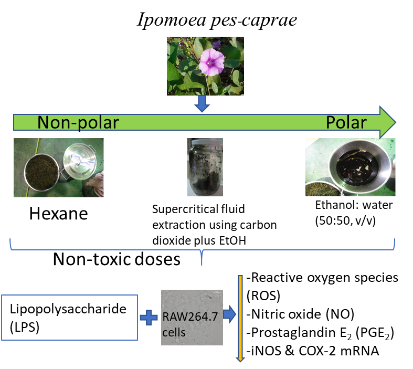
Downloads
References
U Pongprayoon, P Baeckstrom, U Jacabsson, M Lindstrom and L Bohlin. Compounds inhibiting prostaglandin synthesis isolated from Ipomoea pes caprae. Planta Med. 1991; 57, 515-8.
D Vieira, D Padoani, JDS Soares, J Adriano, VC Filho, MMD Souza, TMB Bresolin and AG Couto. Development of hydro-ethanolic extract of Ipomoea pescaprae using factorial design followed by antinociceptive and anti-inflammatory evaluation. Braz. J. Pharmacog. 2013; 23, 72-8.
ND Venkataraman, WC Atlee, TP Prabhu and R Kannan. Anti-inflammatory potential of ethanolic extracts from aerial parts of Ipomeae pes-caprae (L.). R. Br. Using cotton pellet induced granuloma model. J. Appl. Pharm. Sci. 2013; 3, 061-3.
MM de Souza, A Madeira, C Berti, R Krogh, RA Yunes and V Cechinel-Filho. Antinociceptive properties of the methanolic extract obtained from Ipomoea pes-caprae (L.) R. Br. J. Ethnopharmacol. 2000; 69, 85-90.
CS Barth, HG T de Souza, LW Rocha, GF da Silva, MF Dos Anjos, VD Pastor, TM B Bresolin, AG Couto, JR Santin and NL M Quintão. Ipomoea pes-caprae (L.) R. Br (Convolvulaceae) relieved nociception and inflammation in mice - A topical herbal medicine against effects due to cnidarian venom-skin contact. J. Ethnopharmacol. 2017; 200, 156-64.
P Arulselvan, MT Fard, WS Tan, S Gothai, S Fakurazi, ME Norhaizan and SS Kumar. Role of antioxidants and natural products in inflammation. Oxid. Med. Cell. Longev. 2016; 2016, 5276130.
M Kumar, S Kumar and S Kaur. Role of ROS and COX-2/iNOS inhibition in cancer chemoprevention: A review. Phytochem. Rev. 2012; 11, 309-37.
Z Liu, Z Ren, J Zhang, CC Chuang, E Kandaswamy, T Zhou and L Zuo. Role of ROS and nutritional antioxidants in human diseases. Front. Physiol. 2018.
V Aggarwal, HS Tuli, A Varol, F Thakral, MB Yerer, K Sak, M Varol, A Jain, MA Khan and G Sethi. Role of reactive oxygen species in cancer progression: Molecular mechanisms and recent advancements. Biomolecules 2019; 9, 735.
R Pereda-Miranda, E Escalante-Sa´nchez and C Escobedo-Martı´nez. Characterization of lipophilic pentasaccharides from beach Morning Glory (Ipomoea pes-caprae). J. Nat. Prod. 2005; 68, 226-30.
A Manigauha, MD Kharya and N Ganesh. In vivo antitumor potential of Ipomoea pes-caprae on melanoma cancer. Pharmacogn. Mag. 2015; 11, 426-33.
C Saengkhae, N Uawongyart and S Osiri. Cytotoxicity and apoptotic mechanisms of different solvent extracts from Ipomoea pes-caprae on human nasopharyngeal cells. Chula. Med. J. 2019; 63, 143-51.
M Chatatikun and A Chiabchalard. Phytochemical screening and free radical scavenging activities of orange baby carrot and carrot (Daucus carota Linn.) root crude extracts. J. Chem. Pharmaceut. Res. 2013; 5, 97-102.
CF Lin, KC Young, CH Bai, BC Yu, CT Ma, YC Chien, CL Chiang, CS Liao, HW Lai and CW Tsao. Rosiglitazone regulates anti-inflammation and growth inhibition via PTEN. Biomed Res. Int. 2014; 2014, 787924.
P Kunnaja, W Kumsaiyai, K Punturee, A Siriphun and T Chatboonward. Inhibition of nitric oxide production and COX-2 protein expression in LPS-stimulated RAW 264.7 cells by the hexane fraction of Murdannia loriformis. J. Assoc. Med. Sci. 2019; 52, 103-11.
CH Kang, YH Choi, IW Choi, JD Lee and GY Kim. Inhibition of lipopolysaccharide-induced iNOS, COX- 2, and TNF-α expression by aqueous extract of Orixa japonica in RAW 264.7 cells via suppression of NF- kB activity. Trop. J. Pharmaceut. Res. 2011; 10, 161-8.
A Ocaña-Fuentes, E Arranz-Gutiérrez, FJ Señorans and G Reglero. Supercritical fluid extraction of oregano (Origanum vulgare) essentials oils: Anti-inflammatory properties based on cytokine response on THP-1 macrophages. Food Chem. Toxicol. 2010; 48, 1568-75.
SK Jaganathan and E Supriyanto. Antiproliferative and molecular mechanism of eugenol-induced apoptosis in cancer cells. Molecules 2012; 17, 6290-304.
F Fadilah, A Yanuar, A Arsianti, R Andrajati. Phenylpropanoids, eugenol scaffold and its derivatives as anticancer. Asian J. Pharmaceut. Clin. Res. 2017; 10, 41-6.
C Escobedo-Martı´nez and R Pereda-Miranda. Resin glycosides from Ipomoea pes-caprae. J. Nat. Prod. 2007; 70, 974-8.
GN Sapkale, SM Patil, US Surwase and PK Bhatbhage. Supercritical fluid extraction. Int. J. Chem. Sci. 2010; 8, 729-43.
D Banerjee, AK Hazra, T Seal, TK Sur, D Bhattacharya, J Ray, A Mukherjee and B Mukherjee. Antioxidant and anti-inflammatory activities of different solvent extracts and isolated compounds of Ipomoea pes-caprae (L) sweet of sunder ban mangrove eco-complex. Asian J. Chem. 2013; 25, 4997-5000.
S Vijayalaxmi, SK Jayalakshmi and K Sreeramulu. Polyphenols from different agricultural residues: Extraction, identification and their antioxidant properties. J. Food Sci. Tech. 2015; 52, 2761-9.
OA Castaneda, SC Lee, CT Ho and TC Huang. Macrophages in oxidative stress and models to evaluate the antioxidant function of dietary natural compounds. J. Food Drug Anal. 2017; 25, 111-8.
H Zhang and R Tsao. Dietary polyphenols, oxidative stress and antioxidant and anti-inflammatory effects. Curr. Opin. Food Sci. 2016; 8, 33-42.
D Salvemini, SF Kim and V Mollace. Reciprocal regulation of the nitric oxide and cyclooxygenase pathway in pathophysiology: relevance and clinical implications. Am. J. Physiol. Regul. Integr. Comp. Physiol. 2013; 304, R473-R487.
SD Manjare and K Dhingra. Supercritical fluids in separation and purification: A review. Mater. Sci. Tech. 2019; 2, 463-84.
Downloads
Published
How to Cite
Issue
Section
License

This work is licensed under a Creative Commons Attribution-NonCommercial-NoDerivatives 4.0 International License.





