
4-Methoxycinnamyl p-Coumarate Mediates Anti-Atherosclerotic Effects by Suppressing NF-ĸB Signaling Pathway and Foam Cell Formation
DOI:
https://doi.org/10.48048/tis.2025.10429Keywords:
4-Methoxycinnamyl p-coumarate, ICAM-1, VCAM-1, Endothelial cell, Ox-LDL, Foam cell, Vascular inflammationAbstract
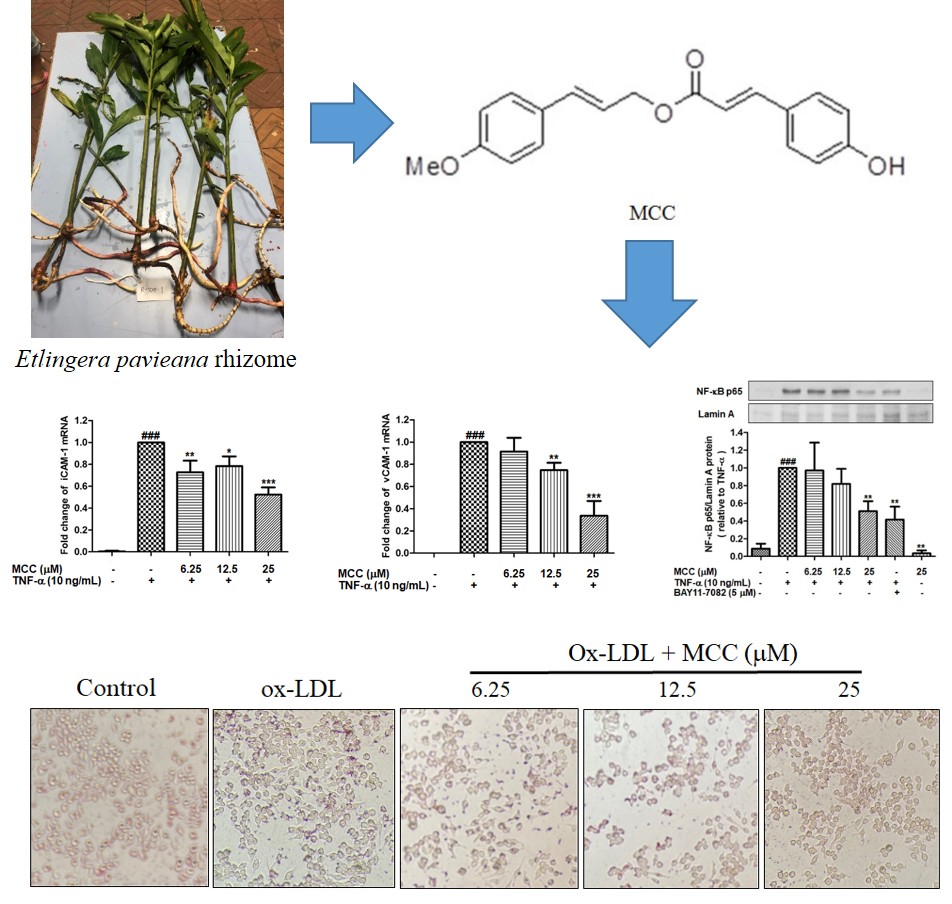
Vascular inflammation plays a crucial role in atherosclerosis initiation and progression. 4-methoxycinnamyl p-coumarate (MCC), a major bioactive phenylpropanoid found in Etlingera pavieana rhizomes, has demonstrated anti-inflammatory activity in lipopolysaccharide-induced macrophages and microglial cells. Therefore, we hypothesized that MCC may also exert anti-inflammatory effects on human vascular endothelial cells, which are key players in the early stages of atherosclerotic plaque formation. To test this hypothesis, we investigated the mechanisms underlying MCC-mediated anti-atherosclerotic effects in tumor necrosis factor-alpha (TNF-α)-treated vascular endothelial cells. An MTT assay was performed to assess the cytotoxicity of MCC on human vascular endothelial EA.hy926 cells. The mRNA expression levels of intercellular adhesion molecule-1 (ICAM-1) and vascular cell adhesion molecule-1 (VCAM-1) were analyzed using real-time reverse transcription polymerase chain reaction. Foam cell formation induced by oxidized low-density lipoprotein (ox-LDL) in RAW264.7 macrophages was evaluated by Oil Red O staining. Our findings revealed that non-toxic concentrations of MCC (6.25 - 25 µM) significantly downregulated ICAM-1 and VCAM-1 mRNA expression in a concentration-dependent manner. In addition, MCC inhibited the nuclear translocation of the nuclear factor-κB (NF-κB) p65 subunit, as demonstrated by western blot analysis. Moreover, MCC reduced ox-LDL-induced foam cell formation in RAW264.7 macrophages. Collectively, these results suggest that MCC exerts its anti-atherosclerotic effects by downregulating ICAM-1 and VCAM-1 expression via inhibition of the NF-κB signaling pathway in endothelial cells and by suppressing formation of ox-LDL-induced foam cells. These findings highlight the potential of MCC as a promising therapeutic agent for the treatment of vascular inflammatory disorders.
HIGHLIGHTS
- 4-methoxycinnamyl p-coumarate (MCC) reduces ICAM-1 and VCAM-1 expression in TNF-α-stimulated
- endothelial cells.
- MCC inhibits NF-κB p65 nuclear translocation, blocking inflammatory signaling.
- MCC suppresses ox-LDL-induced foam cell formation in macrophages.
GRAPHICAL ABSTRACT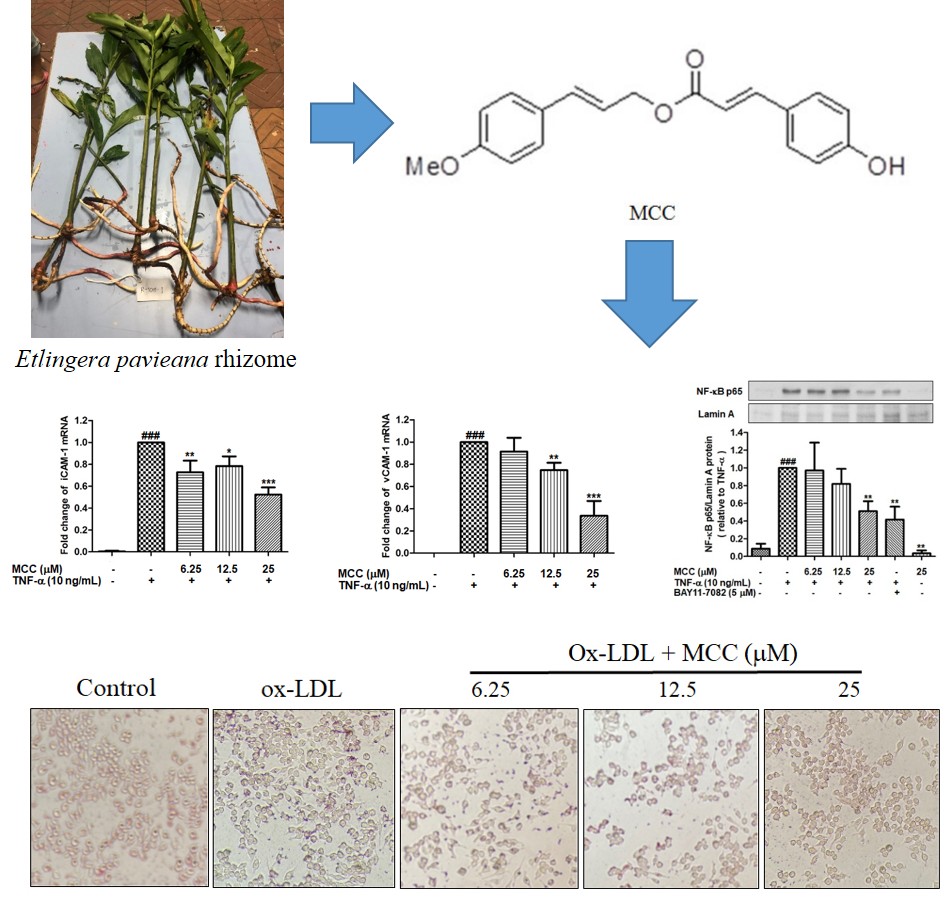
Downloads
References
S Jebari-Benslaiman, U Galicia-García, A Larrea-Sebal, JR Olaetxea, I Alloza, K Vandenbroeck, A Benito-Vicente and C Martín. Pathophysiology of atherosclerosis. International Journal of Molecular Sciences 2022; 23(6), 3346.
World Health Organization. Non-communicable diseases. 2022, Available at: https://www.who.int/ news-room/fact-sheets/detail/noncommunicable-diseases, accessed January 2024.
CM Steyers and FJJ Miller. Endothelial dysfunction in chronic inflammatory diseases. International Journal of Molecular Sciences 2014; 15(7), 11324-11349.
N Mosalmanzadeh and BD Pence. Oxidized low-density lipoprotein and its role in immunometabolism. International Journal of Molecular Sciences 2024; 25(21), 11386.
XH Yu, YC Fu, DW Zhang, K Yin and CK Tang. Foam cells in atherosclerosis. Clinica Chimica Acta 2013; 424, 245-252.
Y Gui, H Zheng and RY Cao. Foam cells in atherosclerosis: Novel insights into its origins, consequences, and molecular mechanisms. Frontiers in Cardiovascular Medicine 2022; 9, 845942.
WG Gwon, SG Lee, JI Kim, YM Kim, SB Kim and HR Kim. Hexane fraction from the ethanolic extract of Sargassum serratifolium suppresses cell adhesion molecules via regulation of NF-κB and Nrf2 pathway in human umbilical vein endothelial cells. Fisheries and Aquatic Sciences 2019; 22, 7.
HC Lin, CC Li, YC Yang, TH Chiu, KL Liu, CK Lii and HW Chen. Andrographis paniculata diterpenoids and ethanolic extract inhibit TNFα-induced ICAM-1 expression in EA.hy926 cells. Phytomedicine 2019; 52, 157-167.
E Srisook, M Palachot, S Mankhong and K Srisook. Anti-inflammatory effect of Etlingera pavieana (Pierre ex Gagnep.) RM Sm. rhizomal extract and its phenolic compounds in lipopolysaccharide-stimulated macrophages. Pharmacognosy Magazine 2017; 13(S2), S230-S235.
S Mankhong, P Iawsipo, E Srisook and K Srisook. 4-methoxycinnamyl p-coumarateisolated from Etlingera pavieana rhizomes inhibits inflammatory response via suppression of NF-κB, Akt and AP-1 signaling in LPS-stimulated RAW264.7 macrophages. Phytomedicine 2019; 54, 89-97.
M Poonasri, S Mankhong, N Chiranthanut and K Srisook. 4-Methoxycinnamyl p-coumarate reduces neuroinflammation by blocking NF-κB, MAPK, and Akt/GSK-3β pathways and enhancing Nrf2/HO-1 signaling cascade in microglial cells. Biomedicine and Pharmacotherapy 2023; 168, 115808.
N Chiranthanut, N Lertprasertsuke, E Srisook and K Srisook. Anti-inflammatory effect and acute oral toxicity study of 4-methoxycinnamyl p-coumarate from Etlingera pavieana rhizomes in animal models. Journal of Applied Pharmaceutical Science 2021; 11, 24-28.
K Srisook, K Potiprasart, S Sarapusit, CS Park and E Srisook. Etlingera pavieana extract attenuates TNF-α induced vascular adhesion molecule expression in human endothelial cells through NF-κB and Akt/JNK pathways. Inflammopharmacology 2020; 28(6), 1649-1662.
A Giulietti, L Overbergh, D Valckx, B Decallonne, R Bouillon and C Mathieu. An overview of real-time quantitative PCR: Applications to quantify cytokine gene expression. Methods 2001; 25(4), 386-401.
SH Park, JL Kim, MK Kang, JH Gong, SY Han, JH Shim, SS Lim and YH Kang. Sage weed (Salvia plebeia) extract antagonizes foam cell formation and promotes cholesterol efflux in murine macrophages. International Journal of Molecular Medicine 2012; 30(5), 1105-1112.
JR Pickett, Y Wu, LF Zacchi and HT Ta. Targeting endothelial vascular cell adhesion molecule-1 in atherosclerosis: Drug discovery and development of vascular cell adhesion molecule-1-directed novel therapeutics. Cardiovascular Research 2023; 119(13), 2278-2293.
WG Gwon, B Lee, EJ Joung, MW Choi, N Yoon, T Shin, CW Oh and HR Kim. Sargaquinoic acid inhibits TNF-α-induced NF-κB signaling, thereby contributing to decreased monocyte adhesion to human umbilical vein endothelial cells (HUVECs). Journal of Agricultural and Food Chemistry 2015; 63(41), 9053-9061.
AS Lee, J Hur and SY Choi. Isobavachalcone attenuates TNF‑α‑induced ICAM‑1 and VCAM‑1 expression in human umbilical vein endothelial cells by regulating the NF‑κB signaling pathway. Applied Biological Chemistry 2022; 65, 45.
SR Kim, YH Bae, SK Bae, KS Choi, KH Yoon, TH Koo, HO Jang, I Yun, KW Kim, YG Kwon, MA Yoo and MK Bae. Visfatin enhances ICAM-1 and VCAM-1 expression through ROS-dependent NF-kappaB activation in endothelial cells. Biochimica et Biophysica Acta 2008; 1783(5), 886-895.
P Nallasamy, ZY Kang, X Sun, PVA Babu, D Liu and Z Jia. Natural compound resveratrol attenuates TNF-alpha-induced vascular dysfunction in mice and human endothelial cells: The involvement of the NF-κB signaling pathway. International Journal of Molecular Sciences 2021; 22(22), 12486.
T Liu, T Zhang, D Joo and SC Sun. NF-κB signaling in inflammation. Signal Transduction and Targeted Therapy 2017; 2, 17023.
H Blaser, C Dostert, TW Mak and D Brenner. TNF and ROS crosstalk in inflammation. Trends in Cell Biology 2016; 26(4), 249-261.
X Chen, BT Andresen, M Hill, J Zhang, F Booth and C Zhang. Role of reactive oxygen species in tumor necrosis factor-alpha induced endothelial dysfunction. Current Hypertension Reviews 2008; 4(4), 245-255.
M Tanaka, Y Kishimoto, M Sasaki, A Sato, T Kamiya, K Kondo and K Iida. Terminalia bellirica (Gaertn.) Roxb. extract and gallic acid attenuate LPS-induced inflammation and oxidative stress via MAPK/NF-κB and Akt/AMPK/Nrf2 pathways. Oxidative Medicine and Cellular Longevity 2018; 2018, 9364364.
KR Joshi, HP Devkota, KA Al-Mutairi, K Sugimura, S Yahara, R Khadka, S Thapa, MU Shekh, S Poudel and T Watanabe. Therapeutic potential of Leea asiatica: Chemical isolation and validation of ethnomedicinal claims through in vitro and in silico assessment of antioxidant and anti-inflammatory properties. Heliyon 2024; 10(19), e38074.
LN Gao, X Zhou, YR Lu, K Li, S Gao, CQ Yu and YL Cui. Dan-Lou prescription inhibits foam cell formation induced by ox-LDL via the TLR4/NF-B and PPAR signaling pathways. Frontiers in Physiology 2018; 9, 590.
EA Huwait, SY Saddeek, RF Al-Massabi, SJ Almowallad, PN Pushparaj and G Kalamegam. Antiatherogenic effects of quercetin in the THP-1 macrophage model in vitro with insights into its signaling mechanisms using in silico analysis. Frontiers in Pharmacology 2021; 12, 698138.
M Kloc, JZ Kubiak and RM Ghobrial. Macrophage-, dendritic-, smooth muscle-, endothelium-, and stem cells-derived foam cells in atherosclerosis. International Journal of Molecular Sciences 2022; 23(22), 14154.
KJ Min, HJ Um, KH Cho and TK Kwon. Curcumin inhibits ox-LDL-induced CD36 expression and foam cell formation through the inhibition of p38 MAPK phosphorylation. Food Chemical Toxicology 2013; 58, 77-85.
C Li, C Cai, X Zheng, J Sun and L Ye. Orientin suppresses oxidized low-density lipoproteins induced inflammation and oxidative stress of macrophages in atherosclerosis. Bioscience, Biotechnology, and Biochemistry 2020; 84(4), 774-779.
JM Zingg, A Vlad and R Ricciarelli. Oxidized LDLs as signaling molecules. Antioxidants 2021; 10(8), 1184.
Q Zhang, AZS Ma, C Wang, WQ Tang and ZY Song. Nifedipine inhibits ox-LDL-induced lipid accumulation in human blood-derived macrophages. Biochemical and Biophysical Research Communications 2015; 457(3), 440-444.
S Li, H Cao, D Shen, Q Jia, C Chen and SL Xing. Quercetin protects against ox‑LDL‑induced injury via regulation of ABCAl, LXR‑α and PCSK9 in RAW264.7 macrophages. Molecular Medicine Reports 2018; 18(1), 799-806.
S Franceschelli, FD Cecco, M Pesce, P Ripari, MT Guagnano, AB Nuevo, A Grilli, S Sancilio and L Speranza. Hydroxytyrosol reduces foam cell formation and endothelial inflammation regulating the PPARγ/LXRα/ABCA1 pathway. International Journal of Molecular Sciences 2023; 24(3), 2057.
Published
How to Cite
Issue
Section
License
Copyright (c) 2025 Walailak University

This work is licensed under a Creative Commons Attribution-NonCommercial-NoDerivatives 4.0 International License.





