
Cultivar-Specific Responses of Curcuma Longa L. to Soil Properties: A Multivariate Assessment of Phytochemical Profiles and Extraction Yield
DOI:
https://doi.org/10.48048/tis.2027.13991Keywords:
Curcuma longa L., Soil physicochemical Properties, Phytochemical Profile, Heritability, Genotype-environment Interaction, Trang 1 cultivar, Trang 84-2 cultivar, Bisdemethoxycurcumin, Chemometrics, Phenotypic stabilityAbstract
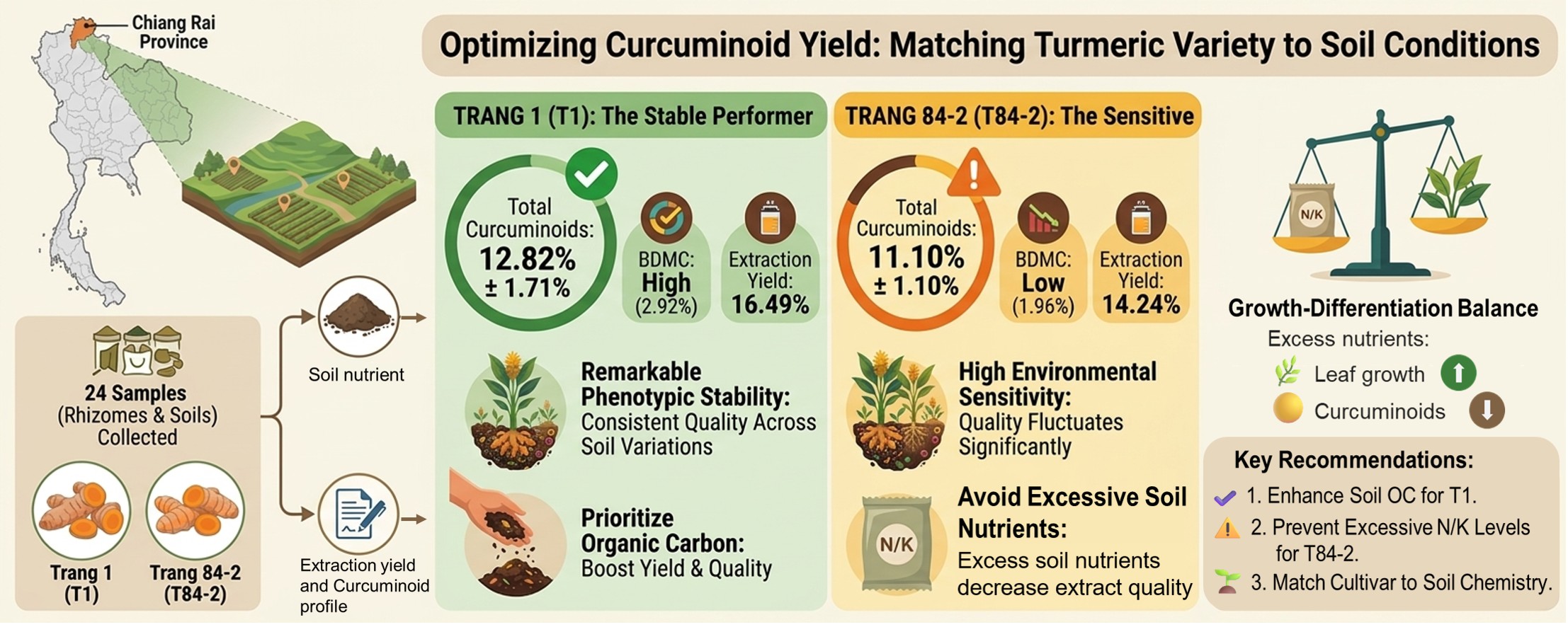
Soil properties significantly impact turmeric (Curcuma longa L.) growth and quality. This study evaluated the response of two commercial cultivars, Trang 1 (T1) and Trang 84-2 (T84-2), to varying soil conditions across 24 sites in Chiang Rai, Thailand. Both cultivars successfully exceeded the Thai Herbal Pharmacopoeia (THP) standard for total curcuminoids ( ). Cluster analysis categorized the soil profiles into three distinct groups: C1 (highest calcium, 2398 ± 749 mg/kg), C2 (highest phosphorus, 68.8 ± 72.0 mg/kg), and C3 (lowest pH, 4.72 ± 0.80). An independent t-test revealed that T1 produced significantly higher extraction yields, total curcuminoids, and bisdemethoxycurcumin (BDMC) than T84-2 (p < 0.05). Its quality parameters correlated positively with soil organic carbon (OC). Furthermore, T1 exhibited remarkable phenotypic stability across soil clusters (ANOVA ), strongly governed by genetic background, as supported by high broad-sense heritability ( for BDMC). Conversely, T84-2 maintained a narrower range of extraction yield but displayed greater sensitivity to nitrate, potassium, and excessive cations. These findings provide crucial insights into the distinct characteristics of turmeric cultivars, highlighting the necessity of cultivar-specific soil management, such as prioritizing organic amendments for T1 and preventing over-fertilization for T84-2, to optimize both extraction yield and medicinal quality.
HIGHLIGHTS
- Multivariate assessment revealed cultivar-specific responses to soil properties in turmeric cultivars Trang 1 and Trang 84-2.
- Trang 1 cultivar exhibits higher extraction yield, and bisdemethoxycurcumin content compared to Trang 84-2, whereas Trang 84-2 showed greater yield and total curcuminoid consistency.
- Soil organic carbon is the primary positive driver for Trang 1 curcuminoid production.
- Excessive soil potassium and nitrate negatively impact the quality of Trang 84-2.
- Cultivar-specific soil management is essential to optimize turmeric medicinal yield.
GRAPHICAL ABSTRACT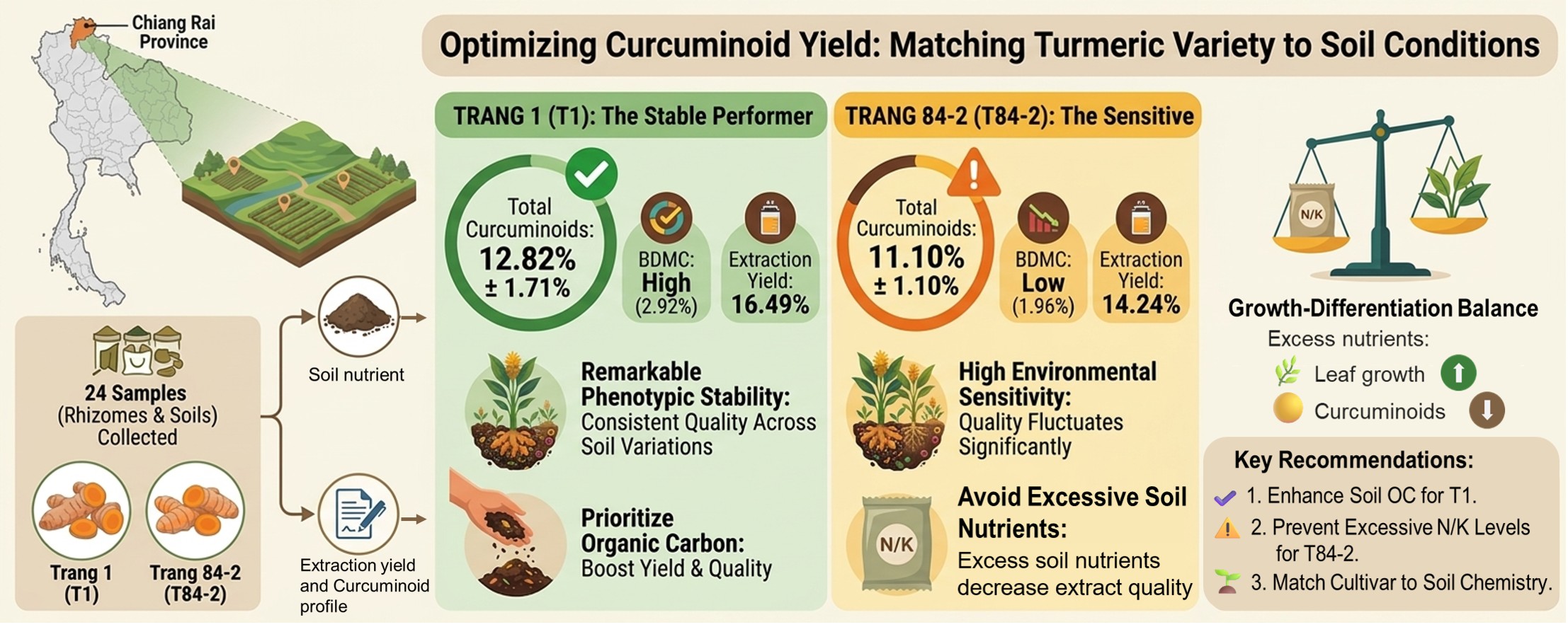
Downloads
References
N Chainani-Wu. Safety and anti-inflammatory activity of curcumin: A component of turmeric (Curcuma longa). Journal of Alternative and Complementary Medicine 2003; 9(1), 161-168.
A Niranjan and D Prakash. Chemical constituents and biological activities of turmeric (Curcuma longa L.) - A review. Journal of Food Science and Technology 2008; 45(2), 109-116.
YJ Wang, MH Pan, AL Cheng, LI Lin, YS Ho, CY Hsieh and JK Lin. Stability of curcumin in buffer solutions and characterization of its degradation products. Journal of Pharmaceutical and Biomedical Analysis 1997; 15(12), 1867-1876.
P Limtrakul, S Anuchapreeda and D Buddhasukh. Modulation of human multidrug-resistance MDR-1 gene by natural curcuminoids. BMC Cancer 2004; 4, 13.
R Kong, OH Kang, YS Seo, T Zhou, SA Kim, DW Shin and DY Kwon. MAPKs and NF-κB pathway inhibitory effect of bisdemethoxycurcumin on phorbol-12-myristate-13-acetate and A23187-induced inflammation in human mast cells. Molecular Medicine Reports 2018; 17(1), 630-635.
Z Chen, H Zhong, J Wei, S Lin, Z Zong, F Gong, X Huang, J Sun, P Li, H Lin, B Wei and J Chu. Inhibition of Nrf2/HO-1 signaling leads to increased activation of the NLRP3 inflammasome in osteoarthritis. Arthritis Research & Therapy 2019; 21(1), 300.
Bureau of Drug and Narcotic, Department of Medical Sciences, Ministry of Public Health. Thai herbal pharmacopoeia. Bureau of Drug and Narcotic, Department of Medical Sciences, Ministry of Public Health, Nonthaburi, Thailand, 2021.
Horticulture Research Institute. Curcuma longa Linn. Horticulture Research Institute, Bangkok, Thailand, 2023.
IS Sandeep, N Sanghamitra and M Sujata. Differential effect of soil and environment on metabolic expression of turmeric (Curcuma longa cv. Roma). Indian Journal of Experimental Biology 2015; 53(6), 406-411.
A Hossain and Y Ishimine. Growth, yield and quality of turmeric (Curcuma longa L.) cultivated on dark-red soil, gray soil and red soil in Okinawa, Japan. Plant Production Science 2005; 8(4), 482-486.
H Akamine, A Hossain, Y Ishimine, K Yogi, K Hokama, Y Iraha and Y Aniya. Effects of application of N, P and K alone or in combination on growth, yield and curcumin content of turmeric (Curcuma longa L.). Plant Production Science 2007; 10(1), 151-154.
V Sanghamithre and MV Menon. Effect of S, Ca and Mg on fresh rhizome yield of turmeric (Curcuma longa L.). Journal of Tropical Agriculture 2014; 52(2), 158-161.
D Jabborova, K Sulaymanov, RZ Sayyed, SH Alotaibi, Y Enakiev, A Azimov, Z Jabbarov, MJ Ansari, S Fahad, S Danish and R Datta. Mineral fertilizers improves the quality of turmeric and soil. Sustainability 2021; 13(16), 9437.
Medicinal Innovation Center of Mae Fah Luang. Guide to growing turmeric. Medicinal Innovation Center of Mae Fah Luang, Chiang Rai, Thailand, 2021.
Plant Variety and Germplasm Database, Available at: https://doaplant.doa.go.th/, accessed February 2024.
JR Sun, JL Bu, GH Cui, Y Ma, H Zhao, YP Mao, W Zeng, J Guo and LQ Huang. Accumulation and biosynthetic of curcuminoids and terpenoids in turmeric rhizome in different development periods. China Journal of Chinese Materia Medica 2019; 44(5), 927-934.
Y Ishimine, MA Hossain, K Motomura, H Akamine and T Hirayama. Effects of planting date on emergence, growth and yield of turmeric (Curcuma longa L.) in Okinawa prefecture, Southern Japan. Japanese Journal of Tropical Agriculture 2004; 48(1), 10-16.
FAO. Turmeric: Post-Production management. Food and Agriculture Organization of the United Nations (FAO), Rome, 2004.
EM Mudge, PN Brown, CA Rimmer and MM Phillips. Determination of curcuminoids in turmeric dietary supplements by HPLC-DAD: Multi-laboratory study through the NIH-ODS/NIST quality assurance program. Journal of AOAC International 2021; 103(6), 1625-1632.
MR Motsara. Guide to laboratory establishment for plant nutrient analysis. Scientific Publishers, Rajasthan, India, 2015.
KL Sahrawat and R Prasad. A rapid method for determination of nitrate, nitrite, and ammoniacal nitrogen in soils. Plant and Soil 1975; 42(1), 305-308.
RH Bray and LT Kurtz. Determination of total, organic, and available forms of phosphorus in soils. Soil Science 1945; 59(1), 39-45.
Food and Agriculture Organization of the United Nations. Standard operating procedure for cation exchange capacity and exchangeable bases 1N ammonium acetate, pH 7.0 method. Food and Agriculture Organization of the United Nations, Rome 2022.
RW Blanchar, G Rehm and AC Caldwell. Sulfur in plant materials by digestion with nitric and perchloric acid. Soil Science Society of America Journal 1965; 29(1), 71-72.
DK Ayer, K Modha, V Parekh, R Patel, G Vadodariya, V Ramtekey and A Bhuriya. Associating gene expressions with curcuminoid biosynthesis in turmeric. Journal of Genetic Engineering & Biotechnology 2020; 18(1), 83.
Y Katsuyama, T Kita and S Horinouchi. Identification and characterization of multiple curcumin synthases from the herb Curcuma longa. FEBS Letters 2009; 583(17), 2799-2803.
IS Sandeep, TK Koley, A Maurya, JR Dash, S Sethi and A Sahoo. Comparative gene expression study between two turmeric (Curcuma longa L.) cultivars. Journal of Applied Research on Medicinal and Aromatic Plants 2017; 6, 82-85.
IS Sandeep, S Das, N Nasim, A Mishra, L Acharya, RK Joshi, S Nayak and S Mohanty. Differential expression of CURS gene during various growth stages, climatic condition and soil nutrients in turmeric (Curcuma longa): Towards site specific cultivation for high curcumin yield. Plant Physiology and Biochemistry 2017; 118, 348-355.
V Ćirić, N Prekop, S Šeremešić, B Vojnov, B Pejić, D Radovanović and D Marinković. The implication of cation exchange capacity (CEC) assessment for soil quality management and improvement. Agriculture and Forestry 2023; 69(4), 113-133.
P Marschner. Marschner’s mineral nutrition of higher plants. Academic Press, New York, 2012. p. 26-456.
PN Ravindran, BK Nirmal and K Sivaraman. Turmeric: The genus curcuma. CRC PRESS, Boca Raton, Florida, 2007. p. 137-141.
I Thornton and JS Webb. Trace elements in soils and plants. In: K Blaxter (Ed.). Food Chains and Human Nutrition. Springer, Dordrecht, 1980, pp. 273-315.
BJ Alloway. Micronutrients and crop production: An introduction. In: BJ Alloway (Ed.). Micronutrient Deficiencies in Global Crop Production. Springer, New York, 2008.
JL Havlin, SL Tisdale, WL Nelson and JD Beaton. Soil fertility and fertilization an introduction to nutrient management. Pearson India Education Services Pvt. Ltd, Tamil Nadu, India, 2014, p. 17-19.
A Adane and A Tadesse. Genetic variability, heritability and genetic advance of turmeric (Curcuma longa L.) genotypes for yield and yield related traits. International Journal of Agricultural Science and Food Technology 2021; 7(1), 126-131.
A Gayatri, K Giridhar, S Suryakumari and AVD Dorajeerao. Genetic variability, heritability and genetic advance studies in turmeric (Curcuma longa L.) In Krishna-Godavari agroclimatic zone of Andhra Pradesh. International Journal of Data Science and IoT Management System. 2024; 3(3), 29-35.
W Liao, H Wang, H Fan, J Chen, L Yin, X Cai and M Lin. Nutrient and biomass dynamics for dual-organ yield in turmeric (Curcuma longa L.). PeerJ 2025; 13, e19933.
A Akbar, A Kuanar, RK Joshi, IS Sandeep, S Mohanty, PK Naik, A Mishra and S Nayak. Development of prediction model and experimental validation in predicting the curcumin content of turmeric (Curcuma longa L.). Frontiers in Plant Science 2016; 7, 1507.
DV Sujatha, P Kavitha and MVS Naidu. Influence of green manure and potassium nutrition on soil potassium fractions and yield of rice crop. International Journal of Current Microbiology and Applied Sciences 2017; 6(11), 13-23.
DA Herms and WJ Mattson. The dilemma of plants: To grow or defend. The Quarterly Review of Biology 1992; 67(3), 283-335.
S Hamza, AK Sadanandan and V Srinivasan. Influence of soil physico-chemical properties on productivity of black pepper (Piper nigrum L.). Journal of Spices and Aromatic Crops 2004; 13(1), 6-9.
MA Alam, S Roy, MA Rahman, MR Islam, MM Rahman, AJ Obaidullah, MN Farid, MM Rahman, MR Islam, SN Mozumder, RS Almalki, A Gaber and A Hossain. Study on the genetic variability and adaptability of turmeric (Curcuma longa L.) genotypes for development of desirable cultivars. PLoS One 2024; 19(1), e0297202.
K Mamatha, MBN Rao, BVK Bhagavan, K Umajyothi, M Anuradha and K Sivaraju. Studies on genetic variability and heritability in turmeric (Curcuma longa L.). International Journal of Current Microbiology and Applied Sciences 2020; 9(9), 329-335.
Downloads
Published
How to Cite
Issue
Section
License
Copyright (c) 2026 Walailak University

This work is licensed under a Creative Commons Attribution-NonCommercial-NoDerivatives 4.0 International License.