
Physicochemical, Microbiological, and Sensory Properties of Gluten-Free Bread Fortified with Caulerpa lentillifera as a Natural Iodine Source
DOI:
https://doi.org/10.48048/tis.2026.13989Keywords:
Gluten-free bread, C. lentilfera, Iodine fortification, Jasmine rice flour, Salt reduction, ICP-MS, Dietary fiber, Gluten-free bread, C. lentillifera, Iodine fortification, Jasmine rice flour, Salt reduction, ICP-MS, Dietary fiberAbstract
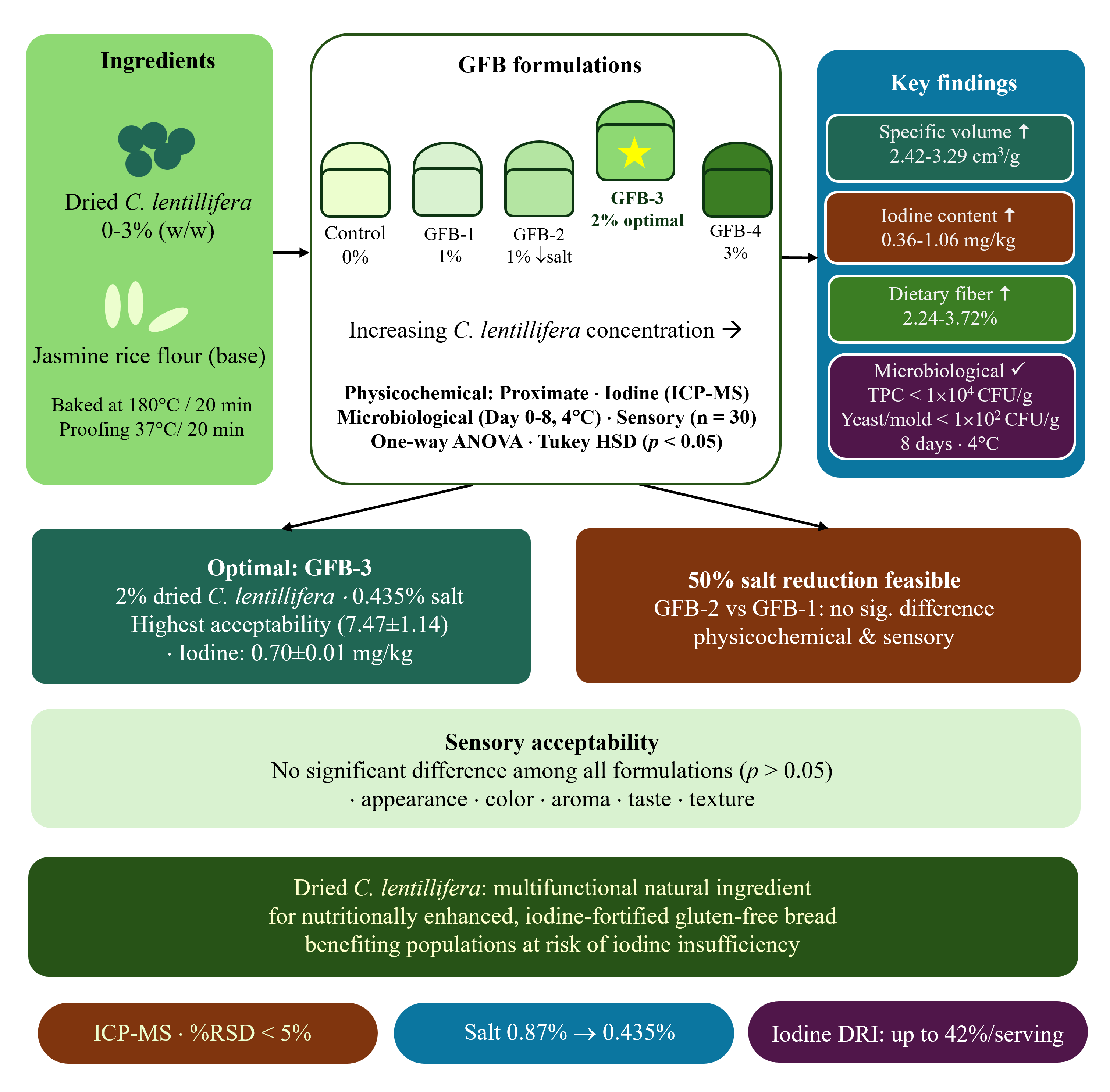
The rising prevalence of celiac disease and gluten-related disorders has substantially increased global demand for gluten-free bread (GFB). Such products remain nutritionally inferior to wheat-based counterparts, particularly in dietary fiber, minerals, and iodine. Caulerpa lentillifera, a mineral-rich green seaweed, represents a promising natural ingredient for iodine fortification of gluten-free bakery products. The present study aimed to develop iodine-fortified GFB incorporating dried C. lentillifera at 0% (w/w) - 3% (w/w) in jasmine rice flour-based formulations and to evaluate physicochemical properties, proximate composition, iodine content, microbiological quality, and sensory acceptability. Five formulations were prepared incorporating dried C. lentillifera at 0% (control), 1% (GFB-1 and GFB-2), 2% (GFB-3), and 3% (GFB-4). Salt content was 0.87% in the control and GFB-1, whereas GFB-2 through GFB-4 contained a reduced salt level of 0.435%. Specific volume, ash content, and dietary fiber increased progressively with C. lentillifera concentration (2.42 - 3.29 cm³/g, 1.05% - 2.32%, and 2.24% - 3.72%, respectively). Total carbohydrate content decreased correspondingly, reflecting compositional displacement of jasmine rice flour. Iodine content increased dose-dependently from 0.36 ± 0.01 mg/kg in the control to 1.06 ± 0.01 mg/kg in GFB-4, with all %RSD values below 5% confirming high ICP-MS precision. A 50% salt reduction in GFB-2 did not significantly compromise physicochemical or sensory quality relative to GFB-1 (p > 0.05), confirming the technical feasibility of sodium reduction. All formulations maintained plate counts below 1×10⁴ CFU/g and yeast and mold below 1×10² CFU/g throughout 8 days at 4 °C. Sensory acceptability did not differ significantly among formulations for any evaluated attribute (p > 0.05). GFB-3 was identified as the optimal formulation, achieving the highest overall acceptability score (7.47 ± 1.14) alongside notable iodine fortification (0.70 ± 0.01 mg/kg), enhanced dietary fiber and mineral content, and acceptable microbiological quality. Overall, dried C. lentillifera represents a multifunctional natural ingredient for developing nutritionally enhanced, iodine-fortified GFB that benefits populations at risk of iodine insufficiency.
HIGHLIGHTS
- Dried lentillifera at 2% optimally enhanced specific volume, dietary fiber, and mineral content of jasmine rice flour-based gluten-free bread.
- Iodine content increased dose-dependently (0.36 - 1.06 mg/kg), confirming dried lentillifera as an effective natural iodine-fortifying ingredient.
- Dried lentillifera and iodized salt served as complementary iodine sources, with ICP-MS confirming high quantification precision (%RSD < 5%).
- A 50% salt reduction did not compromise physicochemical properties or sensory acceptability, supporting feasibility of sodium reduction.
- All formulations maintained acceptable microbiological quality throughout 8 days of refrigerated storage at 4 °C.
GRAPHICAL ABSTRACT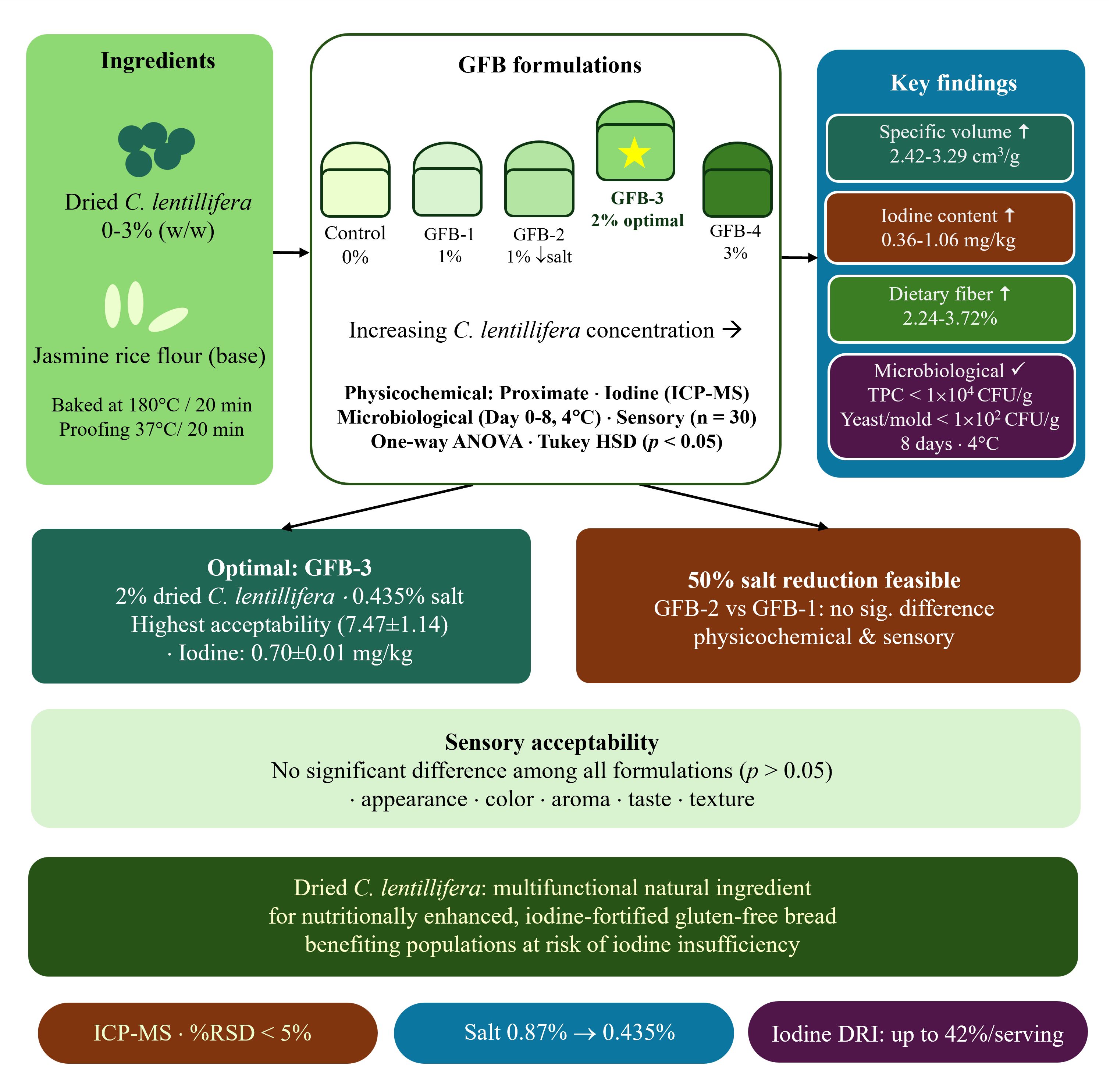
Downloads
References
HF Hassan, L Mourad, N Khatib, R Assi, S Akil, S El Khatib and R Hteit. Perceptions towards gluten free products among consumers: A narrative review. Applied Food Research 2024; 4(2), 100441.
EV Aguiar, FG Santos, U Krupa-Kozak and VD Capriles. Nutritional facts regarding commercially available gluten-free bread worldwide: Recent advances and future challenges. Critical Reviews in Food Science and Nutrition 2023; 63(5), 693-705.
K Kurppa, CJ Mulder, K Stordal and K Kaukinen. Celiac disease affects 1% of global population: Who will manage all these patients? Gastroenterology 2024; 167(1), 148-158.
Z Smidova and J Rysova. Gluten-free bread and bakery products technology. Foods 2022; 11(3), 480.
J Park and H Kim. Rice-based gluten-free foods and technologies: A review. Foods 2023; 12(22), 4110.
RPF Guiné. Textural properties of bakery products: A review of instrumental and sensory evaluation studies. Applied Sciences 2022; 12(17), 8628.
N Syakilla, R George, FY Chye, W Pindi, S Mantihal, NA Wahab, FM Fadzwi, PH Gu and P Matanjun. A review on nutrients, phytochemicals, and health benefits of green seaweed, Caulerpa lentillifera. Foods 2022; 11(18), 2832.
LE Stuthmann, B Brix da Costa, K Springer and A Kunzmann. Sea grapes (Caulerpa lentillifera J. Agardh, Chlorophyta) for human use: Structured review on recent research in cultivation, nutritional value, and post-harvest management. Journal of Applied Phycology 2023; 35(6), 2957-2983.
X Chen, Y Sun, H Liu, Y Qin and P Li. Advances in cultivation, wastewater treatment application, bioactive components of Caulerpa lentillifera and their biotechnological applications. PeerJ 2019; 7, e6118.
K Kasmiati, S Syahrul, B Badraeni and MH Rahmi. Proximate and mineral compositions of the green seaweeds Caulerpa lentilfera and Caulerpa racemosa from South Sulawesi Coast, Indonesia. IOP Conference Series: Earth and Environmental Science 2022; 1119, 012049.
S Sorrenti, E Baldini, D Pironi, A Lauro, V D’Orazi, F Tartaglia, D Tripodi, E Lori, F Gagliardi, M Praticò, G Illuminati, V D’Andrea, P Palumbo and S Ulisse. Iodine: Its role in thyroid hormone biosynthesis and beyond. Nutrients 2021; 13(12), 4469.
MJ Blikra, I Aakre and J Rigutto-Farebrother. Consequences of acute and long-term excessive iodine intake: A literature review focusing on seaweed as a potential dietary iodine source. Comprehensive Reviews in Food Science and Food Safety 2024; 23(6), e70037.
I Aakre, IB Tveit, LS Myrmel, E Fjære, S Ballance and H Rosendal-Riise. Bioavailability of iodine from a meal consisting of sushi and a Wakame seaweed salad-A randomized crossover trial. Food Science & Nutrition 2023; 11, 7707-7717.
K Nicol, E Thomas, AP Nugent, JV Woodside, KH Hart and SC Bath. Iodine fortification of plant-based dairy and fish alternatives: The effect of substitution on iodine intake based on a market survey in the UK. British Journal of Nutrition 2023; 129(5), 832-842.
A Culetu, DE Duta, M Papageorgiou and T Varzakas. The role of hydrocolloids in gluten-free bread and pasta; rheology, characteristics, staling and glycemic index. Foods 2021; 10(12), 3121.
T Di Renzo, MC Trivisonno, S Nazzaro, A Reale and MC Messia. Effect of different hydrocolloids on the qualitative characteristics of fermented gluten-free quinoa dough and bread. Foods 2024; 13(9), 1382.
A Ishaq, M Nadeem, R Ahmad, Z Ahmed and N Khalid. Recent advances in applications of marine hydrocolloids for improving bread quality. Food Hydrocolloids 2024; 148(A), 109424.
S Lomartire and AMM Gonçalves. Novel technologies for seaweed polysaccharides extraction and their use in food with therapeutically applications-A review. Foods 2022; 11(17), 2654.
MD Shah, CF Fui, WH Zuldin, FA Khodzori, WS Chong, N Mazlan and R Shapawi. Caulerpa lentillifera sea grape: A promising source of bioactive metabolites for aquaculture and health. In: NM Faudzi, MD Shah, N Mazlan and SRM Shaleh (Eds.). Essentials of aquaculture practices. Springer Nature, Singapore, 2024.
LS Aabel, SN Jensen, E Hakme and AH Feyissa. Review on physical properties and acrylamide formation in seaweed bread. Frontiers in Food Science and Technology 2023; 3, 1331245.
MW Qazi, IGD Sousa, MC Nunes and A Raymundo. Improving the nutritional, structural, and sensory properties of gluten-free bread with different species of microalgae. Foods 2022; 11(3), 397.
I Aakre, DD Solli, MW Markhus, HK Mæhre, L Dahl, S Henjum, J Alexander, P Korneliussen, L Madsen and M Kjellevold. Commercially available kelp and seaweed products - valuable iodine source or risk of excess intake? Food & Nutrition Research 2021; 65, 7584.
PPA Smyth. Iodine, seaweed, and the thyroid. European Thyroid Journal 2021; 10(2), 101-108.
WHO. Guideline: Sodium intake for adults and children. World Health Organization, Geneva, 2012, Available at: https://www.ncbi.nlm.nih.gov/books/NBK133309/, accessed May 2026.
AACC International. Guidelines for measurement of volume by rapeseed displacement. Method 10-05.01. In: AACC International (Ed.). Approved methods of analysis. 11th ed. Cereals & Grains Association, Minnesota, 2010.
A Wirkijowska, P Zarzycki and K Terpiłowski. Development of wheat bread fortified with sea buckthorn (Hippophae rhamnoides L.) pomace: Nutritional enhancement, technological properties, and consumer acceptance. Applied Sciences 2025; 15, 12319.
MC Bourne. Food texture and viscosity: Concept and measurement. 2nd ed. Academic Press, San Diego, 2002.
AOAC. Official methods of analysis of AOAC International. 21st ed. AOAC International, Maryland, 2019.
J Photi, P Srisakda, T Jurkvon, C Zeder and K Judprasong. Comparison of external calibration and isotope dilution methods for iodine determination in foods by inductively coupled plasma mass spectrometry. Food Chemistry: X 2025; 25, 102119.
US Food and Drug Administration. Elemental analysis manual for food and related products: Section 4.13 - Iodine by ICP-MS (Version 1.0), Available at: https://www.fda.gov/media/103112/download, accessed April 2026.
M Gorman, R Moss, S Barker, A Falkeisen, S Knowles and MB McSweeney. Consumer perception of salt-reduced bread with the addition of brown seaweed evaluated under blinded and informed conditions. Journal of the Science of Food and Agriculture 2023; 103(5), 2337-2346.
M Djordjević, M Djordjević, D Šoronja-Simović, I Nikolić and Z Šereš. Delving into the role of dietary fiber in gluten-free bread formulations: Integrating fundamental rheological, technological, sensory, and nutritional aspects. Polysaccharides 2022; 3(1), 59-82.
C Verbeke, E Debonne, S Versele, FV Bockstaele and M Eeckhout. Technological evaluation of fiber effects in wheat-based dough and bread. Foods 2024; 13, 2582.
R Yanti, T Utami, FA Purwandari, DA Laili and N Kemhay. Influence of wet and dry sourdough from pigeon pea (Cajanus cajan L. Huth) on the characteristics of wheat bread. Trends in Sciences 2025; 22(9), 10468.
S Gaur, US Shivhare, BC Sarkar and J Ahmed. Thermal chlorophyll degradation kinetics of mint leaves puree. International Journal of Food Properties 2007; 10(4), 853-865.
C Mazzocchi, I Benucci, C Lombardelli and M Esti. Enzyme-assisted extraction for the recovery of food-grade chlorophyll-based green colorant. Foods 2023; 12(18), 3440.
L Yu and T Beta. Identification and antioxidant properties of phenolic compounds during production of bread from purple wheat grains. Molecules 2015; 20(9), 15525-15549.
JS Monteiro, P Farage, RP Zandonadi, RBA Botelho, LL de Oliveira, A Raposo, F Shakeel, S Alshehri, WA Mahdi and WMC Araújo. A systematic review on gluten-free bread formulations using specific volume as a quality indicator. Foods 2021; 10(3), 614.
MP González, P López-Laiz, M Achón, R de la Iglesia, V Fajardo, Á García-González, N Úbeda and E Alonso-Aperte. Determination and comparison of fat and fibre contents in gluten-free and gluten-containing flours and breads: Nutritional implications. Foods 2025; 14(5), 894.
GA Sehn, AC Nogueira, EL Almeida, YK Chang and CJ Steel. Fortification of wheat dough with calcium and magnesium ions affects empirical rheological properties. Cereal Chemistry 2015; 92(4), 405-410.
B Romão, AL Falcomer, G Palos, S Cavalcante, RBA Botelho, EY Nakano, A Raposo, F Shakeel, S Alshehri and RP Zandonadi. Glycemic index of gluten-free bread and their main ingredients: A systematic review and meta-analysis. Foods 2021; 10(3), 506.
W Zhou, Y Wang, R Xu, J Tian, T Li and S Chen. Comparative analysis of the nutrient composition of Caulerpa lentillifera from various cultivation sites. Foods 2025; 14(3), 474.
WHO. Assessment of iodine deficiency disorders and monitoring their elimination: A guide for programme managers. 3rd ed. World Health Organization, Geneva, Switzerland, 2007.
EM Cabral, M Oliveira, JRM Mondala, J Curtin, BK Tiwari and M Garcia-Vaquero. Antimicrobials from seaweeds for food applications. Marine Drugs 2021; 19, 211.
S Keramari, C Nouska, M Hatzikamari, CG Biliaderis and A Lazaridou. Impact of sourdough from a commercial starter culture on quality characteristics and shelf life of gluten-free rice breads supplemented with chickpea flour. Foods 2024; 13, 2300.
Downloads
Published
How to Cite
Issue
Section
License
Copyright (c) 2026 Walailak University

This work is licensed under a Creative Commons Attribution-NonCommercial-NoDerivatives 4.0 International License.