
Centella asiatica Ethanolic Extract Induces Apoptosis in Colorectal Cancer Cells via Modulation of the Akt/p53/Bcl-2 Axis: An In Vitro and Network Pharmacology Study
DOI:
https://doi.org/10.48048/tis.2026.13980Keywords:
Centella asiatica, Colorectal cancer, Proliferation, Apoptosis, p53, Akt, Bcl-2Abstract
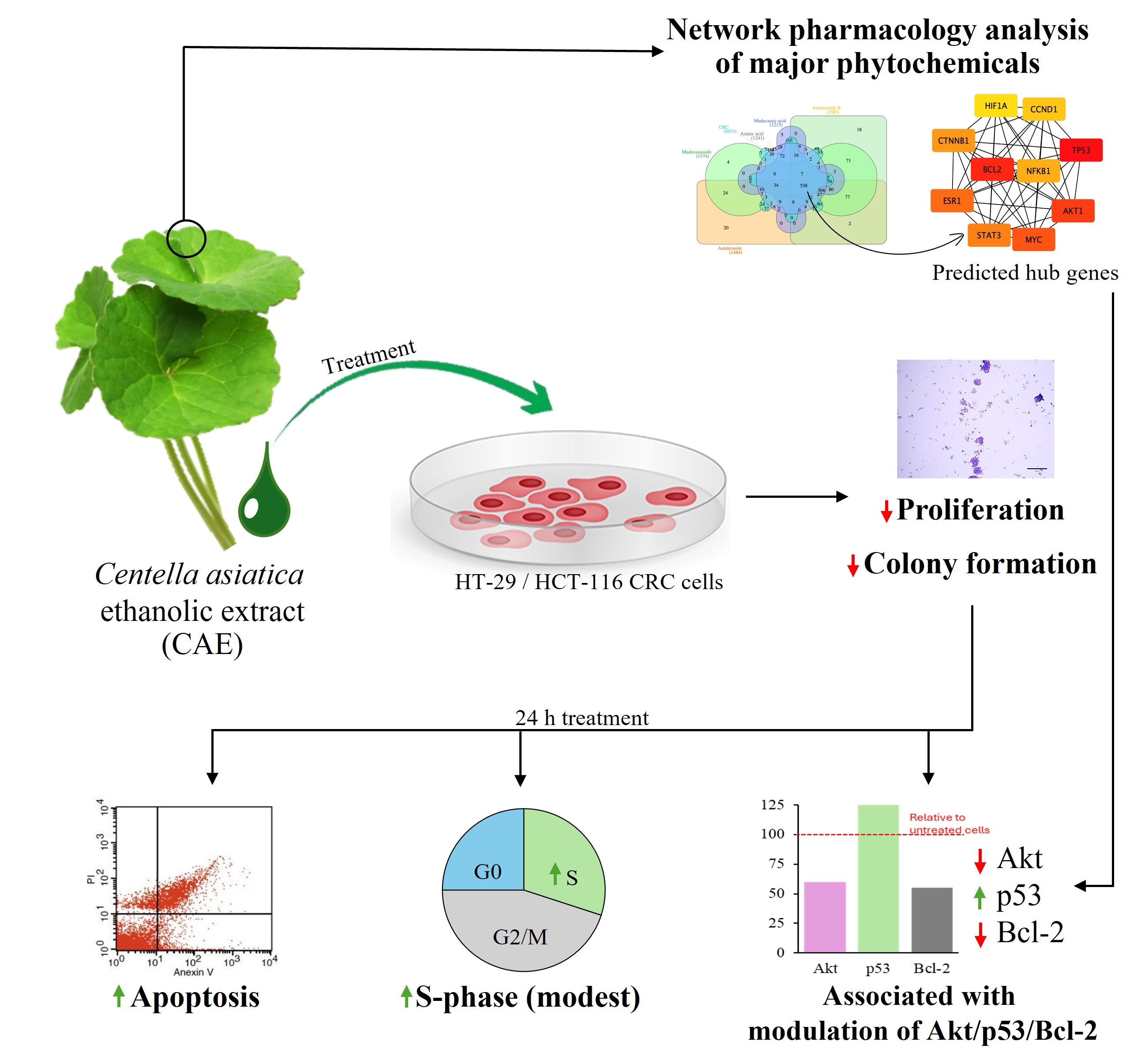
This study aims to investigate the antiproliferative effects of Centella asiatica ethanolic extract (CAE) in colorectal cancer (CRC) cells and to explore its potential apoptosis-related molecular associations using an integrative network pharmacology and experimental approach. Five major reported compounds of C. asiatica were analyzed for CRC-related targets using network pharmacology and STRING analysis. The plant material was authenticated and extracted with ethanol to obtain CAE. Asiaticoside was identified as a marker compound by HPLC analysis. HT-29 (p53 mutant) and HCT-116 (p53 wild type) CRC cell lines were treated with CAE. Cell viability and clonogenic survival were evaluated by MTT and colony formation assays. Apoptosis and cell-cycle distribution were analyzed by flow cytometry. Protein expression levels of p53 and total Akt were assessed by immunofluorescence staining, while Bcl-2 expression was determined by western blotting. HPLC chromatographic analysis confirmed the presence of asiaticoside in CAE. Network pharmacology identified 538 CRC-related targets associated with the 5 dominant compounds, with STRING analysis indicating p53, Bcl-2, and Akt as central nodes. CAE significantly inhibited cell proliferation and colony formation, induced apoptosis, and altered cell-cycle distribution in a dose-dependent manner. These effects were accompanied by increased p53 expression and decreased total Akt fluorescence intensity and Bcl-2 expression. HCT-116 cells exhibited greater sensitivity to CAE compared with HT-29 cells. Therefore, CAE exerts antiproliferative and pro-apoptotic effects in CRC cells, which are associated with modulation of the p53/Akt/Bcl-2 signaling axis, with a more pronounced response observed in HCT-116 cells.
HIGHLIGHTS
- Centella asiatica ethanolic extract (CAE) significantly inhibits proliferation and clonogenic survival in colorectal cancer (CRC) cells.
- CAE induces apoptosis and alters cell cycle progression in HT-29 and HCT-116 cells in a dose-dependent manner.
- Overlapped network pharmacology from 5 previously reported dominant compounds from asiatica identified 538 CRC-related targets, highlighting p53, Akt, and Bcl-2 as potential apoptosis-related targets.
- CAE was associated with alterations in the Akt/p53/Bcl-2 signaling axis in CRC cells by upregulating p53 and downregulating Akt and Bcl-2 expression.
- HCT-116 cells exhibit higher sensitivity to CAE treatment compared to HT-29 cells.
GRAPHICAL ABSTRACT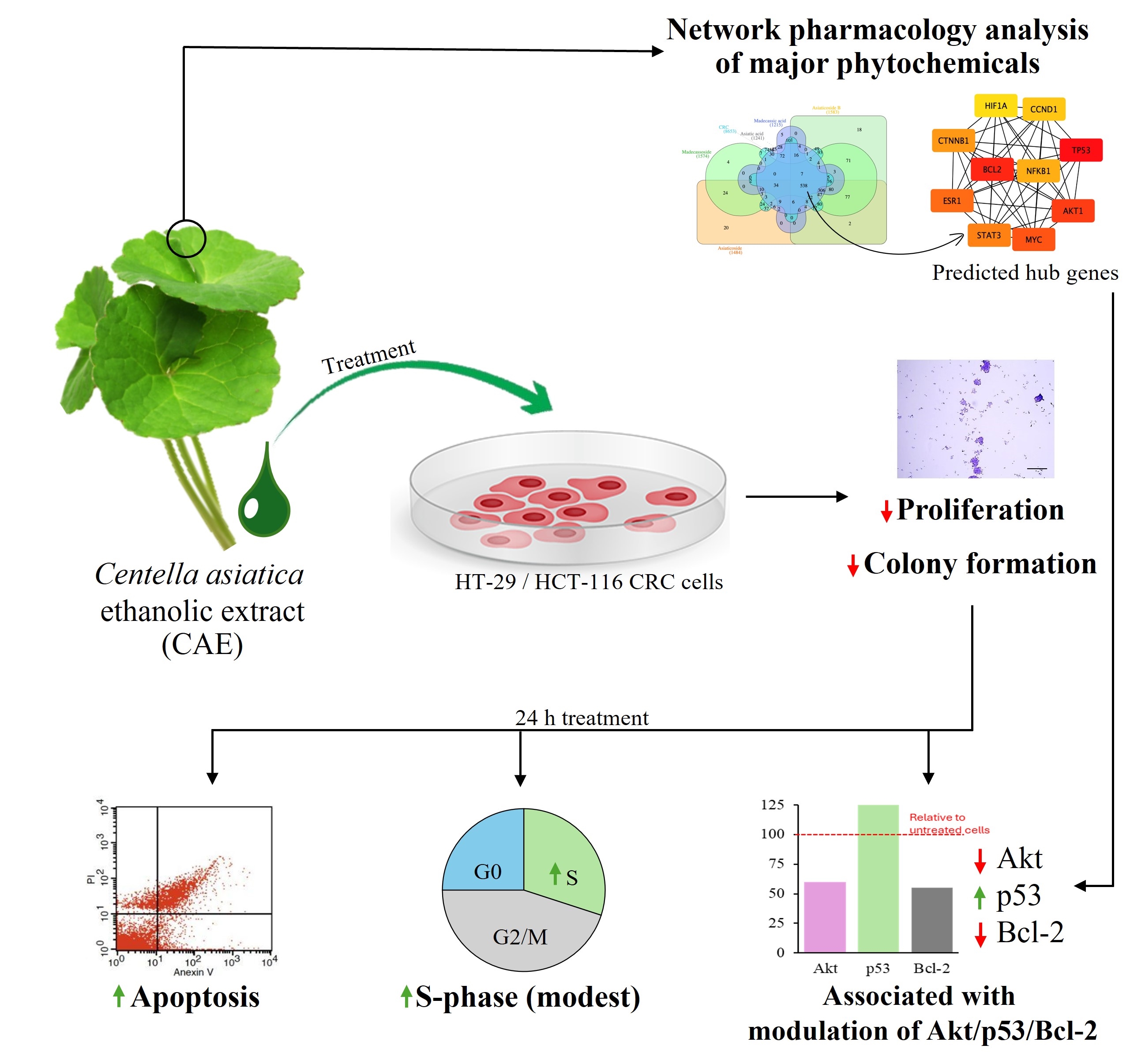
Downloads
References
American Cancer Society. Colorectal cancer facts & figures 2023 - 2025. American Cancer Society, Maryland, United States, 2023.
EP Weledji. The etiology and pathogenesis of colorectal cancer. Clinical Oncology 2024; 9, 2046.
FDE De Palma, V D’Argenio, J Pol, G Kroemer, MC Maiuri and F Salvatore. The molecular hallmarks of the serrated pathway in colorectal cancer. Cancers 2019; 11(7), 1017.
N Murphy, V Moreno, DJ Hughes, L Vodicka, P Vodicka, EK Aglago, MJ Gunter and M Jenab. Lifestyle and dietary environmental factors in colorectal cancer susceptibility. Molecular Aspects of Medicine 2019; 69, 2-9.
W Chen, R Zheng, P D Baade, S Zhang, H Zeng, F Bray and others. Cancer statistics in China, 2015. CA: A Cancer Journal for Clinicians 2016; 66(2), 115-132.
International Agency for Research on Cancer. Global cancer observatory: Thailand 2025. International Agency for Research on Cancer, Lyon, France, 2025.
R Ahmad, J K Singh, A Wunnava, O Al-Obeed, M Abdulla and S K Srivastava. Emerging trends in colorectal cancer: Dysregulated signaling pathways. International Journal of Molecular Medicine 2021; 47(3), 14.
S Qian, Z Wei, W Yang, J Huang, Y Yang and J Wang. The role of BCL-2 family proteins in regulating apoptosis and cancer therapy. Frontiers in Oncology 2022; 12, 985363.
MT Hemann and SW Lowe. The p53-Bcl-2 connection. Cell Death & Differentiation 2006; 13(8), 1256-1259.
AJ Watson. Apoptosis and colorectal cancer. Gut 2004; 53(11), 1701-1709.
M Barathan, AK Zulpa, SL Ng, Y Lokanathan, MH Ng and JX Law. Innovative strategies to combat 5-fluorouracil resistance in colorectal cancer: The role of phytochemicals and extracellular vesicles. International Journal of Molecular Sciences 2024; 25(13), 7470.
J Casale and P Patel. Fluorouracil. StatPearls Publishing, Florida, United States, 2024.
MS Bandara, EL Lee and JE Thomas. Gotu kola (Centella asiatica L.): An under-utilized herb. American Journal of Plant Science and Biotechnology 2011; 5(2), 20-31.
R Sabaragamuwa, CO Perera and B Fedrizzi. Centella asiatica (Gotu kola) as a neuroprotectant and its potential role in healthy ageing. Trends in Food Science & Technology 2018; 79, 88-97.
P Bunpo, K Kataoka, H Arimochi, H Nakayama, T Kuwahara, Y Bando, K Izumi, U Vinitketkumnuen and Y Ohnishi. Inhibitory effects of Centella asiatica on azoxymethane-induced aberrant crypt focus formation and carcinogenesis in the intestines of F344 rats. Food and Chemical Toxicology 2004; 42(12), 1987-1997.
P Bunpo, K Kataoka, H Arimochi, H Nakayama, T Kuwahara, Y Ohnishi and U Vinitketkumnuen. Centella asiatica extract induces cell cycle arrest in Caco-2 human colon cancer cells. Chiang Mai Medical Journal 2005; 44(1), 21-28.
PD Tanvi, NG Nilanjan, VM Chandrashekar and SV Rajendra. Aqueous extract of aerial parts of Centella asiatica arrests cell cycle at G0/G1 on colorectal cancer cell lines. Journal of Pharmaceutical Research 2016; 15(2), 45-50.
H Heberle, GV Meirelles, FR da Silva, GP Telles and R Minghim. InteractiVenn: A web-based tool for the analysis of sets through Venn diagrams. BMC Bioinformatics 2015; 16(1), 169.
KJ Prateek and KA Ram. High performance liquid chromatographic analysis of asiaticoside in Centella asiatica (L.) Urban. Chiang Mai Journal of Science 2008; 35(3), 521-525.
R Tanomrat, C Naktubtim, P Aimvijarn and P Suwannalert. N-acetylcysteine improves the inhibitory effect of quercetin-rich onion extract on HT-29 and HCT-116 colorectal cancer migration and invasion through iNOS suppression. International Journal of Medical Sciences 2023; 20(9), 1123-1134.
R Praphasawat, S Palipoch, P Suwannalert, W Payuhakrit, P Kunsorn, S Laovitthayanggoon, S Thakaew, N Munkong and W Klajing. Red rice bran extract suppresses colon cancer cells via apoptosis induction/cell cycle arrest and exerts antimutagenic activity. Experimental Oncology 2023; 45(2), 220-230.
A Tiptiri-Kourpeti, K Spyridopoulou, V Santarmaki, G Aindelis, E Tompoulidou, EE Lamprianidou and others. Lactobacillus casei exerts anti-proliferative effects accompanied by apoptotic cell death and up-regulation of TRAIL in colon carcinoma cells. PLoS One 2016; 11(2), e0147960.
CY Huang, JH Chien, KF Chang, CY Hsiao, YC Huang, YT Chen, MY Hsu, MC Hsieh and NM Tsai. Cedrus atlantica extract exerts antiproliferative effect on colorectal cancer through the induction of cell cycle arrest and apoptosis. Food Science & Nutrition 2022; 10(5), 1638-1648.
A Hassametto, R Tanomrat, T Muangthong, S Worawichawong and P Suwannalert. Role of oxidative stress-dependent C/EBPβ expression on CAF transformation inducing HCT116 colorectal cancer cell progression, migration and invasion. Asian Pacific Journal of Cancer Prevention 2023; 24(11), 3825-3835.
V Rao, V Kansal, S Stoupa and D Agrawal. MMP-1 and MMP-9 regulate epidermal growth factor-dependent collagen loss in human carotid plaque smooth muscle cells. Physiological Reports 2014; 2(2), e00224.
DY Lim and JHY Park. Induction of p53 contributes to apoptosis of HCT-116 human colon cancer cells induced by the dietary compound fisetin. American Journal of Physiology-Gastrointestinal and Liver Physiology 2009; 296(5), G1060-G1068.
X Zhou, C Ke, Y Lv, C Ren, T Lin, F Dong and Y Mi. Asiaticoside suppresses cell proliferation by inhibiting the NF-κB signaling pathway in colorectal cancer. International Journal of Molecular Medicine 2020; 46(4), 1525-1537.
JL Coloff. 2010, Akt, glucose metabolism, and the Bcl-2 family. Ph. D. Dissertation. Duke University, North Carolina, United States.
FJ Reyes-Zurita, G Pachón-Peña, D Lizárraga, EE Rufino-Palomares, M Cascante and JA Lupiáñez. The natural triterpene maslinic acid induces apoptosis in HT29 colon cancer cells by a JNK-p53-dependent mechanism. BMC Cancer 2011; 11(1), 154.
S Manmuan, P Manmuan, P Yoykaew, P Thuetong, P Asipong, N Riantong and MH Tantisira. Evaluation of standardized extract of Centella asiatica on cell viability and repressive cancer migration in metastatic colorectal cancer cells in vitro. Walailak Journal of Science and Technology 2021; 18(5), 9016.
MH Tantisira. Research and development of standardized extract of Centella asiatica ECa 233. In: Proceedings of the International Conference on Herbal and Traditional Medicine, Khon Kaen, Thailand. 2015.
Downloads
Published
How to Cite
Issue
Section
License
Copyright (c) 2026 Walailak University

This work is licensed under a Creative Commons Attribution-NonCommercial-NoDerivatives 4.0 International License.