
Pharmacological and In Vitro Studies on Quercetin-Rich Onion Peel Extract (Allium cepa) and N-Acetylcysteine Enhancing Apoptosis in Colorectal Cancer
DOI:
https://doi.org/10.48048/tis.2025.9111Keywords:
Onion peel extract, Quercetin, Genotoxicity, Pharmacological network, CRC, ApoptosisAbstract
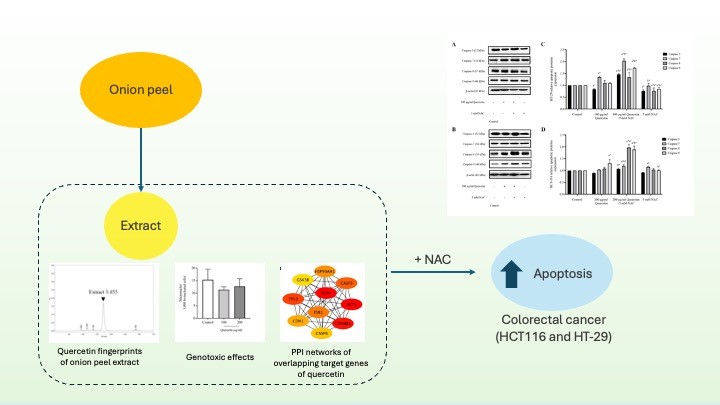
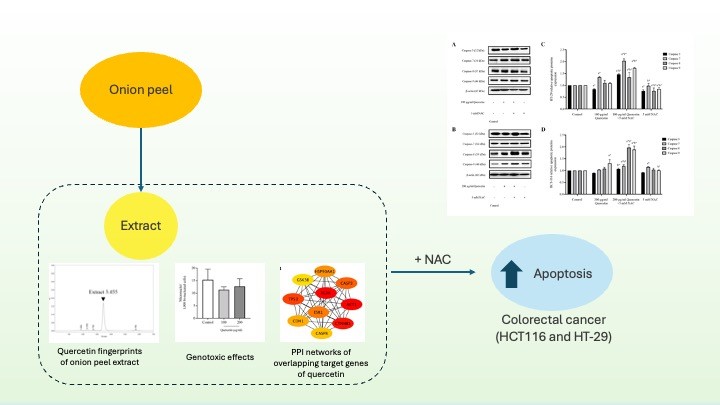
Colorectal cancer (CRC) is one of the most common types of cancer globally with the second highest cancer-related mortality, having increased by almost 40 % over the past 40 years. Considering quercetin's limited bioavailability, N-acetylcysteine (NAC) has previously emerged as a promising candidate for treatment as it has been shown to stabilize quercetin and enhance its anti-cancer effectiveness. Therefore, the present study aims to investigate the effectiveness of onion peel extract and NAC in inducing apoptosis in CRC. Extracts were taken from onion peel using 60 % v/v ethanol and identified using High-Performance Liquid Chromatography (HPLC). Furthermore, the micronucleus assay was utilized to investigate the genotoxicity of the extract. Pharmacological network analysis was employed to elucidate the mechanism underlying the combined action of quercetin and NAC on CRC, with KEGG enrichment analysis also used to study key signaling pathways. Additionally, in vitro studies were conducted using MTT assay, apoptosis assay via flow cytometry, and western blot analysis in HT-29 and HCT-116 cells. Quercetin is a major compound in onion peel extract and showed no genotoxic effects. Pharmacological network analysis identified potential targets for quercetin and NAC combination therapy, revealing 363 overlapping target genes of quercetin and NAC in CRC, indicating their involvement in inducing CRC apoptosis. The KEGG pathway analysis revealed the top 10 pathways and showed that a majority of the genes were involved in MAPK pathways. In vitro studies demonstrated that the combined treatment significantly increased cytotoxicity and apoptosis induction, evidenced by upregulated expression of caspases 3, 7, 8, and 9 in HT-29 and HCT-116 cells. These findings emphasize the therapeutic potential of quercetin-rich onion peel extraction, characterized by the absence of genotoxicity, when used in combination with NAC therapy to enhance apoptosis efficacy in CRC. This approach holds promise as a candidate for alternative medicine in the treatment of human CRC.
HIGHLIGHTS
- Quercetin is a major compound in onion peel extract and showed no genotoxic effects using the micronucleus assay.
- Network pharmacology revealed that quercetin and NAC significantly modulate ROS-related genes and apoptotic pathways in CRC.
- Quercetin-rich extract and NAC together substantially activate caspases 3, 7, 8, and 9 in the apoptotic pathway of CRC cells.
GRAPHICAL ABSTRACT
Downloads
References
H Sung, J Ferlay, RL Siegel, M Laversanne, I Soerjomataram, A Jemal and F Bray. Global cancer statistics 2020: GLOBOCAN estimates of incidence and mortality worldwide for 36 cancers in 185 countries. CA: A Cancer Journal for Clinicians 2021; 71(3), 209-249.
AB Ballinger and C Anggiansah. Colorectal cancer. BMJ 2007; 335, 715.
N Noda and H Wakasugi. Cancer and oxidative stress. Japan Medical Association Journal 2001; 44(12), 535-539.
BD Craft, A Kerrihard, R Amarowicz and RB Pegg. Phenol-Based antioxidants and the in vitro methods used for their assessment. Comprehensive Reviews in Food Science and Food Safety 2012; 11(2), 148-173.
J Cassidy and J Misset. Oxaliplatin-related side effects: Characteristics and management. Seminars in Oncology 2002; 29(5), 11-20.
SB Mali. Cancer treatment: Role of natural products. Time to have a serious rethink. Oral Oncology Reports 2023; 6, 100040.
X Huang, Z Yang, Q Xie, Z Zhang, H Zhang and J Ma. Natural products for treating colorectal cancer: A mechanistic review. Biomedicine & Pharmacotherapy 2019; 117, 109142.
L Yang, Y Liu, M Wang, Y Qian, X Dong, H Gu, H Wang, S Guo and T Hisamitsu. Quercetin-induced apoptosis of HT-29 colon cancer cells via inhibition of the Akt-CSN6-Myc signaling axis. Molecular Medicine Reports 2016; 14(5), 4559-4566.
S Kim, E Yoo, J Woo, S Han, J Lee, S Jung, H Kim and J Jung. Antitumor and apoptotic effects of quercetin on human melanoma cells involving JNK/P38 MAPK signaling activation. European Journal of Pharmacology 2019; 860, 172568.
S Andres, S Pevny, R Ziegenhagen, N Bakhiya, B Schafer, KI Hirsch-Ernst and A Lampen. Safety aspects of the use of quercetin as a dietary supplement. Molecular Nutrition & Food Research 2018; 62(1), 1700447.
A Mirzaei, R Deyhimfar, H Azodian Ghajar, R Mashhadi, M Noori, H Dialameh, Z Aghsaeifard and SMK Aghamir. Quercetin can be a more reliable treatment for metastatic prostate cancer than the localized disease: An in vitro study. Journal of Cell and Molecular Medicine 2023; 27(12), 1725-1734.
G Sethi, P Rath, A Chauhan, A Ranjan, R Choudhary, S Ramniwas, K Sak, D Aggarwal, I Rani and HS Tull. Apoptotic mechanisms of quercetin in liver cancer: Recent trends and advancements. Pharmaceutics 2023; 15(2), 172.
B Dilek and O Meltem. Quercetin suppresses cell proliferation using the apoptosis pathways in MCF-7 and MDA-MB-231 human breast carcinoma cells in monolayer and spheroid model cultures. South African Journal of Botany 2023; 162, 259-270.
P Asgharian, A P Tazehkand, S R Soofiyani, K Hosseini, M Martorell, V Tarhriz, H Ahangari, N Cruz-Martins, J Sharifi-Rad, ZM Almarhoon, A Ydyrys, A Nurzhanyat, A Yessenbekova and WC Cho. Quercetin impact in pancreatic cancer: An overview on its therapeutic effects. Oxidative Medicine and Cell Longevity 2021; 2021(1), 4393266.
X Cai, Z Fang, J Dou, A Yu and G Zhai. Bioavailability of quercetin: Problems and promises. Current Medicinal Chemistry 2013; 20(20), 2572-2582.
B Zhou, Y Yang, X Pang, J Shi, T Jiang and X Zheng. Quercetin inhibits DNA damage responses to induce apoptosis via SIRT5/PI3K/AKT pathway in non-small cell lung cancer. Biomedicine & Pharmacotherary 2023; 165, 115071.
Y Yao, W Xiong, L Chen, X Ju and L Wang. Synergistic growth-inhibition effect of quercetin and N-Acetyl-L-cysteine against HepG2 cells relying on the improvement of quercetin stability. Food Chemistry 2022; 374, 131729.
R Tanomrat, C Naktubtim, P Aimvijarn and P Suwannalert. N-acetylcysteine improves the inhibitory effect of Quercetin-rich onion extract on HT-29 and HCT-116 colorectal cancer migration and invasion through iNOS suppression. International Journal of Medical Sciences 2023; 20(9), 1123-1134.
RM Perez-Gregorio, MS Garcia-Falcon, J Simal-Gandara, AS Rodrigues and DPF Almeida. Identification and quantification of flavonoids in traditional cultivars of red and white onions at harvest. Journal of Food Composition and Analysis 2010; 23(6), 592-598.
S Kalweit, D Utesch, WVD Hude and S Madle. Chemically induced micronucleus formation in V79 cells- -comparison of three different test approaches. Mutation Research/Genetic Toxicology and Environmental Mutagenesis 1999; 439(2), 183-190.
PI Countryman and JA Heddle. The production of micronuclei from chromosome aberrations in irradiated cultures of human lymphocytes. Mutation Research/Fundamental and Molecular Mechanisms of Mutagenesis 1976; 41(2-3), 321-331.
W Wu, W Lan, X Jiao, A Shao, P Wu, K Wang and S Zhan. Mechanisms underlying the therapeutic effects of Gang Huo Qing wen granules in the treatment of influenza based on network pharmacology, molecular docking and molecular dynamics. Scientific Reports 2024; 14, 15853.
S Li, S Wu, L Wang, F Li, H Jiang and F Bai. Recent advances in predicting protein-protein interactions with the aid of artificial intelligence algorithms. Current Opinion in Structural Biology 2022; 73, 102344.
L Shi, Q Liu, H Yang, Q Wang, J Wang and Y Fan. Inflammation-related pathways involved in damaged articular cartilage of rats exposed to T-2 toxin based on RNA-sequencing analysis. Frontiers in Genetics 2022; 13, 1079739.
D Ahmed, PW Eide, IA Eilertsen, SA Danielsen, M Eknæs, M Hektoen, GE Lind and RA Lothe. Epigenetic and genetic features of 24 colon cancer cell lines. Oncogenesis 2013; 2, e71.
JA Plumb. Cell sensitivity assays: The MTT assay. Methods in Molecular Medicine 1999; 28, 25-30.
CM Worsley, RB Veale and ES Mayne. Inducing apoptosis using chemical treatment and acidic pH, and detecting it using the annexin V flow cytometric assay. PLoS One 2022; 17(6), e0270599.
T Mahmood and P Yang. Western blot: Technique, theory, and trouble shooting. North American Journal of Medical Sciences 2012; 4(9), 429-434.
S Elmore. Apoptosis: A review of programmed cell death. Toxicologic Pathology 2007; 35(4), 495-516.
M Ciardi, F Ianni, R Sardella, SD Bona, L Cossignani, R Germani, M Tiecco and C Clementi. Effective and selective extraction of quercetin from onion (Allium cepa L.) skin waste using water dilutions of acid-based deep eutectic solvents. Materials 2021; 14(21), 6465.
MJ Park, DH Ryu, JY Cho, IJ Ha, JS Moon and Y Kang. Comparison of the antioxidant properties and flavonols in various parts of Korean red onions by multivariate data analysis. Horticulture, Environment, and Biotechnology 2018; 59(6), 919-927.
Z Fredotovic, J Puizina, M Nazlic, A Maravic, I Ljubenkov, B Soldo, E Vuko and D Bajic. Phytochemical characterization and screening of antioxidant, antimicrobial and antiproliferative properties of allium × cornutum Clementi and two varieties of Allium cepa L. peel extracts. Plants 2021; 10(5), 832.
AJ Akindele, EG Unachukwu and DD Osiagwu. 90 Days toxicological assessment of hydroethanolic leaf extract of Ipomoea asarifolia (desr.) roem. and schult. (convolvulaceae) in rats. Journal of Ethnopharmacology 2015; 174, 582-594.
R Ortiz-Andrade, JA Araujo-Leon, A Sanchez-Recillas, G Navarrete-Vazquez, AA Gonzalez-Sanchez, S Hidalgo-Figueroa, AJ Alonso-Castro, I Aranda-Gonzalez, E Hernandez-Nunez, TI Coral-Martinez, JC Sanchez-Salgado, V Yanez-Perez and MA Lucio-Garcia. Toxicological screening of four bioactive citroflavonoids: In vitro, in vivo, and in silico approaches. Molecules 2020; 25(24), 5959.
OM Sieber, K Heinimann and IPM Tomlinson. Genomic instability--the engine of tumorigenesis? Nature Reviews Cancer 2003; 3(9), 701-708.
D Thorne, J Whitwell, J Clements, P Walker, D Breheny and M Gaca. The genotoxicological assessment of a tobacco heating product relative to cigarette smoke using the in vitro micronucleus assay. Toxicology Reports 2020; 7, 1010-1019.
I Erlund, T Kosonen, G Alfthan, J Maenpaa, K Perttunen, J Kenraali, J Kenraali, J Parantainen and A Aro. Pharmacokinetics of quercetin from quercetin aglycone and rutin in healthy volunteers. European Journal of Clinical Pharmacology 2000; 56(8), 545-553.
DM Kopustinskiene, V Jakstas, A Savickas and J Bernatoniene. Flavonoids as anticancer agents. Nutrients 2020; 12(2), 457.
Y Zhang, M Hao, X Yang, S Zhang, J Han, Z Wang and H Chen. Reactive oxygen species in colorectal cancer adjuvant therapies. Biochimica et Biophysica Acta: Molecular Basis of Disease 2024; 1870(2), 166922.
HS Marinho, C Real, L Cyrne, H Soares and F Antunes. Hydrogen peroxide sensing, signaling and regulation of transcription factors. Redox Biology 2014; 2, 535-562.
H Dou, PY Yu, YQ Liu, Y Zhu, FC Li, YY Wang, XY Chen and M Xiao. Recent advances in caspase-3, breast cancer, and traditional Chinese medicine: A review. Journal of Chemotheraphy 2023, 36(5), 370-388.
B Tummers and DR Green. Caspase-8: Regulating life and death. Immunological Reviews 2017; 277(1), 76-89.
A Kwak, J Lee, S Lee, J Seo, JW Park, YH Choi, S Cho, G Yoon, M Lee and J shim. Echinatin induces reactive oxygen species-mediated apoptosis via JNK/p38 MAPK signaling pathway in colorectal cancer cells. Phytotherary Research 2023; 37(2), 563-577.
A Neamtu, T Maghiar, A Alaya, N Olah, V Turcus, D Pelea, BD Totolici, C Neamtu, AM Maghiar and E Mathe. A Comprehensive view on the quercetin impact on colorectal cancer. Molecules 2022; 27(6), 1873.
A Amini, S Masoumi-Moghaddam, A Ehteda and DL Morris. Bromelain and N-acetylcysteine inhibit proliferation and survival of gastrointestinal cancer cells in vitro: Significance of combination therapy. Journal of Experimental & Clinical Cancer Research 2014; 33(1), 92.
M Russo, A Mupo, C Spagnuolo and GL Russo. Exploring death receptor pathways as selective targets in cancer therapy. Biochemical Pharmacology 2010; 80(5), 674-682.
S Orrenius, V Gogvadze and B Zhivotovsky. Calcium and mitochondria in the regulation of cell death. Biochemical and Biophysical Research Communication 2015; 460(1), 72-81.
Downloads
Published
How to Cite
Issue
Section
License
Copyright (c) 2024 Walailak University

This work is licensed under a Creative Commons Attribution-NonCommercial-NoDerivatives 4.0 International License.





