
Therapeutic Potential of Garcinia Forbesii King Extracts: Antioxidant Effects and Bioassay-Based Evaluation in PANC-1 and HT29-Derived EV Reporter Cells
DOI:
https://doi.org/10.48048/tis.2027.13962Keywords:
Garcinia forbesii King, Antioxidant, Sequential extractions, PANC-1, HT29/CD63-NlucAbstract
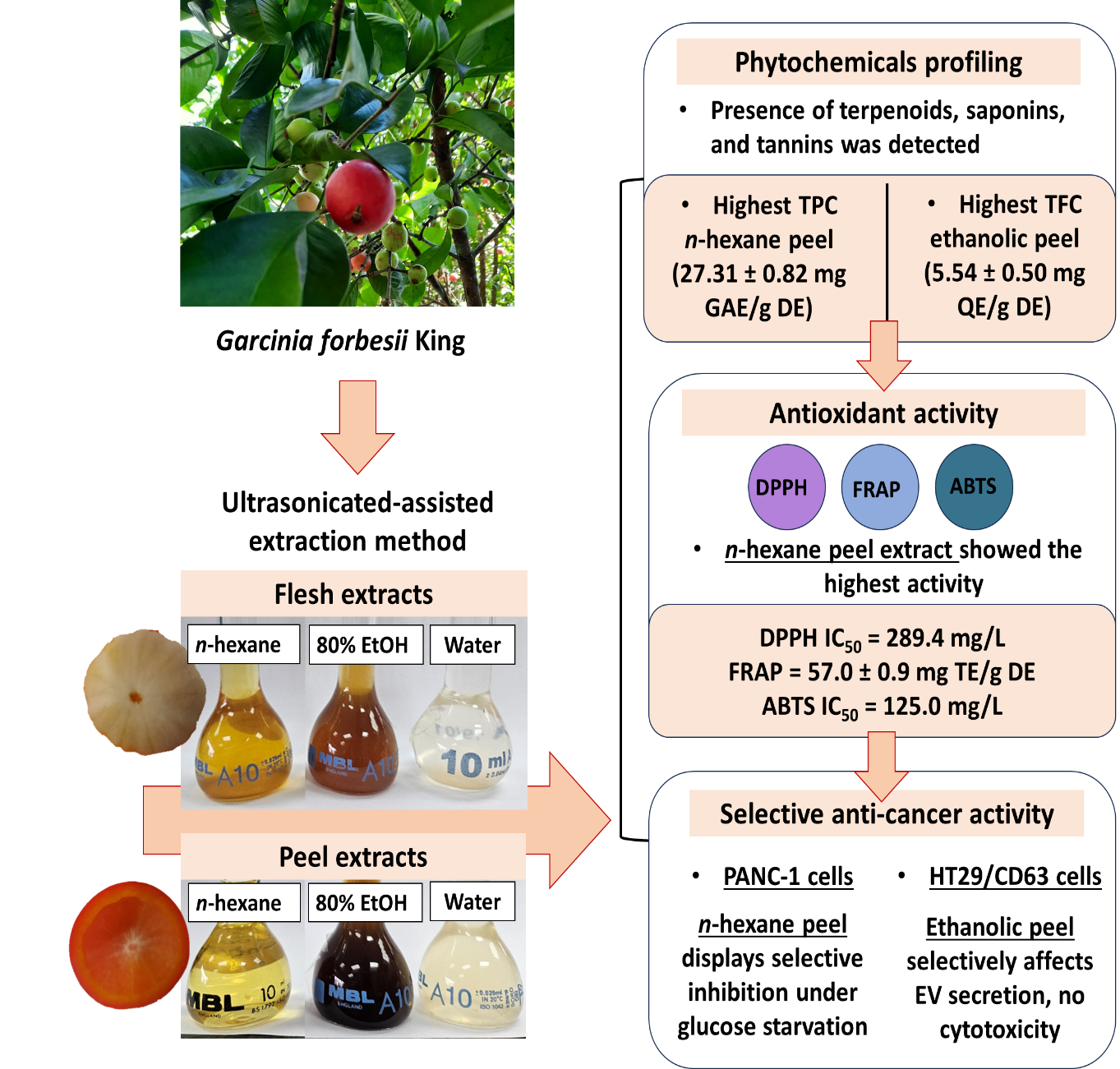
Garcinia forbesii King (G. forbesii) is an indigenous plant of Brunei Darussalam, traditionally used for medicinal purposes. This study evaluated the phytochemical composition, antioxidant activity, and anticancer potential of the fruit flesh and peel prepared via ultrasonication-assisted maceration using n-hexane, 80% EtOH, and water as extraction solvents. It was found that 80% EtOH was the most effective solvent for extracting bioactive compounds from G. forbesii, yielding a maximum of 63.8%. Terpenoids, saponins, and tannins were detected in all extracts from the flesh and peel. The n-hexane peel extract had the highest TPC (27.31 ± 0.82 mg GAE/g DE), while the 80% EtOH peel extract had the highest TFC (5.54 ± 0.50 mg QE/g DE). All extracts exhibited potent antioxidant activities in DPPH, FRAP, and ABTS assays, with the n-hexane peel extract showing the highest activity (DPPH IC50 = 289.4 mg/L, ABTS IC50 = 125.0 mg/L, FRAP = 57.0 ± 0.9 mg TE/g DE). Notably, the n-hexane peel extract selectively inhibited PANC-1 cells under glucose-starved conditions, showing the smallest AUC value (0.37), and the 80% EtOH peel extract selectively influenced extracellular vesicle secretion without affecting the cell viability of HT29/CD63-Nluc cells. These findings support G. forbesii extracts as a promising potential source of antioxidant and anticancer properties, providing scientific evidence for its traditional medicinal use.
HIGHLIGHTS
- 80% EtOH gave the highest extraction yield (63.8%).
- n-hexane peel showed the highest phenolics and antioxidant activity.
- Ethanolic peel extract yielded the highest flavonoid content.
- n-hexane peel inhibited PANC-1 under glucose starvation.
- forbesii shows strong antioxidant and anticancer potential.
GRAPHICAL ABSTRACT
Downloads
References
J Ferlay, M Colombet, I Soerjomataram, DM Parkin, M Piñeros, A Znaor and F Bray. Cancer statistics for the year 2020: An overview. International Journal of Cancer 2021; 149(4), 778-789.
Borneo Bulletin, Available at: https://borneobulletin.com.bn/rise-in-brunei-cancer-cases-early-detection-and-prevention-crucial, accessed December 2025.
N Sirimangkalakitti, J Lin, K Harada, A Setiawan, M Arisawa and M Arai. Chemical constituents and anticancer activities of marine-derived fungus Trichoderma lixii. Molecules 2024; 29(9), 2048.
AS Choudhari, PC Mandave, M Deshpande, P Ranjekar and O Prakash. Phytochemicals in cancer treatment: From preclinical studies to clinical practice. Frontiers in Pharmacology 2019; 10, 1614.
AG Atanasov, SB Zotchev, VM Dirsch and CT Supuran. Natural products in drug discovery: Advances and opportunities. Nature Reviews Drug Discovery 2021; 20, 200-216.
Joharman, H Poerwono and Sukardiman. Cytotoxicity effect of the pericarp extracts of Garcinia forbesii King on MCF-7 breast cancer and HepG2 liver cancer cell lines. Pharmacognosy Journal 2021; 13(1), 226-229.
Joharman, Sukardiman and H Poerwono. Thin layer chromatography analysis of ethanol extract of Garcinia forbesii King. and its cytotoxic effect on MCF-7 and HepG2 cell lines. Repo Dosen 2017. https://repodosen.ulm.ac.id/handle/123456789/27693
NSS Ambarwati, NT Sukma, Y Desmiaty, A Auliya, S Budi, M Arifuddin and I Ahmad. Garcinia dulcis and Garcinia forbesii King fruit peel extract: Secondary metabolite composition, antioxidant, and elastase inhibitory activity evaluation. Journal of Advanced Pharmaceutical Technology & Research 2024; 15(1), 8-12.
Lim TK. Edible medicinal and Non-medicinal plants. Springer Dordrecht, Netherlands, 2012.
PF Stevens. Clusiaceae-guttiferae. Springer, Germany, 2007, p. 48-66.
PW Sweeney. Phylogeny and floral diversity in Garcinia (Clusiaceae) and relatives. International Journal of Plant Sciences 2008; 169(9), 1288-1303.
J Wairata, ER Sukandar, A Fadlan, AS Purnomo, M Taher and T Ersam. Evaluation of antioxidant, antidiabetic and antiplasmodial activities of xanthones isolated from Garcinia forbesii and their in silico studies. Biomedicines 2021; 9(10), 1380.
Y Alen, N Safitri, D Hamidi, AM Ali, NH Ladjis and DMV Sargent. Rubraxanthone dari Garcinia forbesii King. dan bioaktivitasnya. Jurnal Riset Kimia 2008; 1(2), 192-201.
MAM Haris and SA Sani. Antioxidant screening of Garcinia forbesii originated from Sabah. Journal of Physics: Conference Series 2022; 2314, 012031.
S Tjahjani, W Widowati, K Khiong, A Suhendra and R Tjokropranoto. Antioxidant properties of Garcinia Mangostana L (Mangosteen) rind. Procedia Chemistry 2014; 13, 198-203.
K Likhitwitayawuid, T Phadungcharoen and J Krungkrai. Antimalarial xanthones from Garcinia cowa. Planta Medica 1998; 64(1), 70-72.
J Wairata, A Fadlan, AS Purnomo, M Taher and T Ersam. Total phenolic and flavonoid contents, antioxidant, antidiabetic and antiplasmodial activities of Garcinia forbesii King: A correlation study. Arabian Journal of Chemistry 2022; 15, 103541.
B Sthapit, H Lamers, R Rao and A Bailey. Tropical fruit tree diversity. Routledge, Oxfordshire, 2016.
F Larasati. Sriwijaya University. Antibacterial activity of Garcinia forbesii King leaves. Sriwijaya University, Sumatera Selatan, Indonesia, 2017.
K Izuishi, K Kato, T Ogura, T Kinoshita and H Esumi. Remarkable tolerance of tumor cells to nutrient deprivation: Possible new biochemical target for cancer therapy. Cancer Research 2000; 60(21), 6201-6207.
K Tomohara, J Maneenet, N Ohashi, T Nose, R Fujii, MJ Kim, S Sun and S Awale. Ugi adducts as novel anti-austerity agents against PANC-1 human pancreatic cancer cell line: A rapid synthetic approach. Biological and Pharmaceutical Bulletin 2023; 46(10), 1412-1420.
JY Han, KS Ahn, YH Kim, TS Kim, WK Baek, SI Suh and KJ Kang. Circulating microRNAs as biomarkers in bile-derived exosomes of cholangiocarcinoma. Annals of Surgical Treatment and Research 2021; 101(3), 140-150.
M Kim, IT Son, GT Noh, SY Woo, RA Lee and BY Oh. Exosomes derived from colon cancer cells promote tumor progression and affect the tumor microenvironment. Journal of Clinical Medicine 2023; 12(12), 3905.
AS Azmi, B Bao and FH Sarkar. Exosomes in cancer development, metastasis, and drug resistance: A comprehensive review. Cancer and Metastasis Reviews 2013; 32, 623-642.
T Hikita, M Miyata, R Watanabe and C Oneyama. Sensitive and rapid quantification of exosomes by fusing luciferase to exosome marker proteins. Scientific Reports 2018; 8, 14035.
JB Harborne. Phytochemical methods. Springer Dordrecht, Germany, 1980.
HO Edeoga, DE Okwu and BO Mbaebie. Phytochemical constituents of some Nigerian medicinal plants. African Journal of Biotechnology 2005; 4(7), 685-688.
OA Aiyegoro and AI Okoh. Preliminary phytochemical screening and in vitro antioxidant activities of the aqueous extract of Helichrysum longifolium DC. BMC Complementary and Alternative Medicine 2010; 10, 21.
N Kancherla, A Dhakshinamoothi, K Chitra and RB Komaram. Preliminary analysis of phytoconstituents and evaluation of anthelminthic property of Cayratia auriculata (in vitro). MÆDICA 2019; 14(4), 350-356.
N Jamila, N Khan, AA Khan, SN Khan and KS Kim. Phytochemical analysis, antioxidant, anti-hyperglycemic and antituberculosis activities of phylogenetically related Garcinia mangostana (Mangosteen) and Garcinia hombroniana (Seashore mangosteen). Journal of the Chemical Society of Pakistan 2016; 38(6), 1181-1189.
E Nortjie, M Basitere, D Moyo and P Nyamukamba. Extraction methods, quantitative and qualitative phytochemical screening of medicinal plants for antimicrobial textiles: A review. Plants 2022; 11(15), 2011.
TM Djordjevic, SS Šiler-Marinkovic and SI Dimitrijevic-Brankovic. Antioxidant activity and total phenolic content in some cereals and legumes. International Journal of Food Properties 2011; 14(1), 175-184.
NI Hanifa, Rumiyati, Sismindari and N Fakhrudin. Cytoprotective and antioxidant effects of ethanolic extract of red dragon fruit (Hylocereus polyrhizus) and carrot (Daucus carota L.). AIP Conference Proceedings 2016; 1755, 030004.
AR Abdullah, NA Bakhari and H Osman. Study on the relationship of the phenolic, flavonoid and tannin content to the antioxidant activity of Garcinia atroviridis. Universal Journal of Applied Science 2013; 1(3), 95-100.
MA Ebrahimzadeh, F Pourmorad and AR Bekhradnia. Iron chelating activity, phenol and flavonoid content of some medicinal plants from Iran. African Journal of Biotechnology 2008; 7(18), 3188-3192.
S Aryal, MK Baniya, K Danekhu, P Kunwar, R Gurung and N Koirala. Total phenolic content, flavonoid content and antioxidant potential of wild vegetables from Western Nepal. Plants 2019; 8(4), 96.
IG Munteanu and C Apetrei. Analytical methods used in determining antioxidant activity: A review. International Journal of Molecular Sciences 2021; 22(7), 3380.
Z Khiya, Y Oualcadi, A Gamar, F Berrekhis, T Zair and FE Hilali. Correlation of total polyphenolic content with antioxidant activity of hydromethanolic extract and their fractions of Salvia officinalis leaves from different regions of Morocco. Journal of Chemistry 2021; 2021, 8585313.
R Re, N Pellegrini, A Proteggente, A Pannala, M Yang and C Rice-Evans. Antioxidant activity applying an improved ABTS radical cation decolorization assay. Free Radical Biology and Medicine 1999; 26(9-10), 1231-1237.
K Thaipong, U Boonprakob, K Crosby, L Cisneros-Zevallos and DH Byrne. Comparison of ABTS, DPPH, FRAP and ORAC assays for estimating antioxidant activity from guava fruit extracts. Journal of Food Composition and Analysis 2006; 19(6-7), 669-675.
RS Nilima and SM Hande. Estimation of phytochemical content and antioxidant activity of some selected traditional Indian medicinal plants. Indian Journal of Pharmaceutical Sciences 2011; 73(2), 146-151.
AM Zaher, J Lin and M Arai. Cytotoxic activity of abietane-type diterpenes isolated from Taxodium distichum against cancer cells adapted to nutrient-starved conditions. Natural Product Communications 2020; 15(3), 1-6.
R Tang, A Kimishima, R Ishida, A Setiawan and M Arai. Selective cytotoxicity of epidithiodiketopiperazine DC1149B, produced by marine-derived Trichoderma lixii on the cancer cells adapted to glucose starvation. Journal of Natural Medicines 2021; 75, 108-118
E Julianti, M Azhari, M Singgih, FSD Aminah, MY Putra, J Lin, A Kimishima and M Arai. Cytotoxic activity of cordycepin produced by marine-derived fungus Emericella sp. against HT29 human colon cancer cell lines. Archives of Microbiology 2023; 205, 378.
F Mitani, J Lin, T Sakamoto, R Uehara, T Hikita, T Yoshida, A Setiawan, M Arai and C Oneyama. Asteltoxin inhibits extracellular vesicle production through AMPK/mTOR-mediated activation of lysosome function. Scientific Reports 2022; 12, 6674.
R Muthia, R Saputri and SA Verawati. Uji aktivitas antioksidan ekstrak etanol kulit buah mundar (Garcinia forbesii King.) menggunakan metode DPPH (2,2-diphenyl-1-picrylhydrazil). Jurnal Pharmascience 2019; 6(1), 74.
S Núñez, MS Valero, AM Mustafa, G Caprioli, F Maggi, C Gómez-Rincón and V López. Ultrasound-assisted extraction versus traditional Soxhlet apparatus for the obtention of polyphenols, carotenoids and tocopherols from Tagetes erecta L. flowers. Journal of the Science of Food and Agriculture 2025; 105(6), 3453-3462.
S Meir, J Kanner, B Akiri and S Philosoph-Hadas. Determination and involvement of aqueous reducing compounds in oxidative defense systems of various senescing leaves. Journal of Agricultural and Food Chemistry 1995; 43(7), 1813-1819.
HF Chang and LL Yang. Radical-scavenging and rat liver mitochondria lipid peroxidative inhibitory effects of natural flavonoids from traditional medicinal herbs. Journal of Medicinal Plants Research 2012; 6(6), 997-1006.
S Dudonné, X Vitrac, P Coutière, M Woillez and JM Mérillon. Comparative study of antioxidant properties and total phenolic content of 30 plant extracts of industrial interest using DPPH, ABTS, FRAP, SOD and ORAC assays. Journal of Agricultural and Food Chemistry 2009; 57(5), 1768-1774.
J Maneenet, AM Tawila, HH Nguyen, ND Phan, O Monthakantirat, S Daodee, C Boonyarat, C Khamphukdee, Y Chulikhit and S Awale. Calliviminone A from Callistemon citrinus induces PANC-1 pancreatic cancer cell death by targeting the PI3K/Akt/mTOR pathway. Plants 2025; 14(3), 2074.
M Fallahi-Sichani, S Honarnejad, LM Heiser, JW Gray and PK Sorger. Metrics other than potency reveal systematic variation in responses to cancer drugs. Nature Chemical Biology 2013; 9, 708-714.
IS Jang, EC Neto, J Guinney, SH Friend and AA Margolin. Systematic assessment of analytical methods for drug sensitivity prediction from cancer cell line data. Pacific Symposium on Biocomputing 2014; 2014, 63-74.
C Ojong, SA Besong and ANA Aryee. Solvent-based extraction recovers phytochemicals from medicinal plants demonstrating anticancer and chemopreventive potential: A review. Molecules 2026; 31(7), 1202.
G Raposo and W Stoorvogel. Extracellular vesicles: Exosomes, microvesicles, and friends. Journal of Cell Biology 2013; 200(4), 373-383.
N Kosaka, Y Yoshioka, Y Fujita and T Ochiya. Versatile roles of extracellular vesicles in cancer. Journal of Clinical Investigation 2016; 126(4), 1163-1172.
N Kosaka, H Iguchi and T Ochiya. Circulating microRNA in body fluid: A new potential biomarker for cancer diagnosis and prognosis. Cancer Science 2010; 101(10), 2087-2092.
D Prieto, N Sotelo, N Seija, S Sernbo, C Abreu, R Durán, M Gil, E Sicco, V Irigoin, C Oliver, AI Landoni, R Gabus, G Dighiero and P Oppezzo. S100-A9 protein in exosomes from chronic lymphocytic leukemia cells promotes NF-κB activity during disease progression. Blood 2017; 130(6), 777-788.
H Zhang, T Deng, S Ge, Y Liu, M Bai, K Zhu, Q Fan, J Li, T Ning, F Tian, H Li, W Sun, G Ying and Y Ba. Exosome circRNA secreted from adipocytes promotes the growth of hepatocellular carcinoma by targeting deubiquitination-related USP7. Oncogene 2019; 38(15), 2844-2859.
D Dabitao, JB Margolick, J Lopez and JH Bream. Multiplex measurement of proinflammatory cytokines in human serum: Comparison of the Meso Scale Discovery electrochemiluminescence assay and the Cytometric Bead Array. Journal of Immunological Methods 2011; 372(1-2), 71-77.
J Lin, H Lin, K Sato, A Kimishima, S Tamura, K Ujiie, C Oneyama, J Liu and M Arai. Oleanane-type triterpene saponins promote extracellular vesicle secretion of human adipose-derived mesenchymal stem cells. Journal of Natural Medicines 2025; 79, 922-930.
H Matta, R Gopalakrishnan, S Choi, R Prakash, V Natarajan, R Prins, S Gong, SD Chitnis, M Kahn, X Han, V Chaudhary, A Soni, J Sernas, P Khan, D Wang and PM Chaudhary. Development and characterization of a novel luciferase-based cytotoxicity assay. Scientific Reports 2018; 8, 199.
P Charlagorla, J Liu, M Patel, JI Rushbrook and M Zhang. Loss of plasma membrane integrity, complement response and formation of reactive oxygen species during early myocardial ischemia/reperfusion. Molecular Immunology 2013; 56(4), 507-512.
AG Cashikar and PI Hanson. A cell-based assay for CD63-containing extracellular vesicles. PLoS One 2019; 14(7), e0220007.
Downloads
Published
How to Cite
Issue
Section
License
Copyright (c) 2026 Walailak University

This work is licensed under a Creative Commons Attribution-NonCommercial-NoDerivatives 4.0 International License.