
In Vivo Analysis of Anti-inflammatory, Analgesic, and Antipyretic Activities of Litsea elliptica Blume Leaf Extracts
DOI:
https://doi.org/10.48048/tis.2026.12228Keywords:
Litsea elliptica, Anti-inflammatory, Analgesic, Antipyretic, Animal models, Litsea elliptica, Anti-inflammatory, Analgesic, Antipyretic, Animal modelsAbstract
The leaves of Litsea elliptica have been traditionally claimed to be beneficial for the treatment of headaches, fever, itch, stomach ulcers, and cancer. This present study investigates the anti-inflammatory, analgesic, and antipyretic activities of the mature and young leaves of L. elliptica extracted via maceration (MACE) and microwave-assisted extraction (MAE) in animal models using adult male Wistar albino rats. Anti-inflammatory activity was assessed via carrageenan-induced paw oedema and xylene-induced ear oedema assays. Analgesic activity was determined using formalin-induced paw flinching test and acetic acid-induced writhing test. The brewer’s yeast-induced pyrexia assay was employed to determine the antipyretic properties of the extracts. The extraction methods did not influence the activity of mature leaf extracts across all the assays conducted. However, MAE seemed to enhance the anti-inflammatory and analgesic activities of young leaf extracts. Treatment with both mature and young leaf extracts attenuated inflammation, pain, and fever in the animal models at varying degrees of inhibition. Overall, our current findings highlighted the potential of L. elliptica leaves as novel anti-inflammatory, analgesic, and antipyretic agents.
HIGHLIGHTS
- Litsea elliptica has been traditionally utilised across the countries of Southeast Asia as a remedy for many ailments, including headaches, fever, itch, stomach ulcers, and cancer.
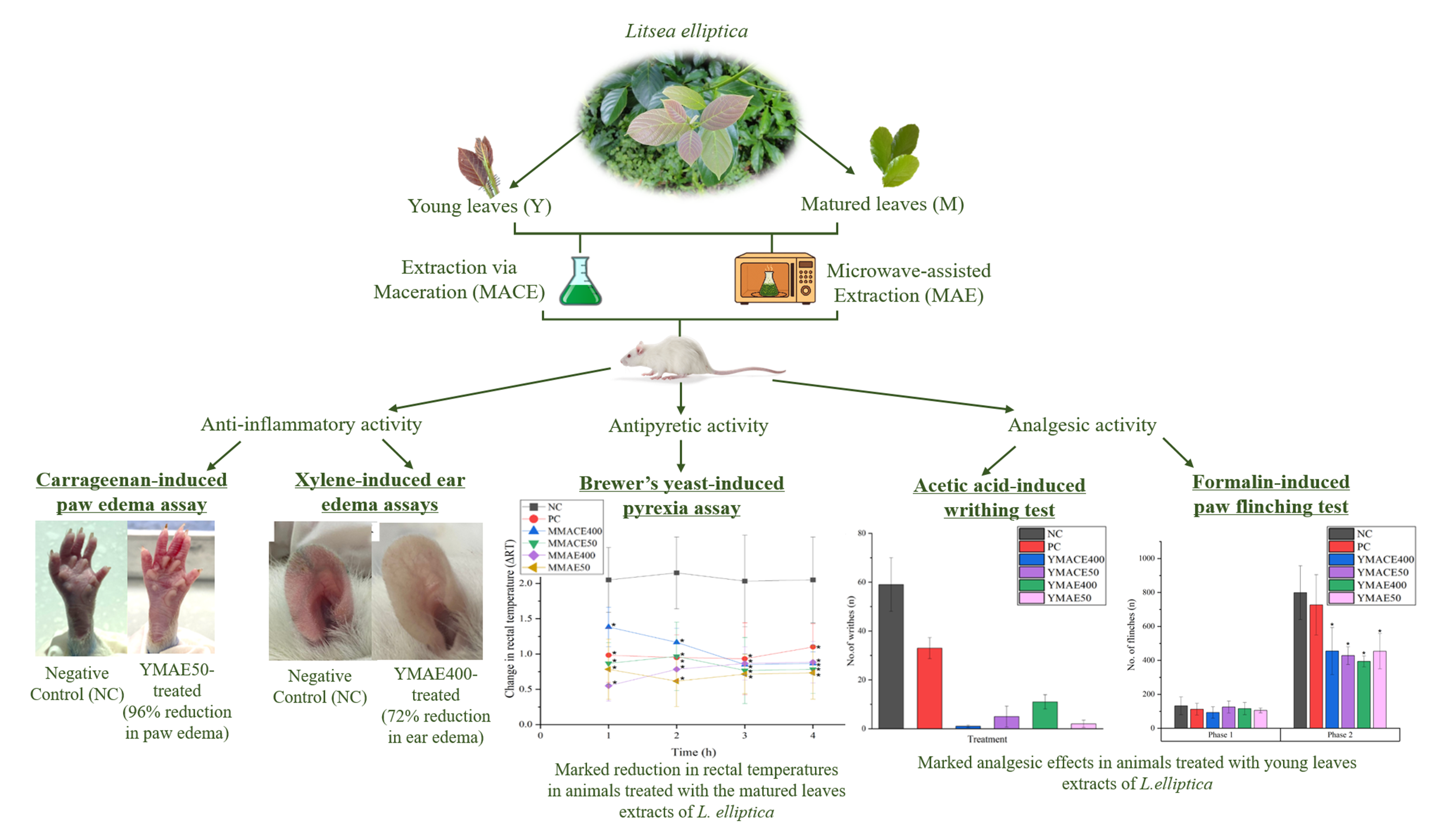
- Pre-treatment with ethanolic mature and young leaf extracts reduced redness and swellings in the carrageenan-induced paw oedema and xylene-induced ear oedema. YMAE50 suppressed paw oedema by 96% while YMACE400 inhibited ear oedema by 72% relative to NC by the end of the assay.
- Young leaf extracts exhibited a potent analgesic effect, as evidenced by the marked reduction in the number of paw flinches and body writhes compared to NC.
- The progression of fever induced by brewer’s yeast was successfully mitigated following treatment with mature leaf extracts of elliptica, with an increase in rectal temperature remaining below 1 °C by the end of the assay.
GRAPHICAL ABSTRACT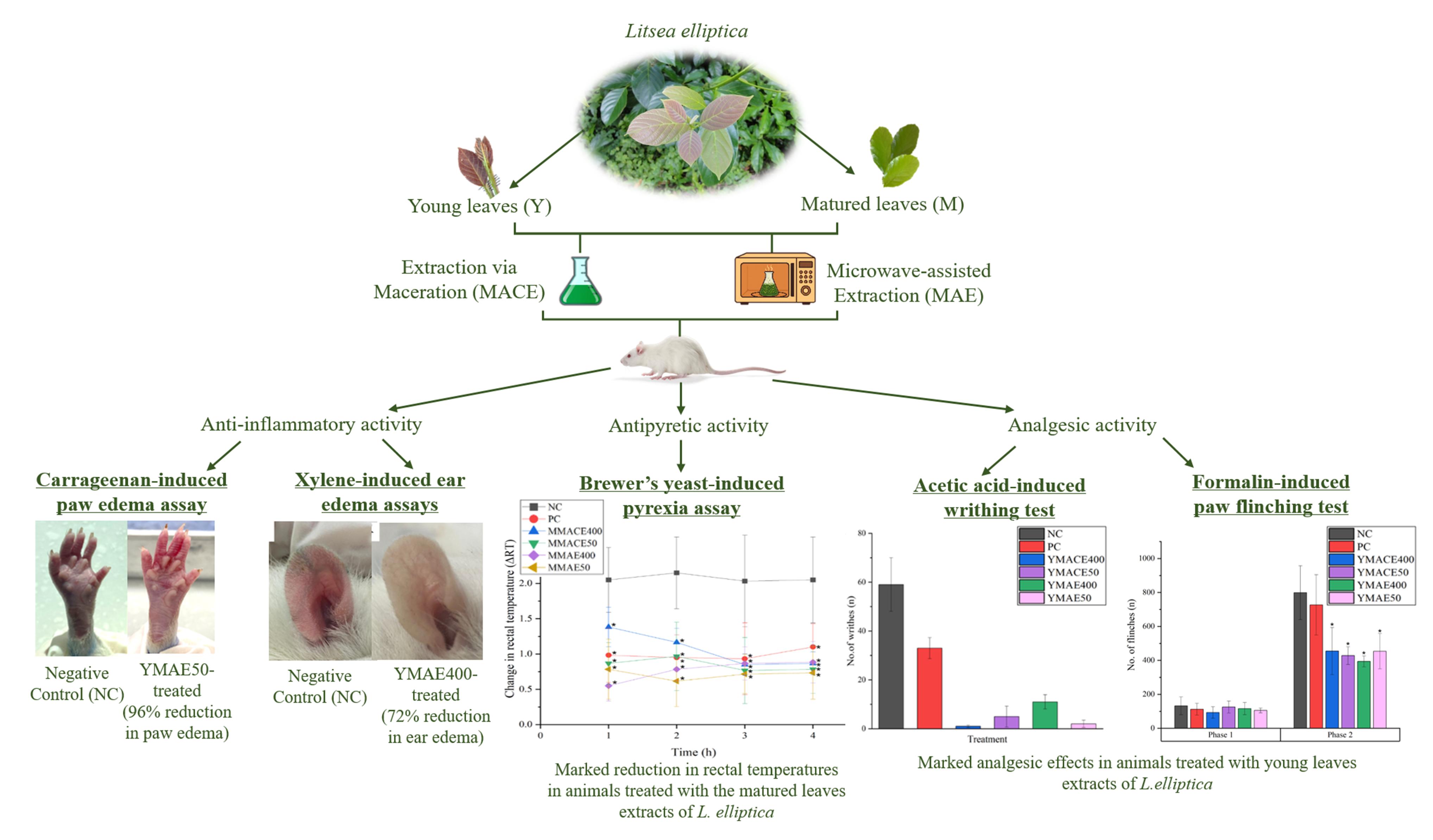
Downloads
References
N Bakar, FM Franco and NH Hassan. The intersection of Kedayan folk medicine and traditional ecological calendar. In: FM Franco, M Knudsen and NH Hassan (Eds.). Case studies in biocultural diversity from Southeast Asia. Spinger, Singapore, 2022, p. 105-124.
MJR Desborough and DM Keeling. The aspirin story - from willow to wonder drug. British Journal of Haematology 2017; 177(5), 674-683.
Y Tu. Artemisinin - a gift from Traditional Chinese Medicine to the world (nobel lecture). Angewandte Chemie International Edition 2016; 55(35), 10210-10226.
S Foster. From herbs to medicines: the Madagascar periwinkle’s impact on childhood leukemia: A serendipitous discovery for treatment. Alternative and Complementary Therapies 2010; 16(6), 347-350.
N Kifli, Z Wint, J Nh and J Nh. Prevalence on the use of traditional medicine in Brunei Darussalam. Journal of Homeopathy & Ayurvedic Medicine 2014; 3(155), 2167-1206.
V Roseberg. 2017, Brunei Malay traditional medicine: Persistence in the face of western medicine and Islamic orthodoxy. Ph. D. Dissertation. The University of Western Australia, Perth, Australia.
K Kamsani, FM Franco and F Slik. A comparative account of the traditional healing practices of healers and non-healers in the Kiudang area of Brunei Darussalam. Journal of Ethnopharmacology 2020; 256, 112788.
MPY Goh, AM Basri, H Yasin, H Taha and N Ahmad. Ethnobotanical review and pharmacological properties of selected medicinal plants in Brunei Darussalam: Litsea elliptica, Dillenia suffruticosa, Dillenia excelsa, Aidia racemosa, Vitex pinnata and Senna alata. Asian Pacific Journal of Tropical Biomedicine 2017; 7(2), 173-180.
RPJD Kok. A revision of Litsea (Lauraceae) in Peninsular Malaysia and Singapore. Garden’s Bulletin Singapore 2021; 73(1), 81-178.
N Chaisoung, H Balslev, R Suksathan, P Panyadee, C Long, C Ngernsaengsaruay, T Chaowasku and A Inta. Essential oil and phylogenetic positions of five medicinal Litsea species (Lauraceae). Diversity 2025; 17(3), 168.
F Awang-Kanak and MF Abu Bakar. Traditional vegetable salad (ulam) of Borneo as source of functional food. Food Research 2019; 4(1), 1-12.
H Kuspradini, MS Mala, AS Putri, NA Sa’adah and Kiswanto. Effect of leaf maturity and solvent extract on the antioxidant activity of Litsea elliptica. Journal of the Korean Wood Science and Technology 2024; 52(5), 450-458.
S Jiwajinda, V Santisopasri, A Murakami, OK Kim, HW Kim and H Ohigashi. Suppressive effects of edible Thai plants on superoxide and nitric oxide generation. Asian Pacific Journal of Cancer Prevention 2002; 3(3), 215-223.
PW Grosvenor, PK Gothard, NC McWilliam, A Supriono and DO Gray. Medicinal plants from Riau Province, Sumatra, Indonesia. part 1: Uses. Journal of Ethnopharmacology 1995; 45(2), 75-95.
S Omar, M Latip and NH Ismail. The use of plants in the management of health of the Melanau community in Sarawak (in Malaysian). In: Proceedings of the 8th Antarabangsa Sains Sosial & Kemanusiaan, Selangor, Malaysia. 2023, p. 2811-4051.
S Phoopha, C Wattanapiromsakul, T Pitakbut and S Dej-adisai. Chemical constituents of Litsea elliptica and their alpha-glucosidase inhibition with molecular docking. Pharmacognosy Magazine 2020; 16(70), 327-334.
MPY Goh, AF Kamaluddin, TJL Tan, H Yasin, H Taha, A Jama and N Ahmad. An evaluation of the phytochemical composition, antioxidant and cytotoxicity of the leaves of Litsea elliptica Blume - An ethnomedicinal plant from Brunei Darussalam. Saudi Journal of Biological Sciences 2022; 29(1), 304-317.
K Nakahara, G Trakoontivakorn, NS Alzoreky, H Ono, M Onishi-Kameyama and M Yoshida. Antimutagenicity of some edible Thai plants, and a bioactive carbazole alkaloid, mahanine, isolated from Micromelum minutum. Journal of Agricultural and Food Chemistry 2002; 50(17), 4796-4802.
F Aryani, IW Kusuma, Y Meliana, NM Sari and H Kuspradini. Potential antibacterial and antioxidant activities of ten essential oils from East Kalimantan, Indonesia. Biodiversitas Journal of Biological Diversity 2023; 24(1), 665-672.
N Chaichanawongsaroj, S Amonyingcharoen, P Pattiyathanee, R Vilaichone and Y Poovorawan. Anti-Helicobacter pylori and anti-internalization activities of Thai folk remedies used to treat gastric ailments. Journal of Medicinal Plants Research 2012; 6(8), 1389-1393.
MH Wong, LF Lim, F Ahmad and Z Assim. Antioxidant and antimicrobial properties of Litsea elliptica Blume and Litsea resinosa Blume (Lauraceae). Asian Pacific Journal of Tropical Biomedicine 2014; 4(5), 386-392.
T Lawal, C Slover, V Lee and GB Mahady. In vitro susceptibility of oral pathogens to traditional medicines used to treat gingivitis and peridontal infections. Planta Medica 2016; 82(5), PB29.
SN Ain, S Masran, H Othman, SB Budin, S Nor, AS Masran, R Salji, SB Budin and IS Taib. Acute toxicity (oral) information of Litsea elliptica Blume essential oil. In: Proceedings of the International Conference on Bioscience, Biochemistry and Bioinformatics, Singapore. 2011, p. 399-403.
SB Budin, SMSN Ain, B Omar, IS Taib and O Hidayatulfathi. Acute and subacute oral toxicity of Litsea elliptica Blume essential oil in rats. Journal of Zhejiang University - Science B 2012; 13(10), 783-790.
IS Taib, SB Budin, SMSN Ain, J Mohamed, SR Louis, S Das, S Sallehudin, NF Rajab and O Hidayatulfathi. Toxic effects of Litsea elliptica Blume essential oil on red blood cells of Sprague-Dawley rats. Journal of Zhejiang University - Science B 2009; 10(11), 813-819.
MK Pillai, F Yakop, N Metussin, MH Hamid, H Yasin, M Majid and DJ Young. Phytochemical characterization of essential oils from shoots, mature leaves and branchlets of Litsea elliptica (Lauraceae) collected in Brunei Darussalam. Scientia Bruneiana 2018; 17(2), 18-22.
MPY Goh, RN Samsul, AW Mohaimin, HP Goh, NH Zaini, N Kifli and N Ahmad. The analgesic potential of Litsea species: A systemic review. Molecules 2024; 29(9), 2079.
G Li, Z Li and Y Wang. The genus Litsea: A comprehensive review of traditional uses, phytochemistry, pharmacological activities and other studies. Journal of Ethnopharmacology 2024; 334, 118494.
R Bhowmick, MS Sarwar, SMR Dewan, A Das, B Das, MMN Uddin, MS Islam and MS Islam. In vivo analgesic, antipyretic, and anti-inflammatory potential in Swiss albino mice and in vitro thrombolytic activity of hydroalcoholic extract from Litsea glutinosa leaves. Biological Research 2014; 47(1), 56.
Z Liu, H Li, Y Qi, Z Zhu, D Huang, K Zhang, J Pan, L Wen and Z Zou. Cinnamomum camphora leaves as a source of proanthocyanidins separated using microwave-assisted extraction method and evaluation of their antioxidant activity in vitro. Arabian Journal of Chemistry 2021; 14(9), 103328.
DGN Pastura, JDV Sousa, MC Silva, AF Matos, HLCD Santos, GL Pereira, EBD Rocha, RS Alves, LDO Bastos, LDO Pires, RN Castro, HR Borba and VMD Lima. Persea americana Mill.: Evaluation of cytogenotoxicity and phytochemical prospection of leaf extracts. Brazilian Journal of Pharmaceutical Sciences 2022; 58, e19261.
NA Shafie, NA Suhaili, H Taha and N Ahmad. Evaluation of antioxidant, antibacterial and wound healing activities of Vitex pinnata. F1000Research 2020; 9, 187.
MT Mansouri, AA Hemmati, B Naghizadeh, SA Mard, A Rezaie and B Ghorbanzadeh. A study of the mechanisms underlying the anti-inflammatory effect of ellagic acid in carrageenan-induced paw oedema in rats. Indian Journal of Pharmacology 2015; 47(3), 292-298.
SM Soliman, MH Teaima, KO Rashwan, BM Ali, BR Jasti, MA El-Nabarawi and SM Abd El-Halim. The deleterious effect of xylene-induced ear oedema in rats: protective role of dexketoprofen trometamol transdermal invasomes via inhibiting the oxidative stress/NF-κB/COX-2 pathway. International Journal of Pharmaceutics 2023; 631, 122525.
RI Erickson, MC Terzi, SM Jaber, FC Hankenson, A McKinstry-Wu, MB Kelz and JO Marx. Intraperitoneal continuous-rate for the maintenance of anesthesia infusion in laboratory mice (Mus musculus). Journal of the American Association for Laboratory Animal Science 2016; 55(5), 548-557.
A Roca-Vinardell, E Berrocoso, M Llorca-Torralba, JA García-Partida, J Gibert-Rahola and JA Mico. Involvement of 5-HT1A/1B receptors in the antinociceptive effect of paracetamol in the rat formalin test. Neurobiology of Pain 2018; 3, 15-21.
MMO Rashid, A Islam, MS Amran and MA Hossain. Evaluation of analgesic activity by acetic acid induced writhing method of crude extracts of Acacia nilotica. Scholars Academic Journal of Pharmacy 2017; 6(4), 126-138.
AD Forkuo, KB Mensah, EO Ameyaw, AO Antwi, NK Kusi-Boadum and C Ansah. Antiplasmodial and antipyretic activity and safety evaluation of the methanolic leaf extract of Murraya exotica (L.). Journal of Parasitology Research 2020; 2020, 1308541.
KR Patil, UB Mahajan, BS Unger, SN Goyal, S Belemkar, SJ Surana, S Ojha and CR Patil. Animal models of inflammation for screening of anti-inflammatory drugs: Implications for the discovery and development of phytopharmaceuticals. International Journal of Molecular Sciences 2019; 20(18), 4367.
X Yang, X Gao, Y Cao, Q Guo, S Li, Z Zhu, Y Zhao, P Tu and X Chai. Anti-Inflammatory effects of boldine and reticuline isolated from Litsea cubeba through JAK2/STAT3 and NF-κB signaling pathways. Planta Medica 2018; 84(1), 20-25.
M Eddouks, D Chattopadhyay, VD Feo and WC Cho. Medicinal plants in the prevention and treatment of chronic diseases. Evidence-Based Complementary and Alternative Medicine 2012; 2012, 458274.
SD Douglas and SE Leeman. Neurokinin-1 receptor: Functional significance in the immune system in reference to selected infections and inflammation. Annals of the New York Academy of Sciences 2011; 1217(1), 83-95.
HW Koon and C Pothoulakis. Immunomodulatory properties of substance P: The gastrointestinal system as a model. Annals of the New York Academy of Sciences 2006; 1088(1), 23-40.
MT Islam, SA Ayatollahi, SMNK Zihad, N Sifat, MR Khan, A Paul, B Salehi, T Islam, MS Mubarak, N Martins and J Sharifi-Rad. Phytol anti-inflammatory activity: Pre-clinical assessment and possible mechanism of action elucidation. Cellular and Molecular Biology 2020; 66(4), 264-269.
RA Abdel-Emam and AM Abd-Eldayem. Systemic and topical Ginkgo biloba leaf extract (Egb-761) ameliorated rat paw inflammation in comparison to dexamethasone. Journal of Ethnopharmacology 2022; 282, 114619.
B Lin, H Zhang, XX Zhao, K Rahman, Y Wang, XQ Ma, CJ Zheng, QY Zhang, T Han and LP Qin. Inhibitory effects of the root extract of Litsea cubeba (lour.) pers. on adjuvant arthritis in rats. Journal of Ethnopharmacology 2013; 147(2), 327-334.
EM Choi and JK Hwang. Effects of methanolic extract and fractions from Litsea cubeba bark on the production of inflammatory mediators in RAW264.7 cells. Fitoterapia 2004; 75(2), 141-148.
PC Liao, TS Yang, JC Chou, J Chen, SC Lee, YH Kuo, CL Ho and LKP Chao. Anti-inflammatory activity of neral and geranial isolated from fruits of Litsea cubeba Lour. Journal of Functional Foods 2015; 19, 248-258.
L Xia, R Li, T Tao, R Zhong, H Du, Z Liao, Z Sun and C Xu. Therapeutic potential of Litsea cubeba essential oil in modulating inflammation and the gut microbiome. Frontiers in Microbiology 2023; 14, 1233934.
YM Ham, YJ Ko, SM Song, J Kim, KN Kim, JH Yun, JH Cho, G Ahn and WJ Yoon. Anti-inflammatory effect of litsenolide B2 isolated from Litsea japonica fruit via suppressing NF-κB and MAPK pathways in LPS-induced RAW264.7 cells. Journal of Functional Foods 2015; 13, 80-88.
QMT Ngo, TQ Cao, PL Tran, JA Kim, ST Seo, JC Kim, MH Woo, JH Lee and BS Min. Lactones from the pericarps of Litsea japonica and their anti-inflammatory activities. Bioorganic & Medicinal Chemistry Letters 2018; 28(11), 2109-2115.
ER Puppala, Md Abubakar, V Swamy, SS Yalamarthi, S NP, AN Prakash, JK Gangasani, D Chamundeswari and VGM Naidu. Litsea salicifolia Roxb. bark ethanolic extract attenuates rheumatoid arthritis by inhibiting TLR4/NF-κB and activating SIRT1-Nrf2/HO-1 signaling axis: In-vitro and in-vivo evaluations. Phytomedicine Plus 2023; 3(1), 100390.
HJ Koo, WJ Yoon, EH Sohn, YM Ham, SA Jang, JE Kwon, YJ Jeong, JH Kwak, E Sohn, SY Park, KH Jang, S Namkoong, HS Han, YH Jung and SC Kang. The analgesic and anti-inflammatory effects of Litsea japonica fruit are mediated via suppression of NF-κB and JNK/p38 MAPK activation. International Immunopharmacology 2014; 22(1), 84-97.
YH Zhang, D Adamo, H Liu, Q Wang, W Wu, YL Zheng and XQ Wang. Editorial: Inflammatory pain: Mechanisms, assessment, and intervention. Frontiers in Molecular Neuroscience 2023; 16, 1286215.
MF Yam, YC Loh, CW Oo and R Basir. Overview of neurological mechanism of pain profile used for animal “pain-like” behavioral study with proposed analgesic pathways. International Journal of Molecular Sciences 2020; 21(12), 4355.
YQ Zhao, HY Wang, JB Yin, Y Sun, Y Wang, JC Liang, XJ Guo, K Tang and YT Wang. The analgesic effects of celecoxib on the formalin-induced short- and long-term inflammatory pain. Pain Physician 2017; 20(4), E575-E584.
R Dangarembizi, KH Erlwanger, C Rummel, J Roth, MT Madziva and LM Harden. Brewer’s yeast is a potent inducer of fever, sickness behavior and inflammation within the brain. Brain, Behavior, and Immunity 2018; 68, 211-223.
CA Dinarello. Overview of the IL‐1 family in innate inflammation and acquired immunity. Immunological Reviews 2018; 281(1), 8-27.
C Liu, D Chu, K Kalantar‐Zadeh, J George, HA Young and G Liu. Cytokines: From clinical significance to quantification. Advanced Science 2021; 8(15), 2004433.
A Septembre-Malaterre, A Boumendjel, ALS Seteyen, C Boina, P Gasque, P Guiraud and J Sélambaro. Focus on the high therapeutic potentials of quercetin and its derivatives. Phytomedicine Plus 2022; 2(1), 100220.
X Xiao, D Shi, L Liu, J Wang, X Xie, T Kang and W Deng. Quercetin suppresses cyclooxygenase-2 expression and angiogenesis through inactivation of P300 signaling. PLoS One 2011; 6(8), e22934.
KA O’Leary, S de Pascual-Tereasa, PW Needs, YP Bao, NM O’Brien and G Williamson. Effect of flavonoids and vitamin E on cyclooxygenase-2 (COX-2) transcription. Mutation Research/Fundamental and Molecular Mechanisms of Mutagenesis 2004; 551(1-2), 245-254.
NY Park, S Im and Q Jiang. Different forms of vitamin E and metabolite 13’-carboxychromanols inhibit cyclooxygenase-1 and its catalyzed thromboxane in platelets, and tocotrienols and 13’-carboxychromanols are competitive inhibitors of 5-lipoxygenase. The Journal of Nutritional Biochemistry 2022; 100, 108884.
H Slika, H Mansour, N Wehbe, SA Nasser, R Iratni, G Nasrallah, A Shaito, T Ghaddar, F Kobeissy and AH Eid. Therapeutic potential of flavonoids in cancer: ROS-mediated mechanisms. Biomedicine & Pharmacotherapy 2022; 146, 112442.
M Termer, C Carola, A Salazar, CM Keck, J Hemberger and J von Hagen. Activity-guided characterization of COX-2 inhibitory compounds in Waltheria indica L. extracts. Molecules 2021; 26(23), 7240.
Q Huang, C Chen, Z Zhang and Q Xue. Anti-inflammatory effects of myristic acid mediated by the NF-κB pathway in lipopolysaccharide-induced BV-2 microglial cells. Molecular Omics 2023; 19(9), 726-734.
WL Smith and MG Malkowski. Interactions of fatty acids, nonsteroidal anti-inflammatory drugs, and coxibs with the catalytic and allosteric subunits of cyclooxygenases-1 and -2. Journal of Biological Chemistry 2019; 294(5), 1697-1705.
Published
How to Cite
Issue
Section
License
Copyright (c) 2025 Walailak University

This work is licensed under a Creative Commons Attribution-NonCommercial-NoDerivatives 4.0 International License.





