
Clinical and Biologic Efficacy of Thai Herbal Blood Glucose-Lowering Formulation for the Treatment of Borderline Diabetes: A Pilot Double-Blind Randomized Controlled Trial
DOI:
https://doi.org/10.48048/tis.2027.13896Keywords:
Thai herbal formulation, Thai herbal medicine, Fasting blood glucose, Hemoglobin A1c, Diabetes, Antioxidant activity, α-glucosidase inhibition, α-amylase inhibitionAbstract
A traditional Thai herbal composition consisting of Caryota mitis, Lagerstroemia speciosa, Piper sarmentosum, Pluchea indica, and Zea mays has been used for the treatment of Type 2 diabetes. Nevertheless, there is an absence of scientific data to validate the therapeutic advantages. This research aimed to investigate the biological and clinical efficacy of a Thai herbal formulation in reducing blood glucose levels in patients with borderline diabetes. The chemical characteristics, in vitro antioxidant activity, α-glucosidase and α-amylase inhibition, and cytotoxicity assays were investigated in the aqueous and ethanol extracts of Thai herbal formulation. The clinical efficacy and safety of Thai herbal formulation for lowering blood glucose levels were evaluated in patients with borderline diabetes over a 12-week duration. The main chemical constituents of the Thai herbal formulation, resulting in exhibit antioxidant and glucose-lowering properties, include quinic acid, gallic acid, chlorogenic acid, and compounds. The aqueous and ethanol extracts of Thai herbal formulation had no inhibitory effect on either cell line including L929 cells and Vero cells. In the clinical investigation, Thai herbal formulation significantly reduced FBS and HbA1c levels (p < 0.05) compared with the control group after a period of 12 weeks, demonstrating its efficacy in managing diabetes. The findings indicated that the Thai herbal formulation had promise for managing diabetes. However, further inquiry is required to elucidate the mechanisms behind these results.
HIGHLIGHTS
- Traditional Thai herbal medicine represents an alternative and complementary approach for diabetes management.
- The Thai herbal formulation significantly reduced fasting blood sugar (FBS) and hemoglobin A1C (HbA1c), whilst significantly elevating high-density lipoprotein cholesterol (HDL) (p < 0.05) throughout a 12-week duration compared to the placebo group, thereby demonstrating its effectiveness in managing borderline diabetes.
- The main chemical constituents of the Thai herbal formulation demonstrated antioxidant and glucose-lowering properties, including quinic acid, gallic acid, chlorogenic acid, and other compounds.
GRAPHICAL ABSTRACT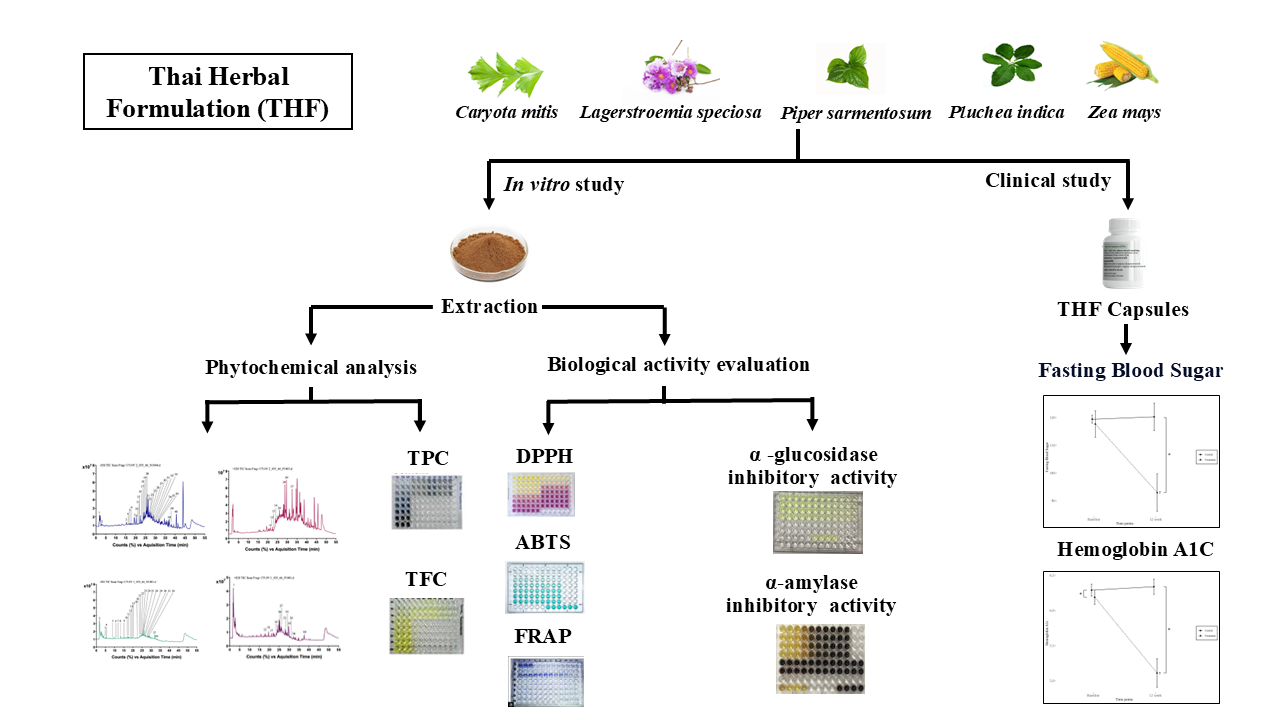
Downloads
References
IP Ampeire, PC Kawugezi and EM Mulogo. Prevalence of prediabetes and associated factors among community members in rural Isingiro district. BMC Public Health 2023; 23(1), 958.
YX Gao, Q Man and J Zhang. The association of prediabetes with dietary patterns, life behavior and cardiovascular risk factors among adult population without previously diagnosed non-communicable diseases. Nutrition, Metabolism & Cardiovascular Diseases 2023; 33(9), 1693-1701.
World Health Organization. Definition and diagnosis of diabetes mellitus and intermediate hyperglycemia: Report of a WHO/IDF consultation. World Health Organization, Geneva, Switzerland, 2006.
American Diabetes Association. Diagnosis and classification of diabetes mellitus. Diabetes Care 2014; 37(1), 81-90.
S Sriraman, D Sreejith, E Andrew, I Okello and M Willcox. Use of herbal medicines for the management of type 2 diabetes: A systematic review of qualitative studies. Complementary Therapies in Clinical Practice 2023; 53, 101808.
CX Liu. Overview on development of ASEAN traditional and herbal medicines. Chinese Herbal Medicines 2021; 13(4), 441-450.
R Kasole, HD Martin and J Kimiywe. Traditional medicine and its role in the management of diabetes mellitus: Patients and herbalists perspectives. Evidence-Based Complementary and Alternative Medicine 2019; 4, 2835691.
Department of Thai Traditional and Alternative Medicine. Monographs of selected Thai materia medica volume 1: A review. Amarin Printing & Publishing, Bangkok, Thailand, 2009.
Department of Thai Traditional and Alternative Medicine. Monographs of selected Thai materia medica volume 2: A review. Amarin Printing & Publishing, Bangkok, Thailand, 2015.
IA Abdelhakim, MA El-Mokhtar, AMA ElBaky an DW Bishay. Chemical constituents and antimicrobial activity of the leaves of Caryota mitis Lour. (Arecaceae). Journal of Medicinal Plants Studies 2017; 5(5), 250-255.
AR Hamed, AH Abou Zeid, H El-Rafie, ZA Kandil, RH El-Akada and M Farag. Bioactivity guided investigation of caryota mitis & caryota urens chemopreventive activity via in vitro and in silico studies. Egyptian Journal of Chemistry 2020; 63(12), 5071-5086.
BK Saha, NH Bhuiyan and K Haque. Hypoglycemic activity of Lagerstroemia speciosa L. extract on streptozotocin-induced diabetic rat: Underlying mechanism of action. Bangladesh Journal of Pharmacology 2009; 4(2), 79-83.
AE Al-snafi. Medicinal value of Lagerstroemia speciosa: An updated review. International Journal of Current Pharmaceutical Research 2019; 11(5), 18-26.
P Peungvicha, SS Thirawarapan, R Temsiririrkkul, H Watanabe, JK Prasain and S Kadota. Hypoglycemic effect of the water extract of Piper sarmentosum in rats. Journal of ethnopharmacology 2018; 60(1), 27-32.
X Sun, W Chen, W Dai, H Xin, K Rahmand, Y Wang, J Zhang, S Zhang, L Xu and T Han. Piper sarment osum Roxb.: A review on its botany traditional uses, phytochemistry and pharmacological activities. Journal of Ethnopharmacology 2020; 263(1), 112897.
B Vongsak, S Kongkiatpaiboon, S Jaisamut and K Konsap. Comparison of active constituents, antioxidant capacity, and α-glucosidase inhibition in Pluchea indica leaf extracts at different maturity stages. Food Bioscience 2018; 25, 68-73.
EW Chan, YK Ng, SK Wong and HT Chan. Pluchea indica: An updated review of its botany, uses,bioactive compounds and pharmacological properties. Pharmaceutical Sciences Asia 2022; 49(1), 77-85.
JE Okokon and ME Nyong. Antidiabetic and hypolipidemic activities of Zea may shusk extract and fractions. Journal of Herbs, Spices & Medicinal Plants 2018; 24(2), 134-150.
L Fougère, S Zubrzycki, C Elfakir and E Destandau. Characterization of corn silk extract using HPLC/HRMS/MS analyses and bioinformatic data processing. Plants 2023; 12(4), 721.
Bureau of Drug and Narcotics. Thai herbal pharmacopoeia: A review. Department of Medicinal Sciences, Ministry of Public Health, Nonthaburi, Thailand, 2016.
The Ayurvedic Pharmacopoeia of India. Part-I, Volume-II: A review. Government of India, Ministry of Health and Family Welfare, Department of Ayush. New Delhi, India. 1999.
P Wetchakul, P Chonsut, C Punsawad and S Sanpinit. LC‐QTOF‐MS characterization, antioxidant activity, and in vitro toxicity of medicinal plants from the Tri‐Than‐Thip Remedy. Evidence-Based Complementary and Alternative Medicine 2022; 2022, 4477003.
A Konsue and L Taepongsorat. Phytochemical screening and antioxidant activity of longevity remedy from national Thai traditional medicine scripture (formulary special edition). Tropical Journal of Natural Product Research 2022; 6(6), 868-871.
P Yupparach, A Sumalee and A Konsue. Phytochemical screening and biological activities of a remedy from A-thi-sa-ra-wak scripture as a folkloric diabetic medicine. Tropical Journal of Natural Product Research 2022; 6(6), 863-867.
A Namwong, P Thongkrajai and A Konsue. Effect of a Thai folk recipe on phytochemical screening, antioxidant activities, and α-Glucosidase inhibition by different solvent extracts. Pharmacognosy Research 2020; 12, 225-229.
P Yupparach and A Konsue. Phytochemical screening and antioxidant activities of Cornukaempferia chayanii extracts and in vitro inhibitory effects on digestive enzymes. Tropical Journal of Natural Product Research 2022; 6(5), 705-708.
IF Benzie and JJ Strain. The ferric reducing ability of plasma (FRAP) as a measure of antioxidant power: The FRAP assay. Analytical Biochemistry 1996; 239, 70-76.
K Li, F Yao, Q Xue, H Fan, L Yang, X Li, L Sun and Y Liu. Inhibitory effects against α-glucosidase and α-amylase of the flavonoids-rich extract from Scutellaria baicalensis shoots and interpretation of structure–activity relationship of its eight flavonoids by a refined assign-score method. Chemistry Central Journal 2018; 12(1), 82.
L Vajrabhaya and S Korsuwannawong. Cytotoxicity evaluation of a Thai herb using tetrazolium (MTT) and sulforhodamine B (SRB) assays. Journal of Analytical Science and Technology 2018; 9, 15.
S Sriwiriyajan, T Ninpesh, Y Sukpondma, T Nasomyon, P Graidist. Cytotoxicity screening of plants of genus Piper in breast cancer cell lines. Tropical Journal of Natural Product Research 2014; 13(6), 921.
The United States Pharmacopeia and National Formulary. USP 41-NF 36. Volume 5. Rockville: The United States pharmacopeial convention. The United States Pharmacopeia and National Formulary, Rockville, 2018, p. 7481-8185.
Department of Medical Sciences, Ministry of Public Health. Thai herbal pharmacopoeia 2018. Keawjawjom Printing & Publishing, Bangkok, Thailand, 2018.
K Chayarop, P Peungvicha, R Temsiririrkkul, Y Wongkrajang, W Chuakul and P Rojsanga. Hypoglycaemic activity of Mathurameha, a Thai traditional herbal formula aqueous extract, and its effect on biochemical profiles of streptozotocin-nicotinamide-induced diabetic rats. BMC Complementary and Alternative Medicine 2017; 17(1), 343.
C Andrade, NG Gomes, S Duangsrisai, PB Andrade, DM Pereira and P Valentao. Medicinal plants utilized in Thai traditional medicine for diabetes treatment: Ethnobotanical surveys, scientific evidence and phytochemicals. Journal of ethnopharmacology 2020; 263, 113177.
AE Shaaban, AR Ali, SN Ayyad and FA Badria. Multi-target directed ligands inspired natural products as an effective approach for the treatment of complex chronic health disorders. Bioorganic Chemistry 2024; 154, 108075.
BC Sarkar. Antioxidant phytochemicals extract from L. Speciosa leaves for the prevention and treatment of type 2 diabetes mellitus and cardiovascular diseases. Food Science and Nutrition 2022; 8(3), 1-8.
SR Kumar, ES Mohd Ramli, NA Abdul Nasir, N Mohd Ismail and NA Mohd Fahami. Methanolic extract of Piper sarmentosum attenuates obesity and hyperlipidemia in fructose-induced metabolic syndrome rats. Molecules 2021; 26(13), 3985.
K Sirichaiwetchakoon, S Churproong, S Kupittayanant and G Eumkeb. The effect of Pluchea indica (L.) Less. tea on blood glucose and lipid profile in people with prediabetes: A randomized clinical trial. Journal of Alternative and Complementary Medicine 2021; 27(8), 669-677.
S Fadlilah, S Sumarni, H Hartati, AS Harnany, D Sarbini and A Nugroho. Corn (Zea mays L) boiled water provides good evidence for lowering of lipid profile (HDL-C, LDL-C, triglycerides, and total cholesterol) in dyslipidemia. Malaysian Journal of Medicine and Health Sciences 2023; 19(6), 118-126.
MM Rahman, PS Dhar, F Anika, L Ahmed, MR Islam, NA Sultana, S Cavalu, O Pop and A Rauf. Exploring the plant-derived bioactive substances as antidiabetic agent: An extensive review. Biomedicine & Pharmacotherapy 2022; 152, 113217.
S Alam, MM Sarker, TN Sultana, MN Chowdhury, MA Rashid, NI Chaity, C Zhao, J Xiao, EE Hafez, SA Khan and IN Mohamed. Antidiabetic phytochemicals from medicinal plants: Prospective candidates for new drug discovery and development. Frontiers in Endocrinology 2022; 24(13), 800714.
N Shahzad, AR Alzahrani, IA Ibrahim, I Shahid, IM Alanazi, AH Falemban, MT Imam, N Mohsin, MF Azlina and P Arulselvan. Therapeutic strategy of biological macromolecules based natural bioactive compounds of diabetes mellitus and future perspectives: A systematic review. Heliyon 2024; 10(2), e24207.
Anshika, RK Pandey, L Singh, S Kumar, P Singh, M Pathak and S Jain. Plant bioactive compounds and their mechanistic approaches in the treatment of diabetes: A review. Future Journal of Pharmaceutical Sciences 2022; 8(1), 52.
N Tran, B Pham and L Le. Bioactive compounds in anti-diabetic plants: From herbal medicine to modern drug discovery. Biology 2020; 9(9), 252.
GQ Li, A Kam, KH Wong, X Zhou, EA Omar, A Alqahtani, KM Li, V Razmovski-Naumovski and K Chan. Herbal medicines for the management of diabetes. Advances in Experimental Medicine and Biology 2012; 771, 396-413.
Y Xu, G Tang, C Zhang, N Wang and Y Feng. Gallic acid and diabetes mellitus: Its association with oxidative stress. Molecules 2021; 26(23), 115.
H Ghazaee, A Raouf Sheibani, H Mahdian, S Gholami, VR Askari and VB Rahimi. Ellagic acid as potential therapeutic compound for diabetes and its complications: A systematic review from bench to bed. Naunyn-Schmiedeberg’s Archives of Pharmacology 2024; 397(12), 9345-9366.
S Sabarathinam and S Satheesh. Unveiling the molecular mechanisms and clinical implications of maslinic acid in diabetes mellitus: Insights from network pharmacology. Aspects of Molecular Medicine 2025; 5, 100060.
R Ganguly, SV Singh, K Jaiswal, R Kumar and AK Pandey. Modulatory effect of caffeic acid in alleviating diabetes and associated complications. World Journal of Diabetes 2023; 14(2), 62-75.
Y Yan, X Zhou, K Guo, F Zhou and H Yang. Use of chlorogenic acid against diabetes mellitus and its complications. Journal of Immunology Research 2020; 2020, 9680508.
LT Marton, LM Pescinini-E-Salzedas, ME Camargo, SM Barbalho, JF Haber, RV Sinatora, CR Detregiachi, RJ Girio, DV Buchaim and PCDS Bueno. The effects of curcumin on diabetes mellitus: A systematic review. Frontiers in Endocrinology 2021; 12, 669448.
Downloads
Published
How to Cite
Issue
Section
License
Copyright (c) 2026 Walailak University

This work is licensed under a Creative Commons Attribution-NonCommercial-NoDerivatives 4.0 International License.