
Relaxant Effects of Curcuma aeruginosa Rhizome Extracts on Isolated Rat Gastric Fundus and Ileum Contraction
DOI:
https://doi.org/10.48048/tis.2024.7356Keywords:
Curcuma aeruginosa, Gastric fundus, Gastrointestinal remedies, Ileum contractions, Rhizome extractAbstract
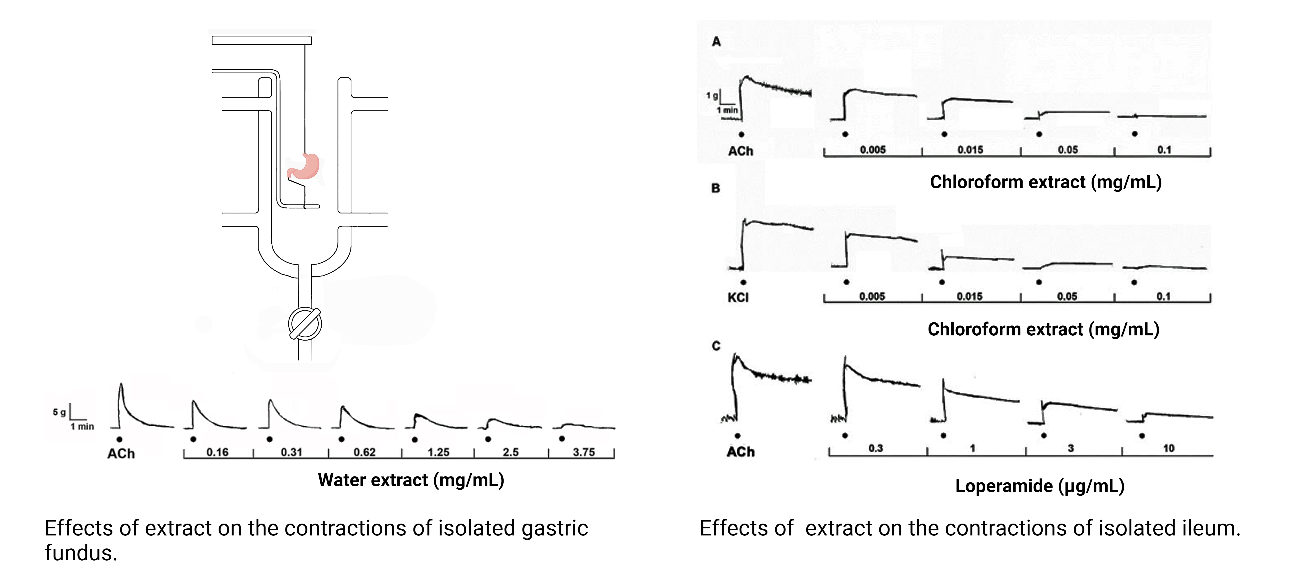
Curcuma aeruginosa (CA) rhizomes are used in traditional medicine as gastrointestinal remedies, postpartum care and uterine issues. However, its effects on gastrointestinal motility have not yet been explored. Extracts of CA rhizomes prepared using chloroform, methanol and water were evaluated for their effects on gastrointestinal contractions using isolated rat gastric fundus and ileum. Varied solvents aim for extraction of different compounds of CA rhizome. In the ileum, the 3 extracts did not significantly affect spontaneous contractions, but significantly reduced contractions induced by acetylcholine (ACh, 0.3 µM) and KCl (40 mM) in a concentration-dependent manner. The order of potency, based on ACh-induced contraction, was chloroform > methanol > water extracts, with respective IC50 values of 0.025 ± 0.001, 0.46 ± 0.02 and 2.57 ± 0.47 mg/mL. Similar potency order against KCl-induced contraction was observed, with IC50 values of 0.011 ± 0.002, 0.47 ± 0.06 and 1.18 ± 0.18 mg/mL, respectively. In the isolated gastric fundus model, both methanol and water extracts resulted in an increase in the force of contraction in the absence of stimulation. However, when ACh (0.3 µM) was introduced, the methanol and water extracts exhibited a concentration-dependent reduction in contractions, with IC50 values of 0.62 ± 0.06 and 2.30 ± 0.32 mg/mL, respectively. As for KCl (40 mM)-induced contraction, only the highest concentration of the water extract (3.75 mg/mL) significantly decreased the contraction by 41.29 ± 2.94 %. CA extract demonstrated relaxant effects on both isolated rat gastric fundus and ileal contractions induced by ACh and KCl. These findings support the use of CA in traditional medicine as a gastrointestinal remedy. These extracts have the potential to be used as antispasmodics and to treat infectious and non-infectious diarrhea, the latter of which occurs in functional gastrointestinal diseases. It might also be useful as a gastroprokinetic.
HIGHLIGHTS
- C. aeruginosa extracts had no impact on rat ileum’s spontaneous contraction
- Extracts caused dose-dependent relaxation of precontracted ileum
- Extracts enhanced spontaneous contraction of isolated gastric fundus
- Extracts induced relaxation in the precontracted isolated gastric fundus
GRAPHICAL ABSTRACT

Downloads
References
M Newman, A Lhuillie and AD Poulsen. Checklist of the Zingiberaceae of Malesia. Nationaal Herbarium Nederland, Leiden, Netherlands, 2004.
Botanical Garden Organization. Curcuma aeruginosa Roxb., Available at: http://www.qsbg.org/database/botanic_book%20full%20option/search_detail.asp?Botanic_ID=2528, accessed May 2023.
P Thaina, P Tungcharoen, M Wongnawa, W Reanmongkol and S Subhadhirasakul. Uterine relaxant effects of Curcuma aeruginosa Roxb. rhizome extracts. J. Ethnopharmacol. 2009; 121, 433-43.
AP Sari and U Supratman. Phytochemistry and biological activities of Curcuma aeruginosa (Roxb.). Indonesian J. Chem. 2022; 22, 576-98.
N Akarchariya, S Sirilun, J Julsrigival and S Chansakaowa. Chemical profiling and antimicrobial activity of essential oil from Curcuma aeruginosa Roxb., Curcuma glans K. Larsen & J. Mood and Curcuma cf. xanthorrhiza Roxb. collected in Thailand. Asian Pac. J. Trop. Biomed. 2017; 7, 881-5.
E Savarino, F Zingone, B Barberio, G Marasco, F Akyuz, H Akpinar, O Barboi, G Bodini, S Bor, G Chiarioni, G Cristian, M Corsetti, AD Sabatino, AM Dimitriu, V Drug, DL Dumitrascu, AC Ford, G Hauser, R Nakov, …, G Barbara. Functional bowel disorders with diarrhoea: Clinical guidelines of the United European Gastroenterology and European Society for Neurogastroenterology and Motility. Unit. Eur. Gastroenterol. J. 2022; 10, 556-84.
AD Sperber, SI Bangdiwala, DA Drossman, UC Ghoshal, M Simren, J Tack, WE Whitehead, DL Dumitrascu, X Fang, S Fukudo, J Kellow, E Okeke, EMM Quigley, M Schmulson, P Whorwell, T Archampong, P Adibi, V Andresen, MA Benninga, B Bonaz,…OS Palsson. Worldwide prevalence and burden of functional gastrointestinal disorders, results of Rome foundation global study. Gastroenterology 2021; 160, 99-114.e3.
YS Kim, JW Kim, NY Ha, J Kim and HS Ryu. Herbal therapies in functional gastrointestinal disorders: A narrative review and clinical implication. Front. Psychiatr. 2020; 11, 601.
P Poonpanang. 2004, Effects of Piper longum fruit, Piper sarmentosum root and Quercus infectoria nut gall on amoebiasis in mice and small intestine motility in rats and guinea-pigs. Master Thesis. Prince of Songkla University, Songkhla, Thailand.
RM Eglen, SS Hegde and N Watson. Muscarinic receptor subtypes and smooth muscle function. Pharmacol. Rev. 1996; 48, 531-65.
H Matsuyama, Y Tanahashi, T Kitazawa, M Yamada, S Komori and T Unno. Evidence for M2 and M3 muscarinic receptor involvement in cholinergic excitatory junction potentials through synergistic activation of cation channels in the longitudinal muscle of mouse ileum. J. Pharmacol. Sci. 2013; 121, 227-36.
Y Tanahashi, S Komori, H Matsuyama, T Kitazawa and T Unno. Functions of muscarinic receptor subtypes in gastrointestinal smooth muscle: A review of studies with receptor-knockout mice. Int. J. Mol. Sci. 2021; 22, 926.
AJ Pappano. Cholinoceptor-activating and cholinesterase-inhibiting drugs. In: BG Katzung (Ed.). McGraw-Hill Education, New York, 2017.
T Godfraind, R Miller and M Wibo. Calcium antagonism and calcium entry blockade. Pharmacol. Rev. 1986; 38, 321-416.
PH Ratz, KM Berg, NH Urban and AS Miner. Regulation of smooth muscle calcium sensitivity: KCl as a calcium-sensitizing stimulus. Am. J. Physiol. Cell Physiol. 2005; 288, C769-C783.
T Kirschstein, M Rehberg, R Bajorat, T Tokay, K Porath and R Kohling. High K+-induced contraction requires depolarization-induced Ca2+ release from internal stores in rat gut smooth muscle. Acta Pharmacol. Sin. 2009; 30, 1123-31.
M Elorriaga, E Anselmi, JM Hernandez, P D’Ocon and D Ivorra. The sources of Ca2+ for muscarinic receptor-induced contraction in the rat ileum. J. Pharm. Pharmacol. 1996; 48, 817-9.
L Hurwitz, LJ McGuffee, SA Little and H Blumberg. Evidence for two distinct types of potassium-activated calcium channels in an intestinal smooth muscle. J. Pharmacol. Exp. Therapeut. 1980; 214, 574-80.
P Thaina, P Poonpanang and K Sawangjaroen. Comparison of spasmolytic activities of Piper longum, P. sarmentosum and Quercus infectoria extracts with loperamide and verapamil in rat and guinea pig intestinal tissues. Acta Horticulturae 2005; 680, 183-9.
S Czigle, SB Fialová, J Tóth, P Mučaji, M Nagy and OEMONOM. Treatment of gastrointestinal disorders-plants and potential mechanisms of action of their constituents. Molecules 2022; 27, 2881.
S Jarikasem, S Thubthimthed, K Chawananoraseth and T Suntorntanasat. Essential oils from three curcuma species collected in Thailand. Acta Horticulturae 2005; 675, 37-40.
H Sadraei, GR Asghari, V Hajhashemi, A Kolagar and M Ebrahimi. Spasmolytic activity of essential oil and various extracts of Ferula gummosa Boiss. on ileum contractions. Phytomedicine 2001; 8, 370-6.
DM Jucá , MTB Silva, RCP Junior, FJB Lima, W Okoba, S Lahlou, RBD Oliveira, AAD Santos and PJC Magalhães. The essential oil of Eucalyptus tereticornis and its constituents, alpha- and beta-pinene, show accelerative properties on rat gastrointestinal transit. Planta Med. 2011; 77, 57-9.
Y Nozohour, M Maham and B Dalir-Naghadeh. Spasmolytic effect of 1,8 cineole is mediated through calcium channel blockade in the bovine ileum. Vet. Res. Forum 2022; 13, 357-62.
I Takano, I Yasuda, K Takeya and H Itokawa. Guaiane sesquiterpene lactones from Curcuma aeruginosa. Phytochemistry 1995; 40, 1197-200.
H Sirat, S Jamil and A Rahman. Sesquiterpenes from Curcuma aeruginosa. Planta Med. 1998; 64, 584-5.
A Shmygol, J Gullam, A Blanks and S Thornton. Multiple mechanisms involved in oxytocin-induced modulation of myometrial contractility. Acta Pharmacol. Sin. 2006; 27, 827-32.
K Irie, T Yoshioka, A Nakai, K Ochiai, T Nishikori, GR Wu, H Shibuya and T Muraki. A Ca2+ channel blocker-like effect of dehydrocurdione on rodent intestinal and vascular smooth muscle. Eur. J. Pharmacol. 2000; 403, 235-42.
O Prakash, VK Kasana, AK Pant, A Zafar, SK Hore and CS Mathela. Phytochemical composition of essential oil from seeds of Zingiber roseum Rosc. and its antispasmodic activity in rat duodenum. J. Ethnopharmacol. 2006; 106, 344-7.
DR Milovanovic and SM Jankovic. Pharmacologic characterization of muscarine receptor subtypes in rat gastric fundus mediating contractile responses. Indian J. Med. Res. 1997; 105, 239-45.
HF Wrzos, T Tandon and A Ouyang. Mechanisms mediating cholinergic antral circular smooth muscle contraction in rats. World J. Gastroenterol. 2004; 10, 3292-8.
KM Sanders. Spontaneous electrical activity and rhythmicity in gastrointestinal smooth muscles. In: H Hashitani and RJ Lang (Eds.). Smooth muscle spontaneous activity. Springer, Singapore, 2019, p. 3-46.
W Reanmongkol, S Subhadhirasakul, N Khaisombat, P Fuengnawakit, S Jantasila and A Khamjun. Investigation the antinociceptive, antipyretic and anti-inflammatory activities of Curcuma aeruginosa Roxb. extracts in experimental animals. Songklanakarin J. Sci. Tech. 2006; 28, 999-1008.
Downloads
Published
How to Cite
Issue
Section
License
Copyright (c) 2023 Walailak University

This work is licensed under a Creative Commons Attribution-NonCommercial-NoDerivatives 4.0 International License.





