
Expanding the Known Diversity of Thai Fungus Absidia (Mucorales, Mucoromycota): Morphological and Molecular Evidence for Absidia khaoyaiensis sp. nov.
DOI:
https://doi.org/10.48048/tis.2026.13866Keywords:
Mucorales, Novel taxon, Phylogeny, Soil fungus, ThailandAbstract
The genus Absidia (Mucorales, Mucoromycota) is globally recognized for its ecological, industrial, and medicinal significance, yet its diversity within Thai ecosystems remains understudied. We describe a novel soil-derived fungus, Absidia khaoyaiensis sp. nov. from the rhizosphere of an endemic plant Polyalthia khaoyaiensis in Khao Yai National Park, Thailand. A polyphasic approach was employed combining morphological data with phylogenetic analyses of concatenated internal transcribed spacers (ITS), large subunit (LSU), small subunit (SSU) ribosomal DNA, and α-actin (ACT) sequences. Phylogenetic analyses confirmed that A. khaoyaiensis forms a highly supported distinct lineage within the genus in the Mucorales. Morphologically, the novel species is distinguished from its phylogenetically closest relative, A. hainanensis, by its growth rate, sporangiophore, sporangia, columella measurements, and sporangiospore shape. Our results contribute to diversity of Thai Absidia and provide robust evidence for the establishment of A. khaoyaiensis as a new species.
HIGHLIGHTS
- A new mucoralean fungus, Absidia khaoyaiensis nov., is described from tropical forest soil in Thailand
- The species was isolated from the rhizosphere of the endemic plant Polyalthia khaoyaiensis
- Polyphasic taxonomy using a four-gene phylogeny confirms its distinct lineage
- Morphological traits, including sporangiospore shape and growth rate, distinguish it from a related species hainanensis
GRAPHICAL ABSTRACT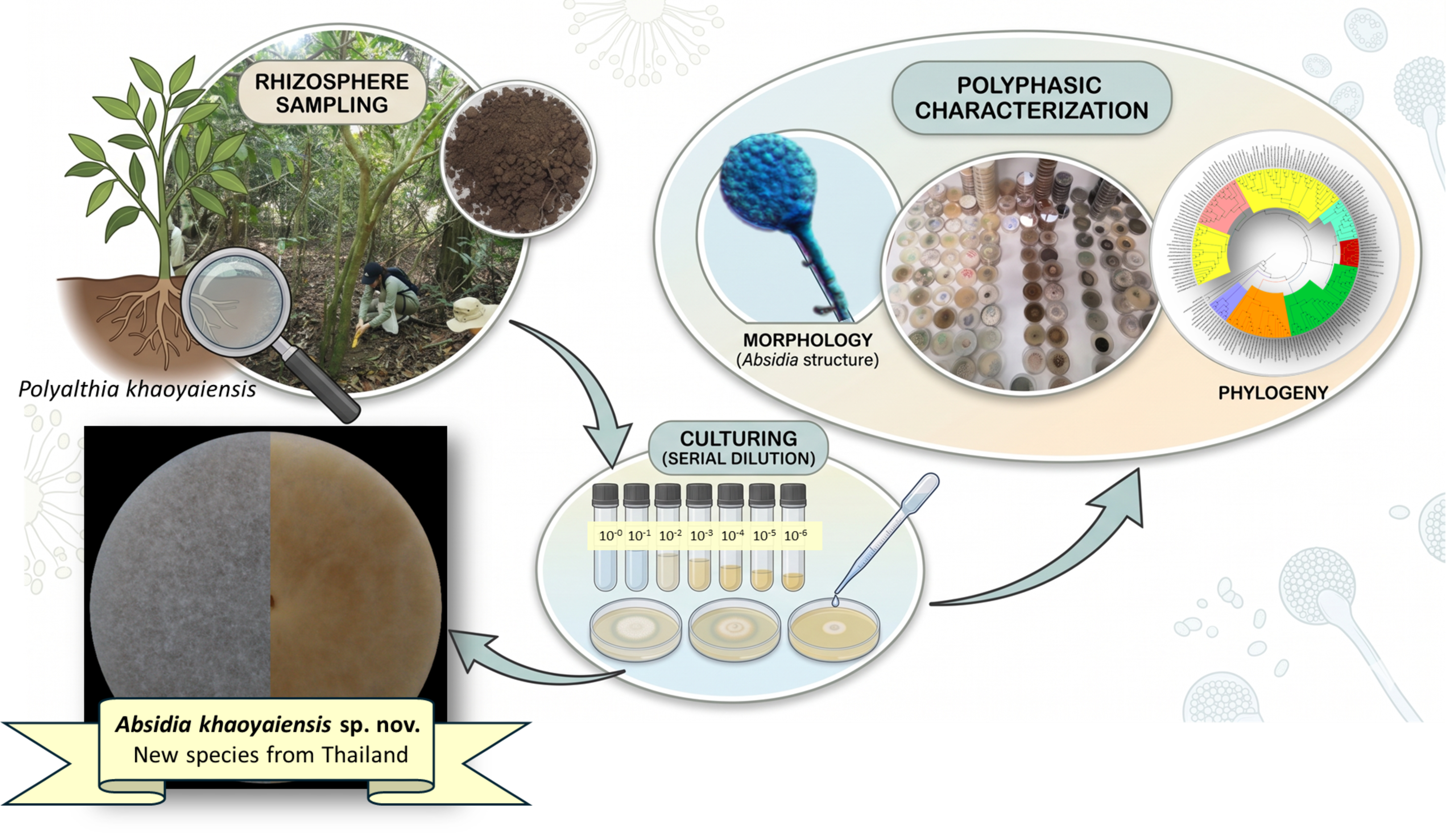
Downloads
References
P Tieghem. Troisième mémoire sur les Mucorinées. Annales des Sciences Naturelles; Botanique 1878; 6(4), 312-399.
XY Ji, ZY Ding, Y Nie, H Zhao, S Wang, B Huang and XY Liu. Unveiling species diversity within early-diverging fungi from China V: Five new species of Absidia (Cunninghamellaceae, Mucoromycota). MycoKeys 2025; 117, 267-288.
H Zhao, Y Nie, T Zong, Y Dai and X Liu. Three new species of Absidia (Mucoromycota) from China based on phylogeny, morphology and physiology. Diversity 2022; 14(2), 132.
SK Lim, K Das, GJ Lim, JS Choi, SY Lee and HY Jung. Molecular identification of a new species of Absidia (Cunninghamellaceae, Mucorales) isolated from soil in Korea. Mycobiology 2024; 52(3), 201-206.
VG Hurdeal, E Gentekaki, HB Lee, R Jeewon, KD Hyde, S Tibpromma, PE Mortimer and J Xu. Mucoralean fungi in Thailand: novel species of Absidia from tropical forest soil. Cryptogamie Mycologie 2021; 42(4), 39-61.
TY Zhang, Y Yu, H Zhu, SZ Yang, TM Zhao, Y Meng and YX Zhang. Absidia panacisoli sp. nov., isolated from rhizosphere of Panax notoginseng. International Journal of Systematic and Evolutionary Microbiology 2018; 68(8), 2468-2472.
K Hoffmann. Identification of the genus Absidia (Mucorales, Zygomycetes): A comprehensive taxonomic revision. In: Y Gherbawy and K Voigt (Eds.). Molecular identification of fungi. Springer, Berlin, Germany, 2010, p. 439-460.
VG Hurdeal, EBG Jones and E Gentekaki. Absidia zygospora (Mucoromycetes), a new species from Nan Province, Thailand. Studies in Fungi 2023; 8(1), 15.
J Kaitera, HM Henttonen and MM Müller. Fungal species associated with butt rot of mature Scots pine and Norway spruce in northern boreal forests of Northern Ostrobothnia and Kainuu in Finland. European Journal of Plant Pathology 2019; 154(3), 541-554.
AS Urquhart and A Idnurm. Absidia healeyae: A new species of Absidia (Mucorales) isolated from Victoria, Australia. Mycoscience 2021; 62(5), 331-335.
YX Wang, ZY Ding, XY Ji, Z Meng and XY Liu. Unveiling species diversity within early-diverging fungi from China VI: Four Absidia sp. nov. (Mucorales) in Guizhou and Hainan. Microorganisms 2025; 13(6), 1315.
H Zhao, Y Nie, TK Zong, K Wang, ML Lv, YJ Cui, A Tohtirjap, JJ Chen, CL Zhao, F Wu and BK Cui. Species diversity, updated classification and divergence times of the phylum Mucoromycota. Fungal Diversity 2023; 123(1), 49-157.
J Park, F Han and IS Lee. Biotransformation of (−)-α-Bisabolol by Absidia coerulea. Molecules 2022; 27(3), 881.
I Benjelloun, D Garon, N Heutte, L Leleyter and F Baraud. A new soil microcosm to evaluate the Cd, Cu and Pb bio-sorption by Absidia cylindrospora. Bioremediation Journal 2022; 26(4), 318-327.
JA Ribes, RK Vanover-Sams and DJ Baker. Zygomycetes in human disease. Clinical Microbiology Reviews 2000; 13(2), 236-301.
A Alastruey-Izquierdo, K Hoffmann, GS de Hoog, JL Rodriguez-Tudela, K Voigt, E Bibashi and G Walther. Species recognition and clinical relevance of the zygomycetous genus Lichtheimia (syn. Absidia pro parte, Mycocladus). Journal of Clinical Microbiology 2010; 48(6), 2154-2170.
B Spellberg, J Edwards Jr and A Ibrahim. Novel perspectives on mucormycosis: pathophysiology, presentation, and management. Clinical Microbiology Reviews 2005; 18(3), 556-569.
WX Liu, F Li, ST Geng, HY Zou, H Zhao and XY Liu. Unveiling species diversity within early-diverging fungi from China XIII: Four new species of Absidia (Cunninghamellaceae, Mucoromycota). Microorganisms 2026; 14(2), 348.
C Luo, F Chen, R Phookamsak, F Sun, J Xu and H Jiang. Polyphasic taxonomic study of Absidia menglianensis sp. nov. (Cunninghamellaceae, Mucorales) isolated from an avocado plantation in Yunnan, China. Studies in Fungi 2024; 9(1), e018.
MF Tao, ZY Ding, YX Wang, ZX Zhang, H Zhao, Z Meng and XY Liu. Unveiling species diversity within early-diverging fungi from China II: Three new species of Absidia (Cunninghamellaceae, Mucoromycota) from Hainan Province. MycoKeys 2024; 110, 255.
ZY Ding, XY Ji, MF Tao, Y Jiang, WX Liu, YX Wang, Z Meng and XY Liu. Unveiling species diversity within early-diverging fungi from China IV: Four new species of Absidia (Cunninghamellaceae, Mucoromycota). Myco-Keys 2025; 119, 29-46.
TTT Nguyen, ALCM de A Santiago, JE Hallsworth, TRL Cordeiro, K Voigt, PM Kirk, PW Crous, MAM Júnior, C Elsztein and HB Lee. New Mucorales from opposite ends of the world. Studies in Mycology 2024; 109(1), 273-321.
A Idnurm. Absidia urquhartii (Mucoromycota) is a new species that is prevalent in Victoria, Australia. Phytotaxa 2025; 687(1), 001-008.
YM Htet, WAE Yasanthika, VG Hurdeal and AR Gomes De Farias. Absidia thailandica sp. nov., an addition to the diversity of soil fungi from Thailand. Phytotaxa 2024; 646(2), 157-168.
A Kornerup and JH Wanscher. Methuen handbook of colour. 2nd ed. Methuen, London, 1978.
K O’Donnell, E Cigelnik, NS Weber and JM Trappe. Phylogenetic relationships among ascomycetous truffles and the true and false morels inferred from 18S and 28S ribosomal DNA sequence analysis. Mycologia 1997; 89, 48-65.
TJ White, T Bruns, S Lee and J Taylor. Amplification and direct sequencing of fungal ribosomal RNA gene for phylogenetics. In: MA Innis, DH Gelfand, JJ Sninsky and TJ White (Eds.). PCR protocol: A guide to methods and applications. Academic Press, Amsterdam, The Netherlands. 1990, p. 315-322.
R Vilgalys and M Hester. Rapid genetic identification and mapping of enzymatically amplified ribosomal DNA from several Cryptococcus species. Journal of Bacteriology 1990; 172(8), 4238-4246.
K Voigt and J Wostemeyer. Reliable amplification of actin genes facilitates deep-level phylogeny. Microbiological Research 2000; 155(3), 179-195.
S Preedanon, A Klaysuban, S Suetrong, O Pracharoen, W Promchoo, T Sangtiean and J Sakayaroj. Morphological, molecular and 3D synchrotron X-ray tomographic characterizations of Helicascus satunensis sp. nov., a novel mangrove fungus. PeerJ 2024; 12, e18341.
TA Hall. BioEdit: A user-friendly biological sequence alignment editor and analysis program for Windows 95/98/NT. Nucleic Acids Symposium Series 1999; 41, 95-98.
A Larsson. AliView: A fast and lightweight alignment viewer and editor for large data sets. Bioinformatics 2014; 30(22), 3276-3278.
A Stamatakis. RAxML version 8: A tool for phylogenetic analysis and post-analysis of large phylogenies. Bioinformatics 2014; 30(9), 1312-1313.
F Ronquist, M Teslenko, P van der Mark, DL Ayres, A Darling, S Höhna, B Larget, L Liu, MA Suchard and JP Huelsenbeck. MrBayes 3.2: Efficient Bayesian phylogenetic inference and model choice across a large model space. Systematic Biology 2012; 61(3), 539-542.
JAA Nylander. MrModeltest v. 2.0. Evolutionary Biology Centre, Uppsala University, Uppsala, Sweden, 2004.
I Letunic and P Bork. Interactive Tree of Life (iTOL) v5: An online tool for phylogenetic tree display and annotation. Nucleic Acids Research 2021; 49(W1), 293-296.
G Walther, J Pawłowska, A Alastruey-Izquierdo, M Wrzosek, JL Rodriguez-Tudela, S Dolatabadi, A Chakrabarti and GS De Hoog. DNA barcoding in Mucorales: An inventory of biodiversity. Persoonia-Molecular Phylogeny and Evolution of Fungi 2013; 30(1), 11-47.
P Panusittikorn and T Prato. Conservation of protected areas in Thailand: the case of Khao Yai National Park. The George Wright Forum 2001; 18, 66-76.
DE Desjardin, T Boonpratuang, P Ruksawong and NL Hywel-Jones. A new species of Incrustocalyptella from Thailand. Fungal Diversity 2000; 4, 75-79.
P Inderbitzin, S Landvik, MA Abdel‐Wahab and ML Berbee. Aliquandostipitaceae, a new family for two new tropical ascomycetes with unusually wide hyphae and dimorphic ascomata. American Journal of Botany 2001; 88(1), 52-61.
C Chuaseeharonnachai, S Somrithipol and N Boonyuen. A new species of Fusticeps from Thailand. Mycosphere 2014; 5(2), 313-317.
S Mongkolsamrit, A Khonsanit, D Thanakitpipattana, K Tasanathai, W Noisripoom, S Lamlertthon, W Himaman, J Houbraken, RA Samson and JJ Luangsa-ard. Revisiting Metarhizium and the description of new species from Thailand. Studies in Mycology 2020; 95(1), 171-251.
K Hoffmann, S Discher and K Voigt. Revision of the genus Absidia (Mucorales, Zygomycetes) based on physiological, phylogenetic, and morphological characters; thermotolerant Absidia spp. form a coherent group, Myocladiaceae fam. nov. Mycological Research 2007; 111(10), 1169-1183.
CW Hesseltine and JJ Ellis. The genus Absidia: Gongronella and cylindrical-spored species of Absidia. Mycologia 1964; 56(4), 568-601.
H Zhao, Y Nie, TK Zong, K Wang, ML Lv, YJ Cui, A Tohtirjap, JJ Chen, CL Zhao, F Wu and BK Cui. Species diversity, updated classification and divergence times of the phylum Mucoromycota. Fungal Diversity 2023; 123, 49-157.
OC Hagem. Untersuchungen über norwegische Mucorineen. I. Skrifter udgivne af Videnskabs-Selskabet i Christiania. Mathematisk-Naturvidenskabelig Klasse 1908; 7, 1-50.
P Bunchalee, P Chantaranothai, DM Johnson and NA Murray. Polyalthia khaoyaiensis (Annonaceae), a new species from Thailand. Phytotaxa 2019; 405(3), 171-179.
S Amma, H Toju, C Wachrinrat, H Sato, AS Tanabe, T Artchawakom and M Kanzaki. Composition and diversity of soil fungi in Dipterocarpaceae-dominated seasonal tropical forests in Thailand. Microbes and Environments 2018; 33(2), 135-143.
DJ Lodge. Nutrient cycling by fungi in wet tropical forests. In: S Isaac, JC Frankland, R Watling and AJS Whalley (Eds.). Aspects of tropical mycology. Cambridge University Press, Cambridge, United States, 1993, p. 37-57.
AE Richardson and RJ Simpson. Soil microorganisms mediating phosphorus availability update on microbial phosphorus. Plant Physiology 2011; 156(3), 989-996.
LJ Yao, J Jalil, A Attiq, CC Hui and NA Zakaria. The medicinal uses, toxicities and anti-inflammatory activity of Polyalthia species (Annonaceae). Journal of Ethnopharmacology 2019; 229, 303-325.
K Nuankaew, K Sotome, S Lumyong and S Boonlue. Trichoderma polyalthiae sp. nov., an endophytic fungus from Polyalthia debilis. Phytotaxa 2018; 371(5), 273-282.
WA Sabry, MF Elsebai, MA Sabry, SH Elsharkawy and AT Khalil. Bioactive natural products from Polyalthia longifolia and its fungal endophyte Alternaria sp. World Journal of Pharmaceutical Sciences 2020; 8(11), 39-46.
Downloads
Published
How to Cite
Issue
Section
License
Copyright (c) 2026 Walailak University

This work is licensed under a Creative Commons Attribution-NonCommercial-NoDerivatives 4.0 International License.





