Swertiamarin Induces Cytotoxicity in KYSE-150 Esophageal Squamous Cell Carcinoma Cells with Potential to Target Multiple Cell Death Pathways
DOI:
https://doi.org/10.48048/tis.2026.13726Keywords:
Swertiamarin, Esophageal squamous cell carcinoma, Cytotoxicity, Selectivity Index, Molecular mechanism, Molecular docking, Multi-death pathway targets, Swertiamarin, Esophageal squamous cell carcinoma, Cytotoxicity, Selectivity index, Molecular mechanism, Molecular docking, Multi-death pathway targetsAbstract
Esophageal squamous cell carcinoma (ESCC) is an aggressive malignancy with poor chemotherapy outcomes, necessitating safer and more effective anticancer agents. Swertiamarin (STM), a natural compound, demonstrates anticancer potential, but its cytotoxicity and associated molecular mechanisms in ESCC remain unclear. To evaluate STM’s drug-likeness, cytotoxicity, and molecular mechanisms in ESCC using in vitro and in silico approaches. STM's physicochemical properties, pharmacokinetics, and toxicity profile were predicted via SwissADME and ProTox 3.0. Cytotoxicity was assessed by MTT assay in ESCC KYSE-150 cells and 2 normal cell lines (HET-1A and Vero), alongside cisplatin and 5-fluorouracil (5-FU) as controls. Molecular docking was used to predict STM's binding affinities with proteins involved in apoptosis, necroptosis, ferroptosis, and pyroptosis. STM showed a favorable drug-likeness and predicted class 4 toxicity. It exhibited the concentration-dependent cytotoxicity with half-maximal inhibitory concentration (IC50) values of 43.75 µM (KYSE-150 cells), 190 µM (HET-1A cells), and 41.61 µM (Vero cells), causing selectivity indices (SI) of 4.343 (HET-1A/KYSE-150) and 0.951 (Vero/KYSE-150), outperforming cisplatin (SI = 0.668). Docking revealed strong binding to key proteins, notably pro-apoptotic APAF-1 (−12.3 kcal/mol), anti-ferroptotic FSP1 (−12.1 kcal/mol), anti-apoptotic Hsp70 (−11 kcal/mol), and necroptotic MLKL (−10.8 kcal/mol). Detailed topological analysis with APAF-1 and FSP1 confirmed stable interactions via hydrogen and hydrophobic bonds. STM demonstrates promising cytotoxicity and selectivity against KYSE-150 cells and targets multiple cell death pathways, supporting its potential as a candidate for ESCC chemotherapy and deserve further preclinical investigations.
HIGHLIGHTS
- Swertiamarin is identified as a potent therapeutic agent for esophageal squamous cell carcinoma.
- Swertiamarin showed superior selectivity toward cancer cells over healthy cells.
- Wide therapeutic margin of swertiamarin supported by a high selectivity index of 4.34.
- Swertiamarin predicted to target APAF-1, FSP1, Hsp70, and MLKL proteins to achieve cancer cell death.
- Swertiamarin potentially induce multiple cell death pathways underlying its cytotoxicity in ESCC cells.
GRAPHICAL ABSTRACT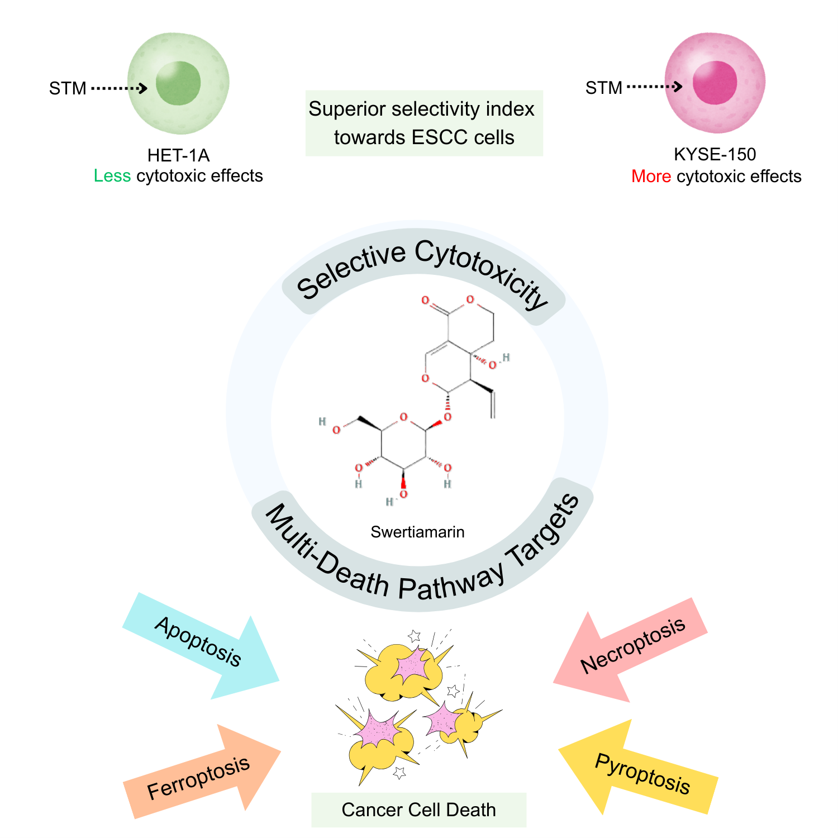
Downloads
References
F Bray, M Laversanne, H Sung, J Ferlay, RL Siegel, I Soerjomataram and A Jemal. Global cancer statistics 2022: GLOBOCAN estimates of incidence and mortality worldwide for 36 cancers in 185 countries. CA: A Cancer Journal for Clinicians 2024; 74(3), 229-263.
CQ Liu, YL Ma, Q Qin, PH Wang, Y Luo, PF Xu and Y Cui. Epidemiology of esophageal cancer in 2020 and projections to 2030 and 2040. Thoracic Cancer 2023; 14(1), 3-11.
G Abbas and M Krasna. Overview of esophageal cancer. Annals of Cardiothoracic Surgery 2017; 6(2), 131.
Z Fang, T Xia, S Pan, C Xu, S Ju, Z Shen and J Zhao. Esophageal carcinosarcoma comprising undifferentiated pleomorphic sarcoma and squamous cell carcinoma: A case report. Journal of Cardiothoracic Surgery 2022; 17(1), 210.
A Ji, R Jin, R Zhang and H Li. Primary small cell carcinoma of the esophagus: Progression in the last decade. Annals of Translational Medicine 2020; 8(7), 502.
J Qu, Y Zhuang, D Zheng, F Huang and S Zhang. Primary esophageal lymphoma: Clinical experience in diagnosis and treatment. Cureus 2021; 13(9), e17628.
E Morgan, I Soerjomataram, H Rumgay, HG Coleman, AP Thrift, J Vignat, M Laversanne, J Ferlay and M Arnold. The global landscape of esophageal squamous cell carcinoma and esophageal adenocarcinoma incidence and mortality in 2020 and projections to 2040: New estimates from GLOBOCAN 2020. Gastroenterology 2022; 163(3), 649-658.
G Businello, P Parente, L Mastracci, G Pennelli, G Traverso, M Milione, E Milione, M Michelotto, A Kotsafti, F Grillo and M Fassan. The pathologic and molecular landscape of esophageal squamous cell carcinogenesis. Cancers 2020; 12(8), 2160.
M Sheikh, H Poustchi, A Pourshams, A Etemadi, F Islami, M Khoshnia, A Gharavi, M Hashemian, G Roshandel, H Khademi, M Zahedi, B Abedi-Ardekani, P Boffetta, F Kamangar, SM Dawsey, PD Pharaoh, CC Abnet, NE Day, P Brennan and R Malekzadeh. Individual and combined effects of environmental risk factors for esophageal cancer based on results from the Golestan cohort study. Gastroenterology 2019; 156(5), 1416-1427.
H Simba, H Kuivaniemi, CC Abnet, G Tromp and V Sewram. Environmental and life-style risk factors for esophageal squamous cell carcinoma in Africa: A systematic review and meta-analysis. BMC Public Health 2023; 23(1), 1782.
L Wang, YM Jia, J Zuo, YD Wang, ZS Fan, L Feng, X Zhang, J Han, WJ Lyu and ZY Ni. Gene mutations of esophageal squamous cell carcinoma based on next-generation sequencing. Chinese Medical Journal 2021; 134(6), 708-715.
C Weidenbaum and MK Gibson. Approach to localized squamous cell cancer of the esophagus. Current Treatment Options in Oncology 2022; 23(10), 1370-1387.
N Jiang, XL Ge, ZY Zhang, J Liu, PP Wang, XC Sun and M Yang. Prognostic factors for patients with esophageal cancer receiving definitive radiotherapy alone: A retrospective analysis. Cancer Management and Research 2021; 13, 3229-3234.
HC Puhr, GW Prager and A Ilhan-Mutlu. How we treat esophageal squamous cell carcinoma. ESMO Open 2023; 8(1), 100789.
MC da Silva, LC Fabiano, KC da Costa Salomão, PLZ de Freitas, CQ Neves, SC Borges, MDG de Souza Carvalho, AC Breithaupt-Faloppa, AA de Thomaz, AM Dos Santos and NC Buttow. A rodent model of human-dose-equivalent 5-fluorouracil: Toxicity in the liver, kidneys, and lungs. Antioxidants 2023; 12(5), 1005.
EA Elmorsy, S Saber, RS Hamad, MA Abdel-Reheim, AF El-kott, MA AlShehri, K Morsy, SA Salama and ME Youssef. Advances in understanding cisplatin-induced toxicity: Molecular mechanisms and protective strategies. European Journal of Pharmaceutical Sciences 2024; 203, 106939.
N Jose, A Joel, RJ Selvakumar, J Ramireddy, AO John, JT Georgy, A Singh and TS Ram. Diagnosis and management of 5-fluorouracil (5-fu)-induced acute leukoencephalopathy: Lessons learnt from a single-centre case series. Journal of the Egyptian National Cancer Institute 2022; 34(1), 22.
S Shruthi and K Bhasker Shenoy. Cisplatin resistance in cancer therapy: Causes and overcoming strategies. ChemistrySelect 2024; 9(25), e202401449.
Y Lugones, P Loren and LA Salazar. Cisplatin resistance: Genetic and epigenetic factors involved. Biomolecules 2022; 12(10), 1365.
J Wonglhow, P Wetwittayakhlang, P Sunpaweravong, C Sathitruangsak and A Dechaphunkul. Comparing the efficacy of carboplatin plus 5-fluorouracil, cisplatin plus 5-fluorouracil, and best supportive care for advanced esophageal squamous cell carcinoma: A propensity score analysis from a tertiary hospital in Southern Thailand. Journal of Clinical Medicine 2024; 13(6), 1735.
NS Muhamad Fadzil, M Sekar, SH Gan, SR Bonam, YS Wu, J Vaijanathappa, S Ravi, PT Lum and SB Dhadde. Chemistry, pharmacology and therapeutic potential of swertiamarin - a promising natural lead for new drug discovery and development. Drug Design, Development and Therapy 2021; 15, 2721-2746.
X Wang and T Wang. Swertiamarin exerts anticancer effects on human cervical cancer cells via induction of apoptosis, inhibition of cell migration and targeting of MEK-ERK pathway. Tropical Journal of Pharmaceutical Research 2021; 20(1), 75-81.
J Wu, Y Li, X Li and T Wu. Swertiamarin attenuates paraquat-induced pulmonary epithelial-like cell apoptosis via NOX4-mediated regulation of redox and mitochondrial function. Brazilian Journal of Pharmaceutical Sciences 2023; 59, e22476.
S Xiao, H Tang, Y Bai, R Zou, Z Ren, X Wu, Z Shi, S Lan, W Liu, T Wu, C Zhang and L Wang. Swertiamarin suppresses proliferation, migration, and invasion of hepatocellular carcinoma cells via negative regulation of FRAT1. European Journal of Histochemistry 2020; 64(4), 3169.
L Li, S Xiao, X Dai, Z Tang, Y Wang, M Ali, FS Ataya, I Sahar, M Iqbal, Y Wu and K Li. Multi-omics analysis and the remedial effects of swertiamarin on hepatic injuries caused by CCl4. Ecotoxicology and Environmental Safety 2024; 282, 116734.
Q Zhang, K Chen, T Wu and H Song. Swertiamarin ameliorates carbon tetrachloride-induced hepatic apoptosis via blocking the PI3K/Akt pathway in rats. The Korean Journal of Physiology & Pharmacology 2019; 23(1), 21-28.
Y Zhu, H Li, M Ma, D Li, O Zhang, S Cai, Y Wang, D Chen, S Jin, C Ding and L Xu. Swertiamarin ameliorates diet-induced obesity by promoting adipose tissue browning and oxidative metabolism in preexisting obese mice. Acta Biochimica et Biophysica Sinica 2022; 55(1), 131-142.
HX Yang, YY Hu, R Liang, H Zheng and X Zhang. Progress in pharmacokinetics, pharmacological effects, and molecular mechanisms of swertiamarin: A comprehensive review. Cells 2025; 14(15), 1173.
EF Pettersen, TD Goddard, CC Huang, GS Couch, DM Greenblatt, EC Meng and TE Ferrin. UCSF Chimera-A visualization system for exploratory research and analysis. Journal of Computational Chemistry 2004; 25(13), 1605-1612.
BIOVIA, Dassault systems, Available at: https://www.3ds.com/products/biovia/all-products, accessed July 2025.
H Tang, Y Ke, Z Ren, X Lei, S Xiao, T Bao, Z Shi, R Zou, T Wu, J Zhou, CA Geng, L Wang and J Chen. Bioinformatics analysis of differentially expressed genes in hepatocellular carcinoma cells exposed to Swertiamarin. Journal of Cancer 2019; 10(26), 6526-6534.
L Deng, X Wu, X Zhu, Z Yu, Z Liu, J Wang and Y Zheng. Combination effect of curcumin with docetaxel on the PI3K/AKT/mTOR pathway to induce autophagy and apoptosis in esophageal squamous cell carcinoma. American Journal of Translational Research 2021; 13(1), 57-72.
C Fang, L Wu, X Yang, K Xie, P Zhang, Y Feng, H Ma and X Tong. Decursin suppresses esophageal squamous cell carcinoma progression via orchestrated cell cycle deceleration, apoptotic activation, and oncoprotein degradation. International Journal of Molecular Sciences 2025; 26(11), 5391.
S Jiang, Y Qiu, Z Wang, Y Ji, X Zhang, X Yan and Z Zhan. Carnosic acid induces antiproliferation and anti‐metastatic property of esophageal cancer cells via MAPK signaling pathways. Journal of Oncology 2021; 2021, 4451533.
Y Cui, W Huang, F Du, X Yin, L Feng and B Li. Therapeutic benefits of niraparib tosylate as radio sensitizer in esophageal squamous cell carcinoma: An in vivo and in vitro preclinical study. Clinical and Translational Oncology 2022; 24, 1643-1656.
T Minegaki, K Takara, R Hamaguchi, M Tsujimoto and K Nishiguchi. Factors affecting the sensitivity of human-derived esophageal carcinoma cell lines to 5-fluorouracil and cisplatin. Oncology Letters 2013; 5(2), 427-434.
F Xue, H Yang, P Xu, S Zhang, N Britzen-Laurent, LL Bao, R Grützmann, C Krautz and C Pilarsky. CRISPR/Cas9 Screening Highlights PFKFB3 Gene as a Major Contributor to 5-Fluorouracil Resistance in Esophageal Cancer. Cancers 2025; 17(10), 1637.
C Zhang, CL Luo, GS Shang, DX Jiang and Q Song. Galangin enhances anticancer efficacy of 5-fluorouracil in esophageal cancer cells and xenografts through NLR family pyrin domain containing 3 (NLRP3) downregulation. Medical Science Monitor: International Medical Journal of Experimental and Clinical Research 2021; 27, e931630-1.
DS Mahdi, RH Al Mosawi and KN Madlum. Evaluation of the effect of valproic acid on 5-fluorouracil cytotoxicity on colon cancer cells. An in vitro study. Medical Journal of Ahl al-Bayt University 2024; 3(1), 140-153.
M Capula, C Corno, B El Hassouni, G Li Petri, S Aranđelović and EORTC PAMM Group. A brief guide to performing pharmacological studies in vitro: Reflections from the EORTC-PAMM course “Preclinical and Early-phase Clinical Pharmacology.” Anticancer Research 2019; 39(7), 3413-3418.
A Moldasheva, L Bakyt, D Bulanin and M Aljofan. The impact of cellular environment on in vitro drug screening. Future Science OA 2023; 9(9), FSO900.
CP Segeritz and L Vallier. Cell culture: Growing cells as model systems in vitro. In: M Jalali, FYL Saldanha and M Jalali (Eds.). Basic science methods for clinical researchers. Academic Press, San Diego, United States, 2017, p. 151-172.
S Weiskirchen, SK Schröder, EM Buhl and R Weiskirchen. A beginner’s guide to cell culture: Practical advice for preventing needless problems. Cells 2023; 12(5), 682.
YS Wu, NS Rahim, A Stephen, SM Shin, NM Hashim, SCB Gopinath and HA Mahendran. Downregulation of transmembrane 4 superfamily 1 gene expression inhibits esophageal squamous cell carcinoma cell viability and Cisplatin resistance and regulates microRNA expression. Medical Journal of Malaysia 2024; 79, 27.
M Muralisankar, JR Chen, J Haribabu and SC Ke. Effective and selective Ru(II)-arene complexes containing 4,4′-substituted 2,2′-bipyridine ligands targeting human urinary bladder cancer cells. International Journal of Molecular Sciences 2023; 24(15), 11896.
C Zhang, C Xu, X Gao and Q Yao. Platinum-based drugs for cancer therapy and anti-tumor strategies. Theranostics 2022; 12(5), 2115-2132.
J Lee, JL Beers, RM Geffert and KD Jackson. A review of CYP-mediated drug interactions: Mechanisms and in vitro drug-drug interaction assessment. Biomolecules 2024; 14(1), 99.
TK Karami, S Hailu, S Feng, R Graham and HJ Gukasyan. Eyes on Lipinski’s rule of five: A new “rule of thumb” for physicochemical design space of ophthalmic drugs. Journal of Ocular Pharmacology and Therapeutics 2022; 38(1), 43-55.
S Bashiardes and C Christodoulou. Orally administered drugs and their complicated relationship with our gastrointestinal tract. Microorganisms 2024; 12(2), 242.
CA Lipinski, F Lombardo, BW Dominy and PJ Feeney. Experimental and computational approaches to estimate solubility and permeability in drug discovery and development settings. Advanced Drug Delivery Reviews 2001; 46(1-3), 3-26.
DF Veber, SR Johnson, HY Cheng, BR Smith, KW Ward and KD Kopple. Molecular properties that influence the oral bioavailability of drug candidates. Journal of Medicinal Chemistry 2002; 45(12), 2615-2623.
WJ Egan, KM Merz and JJ Baldwin. Prediction of drug absorption using multivariate statistics. Journal of Medicinal Chemistry 2000; 43(21), 3867-3877.
I Muegge, SL Heald and D Brittelli. Simple selection criteria for drug-like chemical matter. Journal of Medicinal Chemistry 2001; 44(12), 1841-1846.
O Afzal, ASA Altamimi, MS Nadeem, SI Alzarea, WH Almalki, A Tariq, B Mubeen, BN Murtaza, S Iftikhar, N Riaz and I Kazmi. Nanoparticles in drug delivery: From history to therapeutic applications. Nanomaterials 2022; 12(24), 4494.
TC Ezike, US Okpala, UL Onoja, PC Nwike, EC Ezeako, JO Okpara, CC Okoroafor, SC Eze, OL Kalu, EC Odoh, U Nwadike, JO Ogbodo, BU Umeh, EC Ossai and BC Nwanguma. Advances in drug delivery systems, challenges and future directions. Heliyon 2023; 9(6), e17488.
F Laffleur, G Millotti and J Lagast. An overview of oral bioavailability enhancement through self-emulsifying drug delivery systems. Expert Opinion on Drug Delivery 2025; 22(5), 659-671.
C Winder, R Azzi and D Wagner. The development of the globally harmonized system (GHS) of classification and labelling of hazardous chemicals. Journal of Hazardous Materials 2005; 125(1-3), 29-44.
TA Loomis and AW Hayes. Toxicologic testing methods. In: AW Hayes and TA Loomis (Eds.). Loomis’s essentials of toxicology. 4th ed. Academic Press, San Diego, United States, 1996, p. 205-248.
F Rivero-Pino, MC Millan-Linares and S Montserrat-de-la-Paz. Strengths and limitations of in silico tools to assess physicochemical properties, bioactivity, and bioavailability of food-derived peptides. Trends in Food Science & Technology 2023; 138, 433-440.
P Banerjee, E Kemmler, M Dunkel and R Preissner. ProTox 3.0: A webserver for the prediction of toxicity of chemicals. Nucleic Acids Res 2024; 52(W1), W513-W520.
A Daina, O Michielin and V Zoete. SwissADME: A free web tool to evaluate pharmacokinetics, drug-likeness and medicinal chemistry friendliness of small molecules. Scientific Reports 2017; 7(1), 42717.
J Lica, M Wieczór, GJ Grabe, MW Jancz, M Misiak, K Gucwa, W Brankiewicz, N Maciejewska, A Stupak, M Baginski, K Rolka, A Hellmann and AC Skladanowski. Effective drug concentration and selectivity depends on fraction of primitive cells. International Journal of Molecular Sciences 2021; 22(9), 4931.
MA Mahmood, AH Abd and EJ Kadhim. Assessing the cytotoxicity of phenolic and terpene fractions extracted from Iraqi Prunus arabica against AMJ13 and SK-GT-4 human cancer cell lines. F1000Research 2024; 12, 433.
MJ Goldstein, M Peters, BL Weber and CB Davis. Optimizing the Therapeutic Window of Targeted Drugs in Oncology: Potency‐Guided First‐in‐Human Studies. Clinical and Translational Science 2021; 14(2), 536-543.
Z Yang, R Ma, J Li and L Zhao. Noncoding RNAs in esophageal cancer: A glimpse into implications for therapy resistance. Pharmacological Research 2023; 188, 106678.
S Ghafouri-Fard, A Abak, F Tondro Anamag, H Shoorei, F Fattahi, SA Javadinia, A Basiri and M Taheri. 5-Fluorouracil: A narrative review on the role of regulatory mechanisms in driving resistance to this chemotherapeutic agent. Frontiers in Oncology 2021; 11, 658636.
M Barathan, AK Zulpa, SL Ng, Y Lokanathan, MH Ng and JX Law. Innovative strategies to combat 5-Fluorouracil resistance in colorectal cancer: The role of phytochemicals and extracellular vesicles. International Journal of Molecular Sciences 2024; 25(13), 7470.
A Dutta, A Chakraborty, T Ghosh and A Kumar. 5-Fluorouracil induces apoptosis in nutritional deprived hepatocellular carcinoma through mitochondrial damage. Scientific Reports 2024; 14(1), 23387.
F Ramos-Martin and N D’Amelio. Drug Resistance: An Incessant Fight against Evolutionary Strategies of Survival. Microbiology Research 2023; 14(2), 507-542.
O Morana, W Wood and CD Gregory. The apoptosis paradox in cancer. International Journal of Molecular Sciences 2022; 23(3), 1328.
M Mustafa, R Ahmad, IQ Tantry, W Ahmad, S Siddiqui, M Alam, K Abbas, Moinuddin, MI Hassan, S Habib and S Islam. Apoptosis: A comprehensive overview of signaling pathways, morphological changes, and physiological significance and therapeutic implications. Cells 2024; 13(22), 1838.
KD Kaloni, ST Diepstraten, A Strasser and GL Kelly. BCL-2 protein family: Attractive targets for cancer therapy. Apoptosis 2023; 28(1), 20-38.
C Hu, J Yang, Z Qi, H Wu, B Wang, F Zou, H Mei, J Liu, W Wang and Q Liu. Heat shock proteins: Biological functions, pathological roles, and therapeutic opportunities. MedComm 2022; 3(3), e161.
J Ruan, X Wei, S Li, Z Ye, L Hu, R Zhuang, Y Cao, S Wang, S Wu, D Peng, S Chen, S Yuan and A Xu. Apaf-1 is an evolutionarily conserved DNA sensor that switches the cell fate between apoptosis and inflammation. Cell Discovery 2025; 11(1), 4.
G Sahoo, D Samal, P Khandayataray and MK Murthy. A review on caspases: Key regulators of biological activities and apoptosis. Molecular Neurobiology 2023; 60(10), 5805-5837.
J Li, F Cao, H Yin, Z Huang, Z Lin, N Mao, B Sun and G Wang. Ferroptosis: Past, present and future. Cell Death & Disease 2020; 11(2), 88.
TN Xavier da Silva, C Schulte, AN Alves, HM Maric and JP Friedmann Angeli. Molecular characterization of AIFM2/FSP1 inhibition by iFSP1-like molecules. Cell Death & Disease 2023; 14(4), 281.
X Liu, X Xie, Y Ren, Z Shao, N Zhang, L Li, X Ding and L Zhang. The role of necroptosis in disease and treatment. MedComm 2021; 2(4), 730-755.
YK Dhuriya and D Sharma. Necroptosis: A regulated inflammatory mode of cell death. Journal of Neuroinflammation 2018; 15(1), 199.
Z Rao, Y Zhu, P Yang, Z Chen, Y Xia, C Qiao, W Liu, H Deng, J Li, P Ning and Z Wang. Pyroptosis in inflammatory diseases and cancer. Theranostics 2022; 12(9), 4310-4329.
P Broz. Pyroptosis: Molecular mechanisms and roles in disease. Cell Research 2025; 35(5), 334-344..
R Loveless, R Bloomquist and Y Teng. Pyroptosis at the forefront of anticancer immunity. Journal of Experimental & Clinical Cancer Research 2021; 40(1), 264.
HA Odhar, AF Hashim and SS Humad. Molecular docking analysis and dynamics simulation of salbutamol with the monoamine oxidase B (MAO-B) enzyme. Bioinformation 2022; 18(3), 304-309.
MP Mayer and LM Gierasch. Recent advances in the structural and mechanistic aspects of Hsp70 molecular chaperones. The Journal of Biological Chemistry 2019; 294(6), 2085-2097.
MK Singh, S Han, S Ju, JS Ranbhise, J Ha, SG Yeo, SS Kim and I Kang. Hsp70: A Multifunctional Chaperone in Maintaining Proteostasis and Its Implications in Human Disease. Cells 2025; 14(7), 509.
Y Wang, Z Teng, H Li, W Wang, F Xu, K Sun, J Chu, Y Qian, GJ Loake, C Chu and J Tang. An activated form of NB-ARC protein RLS1 functions with cysteine-rich receptor-like protein RMC to trigger cell death in rice. Plant Communications 2023; 4(2), 100459.
G van Ooijen, G Mayr, MMA Kasiem, M Albrecht, BJC Cornelissen and FLW Takken. Structure-function analysis of the NB-ARC domain of plant disease resistance proteins. Journal of Experimental Botany 2008; 59(6), 1383-1397.
N Maruta, H Burdett, B Lim, X Hu, S Desa, MK Manik and B Kobe. Structural basis of NLR activation and innate immune signalling in plants. Immunogenetics 2022; 74(1), 5-26.
WIL Tameling, JH Vossen, M Albrecht, T Lengauer, JA Berden, MA Haring, BJC Cornelissen and FLW Takken. Mutations in the NB-ARC domain of I-2 that impair ATP hydrolysis cause autoactivation. Plant Physiology 2006; 140(4), 1233-1245.
W Li, L Liang, S Liu, H Yi and Y Zhou. FSP1: A key regulator of ferroptosis. Trends in Molecular Medicine 2023; 29(9), 753-764.
J Lee and JL Roh. Unleashing ferroptosis in human cancers: Targeting ferroptosis suppressor protein 1 for overcoming therapy resistance. Antioxidants 2023; 12(6), 1218.
S Feng, X Huang, D Tang, X Liu, L Ouyang, D Yang, K Wang, B Liao and S Qi. The crystal structure of human ferroptosis suppressive protein 1 in complex with flavin adenine dinucleotide and nicotinamide adenine nucleotide. MedComm 2024; 5(3), e479.
Z Jin, Q Zhang, Y Pan, H Chen, K Zhou, H Cai and P Huang. Roles and prospective applications of ferroptosis suppressor protein 1 (FSP1) in malignant tumor treatment. Current Oncology 2025; 32(8), 456.
Y Liu, L Si, Y Jiang, S Jiang, X Zhang, S Li, J Chen and J Hu. Design of pH-responsive nanomaterials based on the tumor microenvironment. International Journal of Nanomedicine 025; 20(0), 705-721.
Faridoon, R Ng, G Zhang and JJ Li. An update on the discovery and development of reversible covalent inhibitors. Medicinal Chemistry Research 2023; 32(6), 1039-1062.
DS Johnson, E Weerapana and BF Cravatt. Strategies for discovering and derisking covalent, irreversible enzyme inhibitors. Future Medicinal Chemistry 2010; 2(6), 949-964.
B Lubinski and GR Whittaker. Host cell proteases involved in human respiratory viral infections and their inhibitors: A review. Viruses 2024; 16(6), 984.
KK Kumaree, NVA Anthikapalli and A Prasansuklab. In silico screening for potential inhibitors from the phytocompounds of Carica papaya against Zika virus NS5 protein. F1000Research 2024; 12, 655.
R Kurczab, P Śliwa, K Rataj, R Kafel and AJ Bojarski. Salt bridge in ligand-protein complexes - systematic theoretical and statistical investigations. Journal of Chemical Information and Modeling 2018; 58(11), 2224-2238.
K Mierzejewska, M Bochtler and H Czapinska. On the role of steric clashes in methylation control of restriction endonuclease activity. Nucleic Acids Research 2016; 44(1), 485-495.
P Garg, J Malhotra, P Kulkarni, D Horne, R Salgia and SS Singhal. Emerging therapeutic strategies to overcome drug resistance in cancer cells. Cancers 2024; 16(13), 2478.
Downloads
Published
How to Cite
Issue
Section
License
Copyright (c) 2026 Walailak University

This work is licensed under a Creative Commons Attribution-NonCommercial-NoDerivatives 4.0 International License.