
Structure–Activity Relationship of Magnesium Tin Fluoride Catalysts (MSF) with Varying Sn Doping Levels in the Reduction of p-Nitrophenol (PNP) to p Aminophenol (PAP)
DOI:
https://doi.org/10.48048/tis.2026.13670Keywords:
Magnesium Tin Fluoride, Sol-gel synthesis, P-nitrophenol reduction, Sn doping, Structure–activity relationshipAbstract
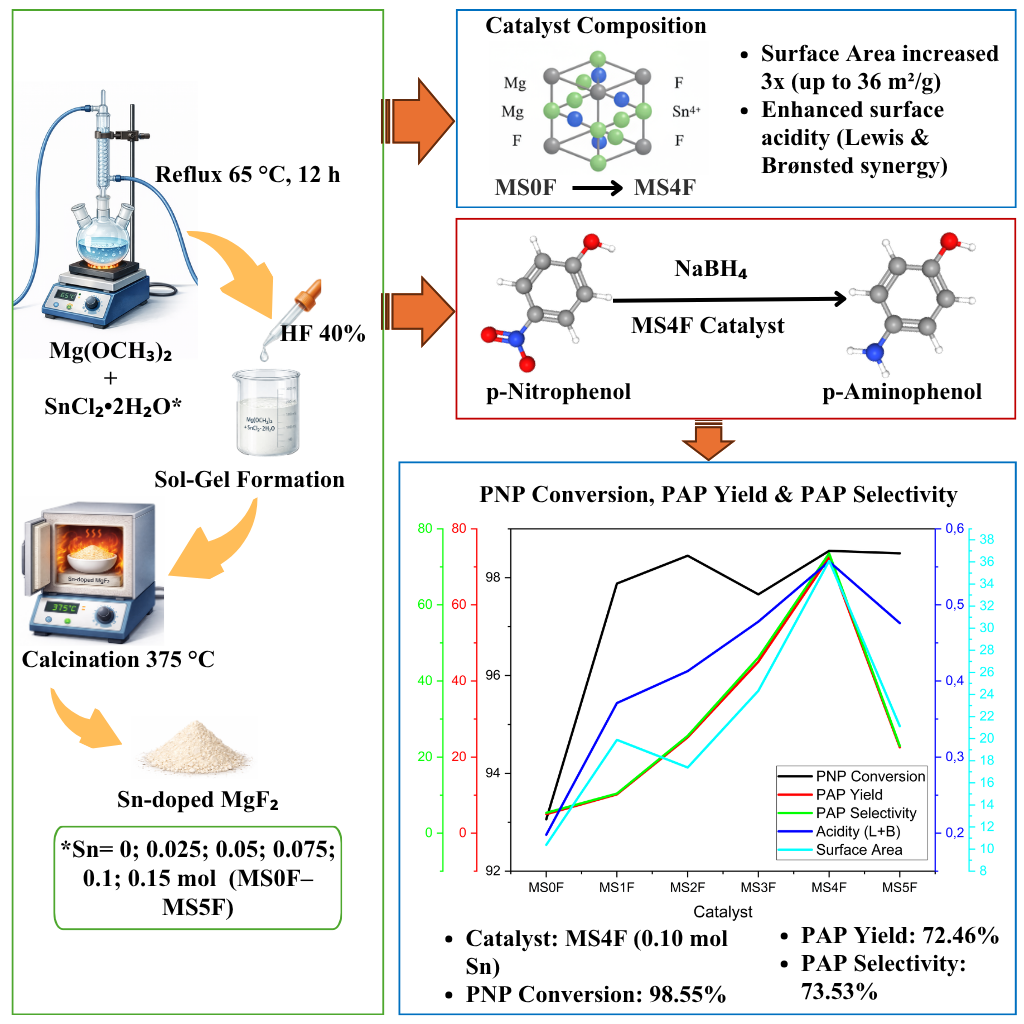
The catalytic reduction of toxic p-nitrophenol (PNP) into industrially valuable p-aminophenol (PAP) requires efficient, non-noble metal catalysts to ensure sustainability and cost-effectiveness. In this study, Magnesium Tin Fluoride (MSF) catalysts were synthesized via a fluorolytic sol-gel method using magnesium methoxide and tin(II) chloride dihydrate as precursors to ensure high phase purity and minimize residual anion interference. The effects of varying Sn doping levels (0 to 0.150 mol) on the physicochemical properties were systematically investigated using XRD, FTIR, BET, and SEM-EDX. XRD analysis confirmed the retention of the tetragonal MgF₂ structure (JCPDS No. 70-2269), while subtle shifts in diffraction peaks indicated the successful incorporation of Sn⁴⁺ into the MgF₂ lattice. Nitrogen adsorption-desorption revealed that Sn doping significantly enhanced the specific surface area, peaking at 36.096 m²/g for the MS4F sample (0.10 mol Sn), compared to only 10.391 m²/g for the undoped MS0F. Catalytic testing showed that MS4F achieved an optimal PNP conversion of 98.55% and a PAP yield of 72.46%. The enhanced performance is attributed to the synergistic effect of increased surface area and optimized Brønsted acidity provided by hydroxyl groups, which facilitate electron transfer during the reduction process. However, excessive doping (MS5F) led to particle agglomeration and a subsequent decline in catalytic efficiency. This study establishes a clear structure–activity relationship, demonstrating that precise control of Sn concentration is vital for tailoring the structural integrity and reactivity of fluoride-based catalysts.
HIGHLIGHTS
Highlights
- High-purity Magnesium Tin Fluoride (MSF) catalysts were successfully developed via a strategic sol-gel method using magnesium methoxide precursors to ensure phase purity and minimize ionic interference.
- Systematic Sn-doping (0 - 0.150 mol) effectively tailored the catalyst's physicochemical properties, tripling the specific surface area from 10.391 to 36.096 m²/g.
- The MS4F catalyst (0.10 mol Sn) achieved a rem2arkable 98.55% conversion of toxic p-nitrophenol (PNP) and a 72.46% yield of industrially valuable p-aminophenol (PAP).
- This study establishes a clear correlation between dopant concentration, surface acidity (Lewis and Brønsted), and reactivity, providing critical insights into the synergy required for efficient electron transfer.
- These findings highlight the potential of non-noble metal fluoride catalysts as cost-effective and robust alternatives for green chemical synthesis and environmental remediation.
GRAPHICAL ABSTRACT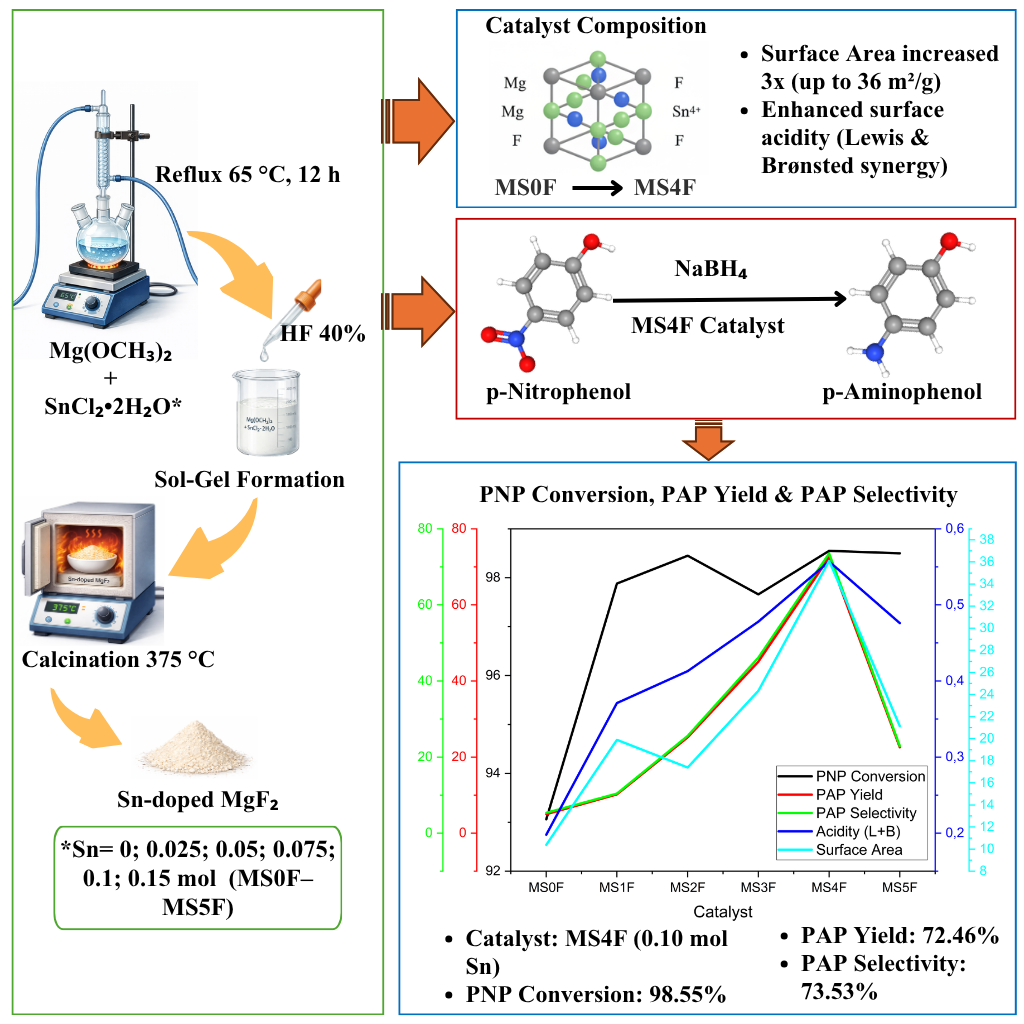
Downloads
References
M Soto-Hernandez, M Palma-Tenango and R Garcia-Mateos. Phenolic compounds - Natural sources, importance and applications. IntechOpen, London, 2017.
M Qian, Y Zhang, Y Bian, X Feng and Z Zhang. Nitrophenols in the environment: An update on pretreatment and analysis techniques since 2017. Ecotoxicology and Environmental Safety 2024; 281, 116611.
A Farajollahi and AP Marjani. A practical approach for reduction 4-nitrophenol to 4-aminophenol using CoMnaOb (a = 2, and b = 4)/MWCNT nanocatalyst. Journal of Alloys and Compounds 2024; 988, 174240.
H Badamasi, Z Naeem, G Antoniolli, AP Kumar, AA Olaleye, IS Sadiq, NI Durimin-Iya and MS Khan. A review of recent advances in green and sustainable technologies for removing 4-nitrophenol from the water and wastewater. Sustainable Chemistry and Pharmacy 2025; 43, 101867.
JL Chen, JY Hu, QF Wang, P Ge, QH Wang and ZS Lou. Multistep synthesis of paracetamol in continuous flow. Pharmaceutical Fronts 2023; 05(3), e161-e167.
S Gu, S Wunder, Y Lu, M Ballauff, R Fenger, K Rademann, B Jaquet and A Zaccone. Kinetic analysis of the catalytic reduction of 4-Nitrophenol by metallic nanoparticles. The Journal of Physical Chemistry C 2014; 118(32), 18618-18625.
E Kemnitz. Nanoscale metal fluorides: A new class of heterogeneous catalysts. Catalysis Science & Technology 2015; 5(2), 786-806.
T Krahl and E Kemnitz. Aluminium fluoride – the strongest solid Lewis acid: Structure and reactivity. Catalysis Science & Technology 2017; 7(4), 773-796.
D Gao, X Wu, P Wang, Y Xu, H Yu and J Yu. Simultaneous realization of direct photoinduced deposition and improved H2-evolution performance of Sn-nanoparticle-modified TiO2 photocatalyst. ACS Sustainable Chemistry & Engineering 2019; 7(11), 10084-10094.
J Lee, A Kumar, MG Kim, T Yang, X Shao, X Liu, Yang Liu, Y Hong, AR Jadhav, M Liang, NQ Tran and H Lee. Single-metal-atom dopants increase the lewis acidity of metal oxides and promote nitrogen fixation. ACS Energy Letters 2021; 6(12), 4299-4308.
B Wu, Y Cao, X Yin, X Dai, Y Tian, Y Gan, Y Ye, R Cai and X Zhang. Sn-doping facilitating electronic modulation and surface reconstruction of 3D hierarchical nanoflowers assembled by Fe(PO3)2/Ni2P nanosheets to trigger oxidation evolution reaction. Journal of Alloys and Compounds 2023; 966, 171639.
K Scheurell and E Kemnitz. Fluorolytic Sol-gel synthesis of nanometal fluorides: Accessing new materials for optical applications. Inorganics 2018; 6(4), 128.
C Perego and P Villa. Catalyst preparation methods. Catalysis Today 1997; 34(3-4), 281-305.
H Wang, Y Zhu, J Li, X Liu, Y Ma, Y Yao, J Zhang and L Pan. Machine learning-accelerated exploration on element doping-triggering material performance improvement for energy conversion and storage applications. Journal of Materials Chemistry A 2025; 13(23), 17197-17213.
IK Murwani, E Kemnitz, T Skapin, M Nickkho-Amiry and JM Winfield. Mechanistic investigation of the hydrodechlorination of 1,1,1,2-tetrafluorodichloroethane on metal fluoride-supported Pt and Pd. Catalysis Today 2004; 88(3-4), 153-168.
Sol-Gel Processes of Functional Powders and Films, Available at: https://www.intechopen.com/chapters/55951, accessed October 2025.
E Yilmaz and M Soylak. 15 - Functionalized nanomaterials for sample preparation methods. Chemistry 2020. https://doi.org/10.1016/B978-0-12-816699-4.00015-3
E Kemnitz, S Wuttke and SM Coman. Tailor-made MgF2-Based Catalysts by Sol-Gel Synthesis. European Journal of Inorganic Chemistry 2011; 2011(31), 4773-4794.
T Dippong, O Cadar and EA Levei. Effect of transition metal doping on the structural, morphological, and magnetic properties of NiFe2O4. Materials 2022; 15(9), 2996.
Z Chen, N Han, W Wei, D Chu and BJ Ni. Dual doping: An emerging strategy to construct efficient metal catalysts for water electrolysis. EcoEnergy 2024; 2(1), 114-140.
C Wang, H Liu, G Wang, F Ye, S Tao, X Li, P Qiu and Z Huang. Ni (II) doping induced lattice distortion in Zn3In2S6/BiOBr-OVs for boosting photocatalytic removal of antibiotics and Cr (Ⅵ) performance. Separation and Purification Technology 2023; 324, 124457.
Z Huang, D He, W Deng, G Jin, K Li and Y Luo. Illustrating new understanding of adsorbed water on silica for inducing tetrahedral cobalt(II) for propane dehydrogenation. Nature Communications 2023; 14(1), 100.
YT Gebreslassie and HG Gebretnsae. Green and Cost-effective synthesis of tin oxide nanoparticles: A review on the synthesis methodologies, mechanism of formation, and their potential applications. Nanoscale Research Letters 2021; 16(1), 97.
S Shao, G Wang, Z Gong, M Wang, J Hu, J Peng, K Lu and S Gao. Insights into the role of hydroxyl group on carboxyl-modified MWCNTs in accelerating atenolol removal by Fe(III)/H2O2 system. Chemical Engineering Journal 2021; 425, 130581.
F Gheybi, M Rashidi-Huyeh and MR Mohammadi. High catalytic activity of iron and cobalt-iron oxide nanoparticles synthesized via a green method for the oxygen-evolution reaction. Discover Materials 2025; 5(1), 132.
VH Rane, ST Chaudhari and VR Choudhary. Influence of alkali metal doping on surface properties and catalytic activity/selectivity of CaO catalysts in oxidative coupling of methane. Journal of Natural Gas Chemistry 2008; 17(4), 313-320.
P Bernard, P Stelmachowski, P Broś, W Makowski and A Kotarba. Demonstration of the Influence of Specific Surface Area on Reaction Rate in Heterogeneous Catalysis. Journal of Chemical Education 2021; 98(3), 935-940.
M Sabharwal and M Secanell. Understanding the effect of porosity and pore size distribution on low loading catalyst layers. Electrochimica Acta 2022; 419, 140410.
JD Song, TY Song, TT Zhang, Y Wang, MF Luo and JQ Lu. High performance V2O5/MgF2catalysts for gas-phase dehydrofluorination of 1,1,1,3,3-pentafluoropropane: Support-induced evolution of new active sites. Journal of Catalysis 2018; 364, 271-281.
H Qin, X Hu, J Wang, H Cheng, L Chen and Z Qi. Overview of acidic deep eutectic solvents on synthesis, properties and applications. Green Energy & Environment 2020; 5(1), 8-21.
H Xiao, J Zhang, P Wang, Z Zhang, Q Zhang, H Xie, G Yang, Y Hana and Y Tan. Mechanistic insight to acidity effects of Ga/HZSM-5 on its activity for propane aromatization. RSC Advances 2015; 5(112), 92222-92233.
G Garbarino, P Riani, A Comite, E Finocchio and G Busca. Effect of large d0 cation doping on gamma-alumina’s acid–base and catalytic properties. Journal of Chemical Technology & Biotechnology 2024; 99(3), 727-736.
P Gururani, P Bhatnagar, B Bisht, KK Jaiswal, V Kumar, S Kumar, MS Vlaskin, AV Grigorenko and KG Rindin. Recent advances and viability in sustainable thermochemical conversion of sludge to bio-fuel production. Fuel 2022; 316, 123351.
OQ Carvalho, P Adiga, SK Murthy, JL Fulton, OY Gutiérrez and KA Stoerzinger. Understanding the role of surface heterogeneities in electrosynthesis reactions. iScience 2020; 23(12), 101814.
M Zhang, Z Guan, Y Qiao, S Zhou, G Chen, R Guo, W Pan, J Wu, F Li and J Ren. The impact of catalyst structure and morphology on the catalytic performance in NH3-SCR reaction: A review. Fuel 2024; 361, 130541.
CY Zhang, J Yu, C Huang, C Huang, G Sun, L Balcells, J Li, X Qi, CZ Yi, J Herrero-Martín, L Simonelli, F Fauth, R He, X Pan, J Li, J Arbiol, JY Zhou and A Cabot. Metal doping activation of anion-mediated electron transfer in catalytic reactions. Journal of the American Chemical Society 2025; 147(8), 7070-7082.
E Pocock, M Diefenbach, M Diefenbach, TM HoodMichael, N Richards, V Krewald and RL Webster. Synthetic and mechanistic studies into the reductive functionalization of nitro compounds catalyzed by an Iron(salen) complex. Journal of the American Chemical Society 2024; 146(29), 19839-19851.
M Liu, C Zhang, Y Ying, Y Zhao, Z Zhao, Y Jia, Y Chen, J Shi and Y Li. Optimization strategies for enhancing the stability of Cu-based catalysts. Materials Reports: Energy 2025; 5(3), 100355.
Downloads
Published
How to Cite
Issue
Section
License
Copyright (c) 2026 Walailak University

This work is licensed under a Creative Commons Attribution-NonCommercial-NoDerivatives 4.0 International License.





