
Modulation of BAX/BCL-2 Expression and Cyclophilin A-Targeted In Silico Study by Spatholobus littoralis Combined with Doxorubicin in DMBA-Induced Breast Cancer Rat Model
DOI:
https://doi.org/10.48048/tis.2026.13669Keywords:
BAX/BCL-2 expression ratio, Cyclophilin A, DMBA-induced breast cancer, Doxorubicin, Molecular docking, Spatholobus littoralisAbstract
Cyclophilin A (CypA) has been identified as a key regulator of apoptosis and contributes to chemotherapy resistance in breast cancer cells. One indicator of apoptosis imbalance is the BAX/BCL-2 ratio, where a low ratio is associated with tumor progression and reduced treatment efficacy. Overcoming this resistance remains a challenge, particularly through combination therapies. Spatholobus littoralis, a flavonoid-rich medicinal plant, has shown potential as an anticancer agent, but its effectiveness as an adjuvant to doxorubicin is not fully established. This study aims to evaluate the effects of S. littoralis extract combined with doxorubicin on apoptosis regulation, particularly the BAX/BCL-2 expression ratio, in a DMBA-induced breast cancer rat model, and to investigate the interaction of its major compound with Cyclophilin A through molecular docking analysis. Female Sprague Dawley rats were induced with DMBA to develop breast tumors and subsequently treated with S. littoralis extract, doxorubicin, or their combination. Gene expression levels of BAX and BCL-2 were quantified using real-time PCR, and tumor volume and BW were monitored weekly. Data were analyzed using one-way ANOVA with post hoc tests (p < 0.05). Molecular docking evaluated the interaction between N-2-[4-(3,3-dimethylallyloxy)phenyl]ethylcinnamide, the plant’s main compound, and CypA (PDB ID: 3RDD), while SwissADME assessed drug-likeness and pharmacokinetics. Results showed that DMBA increased BCL-2 and decreased BAX, indicating apoptosis resistance. Treatment with S. littoralis extract combine with doxorubicin individually significantly improved the BAX/BCL-2 ratio, reduced tumor volume, and increased %TGI, with the combination therapy producing the most pronounced pro-apoptotic effect (p < 0.05) and maintaining BW. Molecular docking revealed strong binding affinity of the compound to CypA, and in silico analysis suggested favorable drug-like properties. In conclusion, the combination of S. littoralis extract with doxorubicin enhances breast cancer treatment efficacy by modulating apoptosis markers, reducing tumor growth, and targeting Cyclophilin A, while maintaining body weight.
HIGHLIGHTS
- Combination therapy using doxorubicin and Spatholobus extract inhibited tumor growth in DMBA-induced breast cancer rats
- Combination treatment enhanced intrinsic apoptotic signaling through modulation of the BAX/BCL-2 ratio
- Combination therapy demonstrated stronger pro-apoptotic responses compared with doxorubicin monotherapy
- Bioactive compounds from Spatholobus extract exhibited strong binding affinity toward Cyclophilin A (CypA) in molecular docking analysis
- Integrated in vivo and in silico findings suggested the involvement of CypA-related apoptotic pathways in breast cancer suppression
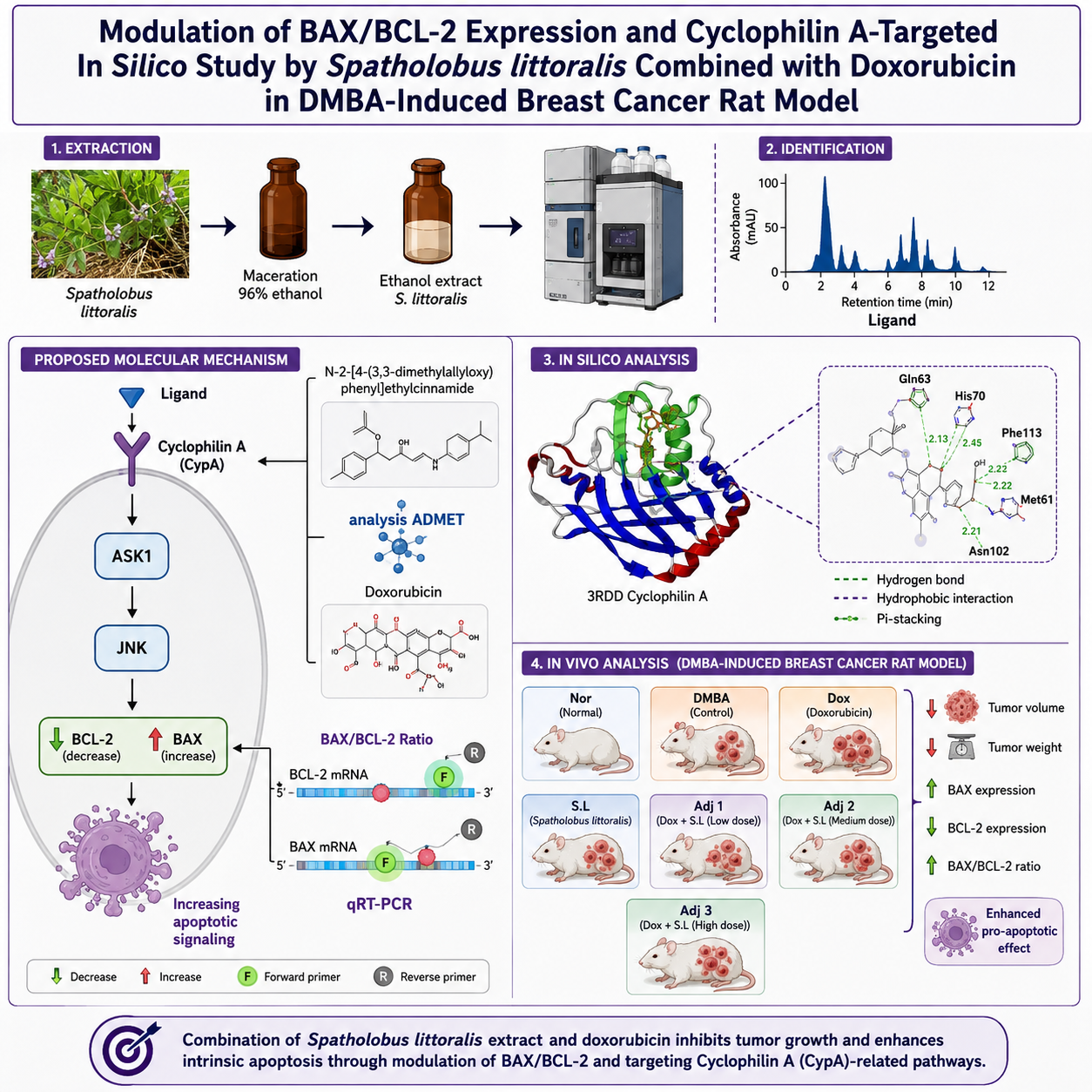
GRAPHICAL ABSTRACT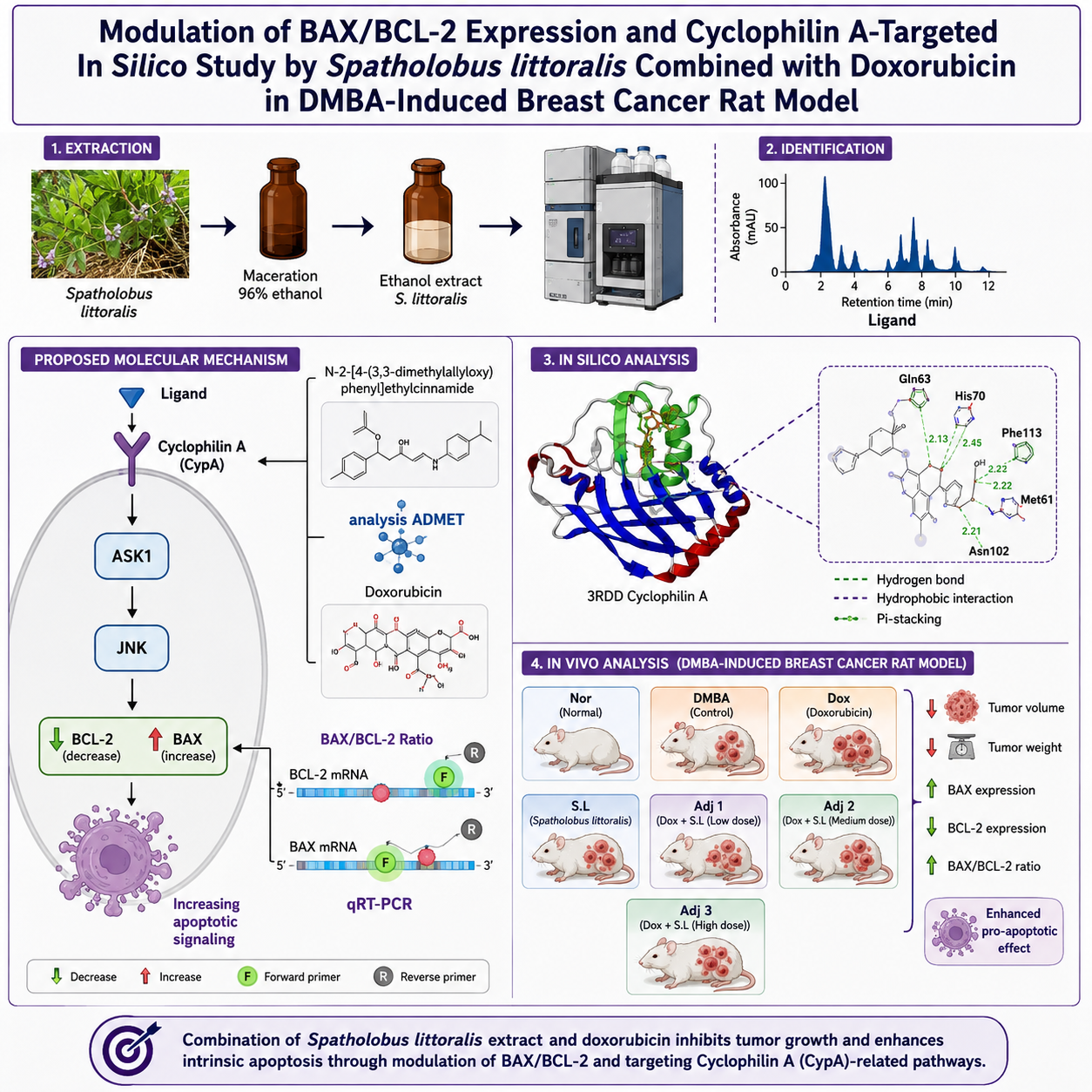
Downloads
References
H Sung, J Ferlay, RL Siegel, M Laversanne, I Soerjomataram, A Jemal and F Bray. Global cancer statistics 2020: GLOBOCAN estimates of incidence and mortality worldwide for 36 cancers in 185 countries. CA: A Cancer Journal for Clinicians 2021; 71(3), 209-249.
P Dong and DA Gewirtz. Editorial: Risks and benefits of adjuvants to cancer therapies. Frontiers in Oncology 2022; 12, 10-12.
M Kciuk, A Gielecinska, S Mujwar, D Kolat, Z Kaluzinska-Kolat, I Celik and R Kontek. Doxorubicin - an agent with multiple mechanisms of anticancer activity. Cells 2023; 12(4), 659.
U Anand, A Dey, AK Singh Chandel, R Sanyal, A Mishra, DK Pandey, V De Falco, A Upadhyay, R Kandimalla, A Chaudhary, JK Dhanjal, S Dewanjee, J Vallamkondu and JMP de la Lastra. Cancer chemotherapy and beyond: Current status, drug candidates, associated risks and progress in targeted therapeutics. Genes & Diseases 2023; 10(4), 1367-1401.
H Dariushnejad, N Roshanravan, HM Wasman, M Cheraghi, L Pirzeh and V Ghorbanzadeh. Silibinin, synergistically enhances vinblastine-mediated apoptosis in triple negative breast cancer cell line: Involvement of Bcl2/Bax and caspase-3 pathway. International Journal of Hematology-Oncology and Stem Cell Research 2024; 18(2), 174.
G Pistritto, D Trisciuoglio, C Ceci, A Garufi and G D’Orazi. Apoptosis as anticancer mechanism: Function and dysfunction of its modulators and targeted therapeutic strategies. Aging 2016; 8(4), 603-619.
DE Pritchard, S Ceryak, KE Ramsey, TJ O’Brien, L Ha, JL Fornsaglio, DA Stephan and SR Patierno. Resistance to apoptosis, increased growth potential, and altered gene expression in cells that survived genotoxic hexavalent chromium [Cr(VI)] exposure. Molecular and Cellular Biochemistry 2005; 279(1-2), 169-181.
P Hussar. Apoptosis regulators Bcl-2. Encyclopedia 2022; 2(4), 1624-1636.
R Singh, A Letai and K Sarosiek. BCL-2 family protein. Definitions 2020; 20(3), 175-193.
MA O'Brien and R Kirby. Apoptosis: A review of pro-apoptotic and anti-apoptotic pathways and dysregulation in disease. Journal of Veterinary Emergency and Critical Care 2008; 18(6), 572-585.
J Han, MK Lee, Y Jang, WJ Cho and M Kim. Repurposing of cyclophilin A inhibitors as broad-spectrum antiviral agents. Drug Discovery Today 2022; 27(7), 1895-1912.
L Liu, L Zuo, J Yang, S Xin, J Zhang, J Zhou, G Li, J Tang and J Lu. Exosomal cyclophilin A as a novel noninvasive biomarker for Epstein-Barr virus associated nasopharyngeal carcinoma. Cancer Medicine 2019; 8(6), 3142-3151.
S Jin, M Zhang and X Qiao. Cyclophilin A: Promising target in cancer therapy. Cancer Biology & Therapy 2024; 25(1), 2425127.
WT Stauffer, AZ Goodman and PA Gallay. Cyclophilin inhibition as a strategy for the treatment of human disease. Frontiers in Pharmacology 2024; 15, 1417945.
Y Liao, D Luo, K Peng and Y Zeng. Cyclophilin A: A key player for etiological agent infection. Applied Microbiology and Biotechnology 2021; 105(4), 1365-1377.
A Abdullah, R Abdullah, Z Nazariah, K Balakrishnan, FJ Abdullah, J Bala and MA Mohd-Lila. Cyclophilin A as a target in the treatment of cytomegalovirus infections. Antiviral Chemistry and Chemotherapy 2018; 26, 2040206618811413.
L Chen, Z Zeng, H Luo, H Xiao and Y Zeng. The effects of CypA on apoptosis: Potential target for the treatment of diseases. Applied Microbiology and Biotechnology 2023; 108(1), 28.
B Wang, Y Ma, Y Zhang and X Yin. Therapeutic potential of ASK1 activators in cancer treatment: Current insights and future directions. Biomedicine & Pharmacotherapy 2024; 178, 117214.
H Kim, Y Oh, K Kim, S Jeong, S Chon, D Kim, MH Jung, YK Pak, J Ha, I Kang and W Choe. Cyclophilin A regulates JNK/p38-MAPK signaling through its physical interaction with ASK1. Biochemical and Biophysical Research Communications 2015; 464(1), 112-117.
P. Nigro, G. Pompilio, and M. C. Capogrossi, “Cyclophilin A: A key player for human disease,” Cell Death Dis 2013;4(10), 1–10.
BNA Susanto and N Zayani. The effect of Bajakah (Spatholobus littoralis Hassk) stem extract on calculation of leukocyte in mice (Mus musculus). The International Conference on Public Health Proceeding 2021; 6(1), 1100-1106.
DW Rousdy, ERP Wardoyo and S Ifadatin. Anti-inflammatory activity of Bajakah stem (Spatholobus littoralis Hassk.) ethanolic extract in carrageenan-induced paw edema mice. Jurnal Biodjati 2022; 7(1), 66-74.
H Hamzah, SUT Pratiwi, A Jabbar, AS Hafifah, BA Al-Fajri and N Nurhalisah. Bioactivity tracing of the ethanol extract of Bajakah Tampala (Spatholobus littoralis Hassk.) typical plant of Kalimantan Island as antibiofilm of Staphylococcus aureus. Open Access Macedonian Journal of Medical Sciences 2023; 11(A), 8-14.
G D’Urso, A Capuano, F Fantasma, MG Chini, V de Felice, G Saviano, G Lauro, A Casapullo, G Bifulco and M Iorizzi. The role of LC-MS in profiling bioactive compounds from plant waste for cosmetic applications: A general overview. Plants 2025; 14(15), 2284.
KD Oliveira, GU Avanzo, MV Tedardi, MM Rangel, JL Avanzo, H Fukumasu, KVK Rao, IL Sinhorini and MLZ Dagli. Chemical carcinogenesis by DMBA (7,12-dimethylbenzanthracene) in female BALB/c mice: New facts. Brazilian Journal of Veterinary Research and Animal Science 2015; 52(2), 125-133.
MM Williams and RS Cook. Bcl-2 family proteins in breast development and cancer: Could Mcl-1 targeting overcome therapeutic resistance? Oncotarget 2015; 6(6), 3519-3530.
H Azimian, M Dayyani, MTB Toossi and M Mahmoudi. Bax/Bcl-2 expression ratio in prediction of response to breast cancer radiotherapy. Iranian Journal of Basic Medical Sciences 2018; 21(3), 325-332.
S Jin, M Zhang and X Qiao. Cyclophilin A: Promising target in cancer therapy. Cancer Biology & Therapy 2024; 25(1), 2425127.
K Tabatabaei, S Moazzezi, M Emamgholizadeh, H Vaez, B Baradaran and B Shokouhi. Improved therapeutic efficacy of doxorubicin chemotherapy with cannabidiol in 4T1 mice breast cancer model. Cancer Medicine 2024; 13(21), e70395.
F Ismed, WN Desti, N Arifa, R Rustini and DP Putra. TLC-bioautographic and LC-MS/MS detection of antimicrobial compounds from four semipolar extracts of Cladonia species. In: Zaini (Ed.). Proceedings of the 2nd International Conference on Contemporary Science and Clinical Pharmacy. Atlantis Press, Dordrecht, Netherlands, 2021, p. 49-59.
AE Wibowo, S Sriningsih, PE Wuyung and R Ranasasmita. The influence of DMBA (7,12-dimethylbenz-[a]anthracene) regimen in the development of mammae carcinogenesis on Sprague Dawley female rat. Indonesian Journal of Cancer Chemoprevention 2010; 1(1), 60-66.
NK Rusdi. 2022, Potensi ekstrak tertarget lunasin pada penghambatan karsinogenesis kanker payudara tikus sprague dawley yang diinduksi DMBA (in Indonesian). Ph. D. Dissertation. Universitas Indonesia, Jawa Barat, Indonesia, 2022.
MM Jensen, JT Jorgensen, T Binderup and A Kjaer. Tumor volume in subcutaneous mouse xenografts measured by microCT is more accurate and reproducible than determined by 18F-FDG-microPET or external caliper. BMC Medical Imaging 2008; 8, 16.
BPOM. Pedoman uji toksisitas pra-klinik secara in vivo (in Indonesian). Badan Pengawas Obat dan Makanan Republik Indonesia, Jakarta, Indonesia, 2022.
MM Tomayko and CP Reynolds. Determination of subcutaneous tumor size in athymic (nude) mice. Cancer Chemotherapy and Pharmacology 1989; 24, 148-154.
JD Sun, Q Liu, J Wang, D Ahluwalia, D Ferraro, Y Wang, JX Duan, WS Ammons, JG Curd, MD Matteucci, CP Hart. Selective tumor hypoxia targeting by hypoxia-activated prodrug TH-302 inhibits tumor growth in preclinical models of cancer. Clinical Cancer Research 2012; 18(3), 758-770.
H Chen, Q Ye, J Lv, P Ye, Y Sun, S Fan, X Su, P Gavine and X Yin. Evaluation of trastuzumab anti-tumor efficacy and its correlation with HER-2 status in patient-derived gastric adenocarcinoma xenograft models. Pathology & Oncology Research 2015; 21(4), 947-955.
KJ Livak and TD Schmittgen. Analysis of relative gene expression data using real-time quantitative PCR and the 2-delta-delta CT method. Methods 2001; 25(4), 402-408.
ARRS Brilhante, GR de Sousa, AKS de Aquino-Vital, NTR de Lima, RBL Souza, TA de Souza, MT Scotti, JMB Filho, JF Tavares and MS da Silva. Fabaceae flavonoids beyond the commonplace: A review of chemical diversity, pharmacological activities, mass spectrometric profiling and in silico insights into their subclasses. Plants 2025; 14(23), 3549.
W Liu, Y Feng, S Yu, Z Fan, X Li, J Li and H Yin. The flavonoid biosynthesis network in plants. International Journal of Molecular Sciences 2021; 22(23), 12824.
V Ninkuu, OO Aluko, J Yan, H Zeng, G Liu, J Zhao, H Li, S Chen and FD Dakora. Phenylpropanoids metabolism: Recent insight into stress tolerance and plant development cues. Frontiers in Plant Science 2025; 16, 1571825.
L Xu and X Wang. A comprehensive review of phenolic compounds in horticultural plants. International Journal of Molecular Sciences 2025; 26(12), 5767.
P Nigro, K Satoh, MR O’Dell, NN Soe, Z Cui, A Mohan, J Abe, JD Alexis, JD Sparks and BC Berk. Cyclophilin A is an inflammatory mediator that promotes atherosclerosis in apolipoprotein E-deficient mice. Journal of Experimental Medicine 2011; 208(1), 53-66.
C Xue, M Sowden and BC Berk. Extracellular Cyclophilin A, especially acetylated, causes pulmonary hypertension by stimulating endothelial apoptosis, redox stress, and inflammation. Arteriosclerosis, Thrombosis, and Vascular Biology 2017; 37(6), 1138-1146.
WT Stauffer, AZ Goodman and PA Gallay. Cyclophilin inhibition as a strategy for the treatment of human disease. Frontiers in Pharmacology 2024; 15, 1-15.
CA Lipinski. Lead- and drug-like compounds: The rule-of-five revolution. Drug Discovery Today: Technologies 2004; 1(4), 337-341.
D Veber, S Johnson, HY Cheng, B Smith, K Ward and K Kopple. Molecular properties that influence the oral bioavailability of drug candidates. Journal of Medicinal Chemistry 2002; 45, 2615-2623.
O Tacar, P Sriamornsak and CR Dass. Doxorubicin: An update on anticancer molecular action, toxicity and novel drug delivery systems. Journal of Pharmacy and Pharmacology 2013; 65(2), 157-170.
CF Thorn, C Oshiro, S Marsh, T Hernandez-Boussard, H McLeod, TE Klein and RB Altman. Doxorubicin pathways: Pharmacodynamics and adverse effects. Pharmacogenetics and Genomics 2011; 21(7), 440-446.
A Daina, O Michielin and V Zoete. SwissADME: A free web tool to evaluate pharmacokinetics, drug-likeness and medicinal chemistry friendliness of small molecules. Scientific Reports 2017; 7(1), 42717.
LE Anderson, JE Morris, LB Sasser and RG Stevens. Effect of constant light on DMBA mammary tumorigenesis in rats. Cancer Letters 2000; 148(2), 121-126.
BV Asbroeck, DN Kruger, SV den Bogaert, D Dombrecht, M Bosman, EMV Craenenbroeck, PJ Guns and EV Breda. Distinct impact of doxorubicin on skeletal muscle and fat metabolism in mice: Without dexrazoxane effect. International Journal of Molecular Sciences 2025; 26(3), 1177.
I Mentoor, T Nell, Z Emjedi, PJ van Jaarsveld, L de Jager and AM Engelbrecht. Decreased efficacy of doxorubicin corresponds with modifications in lipid metabolism markers and fatty acid profiles in breast tumors from obese vs. lean mice. Frontiers in Oncology 2020; 10, 306.
J Dickinson, MD Matas, PA Dickinson and HB Mistry. Exploring a model-based analysis of patient derived xenograft studies in oncology drug development. PeerJ 2021; 9, 1-10.
PS Cella, RLN de Matos, PC Marinello, JC da Costa, FA Moura, APAFRL Bracarense, P Chimin and R Deminice. Doxorubicin causes cachexia, sarcopenia, and frailty characteristics in mice. PLoS One 2024; 19(4), e0301379.
A Elfadadny, RF Ragab, R Hamada, SK Al Jaouni, J Fu, SA Mousa and AH El-Far. Natural bioactive compounds-doxorubicin combinations targeting topoisomerase II-alpha: Anticancer efficacy and safety. Toxicology and Applied Pharmacology 2023; 461, 116405.
D Tungmunnithum, S Drouet, JM Lorenzo and C Hano. Characterization of bioactive phenolics and antioxidant capacity of edible bean extracts of 50 Fabaceae populations grown in Thailand. Studies in Natural Products Chemistry 2021; 58(12), 389-417.
Z Zhang, L Hou, D Liu, S Luan, M Huang and L Zhao. Directly targeting BAX for drug discovery: Therapeutic opportunities and challenges. Acta Pharmaceutica Sinica B 2024; 14(6), 2378-2401.
M Kumar, V Kaur, S Kumar and S Kaur. Phytoconstituents as apoptosis inducing agents: Strategy to combat cancer. Cytotechnology 2016; 68(4), 531-563.
Q Wang, L Zhang, X Yuan, Y Ou, X Zhu, Z Cheng, P Zhang, X Wu, Y Meng and L Zhang. The relationship between the Bcl-2/Bax proteins and the mitochondria-mediated apoptosis pathway in the differentiation of adipose-derived stromal cells into neurons. PLoS One 2016; 11(10), e0163327.
S Zamorano, D Rojas-Rivera, F Lisbona, V Parra, FA Court, R Villegas, EH Cheng, SJ Korsmeyer, S Lavandero and C Hetz. A BAX/BAK and cyclophilin D-independent intrinsic apoptosis pathway. PLoS One 2012; 7(6), e37782.
Z Qian, X Zhao, M Jiang, W Jia, C Zhang, Y Wang, B Li and W Yue. Downregulation of cyclophilin A by siRNA diminishes non-small cell lung cancer cell growth and metastasis via the regulation of matrix metallopeptidase 9. BMC Cancer 2012; 12(1), 442.
Y Chen, N Li, J Yang, K Li, M Tang, X Zhao, W Guo, A Tong, C Nie, Y Peng and Z Yuan. PUMA overexpression dissociates thioredoxin from ASK1 to activate the JNK/BCL-2/BCL-XL pathway augmenting apoptosis in ovarian cancer. Biochimica et Biophysica Acta: Molecular Basis of Disease 2022; 12, 1868.
S Hafezi and M Rahmani. Targeting BCL-2 in cancer: Advances, challenges, and perspectives. Cancers 2021; 13(6), 1292.
S Barille-Nion, S Lohard and PP Juin. Targeting of BCL-2 family members during anticancer treatment: A necessary compromise between individual cell and ecosystemic responses? Biomolecules 2020; 10(8), 1109.
Downloads
Published
How to Cite
Issue
Section
License
Copyright (c) 2026 Walailak University

This work is licensed under a Creative Commons Attribution-NonCommercial-NoDerivatives 4.0 International License.





