
Vitamin D Alleviates Obesity in Insulin Resistance Rat Model via Adipokine-Gut Microbiome Regulation
DOI:
https://doi.org/10.48048/tis.2026.13010Keywords:
Adipokines, Allobaculum, 25-hydroxy-vitamin-D3, Lactobacillus, Lee index, Adipokines, Allobaculum, 25-hydroxy-vitamin D, Lactobacillus, Lee indexAbstract
Introduction: It was established that vitamin D reduced insulin resistance in prediabetic rats in a model induced by a high-fat, high-glucose diet and low-dose streptozotocin (HFDS). However, it remained unclear whether vitamin D could assist with obesity and dysbiosis in the insulin-resistant rat model induced by HFDS. Materials and Methods: Twenty-four male Wistar rats in the study were randomly divided into two groups. Six rats were fed a standard diet, while 18 were fed an HFDS diet. Once obesity and insulin resistance were established, the 18 HFDS rats were randomly assigned to three treatment groups for 12 weeks: one group received no treatment, another received 100 IU/kg BW of vitamin D3, and the third received 1000 IU/kg BW of vitamin D3. Body weight and the Lee index were assessed before and after treatment. At the end of the experiment, microbiome profiles of colon segments and epididymal fat adipose tissues were analyzed. Results and Discussion: We found that in a rat model induced by HFDS, vitamin D3 supplementation at both doses reduced body weight, the Lee index, and adipose tissue size, and increased the adiponectin/leptin ratio. The richness and relative abundance of gut microbiome richness and composition alongside improvements in obesity profiles. The main species modulated by vitamin D3 supplementation; notably Lactobacillus spp. and Allobaculum increased, whereas Blautia spp. decreased, particularly at the dose of 1000 IU/kg BW. Conclusions: Vitamin D3 supplementation was associated with improvements in obesity-related parameters, accompanied by changes in the adiponectin/leptin ratio and shifts in gut microbiome diversity and species composition.
HIGHLIGHTS
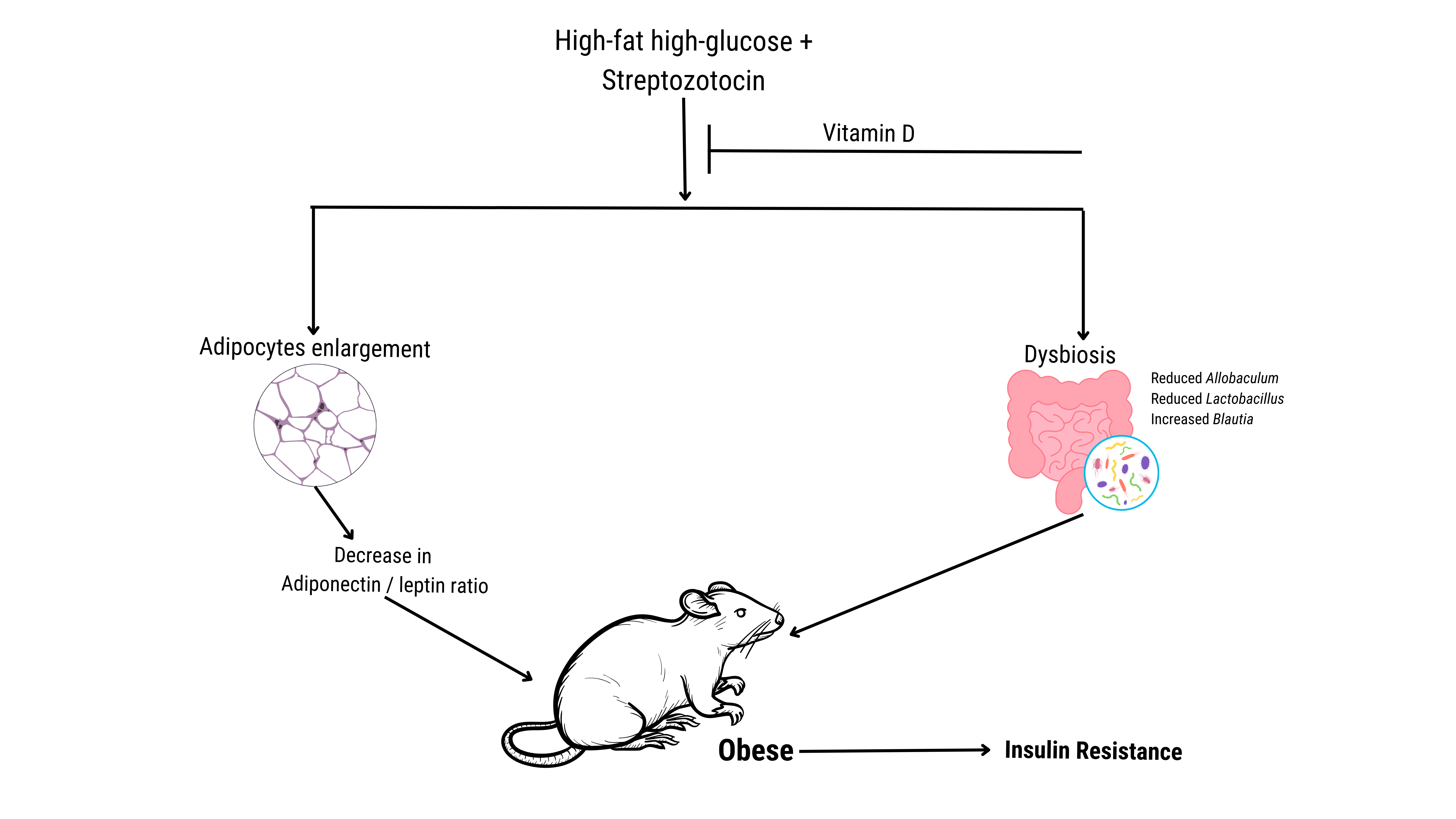
Obesity escalates the process of insulin resistance to type 2 diabetes. In our study, vitamin D3 supplementation reduced body weight in an insulin-resistant rat model induced by a high-fat, high-glucose diet and low-dose streptozotocin. The weight loss was accompanied by restored adipokine balance, an increased adiponectin/leptin ratio, decreased adipocyte size, and a shift in microbial composition including increased Lactobacillus and Allobaculum.
GRAPHICAL ABSTRACT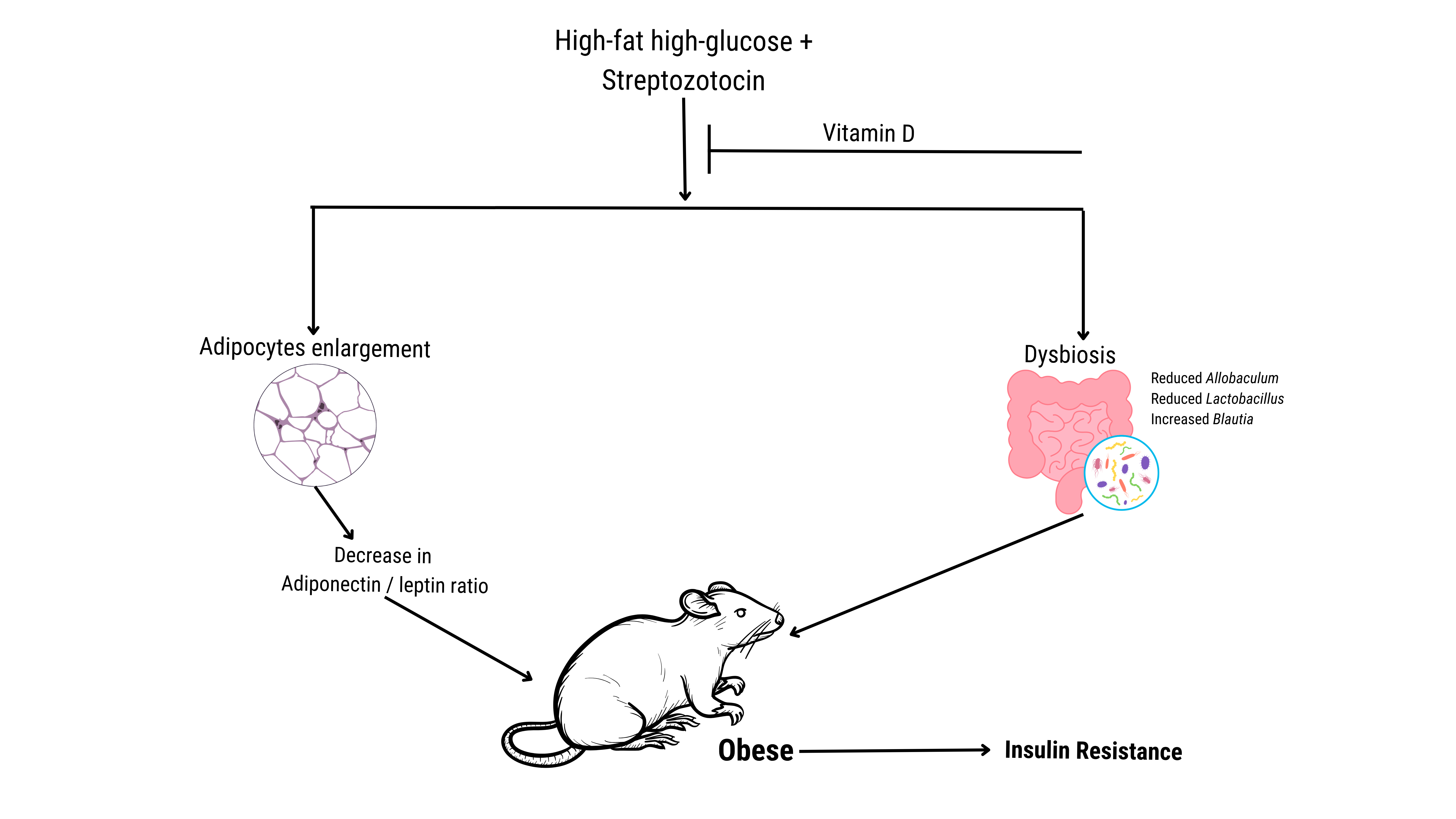
Downloads
References
RN Haththotuwa, CN Wijeyaratne and U Senarath. Worldwide epidemic of obesity. Second (Ed.). Elsevier, Germany, 2020, p. 3-8.
NJ Temple. The origins of the obesity epidemic in the USA-lessons for today. Nutrients 2022; 14(20), 4253.
S Moreno-Fernández, M Garcés-Rimón, G Vera, J Astier, JF Landrier and M Miguel. High fat/high glucose diet induces metabolic syndrome in an experimental Rat Model. Nutrients 2018; 10(10), 1502.
B Arcidiacono, E Chiefari, A Foryst-Ludwig, G Currò, G Navarra, FS Brunetti, M Mirabelli, DM Corigliano, U Kintscher, D Britti, V Mollace, DP Foti, ID Goldfine and A Brunetti. Obesity-related hypoxia via miR-128 decreases insulin-receptor expression in human and mouse adipose tissue promoting systemic insulin resistance. eBioMedicine 2020; 59, 102912.
N Hariri and L Thibault. High-fat diet-induced obesity in animal models. Nutrition Research Reviews 2010; 23(2), 270-299.
YS Lee, P Li, JY Huh, IJ Hwang, M Lu, JI Kim, M Ham, S Talukdar A Chen, WJ Lu, GK Bandyopadhyay, R Schwendener, J Olefsky and JB Kim. Inflammation is necessary for long-term but not short-term high-fat diet-induced insulin resistance. Diabetes 2011; 60(10), 2474-2483.
EA Greco, A Lenzi and S Migliaccio. Role of hypovitaminosis D in the pathogenesis of obesity-induced insulin resistance. Nutrients 2019; 11(7), 1506.
CA Peterson, AK Tosh and AM Belenchia. Vitamin D insufficiency and insulin resistance in obese adolescents. Therapeutic Advances in Endocrinology and Metabolism 2014; 5(6), 166-189.
CB Turer, H Lin and G Flores. Prevalence of vitamin D deficiency among overweight and obese US children. Pediatrics 2013; 131(1), 152-161.
GE Walker, R Ricotti, M Roccio, S Moia, S Bellone, F Prodam and G Bona. Pediatric obesity and vitamin D deficiency: A proteomic approach identifies multimeric adiponectin as a key link between these conditions. PLoS One 2014; 9(1), 83685.
RJA Argan, SG Alqatari, AJ Alwaheed, MA Hasan, SY AlQahtani, MDA Shubbar, AH Alnasser, SMA Abbas and NH AlYousef. Vitamin D deficiency in obesity: Epidemiological evidence, biological mechanisms, and clinical considerations. Obesity Medicine 2026; 59, 100680.
JD Roizen, C Long, A Casella, L OʼLear, I Caplan, M Lai, I Sasson, R Singh, AJ Makowski, R Simmons and MA Levine. Obesity decreases hepatic 25-Hydroxylase activity causing low serum 25-Hydroxyvitamin D. Journal of Bone and Mineral Research 2019; 34(6), 1068-1073.
A Sukik, J Alalwani and V Ganji. Vitamin D, gut microbiota, and cardiometabolic diseases—a possible three-way axis. International Journal of Molecular Sciences 2023; 24(2), 940.
K Zuo, J Li, Q Xu, C Hu, Y Gao, M Chen, R Hu, Y Liu, H Chi, Q Yin, Y Cao, P Wang, Y Qin, X Liu, J Zhong, J Cai, K Li and X Yang. Dysbiotic gut microbes may contribute to hypertension by limiting vitamin D production. Clinical Cardiology 2019; 42(8), 710-719.
N Kazemian, M Mahmoudi, F Halperin, JC Wu and S Pakpour. Gut microbiota and cardiovascular disease: Opportunities and challenges. Microbiome 2020; 8, 36.
M Witkowski, TL Weeks and SL Hazen. Gut microbiota and cardiovascular disease. Circulation Research 2020; 127, 553-570.
DGB Krisnamurti, M Louisa, EH Poerwaningsih, TJE Tarigan, V Soetikno, H Wibowo and CMH Nugroho. Vitamin D supplementation alleviates insulin resistance in prediabetic rats by modifying IRS-1 and PPARγ/NF-κB expressions. Front Endocrinol 2023; 14, 1089298.
YS Jung, D Wu, D Smith, SN Meydani and SN Han. Dysregulated 1,25-dihydroxyvitamin D levels in high-fat diet-induced obesity can be restored by changing to a lower-fat diet in mice. Nutrition Research 2018; 53, 51-60.
CY Park, Y Shin, JH Kim, S Zhu, YS Jung and SN Han. Effects of high fat diet-induced obesity on vitamin D metabolism and tissue distribution in vitamin D deficient or supplemented mice. Nutrition & Metabolism 2020; 17, 44.
R Parsanathan and SK Jain. Glutathione deficiency induces epigenetic alterations of vitamin D metabolism genes in the livers of high-fat diet-fed obese mice. Scientific Reports 2019; 9, 14784.
VJ Clemente-Suárez, L Redondo-Flórez, AI Beltrán-Velasco, A Martín-Rodríguez, I Martínez-Guardado, E Navarro-Jiménez, CC Laborde-Cárdenas and JF Tornero-Aguilera. The role of adipokines in health and disease. Biomedicines 2023; 11(5), 1290.
G Frühbeck, V Catalán, A Rodríguez and J Gómez-Ambrosi. Adiponectin-leptin ratio: A promising index to estimate adipose tissue dysfunction. Relation with obesity-associated cardiometabolic risk. Adipocyte 2018; 7(1), 57-62.
B Antuna-Puente, B Feve, S Fellahi and JP Bastard. Adipokines: The missing link between insulin resistance and obesity. Diabetes & Metabolism Journal 2008; 34(1), 2-11.
YE Kang, JM Kim, KH Joung, JH Lee, BR You, MJ Choi, MJ Ryu, YB Ko, MA Lee, J Lee, BJ Ku, M Shong, KH Lee and HJ Kim. The roles of adipokines, proinflammatory cytokines, and adipose tissue macrophages in obesity-associated insulin resistance in modest obesity and early metabolic dysfunction. PLoS One 2016; 11(4), 0154003.
K Zorena, O Jachimowicz-Duda, D Ślęzak, M Robakowska and M Mrugacz. Adipokines and Obesity. Adipokines and Obesity. Potential link to metabolic disorders and chronic complications. International Journal of Molecular Sciences 2020; 21(10), 3570.
MJ Lee. Vitamin D regulation of adipogenesis and adipose tissue functions. Nutrients 2020; 17(3), 553.
H Nimitphong, W Guo, MF Holick, SK Fried and MJ Lee. Vitamin D inhibits adipokine production and inflammatory signaling through the vitamin D receptor in human adipocytes. Obesity 2021; 29(3), 562-568.
CY Park and SN Han. The role of vitamin D in adipose tissue biology: Adipocyte differentiation, energy metabolism, and inflammation. Journal of Lipid and Atherosclerosis 2021; 10(2), 130-144.
AD Nisio, LD Toni, I Sabovic, MS Rocca, VD Filippis, G Opocher, B Azzena, R Vettor, M Plebani and C Foresta. Impaired release of vitamin D in dysfunctional adipose tissue: New cues on vitamin D supplementation in obesity. The Journal of Clinical Endocrinology & Metabolism 2017; 102(7), 2564-2574.
FA Cimini, F Sentinelli, A Oldani, I Barchetta, and MG Cavallo. Adipose tissue dysfunction and metabolic diseases: The role of vitamin D/vitamin D receptor Axis. International Journal of Molecular Sciences 2025; 26(21), 10256.
CM Apovian, S Bigornia, M Mott, MR Meyers, J Ulloor,M Gagua, M McDonnell, D Hess, L Joseph and N Gokce. Adipose macrophage infiltration is associated with insulin resistance and vascular endothelial dysfunction in obese subjects. Arteriosclerosis, Thrombosis, and Vascular Biology 2008; 28(9), 1654-1659.
A Everard and PD Cani. Diabetes, obesity and gut microbiota. Best Practice & Research Clinical Gastroenterology 2013; 27(1), 73-83.
J Zhao, X Zhang, H Liu, MA Brown and S Qiao. Dietary protein and gut microbiota composition and function. Current Protein & Peptide Science 2018; 20(2), 145-154.
Z Chen, D Radjabzadeh, L Chen, A Kurilshikov, M Kavousi, F Ahmadizar, MA Ikram, AG Uitterlinden, A Zhernakova, J Fu, R Kraaij and T Voortman. Association of insulin resistance and Type 2 diabetes with gut microbial diversity: A microbiome-wide analysis from population studies. JAMA Network Open 2021; 4(7), 2118811.
KS Ibrahim, N Bourwis, S Dolan, S Lang, J Spencer and JA Craft. Characterisation of gut microbiota of obesity and type 2 diabetes in a rodent model. Bioscience of Microbiota, Food and Health 2021; 40(1), 64-74.
J Gong, Y Shen, H Zhang, M Cao, M Guo, J He, B Zhang and C Xiao. Gut microbiota characteristics of people with obesity by meta-analysis of existing datasets. Nutrients 2022; 14(14), 2993.
M Pinart, A Dötsch, K Schlicht, M Laudes, J Bouwman, SK Forslund, T Pischon and K Nimptsch. Gut microbiome composition in obese and non-obese persons: A systematic review and meta-analysis. Nutrients 2021; 14(1), 12.
K Shan, H Qu, K Zhou, L Wang, C Zhu, H Chen, Z Gu, J Cui, G Fu, J Li, H Chen, R Wang, Y Qi, W Chen and YQ Chen. Distinct gut microbiota induced by different Fat-to-Sugar-Ratio High-energy diets share similar Pro-obesity genetic and metabolite profiles in Prediabetic Mice. mSystems 2019; 4(5), 00219-19.
J Long, Q Cai, M Steinwandel, MK Hargreaves, SR Bordenstein, WJ Blot, W Zheng and XO Shu. Association of oral microbiome with Type 2 diabetes risk. Journal of Periodontal Research 2017; 52(3), 636-643.
S Mandal, KM Godfrey, D McDonald, WV Treuren, JV Bjørnholt, T Midtvedt, B Moen, K Rudi, R Knight, AL Brantsæter, SD Peddada and M Eggesbø. Fat and vitamin intakes during pregnancy have stronger relations with a pro-inflammatory maternal microbiota than does carbohydrate intake. Microbiome 2016; 4, 55.
S Gheibi, K Kashfi and A Ghasemi. A practical guide for induction of Type-2 diabetes in rat: Incorporating a high-fat diet and streptozotocin. Biomedicine & Pharmacotherapy 2017; 95, 605-613.
Q Ma, Y Li, J Wang, P Li, Y Duan, H Dai, Y An, L Cheng, T Wang, C Wang, T Wang and B Zhao. Investigation of gut microbiome changes in Type 1 diabetic mellitus rats based on high-throughput sequencing. Biomedicine & Pharmacotherapy 2020; 124, 109873.
PC Lee, YC Hsieh, TI Huo, UC Yang, CH Lin, CP Li, YH Huang, MC Hou, HC Lin and KC Lee. Active vitamin D3 treatment attenuated bacterial translocation via improving intestinal barriers in Cirrhotic Rats. Molecular Nutrition & Food Research 2021; 65(3), 2000937.
N Naderpoor, A Mousa, LFG Arango, HL Barrett, MD Nitert and B de Courten. Effect of vitamin D supplementation on faecal microbiota: A randomised clinical trial. Nutrients 2019; 11(12), 2888.
L Egshatyan, D Kashtanova, A Popenko, O Tkacheva, A Tyakht, D Alexeev, N Karamnova, E Kostryukova, V Babenko, M Vakhitova and S Boytsov. Gut microbiota and diet in patients with different glucose tolerance. Endocrine Connections 2016; 5, 1-9.
A Benítez-Páez, EMG del Pugar, I López-Almela, Á Moya-Pérez, P Codoñer-Franch and Y Sanz. Depletion of Blautia species in the microbiota of obese children relates to intestinal inflammation and metabolic phenotype worsening. mSystems 2020; 5(2), 00857-19.
L Krych, DS Nielsen, AK Hansen and C Hansen. Gut microbial markers are associated with diabetes onset, regulatory imbalance, and IFN-γ level in NOD Mice. Gut Microbes 2015; 6(2), 101-109.
GG Pircalabioru, J Liaw, O Gundogdu, N Corcionivoschi, I Ilie, L Oprea, M Musat and MC Chifiriuc. Effects of the lipid profile, Type 2 diabetes and medication on the metabolic syndrome—associated gut microbiome.
International Journal of Molecular Sciences 2022; 23(14), 7509.
YS Kim, T Unno, BY Kim and MS Park. Sex differences in gut microbiota. World Journal of Menʼs Health 2020; 38(1), 48-60.
JT Nearing, GM Douglas, AM Comeau and MGI Langille. Denoising the Denoisers: An independent evaluation of microbiome sequence error-correction approaches. PeerJ 2018; 6, 26566.
BJ Callahan, PJ McMurdie and SP Holmes. Exact sequence variants should replace operational taxonomic units in marker-gene data analysis. The ISME Journal 2017; 11, 2639-2643.
Published
How to Cite
Issue
Section
License
Copyright (c) 2026 Walailak University

This work is licensed under a Creative Commons Attribution-NonCommercial-NoDerivatives 4.0 International License.





