
Ionospheric Response over Thailand to the 2022 Hunga Tonga-Hunga Ha’apai Eruption from GNSS and VHF Radar Observations
DOI:
https://doi.org/10.48048/tis.2026.13644Keywords:
Ionospheric response, Volcanic eruption, Hunga Tonga, Thailand, VTEC, dTEC, ROTI, RATI, TID, EPB, GNSS, VHF radar, Ionospheric response, Volcanic eruption, Hunga Tonga, Thailand, TEC, TID, EPB, GNSS, VHF radarAbstract
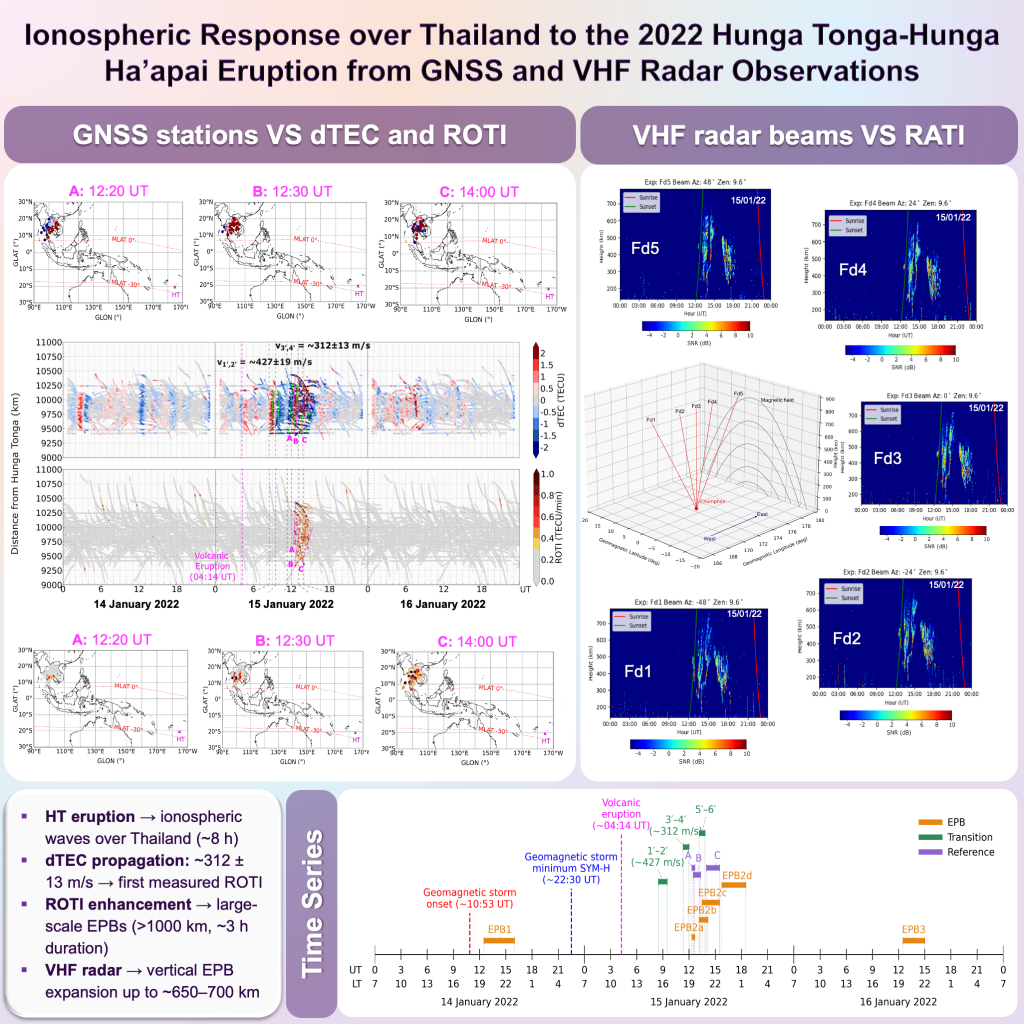
This study reports ionospheric observations over Thailand during the period surrounding the Hunga Tonga-Hunga Ha’apai volcanic eruption on 15 January 2022 (∼04:14 UT). These observations document substantial ionospheric variability over Thailand during a period influenced by volcanic forcing under concurrent geomagnetic activity, providing a regional reference for assessing potential impacts on radio propagation and communication systems. Total electron content (TEC) measurements from 4 GNSS receiver stations in Bangkok (KMI6), Chumphon (CPN1), and Nakhon Ratchasima (RUTI) in Thailand, and Vientiane (NUO2) in Laos were processed to derive vertical TEC (VTEC), detrended TEC (dTEC), and the rate-of-TEC index (ROTI). These parameters were examined using distance-time plots, time-stamped maps, and longitude stack graphs to characterize their temporal evolution, propagation features, and disturbance directions. A coherent disturbance signature was identified in both dTEC and ROTI approximately 8 h after the eruption, with dTEC perturbations reaching several tens of TECU and exceeding typical background variability for this region and period. The dTEC analysis reveals a large-amplitude feature near 12:00 UT with characteristics consistent with a traveling ionospheric disturbance (TID), propagating toward Thailand with an estimated horizontal propagation speed of ∼312 ± 13 m/s. Concurrent ROTI enhancements appear at ∼12:20 UT along the dTEC propagation path and persist for approximately 3 h. Equatorial plasma bubbles (EPBs) are identified using ROTI and corroborated by very high frequency (VHF) radar range-altitude-time intensity (RATI) observations from the CPN1 station. EPBs on 15 January showed larger horizontal and vertical extents (up to ∼1,000 km and ∼650 - 700 km, respectively) than those on 14 and 16 January. In addition to the main post-eruption interval, smaller perturbations in VTEC and dTEC are observed on 16 January, indicating possible contributions from other disturbance sources.
HIGHLIGHTS
- Clear wave-like dTEC signatures occurred approximately 8 h after the Hunga Tonga volcanic eruption and coincided with ROTI enhancements over Thailand.
- The main dTEC disturbance propagated with an apparent horizontal speed of approximately 312 ± 13 m/s, consistent with TID propagation in the acoustic–gravity/Lamb wave speed range.
- Concurrent ROTI enhancements indicated horizontal EPB extents exceeding 1,000 km during the main disturbance interval.
- VHF radar observations showed local vertical plasma expansion reaching approximately 650–700 km altitude.
GRAPHICAL ABSTRACT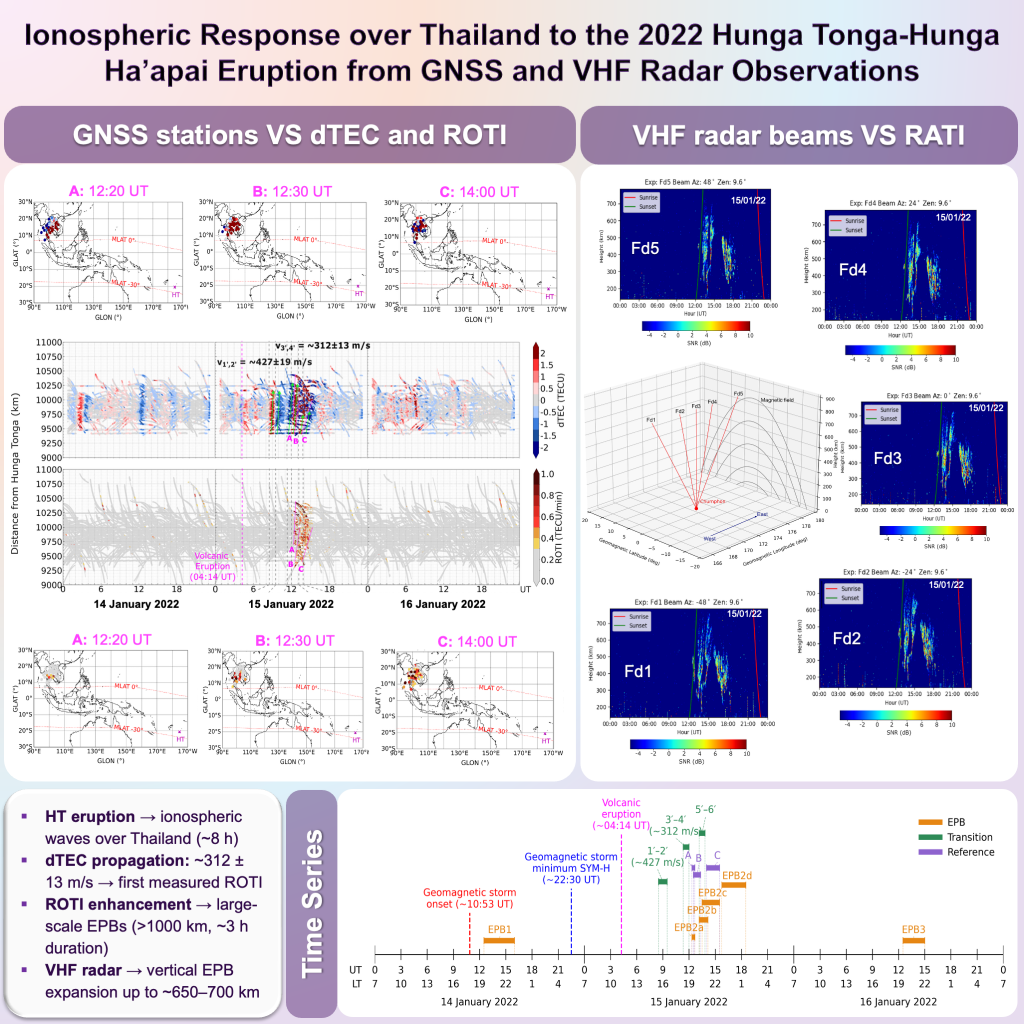
Downloads
References
Y Liu, L Fu, J Wang and C Zhang. Studying ionosphere responses to a geomagnetic storm in June 2015 with multi-constellation observations. Remote Sensing 2018; 10(5), 666.
S Saito. Ionospheric disturbances observed over Japan following the eruption of Hunga Tonga-Hunga Ha’apai on 15 January 2022. Earth Planets Space 2022; 74(1), 57.
A Shinbori, Y Otsuka, T Sori, N Michi, S Perwitasari, T Takuo, N Nozomu, K Atsushi, T Fuminori, M Shoya, K Yoshiya, M Ayako, N Satoko, M Yoshizumi and S Iku. New aspects of the upper atmospheric disturbances caused by the explosive eruption of the 2022 Hunga Tonga-Hunga Ha’apai volcano. Earth Planets Space 2023; 75(1), 175.
R Pradipta, B A Carter, JL Currie, S Choy, P Wilkinson, P Maher and R Marshall. On the propagation of traveling ionospheric disturbances from the Hunga Tonga-Hunga Ha’apai volcano eruption and their possible connection with tsunami waves. Geophysical Research Letters 2023; 50(6), e2022GL101925.
V Rakesh, S Haridas, C Sivan, MG Manoj, S Abhilash, B Paul, K Unnikrishnan, K Mohanakumar and RS Chandran. Impact of the Hunga Tonga-Hunga Ha’apai volcanic eruption on the changes observed over the Indian near-equatorial ionosphere. Advances in Space Research 2022; 70(8), 2480-2493.
X Li, F Ding, X Yue, T Mao, B Xiong and Q Song. Multiwave structure of traveling ionospheric disturbances excited by the Tonga volcanic eruptions observed by a dense GNSS network in China. Space Weather 2023; 1(2), e2022SW003210.
W Sun, AK Kuriakose, G Li, Y Li, X Zhao, L Hu, S Yang, H Xie, Y Li, B Ning and L Liu. Unseasonal super ionospheric plasma bubble and scintillations seeded by the 2022 Tonga volcano eruption related perturbations. Journal of Space Weather and Space Climate 2022; 12(25), 25.
J Hong, H Kil, W K Lee, YS Kwak, BK Choi and LJ Paxton. Detection of different properties of ionospheric perturbations in the vicinity of the Korean Peninsula after the Hunga-Tonga volcanic eruption on 15 January 2022. Geophysical Research Letters 2022; 49(14), e2022GL099163.
E Astafyeva, B Maletckii, TD Mikesell, E Munaibari, M Ravanelli, P Coisson, F Manta and L Rolland. The 15 January 2022 Hunga Tonga eruption history as inferred from ionospheric observations. Geophysical Research Letters 2022; 49(10), e2022GL098827.
E Aa, SR Zhang, W Wang, PJ Erickson, L Qian, R Eastes, BJ Harding, TJ Immel, DK Karan, RE Daniell, AJ Coster, LP Goncharenko, J Vierinen and A Spicher. Pronounced suppression and X-pattern merging of equatorial ionization anomalies after the 2022 Tonga volcano eruption. Journal of Geophysical Research: Space Physics 2022; 127(6), e2022JA030527.
IN Muafiry, I Meilano, K Heki, DD Wijaya and KA Nugraha. Ionospheric disturbances after the 2022 Hunga Tonga-Hunga Ha’apai eruption above Indonesia from GNSS-TEC observations. Atmosphere 2022; 13(10), 1615.
K Tarumi and K Yoshizawa. Eruption sequence of the 2022 Hunga Tonga-Hunga Ha’apai explosion from back-projection of teleseismic P waves. Earth and Planetary Science Letters 2023; 602, 117966.
SL Vadas, E Becker, C Figueiredo, K Bossert, BJ Harding and LC Gasque. Primary and secondary gravity waves and large-scale wind changes generated by the Tonga volcanic eruption on 15 January 2022: Modeling and comparison with ICON-MIGHTI winds. Journal of Geophysical Research: Space Physics 2023; 128(2), e2022JA031138.
K Heki. Ionospheric signatures of repeated passages of atmospheric waves by the 2022 Jan. 15 Hunga Tonga-Hunga Ha’apai eruption detected by QZSS-TEC observations in Japan. Earth Planets Space 2022; 74(12), 112.
K Shults, E Astafyeva and S Adourian. Ionospheric detection and localization of volcano eruptions on the example of the April 2015 Calbuco events. Journal of Geophysical Research: Space Physics 2016; 121(10), 10303-10315.
LFR Vital, J Xu, Y Otsuka, TT Ayorinde, H Takahashi, D Barros, CS Carmo, CAOB Figueiredo, CM Wrasse, LM Lima, I Paulino, C Wang, H Li and L Zhengkuan. On the fresh development of midnight plasma bubbles over South America. Earth Planets and Space 2025; 77(1), 131.
Y Otsuka. Ionosphere dynamics and applications. John Wiley & Sons, New Jersey, 2021, p. 421-437.
MJ Keskinen, SL Ossakow and BG Fejer. Three-dimensional nonlinear evolution of equatorial ionospheric spread-F bubbles. Geophysical Research Letters 2003; 30(16), 1855
T Sori, Y Otsuka, A Shinbori, M Nishioka and S Perwitasari. Geomagnetic conjugacy of plasma bubbles extending to mid-latitudes during a geomagnetic storm on March 1, 2013. Earth Planets Space 2022; 74(1), 120.
Y Otsuka. Review of the generation mechanisms of post-midnight irregularities in the equatorial and low-latitude ionosphere. Progress in Earth and Planetary Science 2018; 5(1), 57.
MM Miller, JJ Makela and MC Kelley. Seeding of equatorial plasma depletions by polarization electric fields from middle latitudes: Experimental evidence. Geophysical Research Letters 2009; 36(18), L18105.
H Takahashi, CM Wrasse, CAOB Figueiredo, D Barros, MA Abdu, Y Otsuka and K Shiokawa. Equatorial plasma bubble seeding by MSTIDs in the ionosphere. Progress in Earth and Planetary Science 2018; 5(1), 32.
X Pi, AJ Mannucci, UJ Lindqwister and CM Ho. Monitoring of global ionospheric irregularities using the worldwide GPS network. Geophysical Research Letters 1997; 24(18), 2283-2286.
MA Kelly, JM Comberiate, ES Miller and LJ Paxton. Progress toward forecasting of space weather effects on UHF SATCOM after Operation Anaconda. Space Weather 2014; 12(10), 601-611.
H Nakata, I Nagashima, K Sakata, Y Otsuka, Y Akaike, T Takano, S Shimakura, K Shiokawa and T Ogawa. Observations of equatorial plasma bubbles using broadcast VHF radio waves. Geophysical Research Letters 2005; 32(17), L17110.
T Thanakulketsarat, P Supnithi, LMM Myint, K Hozumi and M Nishioka. Classification of the equatorial plasma bubbles using convolutional neural network and support vector machine techniques. Earth Planets Space 2023; 75(1), 161.
Y Otsuka, T Ogawa and Effendy. VHF radar observations of nighttime F-region field-aligned irregularities over Kototabang, Indonesia. Earth, Planets Space 2009; 61(4), 431-437.
S Fukao, MC Kelley, T Shirakawa, T Takami, M Yamamoto, T Tsuda and S Kato. Turbulent upwelling of the mid-latitude ionosphere, 1. observational results by the MU radar. Journal of Geophysical Research 1991; 96(A3), 3725-3746.
T Charoenkalunyuta, C Satirapod, HK Lee and YS Choi. Performance of networkbased RTK GPS in low-latitude region: A case study in Thailand. Engineering Journal 2012; 16(5), 95-104.
E Aa, SR Zhang, PJ Erickson, J Vierinen, AJ Coster, LP Goncharenko, A Spicher and W Rideout. Significant ionospheric hole and equatorial plasma bubbles after the 2022 Tonga volcano eruption. Space Weather 2022; 20(7), e2022SW003101.
A Bumrungkit, P Supnithi and S Saito. Statistical analysis of separation distance between equatorial plasma bubbles near Suvarnabhumi International Airport, Thailand. Journal of Geophysical Research: Space Physics 2018; 123(9), 7858-7870.
N Ya’Acob, M Abdullah and M Ismail. GPS Total Electron Content (TEC) prediction at ionosphere layer over the equatorial region. In: CJ Bouras (Ed.). Trends in telecommunications technologies. IntechOpen, Rijeka, Croatia, 2010.
G Blewitt. Carrier phase ambiguity resolution for the global positioning system applied to geodetic baselines up to 2000 km. Journal of Geophysical Research 1989; 94(B8), 10187-10203.
G Ma and T Maruyama. Derivation of TEC and estimation of instrumental biases from GEONET in Japan. Annales Geophysicae 2023; 21(10), 2083-2093.
L Kersley, D Malan, SE Pryse, LR Cander, RA Bamford, A Belehaki, R Leitinger, SM Radicella, CN Mitchell and PSJ Spencer. Total electron content - a key parameter in propagation: measurement and use in ionospheric imaging. Annales Geophysicae 2004; 47(2/3), 1067-1091.
RK Vankadara, P Jamjareegulgarn, GK Seemala, MdIH Siddiqui and SK Panda. Trailing equatorial plasma bubble occurrences at a low-latitude location through multi-GNSS Slant TEC depletions during the strong geomagnetic storms in the ascending phase of the 25th solar cycle. Remote Sensing 2023; 15(20), 4944.
I Cherniak, I Zakharenkova and A Krankowski. IGS ROTI maps: Current status and its extension towards equatorial region and southern hemisphere. Sensors 2022; 22(10), 3748.
NASA/GSFC’s space physics data facility’s OMNI webservice, Available at: https://omniweb.gsfc.nasa.gov, accessed August 2023.
World Data Center for Geomagnetism, Available at: https://wdc.kugi.kyoto-u.ac.jp, accessed February 2026.
HB Mann and DR Whitney. On a test of whether one of two random variables is stochastically larger than the other. The Annals of Mathematical Statistics 1947; 18(1), 50-60.
PF Michael and AP Michael. Wilcoxon-Mann-Whitney or t-test? On assumptions for hypothesis tests and multiple interpretations of decision rules. Statistics Surveys 2010; 4, 1-39.
N Tongkasem, P Supnithi, M Nishioka, S Perwitasari, S Saito, J Klenzing and LMM Myint. Spatio-temporal characteristics of ionospheric irregularities in low latitude regions during the peak of solar cycle 25. Advances in Space Research 2025; 76(1), 254-268.
T Yokoyama, H Shinagawa and H Jin. Nonlinear growth, bifurcation and pinching of equatorial plasma bubble simulated by three-dimensional high-resolution bubble model. Journal of Geophysical Research: Space Physics 2014; 119(12), 10474-10482.
Downloads
Published
How to Cite
Issue
Section
License
Copyright (c) 2026 Walailak University

This work is licensed under a Creative Commons Attribution-NonCommercial-NoDerivatives 4.0 International License.