
Characterisation of Hβ spectra from EXO 051910+3737.7 X-rays binaries
DOI:
https://doi.org/10.48048/tis.2024.7653Keywords:
Be stars, High-mass X-ray binaries, Spectral characteristics, Emission lineAbstract
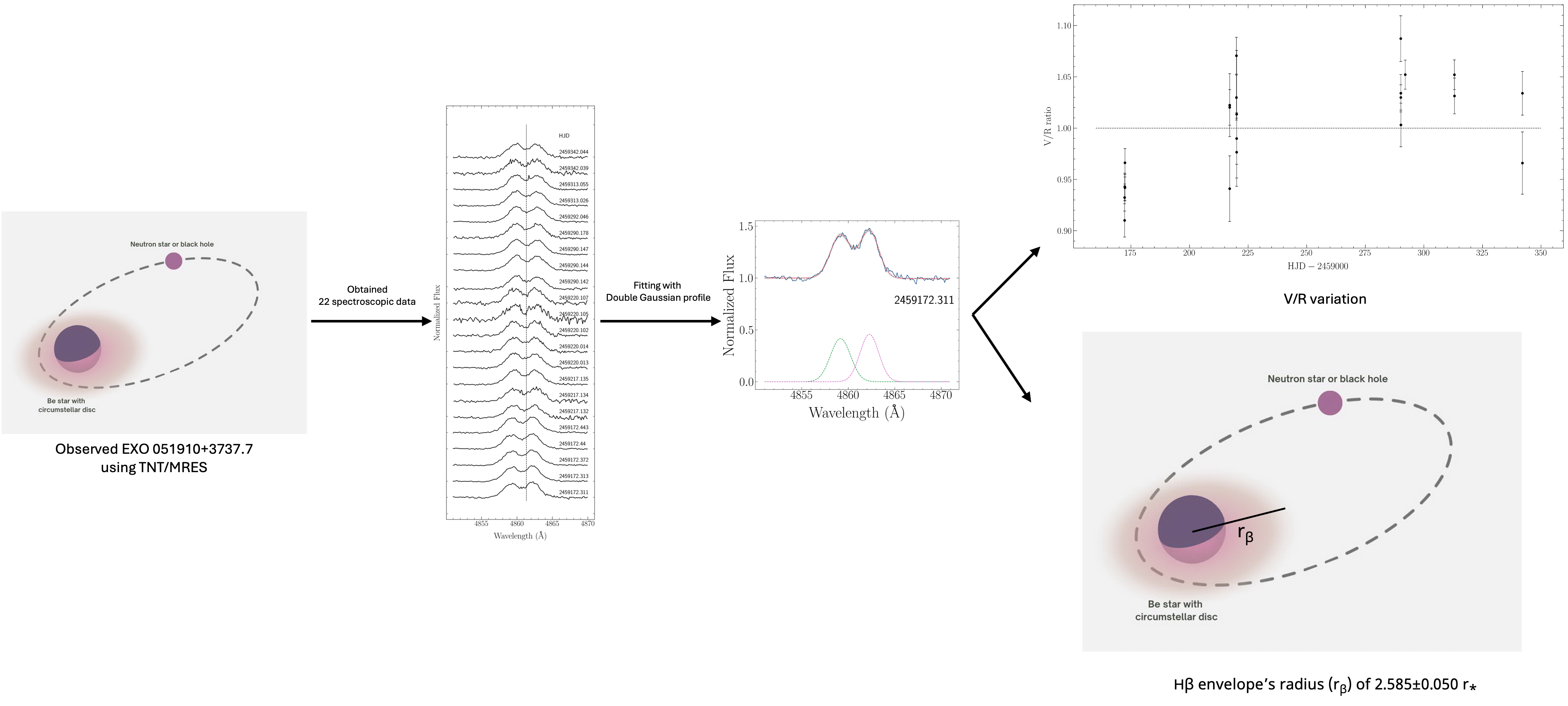
We investigate the spectral characteristics of the Be/X-ray binary system, EXO 051910+3737.7, in which Be/X-ray systems are the largest sub-class of high-mass X-ray binaries. Spectroscopic observations are taken by the Thai National Telescope (TNT) with a Medium-RESolution spectrograph (MRES) instrument for seven nights spanning from 2020 to 2021. Our primary focus is directed towards the analysis of two Balmer lines, namely Hα and Hβ, given that Be stars typically exhibit emission features in at least one of these hydrogen Balmer lines during certain phases. Our observations reveal split Balmer emission lines throughout the entire duration of our monitoring. Double Gaussian profiles were employed for line fitting to characterize these lines. The presence of double peaks in the Balmer lines indicates the presence of asymmetries within the circumstellar disc. We then analyze V/R variations and the changes in Hβ spectra. Our analysis of V/R variation which Violet (V) and Red (R) peak intensity components, revealed rapid fluctuations occurring within a single day, although determining the precise periodicity was constrained by instrumental limitations and the duration of observability. Furthermore, employing observed the wavelength differences (Δλ) in conjunction with typical Be star parameters allowed us to estimate the radius (rβ) of the Hβ emitting envelope. The average value was calculated to be 2.585r∗, with a standard deviation of 0.050r∗.
HIGHLIGHTS
- EXO 051010+3737.7 spectral line profiles were observed using the TNO/MRES instrument, revealing absorption lines for He I, and double-peak emission lines for Hand H.
- Rapid V/R variations were detected within a single day.
- The radius of the Hemitting envelope use the observed and typical Be star parameters.
GRAPHICAL ABSTRACT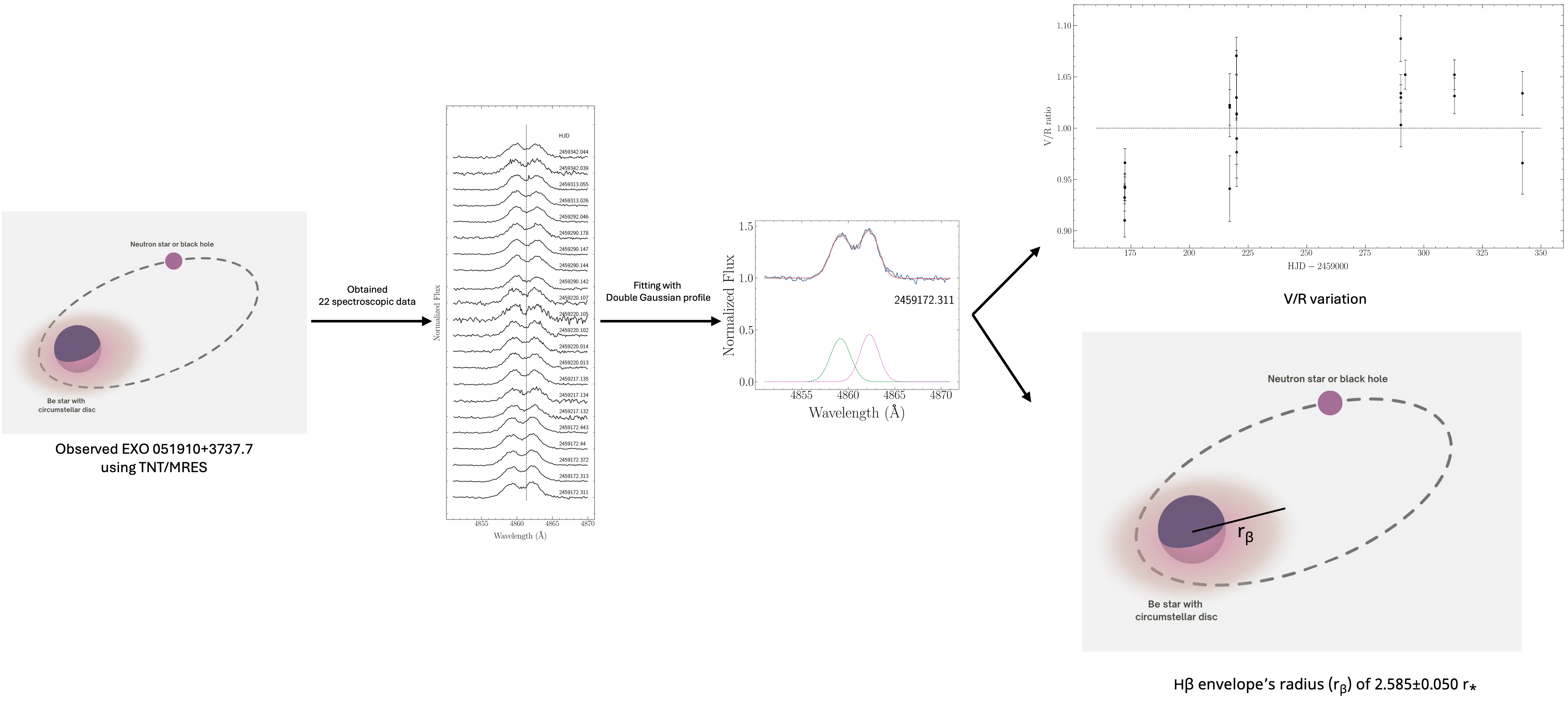
Downloads
References
QZ Liu, J van Paradijs and EPJ van den Heuvel. Catalogue of high-mass X-ray binaries in the Galaxy (4th edition). Astron. Astrophys. 2006; 455, 1165-1168.
AJ Bird, A Bazzano, A Malizia, M Fiocchi, V Sguera, L Bassani, AB Hill, P Ubertini and C Winkler. The IBIS Soft Gamma-Ray Sky after 1000 Integral Orbits. Astrophys. J. Suppl. S. 2006; 223, 15.
M Neumann, A Avakyan, V Doroshenko and A Santangelo. XRBcats: Galactic High Mass X-ray Binary Catalogue. Astron. Astrophys. 2023; 677, A134.
R Walter, AA Lutovinov, E Bozzo and SS Tsygankov. High-mass X-ray binaries in the Milky Way. A closer look with INTEGRAL. Astron. Astrophys. Rev. 2015; 23, 2.
AT Okazaki and I Negueruela. A natural explanation for periodic X-ray outbursts in Be/X-ray binaries. Astron. Astrophys. 2001; 377, 161-174.
VF Polcaro, C Lapadula, F Giovannelli, M Ferrari-Toniolo, P Persi, RK Manchanda, L Norci, C Rossi, IM Golinnskaya, VG Kurt, TA Misykima, EY Shafer, VM Shamolin, AS Smirnov, EK Sheffer, AA Boyarchuck and R Gershberg. Search of the Optical Counterpart of the X-Rays Source 1H:0521+373. ESA Special Publication 1989; 1, 579.
Gaia Collaboration. VizieR Online Data Catalog: Gaia DR3 Part 1. Main source (Gaia Collaboration, 2022). VizieR Online Data Catalog 2022; I/355.
C Rossi, L Norci and VF Polcaro. Rapid variability of BD +37 1160, a possible optical counterpart of the X-ray source 1H 0521+373. Astron. Astrophys. 1991; 249, L19.
J Dachs, R Hanuschik, D Kaiser, D Ballereau, P Bouchet, R Kiehling, J Kozok, R Rudolph and W Schlosser. Measurements of Balmer emission line profiles for southern Be stars. II. New data and radial velocities. Astron. Astrophys. Sup. 1986; 63, 87-141.
J Dachs, R Hanuschik, D Kaiser, D Ballereau, P Bouchet, R Kiehling, J Kozok, R Rudolph and W Schlosser. Variability of Be-Stars. Pulsating B stars. In: Proceedings of the Workshop, at Nice Observatory. 1981, p. 217.
RE Mennickent. V/R variations in H-beta emission profiles of Be stars. Astron. Astrophys. 1991; 241, 159.
R Hirata and T Kogure. The Be star phenomena. II - Spectral formation and structure of envelopes. Bull. Astr. Soc. Ind. 1984; 12, 109.
A Underhill and V Doazan. B Stars with and without emission lines. Monograph Series on Nonthermal Phenomena in Stellar Atmospheres - NASA SP 456, Paris: Centre National de la Recherche Scientifique (CNRS) and Washington: NASA, 1982, p. 35-37.
EM Halbedel. Rotational Velocity Determinations for 164 Be and B Stars. Astr. Soc. P. 1996; 108, 833.
A Kramida, Y Ralchenko, J Reader and NIST ASD Team (2022). NIST Atomic Spectra Database (version 5.10), Available at: https://physics.nist.gov/asd, accessed October 2023.
Downloads
Published
How to Cite
Issue
Section
License
Copyright (c) 2023 Walailak University

This work is licensed under a Creative Commons Attribution-NonCommercial-NoDerivatives 4.0 International License.





