
Steam-Pressure-Assisted Template-Free Synthesis of Highly Porous Amorphous Silica Nanoparticles from Bantargebang MSWI Fly Ash
DOI:
https://doi.org/10.48048/tis.2026.13600Keywords:
Amorphous silica nanoparticles, Fly ash, Municipal Solid Waste Incineration (MSWI)Abstract
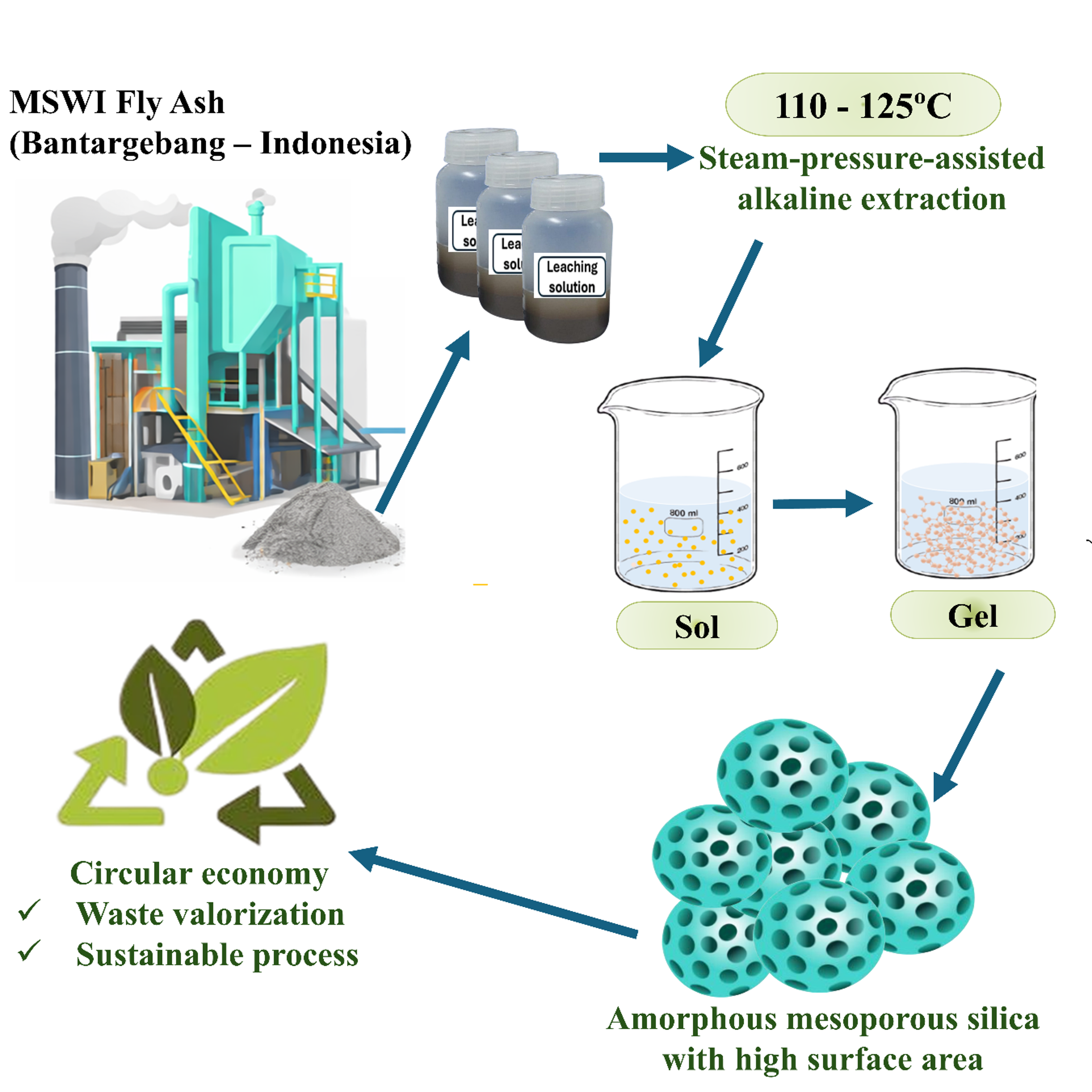
The Bantargebang Municipal Solid Waste Incineration (MSWI) pilot project provides a national model for sustainable waste management. The incineration process generates fly ash rich in mineral oxides, including calcium oxide (45.00%), silicon dioxide (13.40%), iron oxide (8.00%), and aluminum oxide (7.50%), providing a promising source of silica for further utilization. In this study, silicon dioxide was extracted from Bantargebang MSWI fly ash via sodium silicate formation and converted into amorphous silica nanoparticles through acid-induced sol-gel precipitation without organic structure-directing agents. Extraction time and heating temperature during sodium silicate preparation were systematically evaluated using inductively coupled plasma-optical emission spectroscopy (ICP-OES). The synthesized nanoparticles were characterized by Fourier transform infrared spectroscopy (FTIR), X-ray diffraction (XRD), transmission electron microscopy (TEM), and nitrogen adsorption-desorption analysis. Optimal conditions using a 2 h steam-pressure treatment at 125 °C yielded 20.00% silica. TEM revealed spherical, aggregated nanoparticles averaging 19.85 ± 0.09 nm at 110 °C and 17.40 ± 0.29 nm at 125 °C. Brunauer-Emmett-Teller (BET) analysis showed surface areas of 156.36 and 802.51 m² g⁻¹, with corresponding pore volumes of 0.75 and 1.85 cm³ g⁻¹, for silica synthesized at 110 and 125 °C, respectively. The high surface area and pore volume obtained at 125 °C confirm the formation of highly porous amorphous silica nanoparticles. These results highlight the potential of industrial fly ash as a sustainable source of high-performance silica. Owing to their exceptionally high surface area and well-developed porosity, the synthesized silica nanoparticles exhibit strong potential for future applications in environmental remediation, particularly as adsorbent materials for wastewater treatment.
HIGHLIGHTS
- First direct synthesis of amorphous mesoporous silica nanoparticles from Bantargebang municipal solid waste incineration fly ash (MSWI FA).
- Steam-pressure-assisted sol–gel extraction was successfully performed under mild hydrothermal conditions (110 - 125 °C).
- Acid washing and demineralization steps were intentionally omitted to simplify the process and improve its environmental sustainability.
GRAPHICAL ABSTRACT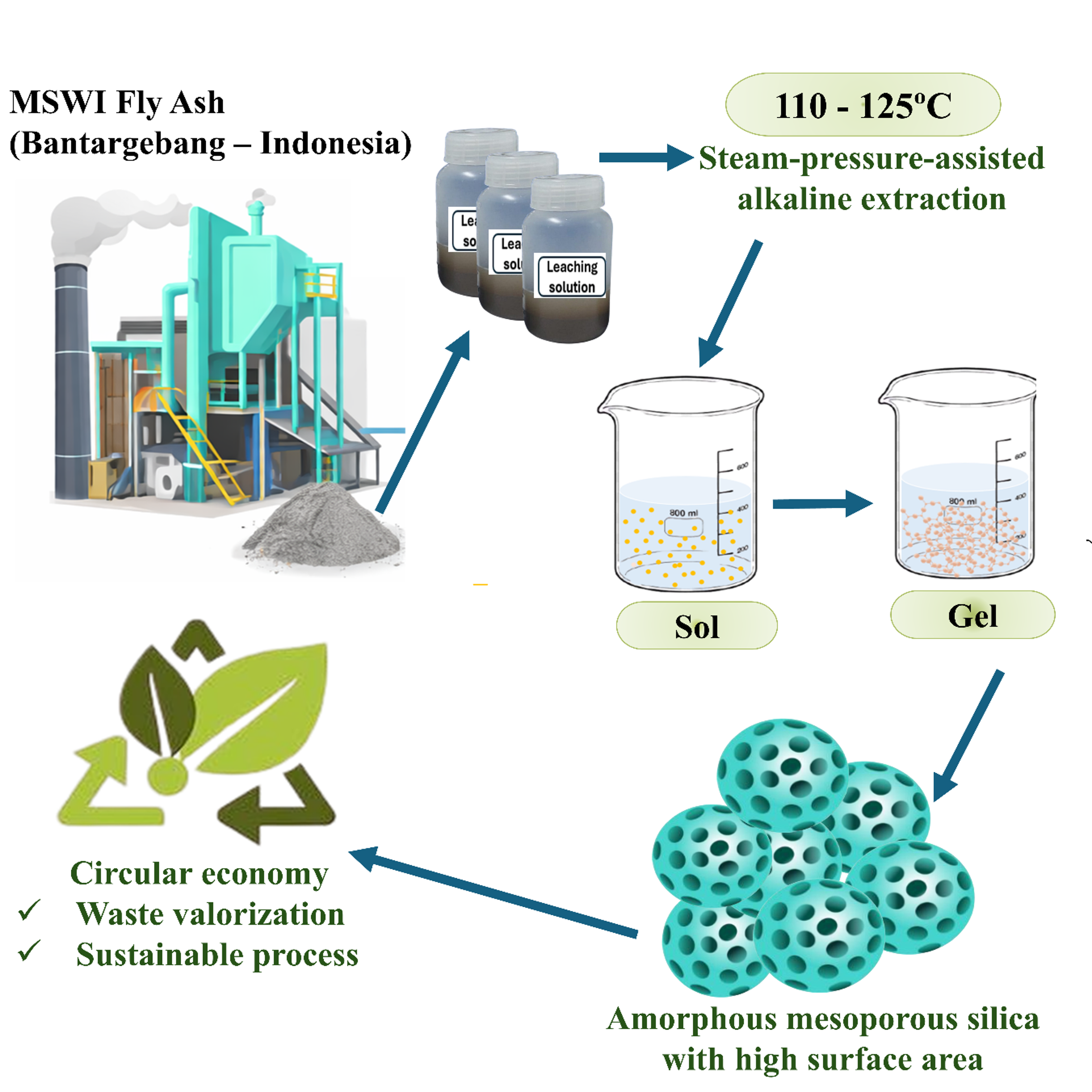
Downloads
References
Y Liu, T Tian, X Hao, Q Zhang, C Yao and G Liu. Promotion of household waste utilization in China: Lessons learnt from three case studies. Sustainability 2021; 13(21), 11598.
J Hidalgo-Crespo, P Rivas-García, EE García-Balandrán, A Albalate-Ramírez, S Quintero-Herrera, A Velastegui-Montoya, JLA Rivas and M Soto. Validating circular end-of-life strategies for domestic post-consumer materials in the latin american region: A life cycle assessment approach. Environments 2024; 11(11), 228.
DS Babu, AR Rao, AV Narayana and K Chandrasekhar. From waste to wealth: Biological methods and sustainability in municipal solid waste management. Industrial Biotechnology 2026; 22(4), 286-298.
SS Owoeye, SM Abegunde and B Oji. Effects of process variable on synthesis and characterization of amorphous silica nanoparticles using sodium silicate solutions as precursor by sol-gel method. Nano-Structures & Nano-Objects 2021; 25, 100625.
WS Winanti, W Purwanta and Wiharja. Utilization of municipal solid waste into electricity energy: A performance of PLTSa Bantargebang pilot project. IOP Conference Series: Earth and Environmental Science 2022; 1034, 012003.
AN Tugoy. Modern technologies for the thermal treatment of municipal solid waste, and prospects for their implementation in Russia (Review). Thermal Engineering 2021; 68(1), 1-16.
F Teng, Z Wang, K Ren, S Liu and H Ding. Analysis of composition characteristics and treatment techniques of municipal solid waste incineration fly ash in China. Journal of Environmental Management 2024; 357, 120783.
Y Chen, M Zhao, Y Lv, ZJ Ting, S Zhao, Z Liu, X Zhang, Y Yang, Y You and W Yuan. Utilization of municipal solid waste incineration fly ash as construction materials based on geopolymerization. Resources, Conservation and Recycling Advances 2023; 19, 200162.
C Vogelsang and M Umar. Municipal solid waste fly ash-derived zeolites as adsorbents for the recovery of nutrients and heavy metals: A review. Water 2023; 15(21), 3817.
Q Liu, X Wang, M Gao, Y Guan, C Wu, Q Wang, Y Rao and S Liu. Heavy metal leaching behaviour and long-term environmental risk assessment of cement-solidified municipal solid waste incineration fly ash in sanitary landfill. Chemosphere 2022; 300, 134571.
Y Wei, S Liu, R Yao, S Chen, J Gao and T Shimaoka. Removal of harmful components from MSWI fly ash as a pretreatment approach to enhance waste recycling. Waste Management 2022; 150, 110-121.
P Su, M Xia, K Chen, H Wang, X Li, Z Zhou, R Zhang, L Zhang and S Zhao. Study on the solidification/stabilization of MSWI fly ash by composite alkali-activated cementitious materials. ACS Omega 2025; 10(6), 5659-5667.
Z Zhang, C Zhao, Y Rao, C Yu, Z Luo, H Zhao, X Wang, C Wu and Q Wang. Solidification/ stabilization and risk assessment of heavy metals in municipal solid waste incineration fly ash: A review. Science of the Total Environment 2023; 892, 164451.
X Ren, K Song, D Liu and Z Pan. Leaching characteristics of sulfates and chlorides from fly ash produced by municipal solid waste incineration. Desalination and Water Treatment 2022; 273, 180-189.
Y Tian, NJ Themelis, D Zhao, ACT Bourtsalas and S Kawashima. Stabilization of Waste-to-Energy (WTE) fly ash for disposal in landfills or use as cement substitute. Waste Management 2022; 150, 227-243.
J Tan, JD Vlieger, P Desomer, J Cai and J Li. Co-disposal of construction and demolition waste (CDW) and municipal solid waste incineration fly ash (MSWI FA) through geopolymer technology. Journal of Cleaner Production 2022; 362, 132502.
Y Duan, X Liu, W Hong, Z Khalid, G Lv and X Jiang. Leaching behavior and comprehensive toxicity evaluation of heavy metals in MSWI fly ash from grate and fluidized bed incinerators using various leaching methods: A comparative study. Science of The Total Environment 2024; 914, 169595.
X Lin, Y Shen, Z Chen, J Chen, P Yi, Q Wang, X Li and J Yan. Insights into the environmental risk variation of heavy metals from MSWI fly ash after thermal plasma vitrification. Process Safety and Environmental Protection 2024; 191, 2533-2542.
M Nag and T Shimaoka. A novel and sustainable technique to immobilize lead and zinc in MSW incineration fly ash by using pozzolanic bottom ash. Journal of Environmental Management 2023; 329, 117036.
HA Ali, D Xuan, B Zhang, C Xiao and B Zhao. Cementitious characteristics and environmental behaviour of vitrified MSW incineration fly ash slag. Cleaner Materials 2022; 4, 100092.
AM Vele, FC Galisteo, E Atanes-Sánchez, A Nieto-Márquez and MJM de Vidales. Sustainable management of municipal solid waste incineration fly ash: A life cycle assessment based review of treatment and valorization pathways. Journal of Hazardous Materials Advances 2025; 19, 100817.
EI Anjana, K Aiswariya, KP Prathish, SK Sahoo and K Jayasankar. Recovery and recycling of silica fabric from waste printed circuit boards to develop epoxy composite for electrical and thermal insulation applications. Waste Management 2025; 198, 174-186.
T Bakalár, H Pavolová, Z Hajduová, R Lacko and K Kyšeľa. Metal recovery from municipal solid waste incineration fly ash as a tool of circular economy. Journal of Cleaner Production 2021; 302, 126977.
AH Kanhar, S Chen and F Wang. Incineration fly ash and its treatment to possible utilization: A review. Energies 2020; 13(24), 6681.
H Ye, J Shi, Y Wu, Y Yuan, L Gan, Y Wu, H Xie, A Pugazhendhi and C Xia. Research progress of nano-catalysts in the catalytic conversion of biomass to biofuels: Synthesis and application. Fuel 2024; 356, 129594.
YN Cao, JJ Luo and SQ Sun. Characteristics of MSWI fly ash with acid leaching treatment. Journal of Fuel Chemistry and Technology 2021; 49(8), 1208-1218.
PU Nzereogu, AD Omah, FI Ezema, EI Iwuoha and AC Nwanya. Silica extraction from rice husk: Comprehensive review and applications. Hybrid Advances 2023; 4, 100111.
D Shrestha, T Nayaju, MR Kandel, RR Pradhananga, CH Park and CS Kim. Rice husk-derived mesoporous biogenic silica nanoparticles for gravity chromatography. Heliyon 2023; 9(4), 15142.
GA Habte, TA Bullo and Y Ahmed. Statistical optimization characterizations and Eco- friendly synthesis of silica from sugarcane bagasse. Scientific Reports 2025; 15, 8492.
D Bokov, AT Jalil, S Chupradit, W Suksatan, MJ Ansari, IH Shewael, GH Valiev and E Kianfar. Nanomaterial by Sol-Gel Method: Synthesis and application. Advances in Materials Science and Engineering 2021; 2021, 5102014.
LAD Meiliyadi, M Wahyudi, K Arizona ANDZ Zain. Synthesis of nanosilica gel based on river sand and its use as water treatment. Journal of Materials and Environmental Science 2023; 14(11), 1204-1213.
S Aisvarya, M Kalyanasundaram, M Kannan, S Preetha, K Elango, T Srinivasan and K Govindaraju. Preparation and characterization of silica nanoparticles (sol-gel & river sand): A comparative toxicity studies against seed weevil (Sitophilus oryzae L). and effect on agro-morphological characteristics of maize seeds. Materials Science and Engineering: B 2023; 293, 116503.
PE Imoisili and TC Jen. Microwave-assisted sol-gel template-free synthesis and characterization of silica nanoparticles obtained from South African coal fly ash. Nanotechnology Reviews 2022; 11, 3042-3052.
P Markov, G Chernev, D Nintianova, N Kazakova and H Karakostov. Synthesis and characterization of nanoparticles from coal fly ash. Journal of Chemical Technology and Metallurgy 2024; 59(6), 1437-1441.
FF Hanum, A Rahayu and I Hapsauqi. The comparison effects of NaOH and KOH as solvents for silica extraction from two different coal fly ashes. Indonesian Journal of Chemical Research 2022; 10(1), 27-31.
PE Imoisili and TC Jen. Synthesis and characterization of amorphous nano silica from South African coal fly ash. Materials Today: Proceedings 2023; 105, 21-26.
Y Chambioso, AL Juwono and A Daulay. Synthesis and characterization of amorphous silica nanoparticles production from indonesia coal fly ash. Journal of Chemical Natural Resources 2025; 7(2), 96-104.
FO Ochedi, Y Liu and A Hussain. A review on coal fly ash-based adsorbents for mercury and arsenic removal. Journal of Cleaner Production 2020; 267, 122143.
SN Mahdi, DV Babu, M Shivakumar and MMAB Abdullah. Mitigation of environmental problems using brick kiln rice husk ash in geopolymer composites for sustainable development. Current Research in Green and Sustainable Chemistry 2021; 4, 100193.
PE Imoisili, KO Ukoba and TC Jen. Green technology extraction and characterisation of silica nanoparticles from palm kernel shell ash via sol-gel. Journal of Materials Research and Technology 2020; 9(1), 307-313.
TH Liou, SY Wang, YT Lin and S Yang. Sustainable utilization of rice husk waste for preparation of ordered nanostructured mesoporous silica and mesoporous carbon: Characterization and adsorption performance. Colloids and Surfaces A: Physicochemical and Engineering Aspects 2022; 636, 128150.
LA September, N Kheswa, NS Seroka and L Khotseng. Green synthesis of amorphous silica nanoparticles (SiO2NPs) from sugarcane bagasse ash by sol-gel method. Next Materials 2026; 10, 101396.
IH Nurwahid, LCC Dimonti, AA Dwiatmoko, JM Ha and RT Yunarti. Investigation on SiO2 derived from sugarcane bagasse ash and pumice stone as a catalyst support for silver metal in the 4-nitrophenol reduction reaction. Inorganic Chemistry Communications 2022; 135, 109098.
NAA Razak, NH Othman, MSM Shayuti, A Jumahat, N Sapiai and WJ Lau. Agricultural and industrial waste-derived mesoporous silica nanoparticles: A review on chemical synthesis route. Journal of Environmental Chemical Engineering 2022; 10(2), 107322.
J Xia, B Zhao, Y Guo, K Li, Q Na, S He and J Zhang. Synergistic alkali fusion-acid leaching strategy for silica aerogel synthesis from fly ash and performance optimization. Scientific Reports 2025; 15, 40299
N Nurmalita, SN Abdulmadjid, A Setiawan, R Idroes and Z Jali. Characteristics of silica powder extracted from fly ash of coal fired power plant – effect of heat treatment process. Journal of Ecological Engineering 2023; 24(9), 282-292.
HIFULL. Fumed silica. Hubei Huifu Nanomaterial Co., Ltd., Hubei, China, 2020.
HIFULL. Hydrophilic fumed silica. Hubei Huifu Nanomaterial Co., Ltd., Hubei, China, 2020.
F Aghabeyk, B Chen, MB van Zijl and G Ye. Physicochemical characterization and resource recovery potential of hazardous municipal solid waste incineration (MSWI) fly ash and air pollution control (APC) residues in the Netherlands. Journal of Environmental Management 2025; 384, 125579.
C Zhou, Q Gao, W Luo, Q Zhou, H Wang, C Yan and P Duan. Preparation, characterization and adsorption evaluation of spherical mesoporous Al-MCM-41 from coal fly ash. Journal of the Taiwan Institute of Chemical Engineers 2015; 52, 147-157.
Y Zhang, L Wang, L Chen, B Ma, Y Zhang, W Ni and DCW Tsang. Treatment of municipal solid waste incineration fly ash: State-of-the-art technologies and future perspectives. Journal of Hazardous Materials 2021; 411, 125132.
X Qu, Y Wang, F Chen, C Li, Y He, J Dou, S Zhang, J Ding, H Zhang and Y Zhong. Evaluation of fly ash composition from municipal solid waste incinerators: The role of the incinerator type and flue gas deacidification process. Toxics 2025; 13(7), 588.
Q Wang, Y Peng, M Chen, M Xu, J Ding, Q Yao and S Lu. Synthesis of layered double hydroxides from municipal solid waste incineration fly ash for heavy metal adsorption. Science of the Total Environment 2024; 912, 169482.
CK Tsai, NAA Sezali, ZF Lin, JJ Horng and HL Ong. Efficient fluoride recovery from wastewater using mesoporous Ca-based nanomaterials derived from municipal solid waste incineration fly ash via fluidized bed crystallization. Journal of Environmental Chemical Engineering 2024; 12(6), 114550.
NT Mai, KT Hong, NTT Hang, NTH Lien, VH Tap, PTT Hang, TT Tham, VD Toan, TT Cuong, NT Hoa, DT Duong, NH Son, NT Nghia and DTL Chi. Analytical procedures using SEM/EDX equipment for determining heavy metals contents in fly ash genereated from domestic solid waste incinerators: A casestudy of Soc Son waste to power plant in Ha Noi. Vietnam Journal of Science and Technology 2024; 62(2), 312-323.
M Matinfar and JA Nychka. Process mapping of the sol-gel transition in acid-initiated sodium silicate solutions. Gels 2024; 10(10), 673.
R Fatima, P Katiyar and K Kushwaha. Recent advances in mesoporous silica nanoparticle: Synthesis, drug loading, release mechanisms, and diverse applications. Frontiers in Nanotechnology 2025; 7, 1564188.
L Xing, X Li, P Cao, J Luo and H Jiang. Stepwise extraction and utilization of silica and alumina from coal fly ash by mild hydrothermal process. Process Safety and Environmental Protection 2024; 182, 918-929.
R Yuan, X Fan, M Gan, Q Zhao, S Lu and S Li. Facile treatment of municipal solid waste incineration fly ash by one-step microwave hydrothermal method: Hazards detoxification and tobermorite synthesis. Journal of Environmental Chemical Engineering 2023; 11(3), 109768.
Y Han, S Han, S Kim, M Jung, HS Jeon, SQ Choi, K Kim and Y Kim. Mesoporous silica derived from municipal solid waste incinerator (MSWI) ash slag: Synthesis, characterization and use as supports for Au(iii) recovery. Materials 2021; 14(22), 6894.
Y Xiao, Y Huang, H Cheng, Z Zhu, M Yu, W Xu, Z Li, W Zuo, H Zhou and B Jin. Advances and outlook of heavy metal treatment technology from municipal solid waste incineration fly ash: A review. Energy and Fuels 2024; 38(2), 895-918.
A Saha, P Mishra, G Biswas and S Bhakta. Greening the pathways: A comprehensive review of sustainable synthesis strategies for silica nanoparticles and their diverse applications. RSC Advances 2024; 14(16), 11197-11216.
R Peng, MA Khan and CL Liu. Synthesis of silica nanoparticles and their application of Dielectric relaxation spectroscopy: A review. Results in Chemistry 2023; 6, 101218.
R Ellerbrock, M Stein and J Schaller. Comparing amorphous silica, short-range-ordered silicates and silicic acid species by FTIR. Scientific Reports 2022; 12, 11708.
N Meftah, A Hani and A Merdas. Extraction and physicochemical characterization of highly-pure amorphous silica nanoparticles from locally available dunes sand. Chemistry Africa 2023; 6, 3039-3048.
AM EL-Rafei. Preparation and characterization of mesoporous amorphous nano-silica and nano-cristobalite for value enhancement of low-cost Egyptian waste materials. Ceramics International 2022; 48(21), 32185-32195.
RH Ellerbrock, M Stein and J Schaller. Comparing silicon mineral species of different crystallinity using Fourier transform infrared spectroscopy. Frontiers in Environmental Chemistry 2024; 5, 1462678.
S Aprilia, CM Rosnelly, Zuhra, Fitriani, EH Akbar, M Raqib, K Rahmah, A Amin and RA Baity. Synthesis of amorphous silica from rice husk ash using the sol-gel method: Effect of alkaline and alkaline concentration. Materials Today: Proceedings 2023; 87(2), 225-229.
S Karafiludis, AG Buzanich, C Heinekamp, A Zimathies, GJ Smales, VD Hodoroaba, JE ten Elshof, F Emmerling and TM Stawski. Template-free synthesis of mesoporous and amorphous transition metal phosphate materials. Nanoscale 2023; 15(8), 3952-3966.
Downloads
Published
How to Cite
Issue
Section
License
Copyright (c) 2026 Walailak University

This work is licensed under a Creative Commons Attribution-NonCommercial-NoDerivatives 4.0 International License.





