
Chemical Profiling, Antioxidant, and Antibacterial Activities of Ethanolic Extract of Melaleuca cajuputi Flower and Its Mode of Action
DOI:
https://doi.org/10.48048/tis.2026.13457Keywords:
Melaleuca cajuputi, Antioxidant activity, Antibacterial activity, Liquid chromatography/mass spectrometry (LC/MS), Methicillin-resistant Staphylococcus aureus (MRSA)Abstract
Despite well-documented antimicrobial properties of Melaleuca cajuputi extracts, particularly from leaves and essential oils, the antibacterial potential of flower extracts against multidrug-resistant (MDR) pathogens, such as methicillin-resistant Staphylococcus aureus (MRSA), remains largely underexplored. This study characterized the phytochemical composition, antioxidant, and antibacterial activities of ethanol extracts from M. cajuputi flowers. Dried flowers of M. cajuputi were extracted with ethanol, followed by phytochemical analysis using liquid chromatography/mass spectrometry (LC/MS). Antioxidant activity was determined using 1,1-diphenyl-2-picryl hydrazyl (DPPH) radical and 2,2′-azino-bis(3-ethylbenzothiazoline-6-sulfonic acid (ABTS) radical scavenging assay. Antibacterial activity of the crude extract was assessed using the agar well diffusion method. The minimal inhibitory concentrations (MICs) and minimum bactericidal concentrations (MBCs) were determined by microdilution, including time-kill assays. Scanning electron microscopy (SEM) was employed to investigate the effects of the extract on the morphology of MRSA cells. Phytochemical profiling established that the extract was abundant in phenolics, flavonoids, and tannins. Notable antioxidant capacity was observed, with IC50 values of 11.28 ± 0.30 μg/mL (DPPH) and 61.90 ± 14.84 μg/mL (ABTS). Evaluation against 5 significant bacterial pathogens, including MRSA, revealed broad-spectrum inhibitory effects. The lowest recorded MIC and MBC values were 0.33 and 5.31 mg/mL, respectively, with ranges spanning 0.33 - 125 mg/mL (MIC) and 5.31 - 250 mg/mL (MBC). Time-kill studies indicated concentration- and time-dependent bactericidal mode of action against most strains. At the same time, MRSA was primarily inhibited in a bacteriostatic manner. SEM revealed dose-dependent morphological damage to MRSA cells, including membrane disruption and shrinkage, indicating compromised cell envelope integrity. These findings indicate that M. cajuputi flower extract is a promising candidate for natural antibacterial and antioxidant applications, meriting further investigation for its role in controlling MDR bacterial infections.
HIGHLIGHTS
- Ethanolic extract of cajuputi flowers contains high phenolics, flavonoids, and tannins.
- The extract shows strong antioxidant and broad‑spectrum antibacterial activities.
- cajuputi flower extract inhibits both Gram‑positive and Gram‑negative bacteria.
- The extract acts via bactericidal and bacteriostatic modes of action.
- The extract damages MRSA cell morphology and membrane integrity.
GRAPHICAL ABSTRACT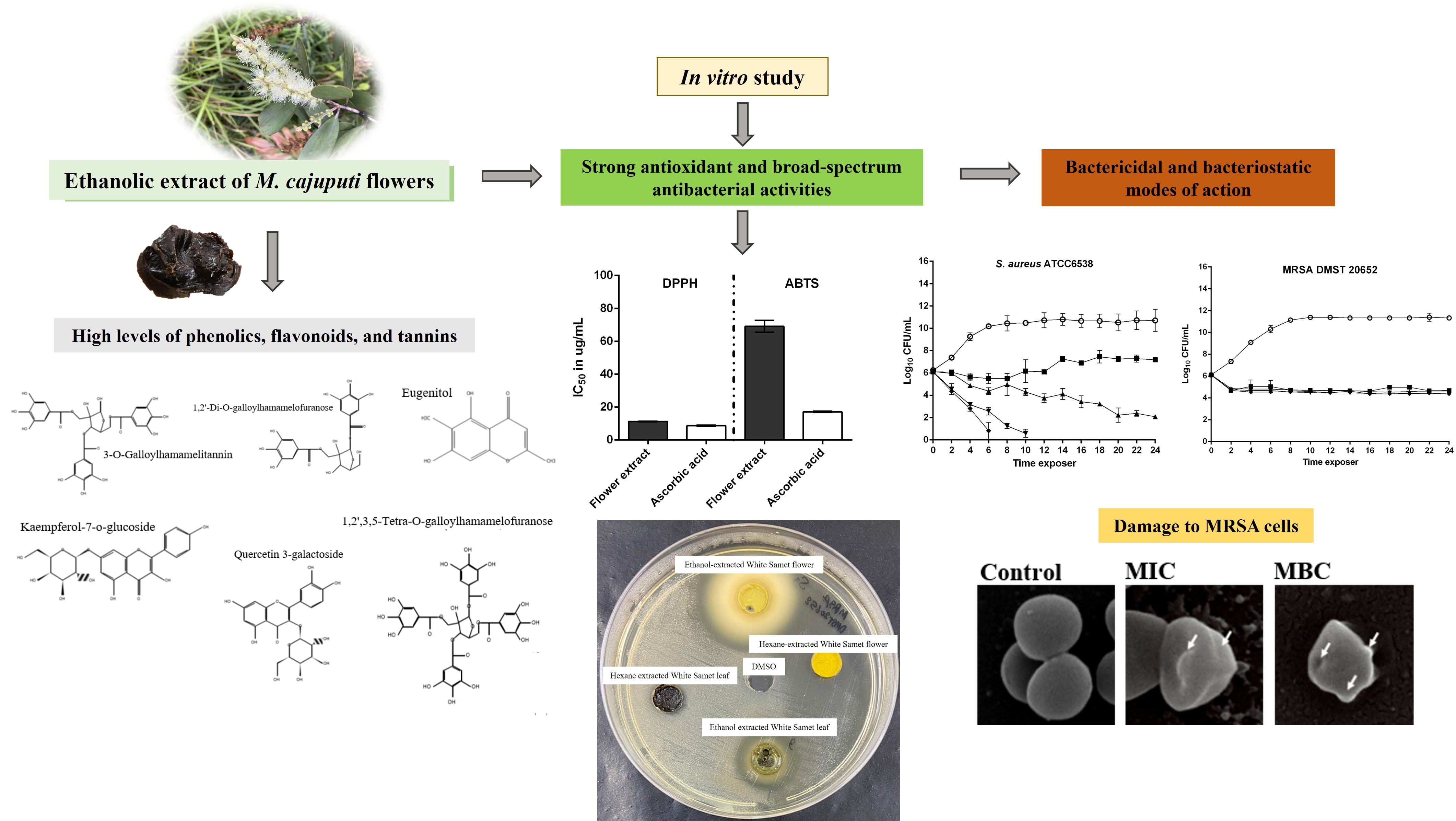
Downloads
References
A Parmanik, S Das, B Kar, A Bose, GR Dwivedi and MM Pandey. Current treatment strategies against multidrug-resistant bacteria: A review. Current Microbiology 2022; 79(12), 388.
OF Nwabor, S Leejae and SP Voravuthikunchai. Rhodomyrtone accumulates in bacterial cell wall and cell membrane and inhibits the synthesis of multiple cellular macromolecules in epidemic methicillin-resistant Staphylococcus aureus. Antibiotics 2021; 10(5), 543.
J Sharifi-Rad, B Salehi, EM Varoni, F Sharopov, Z Yousaf, SA Ayatollahi, F Kobarfard, M Sharifi-Rad, MH Afdjei, M Sharifi-Rad and M Iriti. Plants of the Melaleuca genus as antimicrobial agents: From farm to pharmacy. Phytotherapy Research 2017; 31(10), 1475-1494.
NM Al-Abd, ZM Nor, M Mansor, F Azhar, MS Hasan and M Kassim. Antioxidant, antibacterial activity, and phytochemical characterization of Melaleuca cajuputi extract. BMC Complementary and Alternative Medicine 2015; 15(1), 385.
AAM Noor. Melaleuca cajuputi Powell essential oil: A review of botanical, phytochemical and pharmacological properties. Borneo Journal of Resource Science and Technology 2023; 13(2), 1-12.
FMA Bar. Genus Melaleuca: A review on the phytochemistry and pharmacological activities of the non-volatile components. Records of Natural Products 2021; 15(4), 219-242.
CJL Murray. Global burden of bacterial antimicrobial resistance, 1990-2021: A systematic analysis with forecasts to 2050. The Lancet 2024; 404(10459), 1199-1226.
MH Nabi, FH Rupa, I Jahan, ABMN Hasan, F Naz, I Masud, MDH Hawlader and M Hossian. Water, sanitation, and hygiene (WASH) factors and the incidence of communicable diseases in Urban Bangladesh: Evidence from municipal areas. PLOS Neglected Tropical Diseases 2025; 19(7), e0013329.
N Hiermandi, C Foster, J Campbell, K Purnell, E Tocco, T Koy, K Nobleza, D Nguyen and L Marquez. Impact of methicillin-resistant Staphylococcus aureus surveillance and decolonization in the NICU: The Texas children's hospital experience. Antimicrobial Stewardship & Healthcare Epidemiology 2025; 5(1), e60.
NA Turner, BK Sharma-Kuinkel, SA Maskarinec, EM Eichenberger, PP Shah, M Carugati, TL Holland and VG Fowler. Methicillin-resistant Staphylococcus aureus: An overview of basic and clinical research. Nature Reviews Microbiology 2019; 17(4), 203-218.
A Selim, M Marzok, HS Gattan and AM Hereba. Prevalence of methicillin-resistant Staphylococcus aureus (MRSA) in Egyptian water buffaloes and risk factors for subclinical mastitis. Transboundary and Emerging Diseases 2025; 2025(1), 8862271.
SP Voravuthikunchai and L Kitpipit. Activity of medicinal plant extracts against hospital isolates of methicillin-resistant Staphylococcus aureus. Clinical Microbiology and Infection 2005; 11(6), 510-512.
M Isah, MD Sul’Ain, WWA Wahab, H Abdullah, S Jamil, N Syamira M Shabudin, AN Shuid and WRW Ishak. Chemical profiling and mechanistic insights into the antibacterial efficacy of Melaleuca cajuputi leaf extract. BMC Complementary Medicine and Therapies 2025; 25(1), 121.
S Khongsai, C Chalad and P Phumee. Phytochemical analysis, in vitro screening of antioxidant and antibacterial potential of cajuput (Melaleuca cajuputi) extract against pathogenic Vibrio spp. Tropical Journal of Natural Product Research 2024; 8(12), 9517-9523.
NZA Wahab, NS Aqilah Ja’Afar and SB Ismail. Evaluation of antibacterial activity of essential oils of Melaleuca cajuputi Powell. Journal of Pure & Applied Microbiology 2022; 16(1), 549-556.
S Nanasombat, K Yansodthee and I Jongjaited. Evaluation of antidiabetic, antioxidant and other phytochemical properties of Thai fruits, vegetables and some local food plants. Walailak Journal of Science and Technology 2018; 16(11), 851-866.
S Settharaksa, F Madaka, K Chakree and L Charoenchai. Total phenolic and flavonoid contents and antioxidant properties of Thai traditional herbal. International Journal of Pharmacy and Pharmaceutical Sciences 2014; 6(9), 564-566.
M Haile and WH Kang. Antioxidant activity, total polyphenol, flavonoid and tannin contents of fermented green coffee beans with selected yeasts. Fermentation 2019; 5(1), 29.
R Sawczuk, J Karpinska, D Filipowska, A Bajguz and M Hryniewicka. Evaluation of total phenols content, anti-DPPH activity and the content of selected antioxidants in the honeybee drone brood homogenate. Food Chemistry 2022; 368, 130745.
OM Noman, FA Nasr, AS Alqahtani, M Al-zharani, MAW Cordero, AA Alotaibi, A Bepari, S Alarifi and A Daoud. Comparative study of antioxidant and anticancer activities and HPTLC quantification of rutin in white radish (Raphanus sativus L.) leaves and root extracts grown in Saudi Arabia. Open Chemistry 2021; 19(1), 408-416.
S Arora, SA Saquib, YA Algarni, MA Kader, I Ahmad, MY Alshahrani, P Saluja, SM Baba, AM Abdulla and SS Bavabeedu. Synergistic effect of plant extracts on endodontic pathogens isolated from teeth with root canal treatment failure: An in vitro study. Antibiotics 2021; 10(5), 552.
M Bakht, SA Alizadeh, S Rahimi, RK Anari, M Rostamani, A Javadi, A Peymani, SMA Marashi and F Nikkhahi. Phenotype and genetic determination of resistance to common disinfectants among biofilm-producing and non-producing Pseudomonas aeruginosa strains from clinical specimens in Iran. BMC Microbiology 2022; 22, 114.
G Montrucchio, S Corcione, G Sales, A Curtoni, FG De Rosa and L Brazzi. Carbapenem-resistant Klebsiella pneumoniae in ICU-admitted COVID-19 patients: Keep an eye on the ball. Journal of Global Antimicrobial Resistance 2020; 23, 398-400.
K Kawamura-Sato, JI Wachino, T Kondo, H Ito and Y Arakawa. Reduction of disinfectant bactericidal activities in clinically isolated Acinetobacter species in the presence of organic material. Journal of Antimicrobial Chemotherapy 2008; 61(3), 568-576.
A Mordmuang, E Brouillette, SP Voravuthikunchai and F Malouin. Evaluation of a Rhodomyrtus tomentosa ethanolic extract for its therapeutic potential on Staphylococcus aureus infections using in vitro and in vivo models of mastitis. Veterinary Research 2019; 50(1), 49.
S Santajit, T Thavorasak, D Horpet, T Kong-Ngoen, U Permpoon, CY Kim, TG Nam and N Indrawattana. Phytochemical inhibition of quorum sensing and biofilm formation by Paederia foetida Linn. against multidrug-resistant Acinetobacter baumannii: An integrated in vitro and in silico investigation. Veterinary World 2025; 18(8), 2181.
M Isah, RA Rosdi, H Abdullah, MD Sul’Ain and WRW Ishak. Phytoconstituents and biological activities of Melaleuca cajuputi Powell: A scoping review. Journal of Applied Pharmaceutical Science 2023; 13(1), 010-023.
W Hou, W Zhang, G Chen and Y Luo. Optimization of extraction conditions for maximal phenolic, flavonoid and antioxidant activity from Melaleuca bracteata leaves using the response surface methodology. PLoS One 2016; 11(9), e0162139.
S Assaw, MIH Mohd Amir, TT Khaw, K Bakar, SA Mohd Radzi and NW Mazlan. Antibacterial and antioxidant activity of naphthofuranquinones from the twigs of tropical mangrove Avicennia officinalis. Natural Product Research 2020; 34(16), 2403-2406.
QD Do, AE Angkawijaya, PL Tran-Nguyen, LH Huynh, FE Soetaredjo, S Ismadji and YH Ju. Effect of extraction solvent on total phenol content, total flavonoid content, and antioxidant activity of Limnophila aromatica. Journal of Food and Drug Analysis 2014; 22(3), 296-302.
PH Tran, TTT Vu, TDT Phan, VM Nguyen, TNM Ngo, CVC Le and THD Ton. Chemical compositions and biological properties of the leaf essential oil of three Melaleuca species. World Academy of Sciences Journal 2024; 6(6), 67.
A Roy, A Khan, I Ahmad, S Alghamdi, BS Rajab, AO Babalghith, MY Alshahrani, S Islam and R Islam. Flavonoids a bioactive compound from medicinal plants and its therapeutic applications. BioMed Research International 2022; 2022(1), 5445291.
J Huang, M Zaynab, Y Sharif, J Khan, R Al-Yahyai, M Sadder, M Ali, SR Alarab and S Li. Tannins as antimicrobial agents: Understanding toxic effects on pathogens. Toxicon 2024; 247, 107812.
X Villanueva, L Zhen, JN Ares, T Vackier, H Lange, C Crestini and HP Steenackers. Effect of chemical modifications of tannins on their antimicrobial and antibiofilm effect against Gram-negative and Gram-positive bacteria. Frontiers in Microbiology 2023; 13, 987164.
H Han, B Xu, A Amin, H Li, X Yu, M Gong and L Zhang. Quercetin-3-O-α-L-rhamnopyranoside derived from the leaves of Lindera aggregata (Sims) Kosterm. evokes the autophagy-induced nuclear factor erythroid 2-related factor 2 antioxidant pathway in human umbilical vein endothelial cells. International Journal of Molecular Medicine 2019; 43(1), 461-474.
D Aggarwal, M Chaudhary, SK Mandotra, HS Tuli, R Chauhan, NC Joshi, D Kaur, L Dufossé and A Chauhan. Anti-inflammatory potential of quercetin: From chemistry and mechanistic insight to nanoformulations. Current Research in Pharmacology and Drug Discovery 2025; 8, 100217.
D Yang, T Wang, M Long and P Li. Quercetin: Its main pharmacological activity and potential application in clinical medicine. Oxidative Medicine and Cellular Longevity 2020; 2020, 8825387.
ROS Damasceno, JLS Pinheiro, LHM Rodrigues, RC Gomes, ABS Duarte, JJ Emidio, LRL Diniz and DP de Sousa. Anti-inflammatory and antioxidant activities of eugenol: An update. Pharmaceuticals 2024; 17(11), 1505.
MK Elbestawy, GM El-Sherbiny and SA Moghannem. Antibacterial, antibiofilm and anti-inflammatory activities of eugenol clove essential oil against resistant Helicobacter pylori. Molecules 2023; 28(6), 2448.
H Cheng, H Liu, X Qi, Y Fan, Z Yuan, Y Xu, Y Liu, K Guo and S Li. Anti-inflammatory and hepatoprotective triterpenoids from the traditional Mongolian medicine Gentianopsis barbata. Chinese Journal of Natural Medicines 2025; 23(9), 1111-1121.
JX Ma, CS Cai, JJ Liu, S Gao, GZ Zhao and XW He. In vitro antibacterial and antitumor activity of total triterpenoids from a medicinal mushroom Sanghuangporus sanghuang (Agaricomycetes) in liquid fermentation culture. International Journal of Medicinal Mushrooms 2021; 23(7), 27-39.
G Renda, İ Gökkaya and D Şöhretoğlu. Immunomodulatory properties of triterpenes. Phytochemistry Reviews 2022; 21(2), 537-563.
M Wang, S Jiang, N Hussain, S Zafar, Q Xie, F Huang, L Mao, B Li, Y Jian and W Wang. Anti-RAFLS triterpenoids and hepatoprotective lignans from the leaves of Tujia ethnomedicine Kadsura heteroclita (Xuetong). Frontiers in Chemistry 2022; 10, 878811.
N Mohammadi, ADS Lima, L Azevedo and D Granato. Bridging the gap in antioxidant activity of flavonoids: Correlating the oxidation of human plasma with chemical and cellular assays. Current Research in Food Science 2024; 8, 100714.
NW Albert, DJ Lafferty, SM Moss and KM Davies. Flavonoids-flowers, fruit, forage and the future. Journal of the Royal Society of New Zealand 2023; 53(3), 304-331.
J Rumpf, R Burger and M Schulze. Statistical evaluation of DPPH, ABTS, FRAP, and Folin-Ciocalteu assays to assess the antioxidant capacity of lignins. International Journal of Biological Macromolecules 2023; 233, 123470.
F Shahidi and J Yeo. Bioactivities of phenolics by focusing on suppression of chronic diseases: A review. International Journal of Molecular Sciences 2018; 19(6), 1573.
GA Pankey and LD Sabath. Clinical relevance of bacteriostatic versus bactericidal mechanisms of action in the treatment of Gram-positive bacterial infections. Clinical Infectious Diseases 2004; 38(6), 864-870.
TT Cushnie and AJ Lamb. Recent advances in understanding the antibacterial properties of flavonoids. International Journal of Antimicrobial Agents 2011; 38(2), 99-107.
I Wiegand, K Hilpert and RE Hancock. Agar and broth dilution methods to determine the minimal inhibitory concentration (MIC) of antimicrobial substances. Nature Protocols 2008; 3(2), 163-175.
M Takó, EB Kerekes, C Zambrano, A Kotogán, T Papp, J Krisch and C Vágvölgyi. Plant phenolics and phenolic-enriched extracts as antimicrobial agents against food-contaminating microorganisms. Antioxidants 2020; 9(2), 165.
A Lobiuc, NE Pavăl, II Mangalagiu, R Gheorghiță, GC Teliban, D Amăriucăi-Mantu and V Stoleru. Future antimicrobials: Natural and functionalized phenolics. Molecules 2023; 28(3), 1114.
N Ibrahim and WA Yaacob. Disruption of methicillin-resistant Staphylococcus aureus protein synthesis by tannins. Germs 2017; 7(4), 186.
N Shen, T Wang, Q Gan, S Liu, L Wang and B Jin. Plant flavonoids: Classification, distribution, biosynthesis, and antioxidant activity. Food Chemistry 2022; 383, 132531.
OS Faleye, JH Lee and J Lee. Selected flavonoids exhibit antibiofilm and antibacterial effects against Vibrio by disrupting membrane integrity, virulence and metabolic activities. Biofilm 2023; 6, 100165.
MS Mohamed, K Abdelkader, HA Gomaa, AS Batubara, M Gamal and AM Sayed. Mechanistic study of the antibacterial potential of the prenylated flavonoid auriculasin against Escherichia coli. Archiv der Pharmazie 2022; 355(12), 2200360.
W Xu, Z Lin, C Cortez-Jugo, GG Qiao and F Caruso. Antimicrobial phenolic materials: From assembly to function. Angewandte Chemie International Edition 2025; 64(13), e202423654.
Z Breijyeh, B Jubeh and R Karaman. Resistance of gram-negative bacteria to current antibacterial agents and approaches to resolve it. Molecules 2020; 25(6), 1340.
V Priya, S Nagarathna and KH Veena. Molecular characterization of methicillin-resistant Staphylococcus aureus: Dissemination of multidrug-resistant community-associated MRSA and emergence of LA-MRSA, in a healthcare setting. Indian Journal of Medical Microbiology 2025; 54, 100810.
F Sheydai and A Tukmechi. Cell wall disruption, membrane damage, and decrease in the expression of Yrp1 virulence factor in Yersinia ruckeri by propolis ethanol extract. Iranian Journal of Microbiology 2023; 15(4), 533.
M Hartmann, M Berditsch, J Hawecker, MF Ardakani, D Gerthsen and AS Ulrich. Damage of the bacterial cell envelope by antimicrobial peptides gramicidin S and PGLa as revealed by transmission and scanning electron microscopy. Antimicrobial Agents and Chemotherapy 2010; 54(8), 3132-3142.
EHL Chen, CH Wang, YT Liao, FY Chan, Y Kanaoka, T Uchihashi, K Kato, L Lai, YW Chang, MC Ho and RPY Chen. Visualizing the membrane disruption action of antimicrobial peptides by cryo-electron tomography. Nature Communications 2023; 14(1), 5464.
Published
How to Cite
Issue
Section
License
Copyright (c) 2026 Walailak University

This work is licensed under a Creative Commons Attribution-NonCommercial-NoDerivatives 4.0 International License.





