
High-Capacity Removal of Lead and Cadmium Using FGD Gypsum-Derived Hydroxyapatite: Kinetic and Equilibrium Adsorption Studies
DOI:
https://doi.org/10.48048/tis.2026.13418Keywords:
Hydroxyapatite, Flue gas desulfurization gypsum, FGD, Adsorption, Heavy metals, HydrothermalAbstract
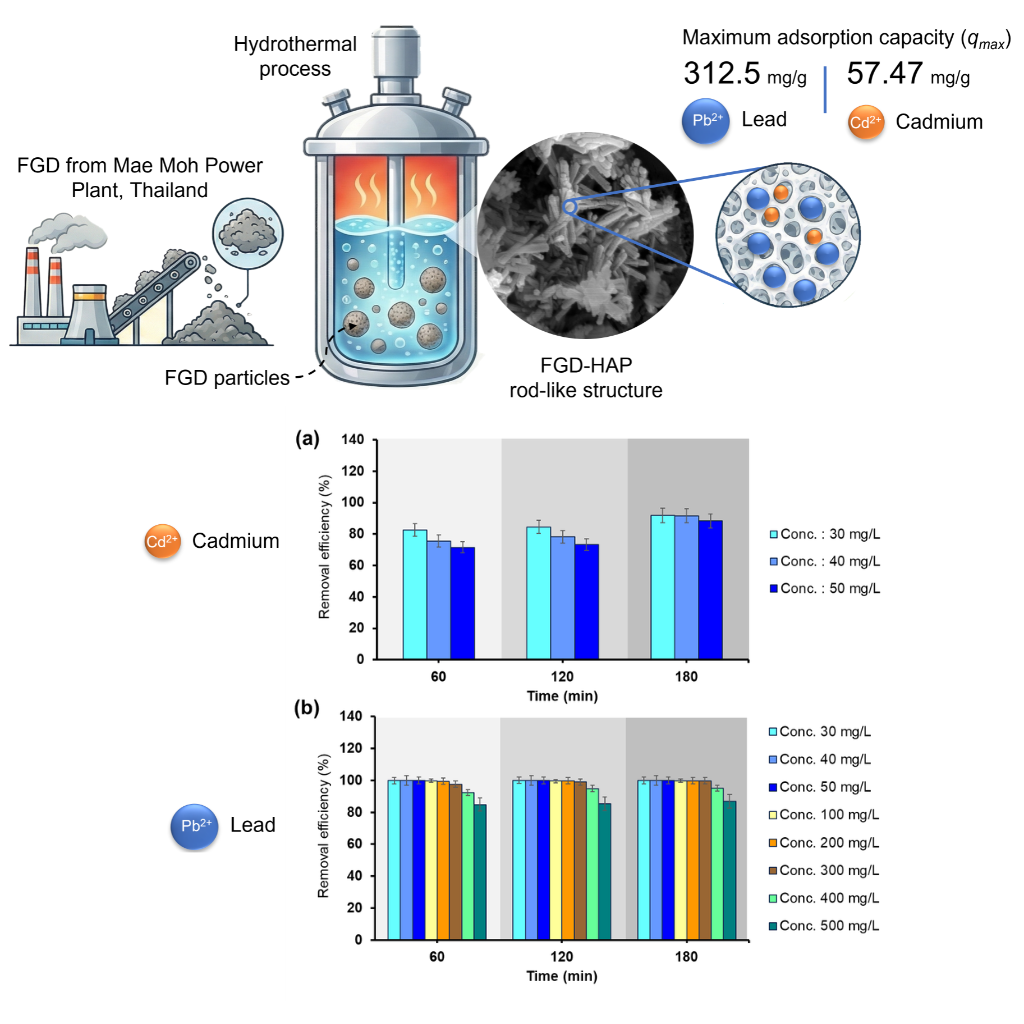
Power plant FGD gypsum was successfully valorized into high-purity hydroxyapatite (FGD-HAP) via a hydrothermal route at 150 °C. Structural and textural analyses confirmed the formation of well-crystallized hexagonal hydroxyapatite with a phase purity of 93.9% and a mesoporous morphology favorable for adsorption processes. Batch adsorption experiments demonstrated exceptional removal efficiencies toward Pb²⁺ and Cd²⁺ ions, achieving maximum adsorption capacities of 312.5 and 57.47 mg/g, respectively. Kinetic data were best described by the pseudo-second-order model, while equilibrium data fitted well with the Langmuir isotherm, indicating monolayer adsorption. Mechanistic analysis based on the Dubinin-Radushkevich model revealed that Pb²⁺ removal was dominated by ion exchange and surface chemical interactions, whereas Cd²⁺ adsorption was governed primarily by physical adsorption. These findings highlight FGD gypsum as a sustainable and highly effective precursor for advanced adsorbents, offering a promising circular-economy solution for heavy-metal remediation in water treatment applications.
HIGHLIGHTS
- Waste valorization of FGD gypsum in Thailand provides a circular economy solution that simultaneously addresses industrial waste management - reducing landfill occupation and dust emissions - and environmental remediation
- The synthesized FGD-HAP exhibits a superior lead (Pb²⁺) adsorption capacity of 312.5 mg/g, which is significantly higher than many other waste-derived adsorbents, including HAP-biochar, eggshells, and bone ash.
- A detailed mechanistic analysis uncovered different removal processes for each metal. It showed that ion exchange and chemical reactions are the main mechanisms for removing Pb²⁺, whereas Cd²⁺ is mainly adsorbed onto the material's surface by physical processes.
GRAPHICAL ABSTRACT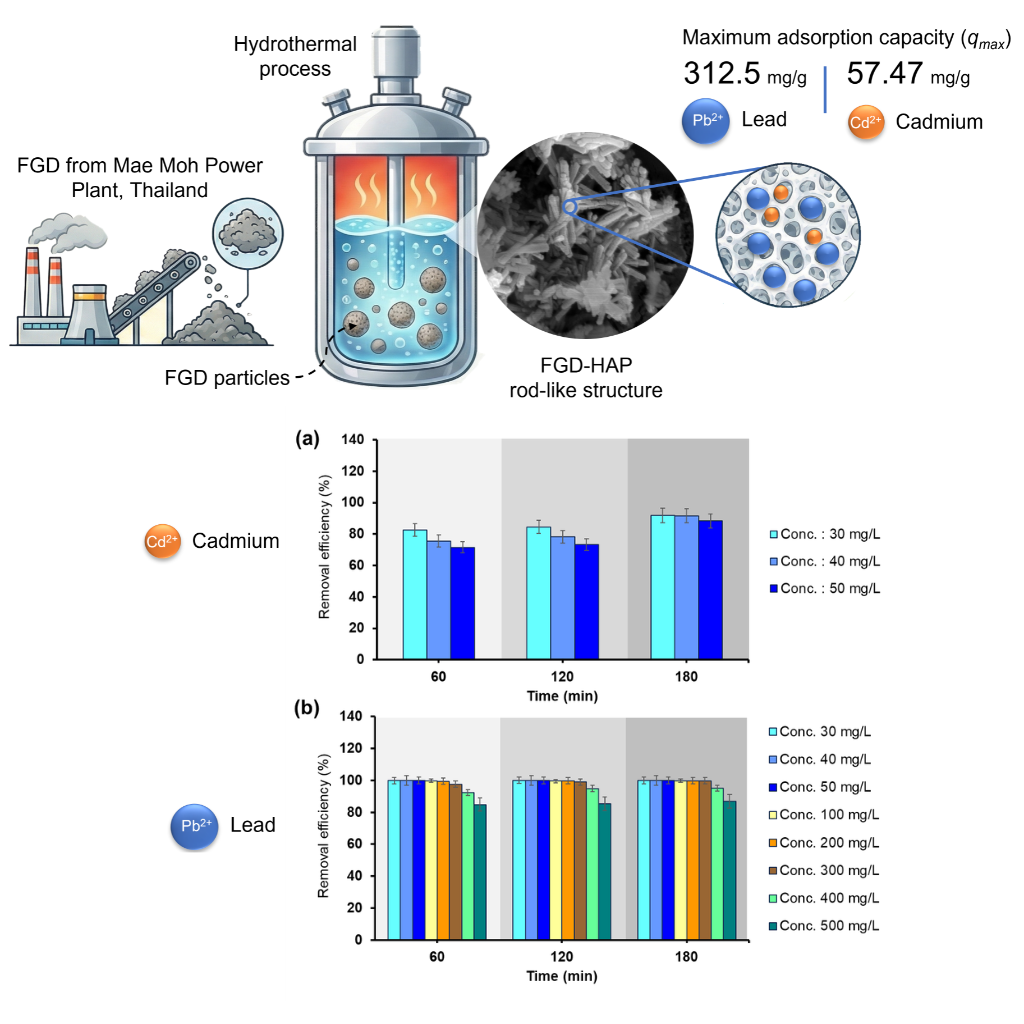
Downloads
References
Y Liu, Y Yan, B Seshadri, F Qi, Y Xu, N Bolan, F Zheng, X Sun, W Han and L Wang. Immobilization of lead and copper in aqueous solution and soil using hydroxyapatite derived from flue gas desulphurization gypsum. Journal of Geochemical Exploration 2018; 184(B), 239-246.
GK Kinuthia, V Ngure, D Beti, R Lugalia, A Wangila and L Kamau. Levels of heavy metals in wastewater and soil samples from open drainage channels in Nairobi, Kenya: Community health implication. Scientific Reports 2020; 10(1), 8434.
World Health Organization. A global overview of national regulations and standards for drinking-water quality 2018. World Health Organization, Geneva, Switzerland, 2018.
T Kikuchi and S Tanaka. Biological removal and recovery of toxic heavy metals in water environment. Critical Reviews in Environmental Science and Technology 2012; 42(10), 1007-1057.
Z Elouear, J Bouzid, N Boujelben, M Feki, F Jamoussi and A Montiel. Heavy metal removal from aqueous solutions by activated phosphate rock. Journal of Hazardous Materials 2008; 156(1), 412-420.
Y Yan, X Dong, X Sun, X Sun, J Li, J Shen, W Han, X Liu and L Wang. Conversion of waste FGD gypsum into hydroxyapatite for removal of Pb2+ and Cd2+ from wastewater. Journal of Colloid and Interface Science 2014; 429, 68-76.
A Corami, S Mignardi and V Ferrini. Cadmium removal from single- and multi-metal (Cd+Pb+Zn+Cu) solutions by sorption on hydroxyapatite. Journal of Colloid and Interface Science 2008; 317, 402-408.
E Mavropoulos, AM Rossi, AM Costa, CAC Perez, JC Moreira and M Saldanha. Studies on the mechanisms of lead immobilization by hydroxyapatite. Environmental Science & Technology 2002; 36(7), 1625-1629.
M Aliabadi, M Irani, J Ismaeili and S Najafzadeh. Design and evaluation of chitosan/hydroxyapatite composite nanofiber membrane for the removal of heavy metal ions from aqueous solution. Journal of the Taiwan Institute of Chemical Engineers 2014; 45(2), 518-526.
NM Pu'ad, RA Haq, HM Noh, HZ Abdullah, MI Idris and TC Lee. Synthesis method of hydroxyapatite: A review. Materials Today: Proceedings 2020; 29, 233-239.
S Kiziltas Demir and N Tugrul. Zinc and cadmium adsorption from wastewater using hydroxyapatite synthesized from flue gas desulfurization waste. Water Science and Technology 2021; 84(5), 1280-1292.
H Zhang, M Liu, H Fan and X Zhang. An efficient method to synthesize carbonated nano hydroxyapatite assisted by poly (ethylene glycol). Materials Letters 2012; 75, 26-28.
J Di Chen, YJ Wang, K Wei, SH Zhang and XT Shi. Self-organization of hydroxyapatite nanorods through oriented attachment. Biomaterials 2007; 28(14), 2275-2280.
S Kongsri, K Janpradit, K Buapa, S Techawongstien and S Chanthai. Nanocrystalline hydroxyapatite from fish scale waste: Preparation, characterization and application for selenium adsorption in aqueous solution. Chemical Engineering Journal 2013; 215, 522-532.
DP Minh, ND Tran, A Nzihou and P Sharrock. Calcium phosphate-based materials starting from calcium carbonate and orthophosphoric acid for the removal of lead (II) from an aqueous solution. Chemical Engineering Journal 2014; 243, 280-288.
J Hu, J Russell, B Ben-Nissan and R Vago. Production and analysis of hydroxyapatite from Australian corals via hydrothermal process. Journal of Materials Science Letters 2001; 20(1), 85-87.
A Fadli, SR Yenti, AP Wisrayetti, J Hasibuan, VG Herjan, A Isnani and R Restyanda. Optimisation of the hydroxyapatite surface area prepared using a porogen rubber suspension. Ceramics-Silikaty 2023; 67(3), 371-378.
SG Mtavangu, W Mahene, RL Machunda, B van der Bruggen and KN Njau. Cockle (Anadara granosa) shells-based hydroxyapatite and its potential for defluoridation of drinking water. Results in Engineering 2022; 13, 100379.
H Ma, A Khalaf, R Chen, Z Wang, Y Li and F Xu. Evaluation of flue gas desulfurization gypsum as a low-cost precipitant for phosphorus removal from anaerobic digestion effluent filtrate. IOP Conference Series: Earth and Environmental Science 2023; 1135(1), 012011.
F Zhang, Z Zhao, R Tan, W Xu, G Jiang and W Song. Efficient and selective immobilization of Pb2+ in highly acidic wastewater using strontium hydroxyapatite nanorods. Chemical Engineering Journal 2012; 203, 110-114.
L Ding, C Wu, H Deng and X Zhang. Adsorptive characteristics of phosphate from aqueous solutions by MIEX resin. Journal of Colloid and Interface Science 2012; 376(1), 224-232.
YS Ho and G McKay. Pseudo-second order model for sorption processes. Process Biochemistry 1999; 34(5), 451-465.
I Langmuir. The adsorption of gases on plane surface of glass, mica and platimnum. Journal of the American Chemical Society 1918; 40(9), 1361-1403.
H Freundlich. Über die adsorption in lösungen. Zeitschrift für Physikalische Chemie 1907; 57(1), 385-470.
MM Dubinin. The potential theory of adsorption of gases and vapors for adsorbents with energetically nonuniform surfaces. Chemical Reviews 1960; 60(2), 235-241.
H Demiral, I Demiral, F Tumsek and B Karabacakoglu. Adsorption of chromium (VI) from aqueous solution by activated carbon derived from olive bagasse and applicability of different adsorption models. Chemical Engineering Journal 2008; 144(2), 188-196.
W Ahmed, S Mehmood, A Núñez-Delgado, S Ali, M Qaswar, A Shakoor, M Mahmood and DY Chen. Enhanced adsorption of aqueous Pb(II) by modified biochar produced through pyrolysis of watermelon seeds. Science of the Total Environment 2021; 784, 147136.
MR Lasheen, NS Ammar and HS Ibrahim. Adsorption/desorption of Cd(II), Cu(II) and Pb(II) using chemically modified orange peel: Equilibrium and kinetic studies. Solid State Sciences 2012; 14(2), 202-210.
L Sun, J Wu, J Wang, M Xu, W Zhou, Y Du, Y Li and H Li. Fabricating hydroxyapatite functionalized biochar composite using steel slag and Hami melon peel for Pb(II) and Cd(II) removal. Colloids and Surfaces A: Physicochemical and Engineering Aspects 2023; 666, 131310.
R Foroutan, SJ Peighambardoust, SS Hosseini, A Akbari and B Ramavandi. Hydroxyapatite biomaterial production from chicken (femur and beak) and fishbone waste through a chemical less method for Cd2+ removal from shipbuilding wastewater. Journal of Hazardous Materials 2021; 413, 125428.
C Phaenark, T Jantrasakul, P Paejaroen, S Chunchob and W Sawangproh. Sugarcane bagasse and corn stalk biomass as a potential sorbent for the removal of Pb(II) and Cd(II) from Aqueous Solutions. Trends in Sciences 2023; 20(2), 6221.
PL Hariani, A Rachmat, M Said and S Salni. Modification of fishbone-based hydroxyapatite with MnFe2O4 for efficient adsorption of Cd(II) and Ni(II) from aqueous solution. Indonesian Journal of Chemistry 2021; 21, 1471.
Published
How to Cite
Issue
Section
License
Copyright (c) 2026 Walailak University

This work is licensed under a Creative Commons Attribution-NonCommercial-NoDerivatives 4.0 International License.





