
Preparation of Pectin Films from Coffee Cherry and Its Antibacterial Activity
DOI:
https://doi.org/10.48048/tis.2021.34Keywords:
Coffee cherry pectin, Low methoxyl pectin (LMP), Antibacterial activity, Pectin filmAbstract
This study aimed to utilize the waste from the coffee bean production process as high value-added material. Pectin extracted from the coffee pulp was classified as low methoxyl pectin (LMP) with the Degree of Esterification (DE) at 33.33 % For further application or upscaling production, the coffee pulp was boiled to retrieve the highest yield at 15.68 g/100 g DW. The antimicrobial assays of crude pectin via minimum inhibition concentration (MIC) showed that coffee pectin could inhibit the growth of Staphylococcus aureus TISTR 1466 in the range of 2.5 - 0.62 mg, while the commercial apple pectin exhibited the inhibition only slightly. The pectin film from the coffee pectin blended with the commercial apple pectin also exhibited antimicrobial activity against S. aureus TISTR 1466. This study shows that coffee pectin could be an alternative material for antibacterial film and other applications.
HIGHLIGHTS
- Pectin extracted from the coffee pulp by this extraction method is classified as low methoxyl pectin with the degree of esterification (DE) at 33.33 % which retrieve the highest yield at 15.68 g/100 g DW of coffee pulp
- The minimum inhibition concentration (MIC) of the coffee pectin against Staphylococcus aureus TISTR 1466 in the range of 2.5 - 0.62 mg, while the commercial apple pectin did not exhibit antimicrobial activity
- The pectin film from the coffee pectin 5 % blended with the commercial apple pectin also exhibited antimicrobial activity against aureus TISTR 1466
- Given its antibacterial activities, as well as the ability to form film, coffee pectin could be potentially used for application in biomedical or pharmaceutical fields. Importantly, pectin from the coffee pulp could add more value to coffee by-products
GRAPHICAL ABSTRACT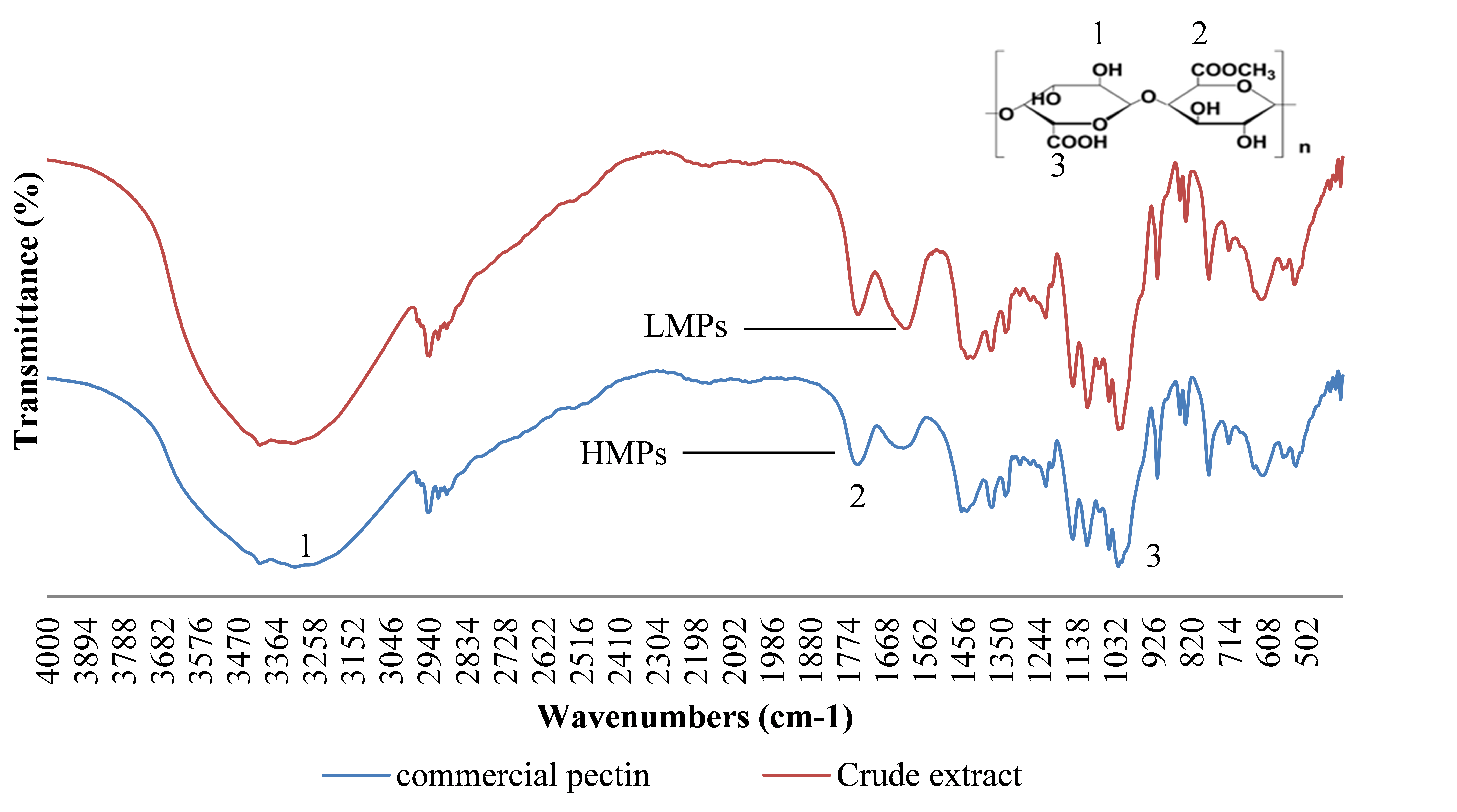
Downloads
References
Office of Agriculture Economics. Coffee production in Thailand. Annual report, 2019.
U Hasanah, M Setyowati, Edwarsyah, R Efendi, E Safitri, R Idroes, LY Heng and ND Sani. Isolation of pectin from coffee pulp Arabica Gayo for the development of matrices membrane. IOP Conf. Ser. Mater. Sci. Eng. 2019; 523, 012014.
R García, D Arriola, MCD Arriola, ED Porres and C Rolz. Characterization of coffee pectin. LWT Food Sci. Tech. 1991; 24, 125-9.
P Esquivel and VM Jiménez. Functional properties of coffee and coffee by-products. Food Res. Int. 2012; 46, 488-95.
LR Adetunji, A Adekunle, V Orsat and V Raghavan. Advances in the pectin production process using novel extraction techniques: A review. Food Hydrocolloid. 2017; 62, 239-50.
CLO Petkowicz, LC Vriesmann and PA Williams. Pectins from food waste: Extraction, characterization and properties of watermelon rind pectin. Food Hydrocolloid. 2017; 65, 57-67.
C Lara-Espinoza, E Carvajal-Millan, R Balandran-Quintana, Y Lopez-Franco and A Rascon-Chu. Pectin and pectin-based composite materials: Beyond food texture. Molecules (Basel, Switzerland) 2018; 23, 942.
L Trejo-Gonzalez, AI Rodriguez-Hernandez, MDR Lopez-Cuellar, VM Juarez-Martinez and N Chavarria-Hernandez. Antimicrobial pectin-gellan films: Effects on three foodborne pathogens in a meat medium, and selected physical-mechanical properties. CyTA J. Food. 2018; 16, 469-76.
ST Minzanova, VF Mironov, DM Arkhipova, AV Khabibullina, LG Mironova, YM Zakirova and VA Milyukov. Biological activity and pharmacological application of pectic polysaccharides: A review. Polymers (Basel) 2018; 10, 1407.
Z Daoud, M Sura and R Abdel-Massih. Pectin shows antibacterial activity against Helicobacter pylori. Adv. Biosci. Biotechnol. 2013; 4, 273-7.
W Rakitikul and P Nimmanpipug. Degree of esterification and gelling properties of pectin structure in coffee pulp. Key Eng. Mater. 2016; 675-676, 11-14.
E Calce, V Bugatti, V Vittoria and SD Luca. Solvent-free synthesis of modified pectin compounds promoted by microwave irradiation. Molecules (Basel, Switzerland) 2012; 17, 12234-42.
F Dranca and M Oroian. Optimization of pectin enzymatic extraction from malus domestica Falticeni apple pomace with celluclast 1.5L. Molecules 2019; 24, 2158.
M Balouiri, M Sadiki and SK Ibnsouda. Methods for in vitro evaluating antimicrobial activity: A review. J. Pharmaceut. Anal. 2016; 6, 71-9.
E Roser, C Grundemann, I Engels and R Huber. Antibacterial in vitro effects of preparations from anthroposophical medicine. BMC Complement. Altern. Med. 2016; 16, 372.
J Hudzicki. Kirby-bauer disk diffusion susceptibility test protocol. American Society for Microbiology, Washington DC, 2009.
MDF Sato, DC Rigoni, MHG Canteri, CLDO Petkowicz, A Nogueira and G Wosiacki. Chemical and instrumental characterization of pectin from dried pomace of eleven apple cultivars. Acta Sci. Agron. 2011; 33, 383-9.
R Ciriminna, A Fidalgo, F Meneguzzo, A Presentato, A Scurria, D Nuzzo, R Alduina, LM Ilharco and M Pagliaro. Pectin: A long-neglected broad-spectrum antibacterial. ChemMedChem 2020; 15, 2228-35.
CG Otoni, MRD Moura, FA Aouada, GP Camilloto, RS Cruz, MV Lorevice, NDFF Soares and LHC Mattoso. Antimicrobial and physical-mechanical properties of pectin/papaya puree/cinnamaldehyde nanoemulsion edible composite films. Food Hydrocolloid. 2014; 41, 188-94.
EG Andriotis, GK Eleftheriadis, C Karavasili and DG Fatouros. Development of bio-active patches based on pectin for the treatment of ulcers and wounds using 3d-bioprinting technology. Pharmaceutics 2020; 12, 56.
A Belscak-Cvitanovic and D Komes. Extraction and formulation of bioactive compounds. In: CM Galanakis (Ed.). Handbook of coffee processing by-products. Academic Press, London, 2017, p. 93-140.
BM Dorsey, MA Jones. Healthy components of coffee processing by-products. In: CM Galanakis (Ed.). Handbook of coffee processing by-products. Academic Press, London, 2017, p. 27-62.
MA Ramirez-Coronel, N Marnet, VS Kolli, S Roussos, S Guyot and C Augur. Characterization and estimation of proanthocyanidins and other phenolics in coffee pulp (coffea arabica) by thiolysis-high-performance liquid chromatography. J. Agr. Food Chem. 2004; 52, 1344-9.
Downloads
Published
How to Cite
Issue
Section
License

This work is licensed under a Creative Commons Attribution-NonCommercial-NoDerivatives 4.0 International License.





